13-05-2026
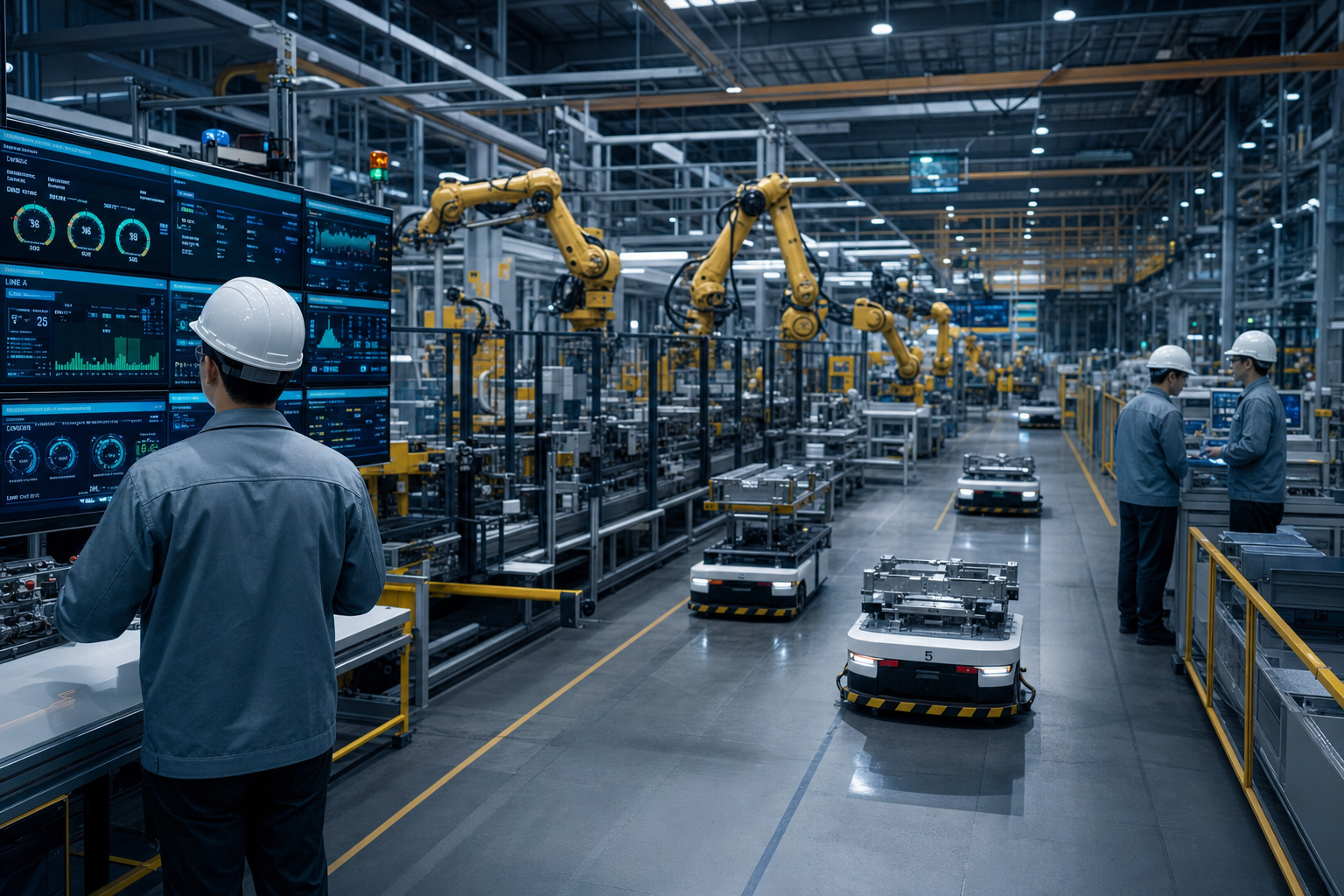
The article examines President Trump’s upcoming visit to China and the possibility that he may seek Chinese investment to support modern American manufacturing. Using a visit to Gree’s massive automated factory in Zhuhai as a case study, the story argues that manufacturing is rapidly evolving toward highly automated, AI-driven production lines that require far fewer workers than traditional factories. Gree’s so-called “dark factory” runs 24/7 with robotic arms and minimal human labor, demonstrating how artificial intelligence and robotics are reshaping industrial production in China and potentially around the world.
The article highlights the strategic implications for the United States. If Trump hopes to attract Chinese investment to revive blue-collar jobs, the piece suggests that the nature of manufacturing may have changed too much for that approach to deliver the kind of employment gains he might want. Gree’s managers argue that the future of manufacturing will not be about large numbers of assembly-line workers, but about engineers and technicians who can design, install, inspect, and maintain AI-powered systems. The article underscores China’s growing share of global manufacturing, its export strength, and its ability not only to produce goods but also to export factory expertise. Overall, the story frames Trump’s China visit within a broader transformation in global manufacturing and raises doubts about whether traditional job-creation narratives still apply in the age of automation.
Entities: Donald Trump, Xi Jinping, CBS News, Zhuhai, Southern China • Tone: analytical • Sentiment: neutral • Intent: analyze
13-05-2026
The article argues that the United States is experiencing a surprising productivity revival after more than a decade in which rich-world productivity growth appeared stagnant. For years after the 2007–09 global financial crisis, economists and institutions such as the Congressional Budget Office expected weak productivity to persist, reinforcing a gloomy outlook for long-run prosperity. The piece frames the recent improvement as a kind of “miracle” or “Lazarus effect,” suggesting that productivity has seemingly come back to life after being assumed dead. It emphasizes that this turnaround has been widely doubted at first, because earlier signs of improvement were often dismissed as misleading or temporary. While the headline and framing highlight a revival in American productivity, the article also notes that artificial intelligence has not yet been the main driver of the change. In other words, the article is not claiming that AI has already transformed the economy; rather, it points to a broader and somewhat unexpected strengthening in output per worker, with the implications for American economic growth and prosperity potentially significant. The tone is analytical and somewhat skeptical of earlier pessimism, presenting the development as a major macroeconomic surprise rather than a settled trend.
Entities: America, Europe, AI, productivity growth, global financial crisis of 2007-09 • Tone: analytical • Sentiment: neutral • Intent: inform
13-05-2026
The article examines how China is rapidly expanding the use of robots and autonomous vehicles while explicitly trying to avoid the social disruptions that often accompany automation, especially mass job losses. Using Qingdao as a vivid example, it shows how quickly driverless delivery vans, autonomous taxis, and food-delivery projects are spreading across the city: one company, Neolix, has deployed around 1,200 unmanned delivery vans locally and expects to reach 4,000 by year-end. Qingdao is presented as a leading test case for China’s AI-driven transformation, and also as a frontline site in the conflict between unmanned vehicles and human drivers.
At the same time, the article frames China’s approach as “human-first,” suggesting that policymakers want automation to improve productivity and services without undermining employment. This creates a central tension: China appears eager to embrace AI and robotics at scale, but it also wants to preserve jobs and social stability. The article likely uses the development in Qingdao to illustrate a broader national strategy in which automation is encouraged, but not at the expense of workers. In this sense, China’s robot push is not merely a technological story; it is also a labor, policy, and social-control story about how a major economy manages the transition to machine-driven systems while trying to keep people employed.
Entities: China, Qingdao, Shanghai, Neolix, autonomous vehicles • Tone: analytical • Sentiment: neutral • Intent: inform
13-05-2026
This page is The Economist’s Finance & economics section landing page rather than a single standalone article. It functions as a curated roundup of recent reporting, commentary, and letters covering major themes in global markets, industrial policy, banking, technology, trade, productivity, and regulation. The listed pieces highlight concerns about energy geopolitics and the stability of oil markets, the growing importance of index rebalancing in financial markets, debates over industrial policy and the World Bank’s shifting stance, China’s effort to expand automation without displacing workers, America’s unexpectedly strong productivity performance, the dollar’s deeper sources of global supremacy, the revival of some Chinese property markets by technology firms, and the political and financial implications of Trump-era and EU policy changes.
Across the collection, the section emphasizes how economics and finance are being reshaped by geopolitics, technology, and policy. Several items point to tension between old assumptions and new realities: oil shocks may not play out as expected, the petrodollar may be less central than commonly thought, AI may not yet explain the productivity boom, and European policymakers may finally be embracing deregulation. Other headlines focus on corporate and market developments such as UniCredit’s bid for Commerzbank, Bill Ackman’s ambitions for a modern financial conglomerate, and the rising importance of reliable government statistics.
The page also includes a letter responding to a prior Economist article on the World Bank and industrial policy, underscoring that the publication is encouraging debate rather than presenting a single argument. Overall, the content presents a high-level survey of the most important current issues in finance and economics, with an analytical, policy-focused framing aimed at informing readers about major developments and disputes in the global economy.
Entities: The Economist, Finance & economics, America, China, Hormuz Strait • Tone: analytical • Sentiment: neutral • Intent: inform