13-05-2026
The article argues that the brief ceasefire ending America’s latest war with Iran has not restored stability to the Middle East; instead, it has exposed and worsened regional insecurity. What began as an escalatory confrontation, punctuated by Donald Trump’s threat to intensify bombing on Iran, ended abruptly in a muddled pause brokered partly through mediation by Pakistan’s prime minister, Shehbaz Sharif. The ceasefire arrangement included a two-week suspension of hostilities and Iran’s agreement to let commercial shipping resume through the Strait of Hormuz, but the article portrays these developments as fragile and uncertain rather than durable peace.
The piece’s core claim is that the war has altered the strategic landscape to the detriment of the Gulf and wider Middle East. Even with fighting paused, the region is left more exposed: shipping routes remain vulnerable, oil markets are strained, and states in the Gulf must now confront the possibility that U.S. guarantees and regional deterrence are less reliable than before. The article suggests that the conflict has not produced clarity or a decisive outcome, but instead a dangerous ambiguity—one in which the ceasefire may hold only temporarily while the underlying risks persist. In that sense, the war is framed less as a concluded military episode than as a destabilizing turning point with broad implications for regional security, commerce, and the credibility of American power.
Entities: Donald Trump, Iran, America, Israel, Pakistan • Tone: analytical • Sentiment: negative • Intent: analyze
13-05-2026
The article argues that the crisis in oil markets is likely to intensify before it improves, driven largely by the effective shutdown of the Strait of Hormuz and the resulting depletion of global oil inventories. What was once considered almost impossible—an extended closure of the world’s most important oil chokepoint—has become reality after months of US and Israeli strikes on Iran and Iran’s retaliatory attacks on commercial shipping. Traders had long assumed Iran would avoid closing Hormuz because it would damage its own economy, alienate Gulf neighbors, and provoke a rapid American response. Instead, traffic through the strait remains near zero, with diplomatic attempts to reopen it proving sporadic and inconclusive. The article suggests that, although a negotiated resolution remains possible, the disruption could persist indefinitely, keeping oil supply constrained.
As a result, the piece implies that further increases in oil prices are unavoidable in the near term because stocks are dwindling and alternative supply routes cannot fully compensate. The broader implication is that markets and governments are facing a more prolonged and destabilizing energy shock than many expected. The article’s central warning is not just about current disruption, but about the possibility that the crisis may deepen before any relief arrives, with significant consequences for global trade, inflation, and geopolitical stability.
Entities: Strait of Hormuz, Iran, United States, Israel, Gulf states • Tone: analytical • Sentiment: negative • Intent: warn
13-05-2026
The article challenges the common claim that the U.S. dollar’s global dominance rests mainly on oil trade and the so-called petrodollar system. Using the title and framing, it argues that America’s currency supremacy is deeper and more durable than a single commodity link. The piece suggests that while oil has historically been associated with dollar demand—because global oil markets are priced and settled in dollars—the real sources of the dollar’s strength are broader: the scale and openness of U.S. financial markets, trust in U.S. institutions, the depth of dollar-denominated assets, and the dollar’s role in global trade and finance. By calling the petrodollar a “myth,” the article likely aims to correct a simplified narrative that overstates OPEC or oil producers’ role in preserving dollar hegemony. It also implies that predictions of the dollar’s decline based on shifts in oil trade or geopolitical tensions may be overstated. The article’s setup points to a more analytical argument about how reserve currencies are sustained over time, and why U.S. monetary dominance is not easily displaced by changes in energy markets or international political rhetoric.
Entities: petrodollar, U.S. dollar, America, oil, global finance • Tone: analytical • Sentiment: neutral • Intent: analyze
13-05-2026
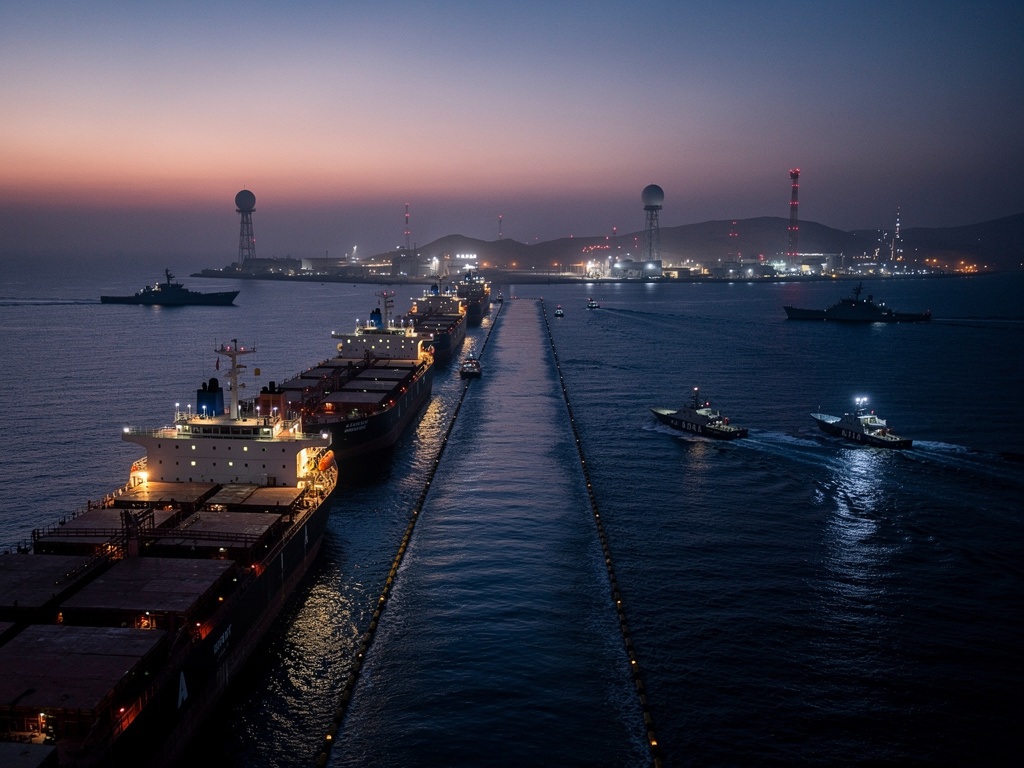
The article describes the escalating struggle between Iran and the United States for control over the Strait of Hormuz, a critical global shipping lane through which a large share of the world’s oil and liquefied natural gas once flowed. The United States Central Command says it has redirected dozens of commercial vessels and disabled several ships as part of an American blockade on Iranian ports, while Iran claims the strait’s operational scope has been expanded far beyond its traditional boundaries. The competing assertions of authority have made safe passage for commercial shipping increasingly uncertain, even for ships with no direct Iranian connection.
Maritime intelligence experts say many vessels are now “going dark,” turning off transponders and even radars to avoid detection and potential attacks. The article notes that more than three dozen retaliatory attacks on commercial vessels have occurred since the U.S.-Israeli war on Iran began in late February, forcing some ships to seek Iranian permission or pay tolls for passage through Iranian waters, while others try to avoid both Iranian and American restrictions. The case of the Agios Fanouris I, a Greek-managed tanker carrying Iraqi oil to Vietnam, illustrates the complexity: U.S. officials say it was redirected to prevent a blockade violation, while Iranian media suggested it had received permission to pass and may have paid for transit. The piece concludes that the blockade and Iran’s countermeasures are disrupting shipping and pressuring Iran’s economy, but also creating dangerous ambiguity for global maritime traffic.
Entities: Strait of Hormuz, Iran, United States, U.S. Central Command, Islamic Revolutionary Guards Corps • Tone: analytical • Sentiment: negative • Intent: inform