Articles in this Cluster
27-06-2026
A BBC report on the deadly earthquakes in Venezuela focuses on the personal tragedy of footballer Héctor Bello, whose wife reportedly died while saving their daughter during the collapse caused by the tremors. According to Bello and local media, Andrea sacrificed her own life to protect their toddler as twin quakes struck near Caracas, leaving the child alive but the family devastated. Bello shared emotional tributes on Instagram, describing his wife as brave and expressing anguish that he was not there to help. The article also places this story within the wider disaster response, noting that rescuers are still searching rubble for survivors after the earthquakes killed at least 920 people and injured more than 3,000, with many still missing.
Beyond Bello’s family, the article reports other deaths and identities emerging from the disaster. Two football players were among the victims: Razan Sijaa, an under-18 player for Caracas Fútbol Club, and Victor Palacios, who had been part of Club Sport San Agustín’s academy and played for Marítimo de La Guaira. Former Miss Venezuela Giselle Reyes also said her mother died after her building in La Guaira collapsed, describing the trauma as causing a fatal heart attack. The piece combines personal grief with the scale of the catastrophe, showing how the earthquakes have affected families, athletes, and public figures across Venezuela.
Entities: Venezuela, Caracas, La Guaira, Héctor Bello, Andrea • Tone: emotional • Sentiment: negative • Intent: inform
27-06-2026
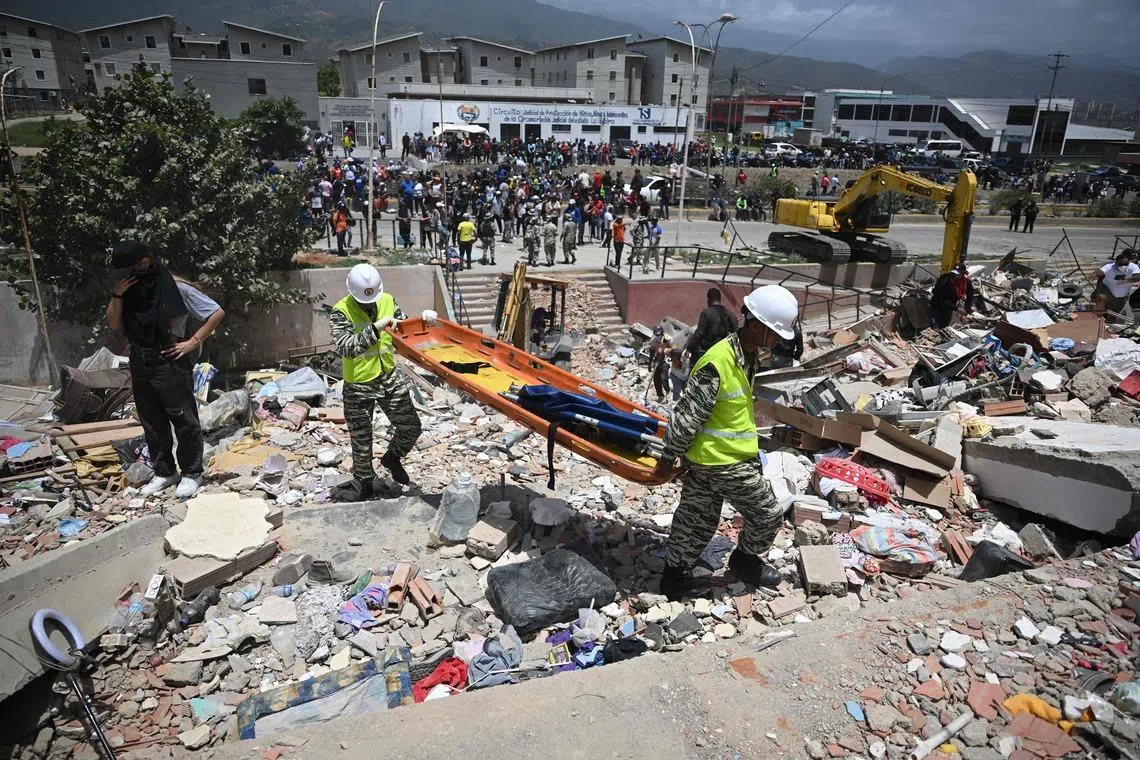
More than 900 people have been killed and 3,360 injured after two powerful earthquakes struck Venezuela in quick succession, with the death toll expected to rise as rescuers continue searching collapsed buildings for survivors. The hardest-hit area is La Guaira, north of Caracas, where dozens of buildings, hospitals, shopping centres and other infrastructure have been destroyed or damaged, and many people are still missing or feared trapped under rubble. Families are pleading for news of missing relatives, while hospitals struggle with shortages of medicine and supplies and overwhelmed emergency services. International rescue assistance has begun arriving from the UK, US, Netherlands, Mexico, Switzerland and other countries, along with humanitarian aid and military support.
The article emphasizes the scale of the devastation and the fragility of Venezuela’s infrastructure, which had already been weakened by years of economic crisis and underinvestment. Local and international officials describe a difficult rescue environment marked by damaged roads, disrupted communications and a lack of resources. Amid the tragedy, there have been moments of relief, including the rescue of three siblings from the rubble, but also stories of profound loss, such as the death of the wife of footballer Héctor Bello while saving their daughter. The piece also places the disaster in a wider political and social context, noting Venezuela’s ongoing instability and the role of civil society in helping where the state has struggled to respond.
Entities: Venezuela, Caracas, La Guaira, Simón Bolívar International Airport, Natacha Diaz • Tone: urgent • Sentiment: negative • Intent: inform
27-06-2026
Two powerful earthquakes struck northern Venezuela on Wednesday night, triggering a rapidly worsening humanitarian disaster as the confirmed death toll climbed to at least 920, with more than 3,300 injured and thousands reported missing. Rescue crews, aided in many places by ordinary residents, raced through collapsed buildings and rubble amid more than 200 aftershocks, including a 4.7-magnitude tremor felt in Caracas. The hardest-hit area was La Guaira, north of the capital, where the country’s main airport was closed because of damage, complicating relief operations. The quakes, measured at 7.2 and 7.5 magnitude, were among the strongest Venezuela has experienced in more than a century and were felt across the region. The article describes harrowing scenes of survivors being pulled from debris, families posting missing-person flyers, and grieving parents mourning children lost in the collapse. It also highlights frustrations with the government’s response, including complaints that heavy machinery and search teams were slow to arrive outside Caracas. Acting President Delcy Rodríguez declared a state of emergency and announced a $200 million reconstruction fund, while appealing for construction equipment to support rescue efforts. International aid was also beginning to mobilize, with U.S. Secretary of State Marco Rubio saying the United States would deploy assistance quickly, although logistical difficulties remained due to the damaged airport. The article further notes that the disaster hit a country already weakened by long-term economic instability, inadequate access to power and water, and political turmoil, making the earthquake response even more difficult.
Entities: Venezuela, La Guaira, Caracas, Moron, National Assembly • Tone: urgent • Sentiment: negative • Intent: inform
27-06-2026
Rescue efforts are intensifying across Venezuela after a pair of devastating earthquakes left at least 920 people dead, thousands injured, and many still trapped beneath rubble. The article describes a countrywide emergency response complicated by aftershocks, damaged infrastructure, shortages of heavy machinery, and an overwhelmed health system. Local authorities and international partners, including teams from the United States, Mexico, Colombia, Spain, and the United Nations, are mobilizing to search for survivors and deliver emergency aid.
The piece emphasizes the narrow "golden window" for rescuing people alive from collapsed buildings, noting that at least 172 people remain trapped and that survival chances diminish sharply over time. It also highlights desperate conditions on the ground: families are digging through debris themselves, some residents are urging civilian volunteers to help, and hospitals are struggling with shortages of water, antibiotics, IV supplies, anesthetics, and basic materials. Satellite imagery and eyewitness accounts underscore the scale of destruction in coastal communities such as La Guaira, Caraballeda, and Catia La Mar, where many homes and buildings were destroyed or damaged.
Beyond the immediate rescue phase, the article points to a long-term humanitarian crisis. The International Rescue Committee says rebuilding support for public services and restoring access to basic necessities will be difficult, especially because the country’s main airport was damaged, complicating the transport of aid. The story also notes a growing international response, with U.S. Southern Command and other global actors expressing solidarity and pledging assistance as Venezuela faces one of its worst natural disasters in recent years.
Entities: Venezuela, La Guaira, Caracas, Caraballeda, Catia La Mar • Tone: urgent • Sentiment: negative • Intent: inform
27-06-2026
President Donald Trump responded to a pair of powerful earthquakes that struck Venezuela by saying the disaster had caused a “devastating number of deaths” and that the United States was ready to help. The quakes, which hit back-to-back on Wednesday, damaged buildings in Caracas and prompted rescue crews to search through rubble as officials assessed the scope of the destruction. Venezuela’s interim president, Delcy Rodríguez, later said at least 32 people were killed and more than 700 were injured, making those the first official casualty figures released after the event.
According to the U.S. Geological Survey, the first quake registered magnitude 7.2, followed just seconds later by a magnitude 7.5 quake. The USGS issued a rare red alert warning that high casualties and extensive damage were likely. Venezuelan authorities declared a state of emergency and said the country had been hit by one of its strongest earthquake events in more than a century, followed by nearly two dozen aftershocks. Rodríguez urged calm and unity in a televised address while emergency responders continued rescue operations.
U.S. officials said they were in contact with Venezuelan authorities and prepared to provide assistance. The State Department and Deputy Secretary of State Christopher Landau publicly stated that Washington was closely monitoring the aftermath and mobilizing support. The article frames the disaster as both a humanitarian emergency and a moment for U.S.-Venezuela engagement, with Trump emphasizing readiness to help despite broader political tensions between the two governments.
Entities: Donald Trump, Delcy Rodríguez, Christopher Landau, Venezuela, Caracas • Tone: urgent • Sentiment: negative • Intent: inform
27-06-2026
Venezuela is reeling from a catastrophic series of earthquakes that struck northern parts of the country, killing at least 235 people, injuring about 4,300, and leaving thousands missing. The strongest quakes, measured at magnitudes 7.2 and 7.5, hit Wednesday night roughly 120 miles west of Caracas, with the coastal region of La Guaira suffering especially severe damage. Rescue crews are still searching through rubble for survivors, and dramatic scenes of people being pulled from collapsed buildings have been broadcast on Venezuelan state television and reported by the Associated Press.
In response, the U.S. military has arrived in Caracas to coordinate relief efforts after the Trump administration activated a government-wide humanitarian response. The administration pledged $150 million in aid and deployed Navy warships to support search-and-rescue and logistics operations. U.S. Southern Command said Maj. Gen. Kevin J. Jarrard is on the ground coordinating American military support, including transport for response personnel, equipment, and humanitarian supplies. The article notes that Venezuela’s interim government, led by acting President Delcy Rodríguez, formally requested U.S. assistance.
The airport in La Guaira has been closed because of earthquake damage, complicating relief operations. Venezuelan authorities are redirecting rescue teams and asking businesses to provide heavy equipment for debris removal and recovery work. Officials say the region remains a disaster zone, and the death toll is expected to rise as more areas are searched and more victims are found.
Entities: Venezuela, Caracas, La Guaira, U.S. Southern Command (SOUTHCOM), Maj. Gen. Kevin J. Jarrard • Tone: urgent • Sentiment: negative • Intent: inform
27-06-2026
Venezuela is reeling from twin powerful earthquakes that have killed at least 920 people, injured 3,360, and left 172 trapped, with more than 50,000 reported missing as rescue workers and volunteers continue searching through collapsed buildings. The quakes, measured at 7.2 and 7.5 magnitude, struck a country already weakened by years of economic and political crisis, compounding an existing humanitarian emergency. Relief operations have been slow and uneven in the hardest-hit areas such as La Guaira state, where residents have been digging through rubble by hand because of shortages of heavy equipment and limited official presence. Families are expressing anguish and anger over delays in retrieving bodies and rescuing survivors, while some areas have also experienced looting amid the chaos.
International assistance is beginning to arrive, including rescue teams from countries previously at odds with Venezuela, along with aid from the United States, which announced US$150 million in assistance and sent military support for search and rescue. The article highlights the political pressure on interim President Delcy Rodriguez, who has promised a major relief effort, as officials struggle to coordinate road closures, rescue access, and emergency response. The disaster may prove one of Latin America’s deadliest earthquakes in the last century, with the UN estimating billions of dollars in damage and millions potentially affected.
Entities: Venezuela, La Guaira, Caracas, Maracay, Delcy Rodriguez • Tone: urgent • Sentiment: negative • Intent: inform
27-06-2026
Venezuela’s interim president, Delcy Rodríguez, says the government is mobilizing to save as many people as possible after twin powerful earthquakes devastated the country’s northern coast, with the official death toll rising to 920 and thousands more injured or missing. The disaster, described as the worst earthquake in Venezuela in more than a century, struck La Guaira and surrounding areas with the most severe destruction concentrated in coastal cities and apartment blocks that collapsed or were flattened. As foreign rescue teams began to arrive, frustration mounted among survivors and volunteers, many of whom reported that government assistance was slow or absent in the first critical hours after the quakes.
The article highlights the scale of the human toll and the strain on Venezuela’s weakened state institutions. Families and volunteer searchers described digging through rubble with bare hands and basic tools while waiting for emergency services. Hospitals in the affected region were overwhelmed, with chaotic scenes underscoring years of neglect, corruption, and economic decline. Experts and opposition figures argue that Venezuela, despite its oil wealth, was badly unprepared for a disaster of this magnitude because of degraded infrastructure, poor construction standards, and a fragile health system.
International assistance is arriving from multiple countries, including the United Kingdom and the United States, while other nations have offered aid and rescue teams. The story also notes expressions of solidarity from King Charles and Queen Camilla, and a US-led deployment under orders from Donald Trump. Overall, the article presents a rapidly unfolding humanitarian catastrophe, a strained and criticized government response, and a large international rescue effort still trying to reach survivors.
Entities: Venezuela, Delcy Rodríguez, Jorge Rodríguez, La Guaira, Catia La Mar • Tone: urgent • Sentiment: negative • Intent: inform
27-06-2026
This CNN video report shows survivors being rescued from earthquake rubble in the Caraballeda area of Venezuela’s La Guaira state, one of the regions hit hardest by the quake. The article is presented primarily as a short video highlight rather than a long-form written piece, and its main focus is the dramatic rescue scene and the human impact of the disaster. The title and accompanying description make clear that the footage centers on people being pulled from collapsed debris after the earthquake, underscoring the urgency and danger of the situation.
Because the content is largely a video entry, there is limited narrative detail beyond the basic scene-setting information. Still, the article conveys that the earthquake caused severe destruction in La Guaira state and that rescue efforts were actively underway. The report’s emphasis on survivors suggests that at least some people were found alive in the rubble, which introduces a hopeful element amid the broader tragedy. The piece functions as a brief visual news update, meant to inform viewers about the immediate aftermath of the quake and the ongoing search-and-rescue response.
The surrounding page includes a carousel of other CNN video headlines, but those are unrelated to the Venezuela earthquake story and appear to be site navigation content rather than article material. The core article is therefore a short, urgent disaster report focused on rescue operations, the Caraballeda area, and the hard-hit La Guaira state.
Entities: Clemente Duran-Ballen, CNN, Venezuela, Caraballeda, La Guaira state • Tone: urgent • Sentiment: negative • Intent: inform
27-06-2026
This France 24 Spotlight segment examines the deadly earthquake in Venezuela through the perspective of journalist Germania Rodriguez Paleo, who argues that the disaster’s worst human toll was not caused by the quake alone but by long-standing institutional collapse. The discussion frames the earthquake as a natural event whose impact became far more catastrophic because of corruption, weakened public institutions, decaying infrastructure, and the lack of an effective emergency response. The central claim is that in a functioning country, many more lives could have been saved. Rather than focusing on geological details, the segment emphasizes the political and humanitarian consequences of state failure. It presents Venezuela’s crisis as the result of years of democratic illegitimacy and governance breakdown, which turned an otherwise survivable emergency into a national tragedy. The article/segment is introduced as part of a TV show conversation hosted by Gavin Lee and features commentary from Rodriguez Paleo, identified as an American-Venezuelan journalist and former US chief reporter for the Daily Mail. The overall framing is critical and analytical, using the earthquake as a lens to discuss the broader collapse of Venezuelan institutions and the human cost of political decay.
Entities: Venezuela, earthquake, Americas, Gavin Lee, Germania Rodriguez Paleo • Tone: analytical • Sentiment: negative • Intent: analyze