05-09-2026
Nepali engineer Rabindra Hamal has described how he and six colleagues narrowly escaped a devastating flash flood at the Upper Trishuli hydropower project in Nepal’s Rasuwa region on August 26. About 8:30am, workers upstream radioed a warning that a huge flood was approaching. Hamal and his colleagues rushed from their office, entered a vehicle and drove downstream, but after travelling only about 700 metres they saw a large muddy wave following them. They abandoned the vehicle and ran towards higher ground.
A boulder shielded some of the group from the full force of the first wave, allowing five people to survive, but a driver and a cook were swept away. The survivors then climbed onto a large boulder, only to feel the ground shake as a second, larger wave approached. They spent the night covered in mud in the jungle before being rescued by helicopter the following day and taken to safety through a nearby army barracks and then Kathmandu. Hamal called his survival a “complete miracle.”
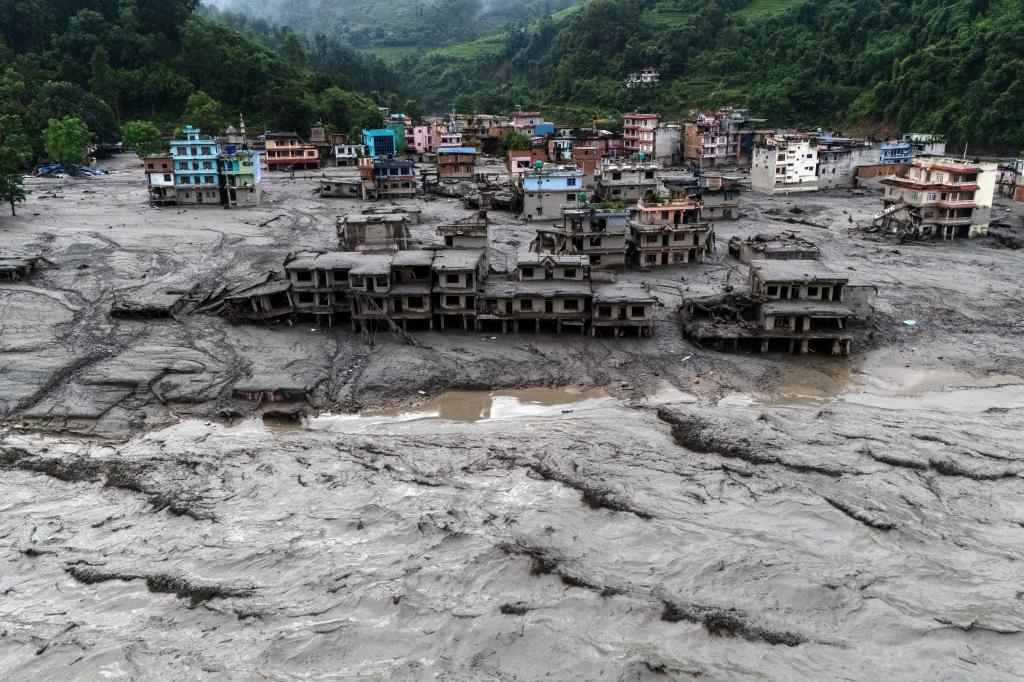
The flood destroyed hydropower camps and left hundreds of workers missing or unaccounted for. Geologist Harichandra Budhathoki, who had left another hydropower site shortly before the disaster because of a medical emergency, joined Hamal in the search for survivors. Budhathoki’s knowledge of underground tunnel layouts was considered valuable to rescue teams. Nine days after the floods, two people were found alive inside a tunnel at the Upper Trishuli 3A Hydropower Station. Nepali authorities had rescued about 300 people from hydropower projects in the region, while searches continued for workers believed to be trapped underground.
Entities: Rabindra Hamal, Harichandra Budhathoki, Upper Trishuli River, Upper Trishuli hydropower project, Upper Trishuli 3A Hydropower Station • Tone: emotional • Sentiment: negative • Intent: inform
05-09-2026
Nepal’s devastating flash floods and mudslides have left families grieving without the bodies of their loved ones. After floods swept through northern and central Nepal on August 26, more than 1,200 people were killed and nearly 5,000 remained missing. With searches yielding few results and hopes of recovery fading, relatives have begun performing Hindu funeral rites using effigies made from sacred kusha grass.
At Pashupatinath Temple in Kathmandu, Sujan Achhami carried an effigy representing his missing father, Dinesh, to the Bagmati River for a symbolic cremation. Other families, including relatives of pilgrims Tham Bahadur Pun and Chausara Pun, made the same decision after finding several bodies from the group’s buses but not their loved ones. Families have provided DNA samples in case unidentified remains are later matched to them.
The disaster has overwhelmed Nepal’s authorities and created severe problems for storing and identifying recovered bodies. Nepal Police spokesman Abi Narayan Kafle said many remains had decomposed or were in pieces, making prolonged preservation impossible. Of 1,344 recovered bodies, 1,030 had been temporarily buried and only 96 had been handed over to families after identification. Authorities say the bodies were numbered, buried at multiple sites, and sampled for DNA so they can later be exhumed and returned to relatives.
The temporary mass burials have angered many people in Nepal, who believe they conflict with Hindu traditions. A priest at Pashupatinath said symbolic cremations are permitted by Hindu scriptures, but described the families’ circumstances as tragic. The article portrays the rituals as an expression of grief, uncertainty and the need for closure amid Nepal’s continuing humanitarian crisis.
Entities: Nepal, Kathmandu, Pashupatinath Temple, Bagmati River, Nepal Police • Tone: emotional • Sentiment: negative • Intent: inform
05-09-2026
Ten days after catastrophic floods struck Nepal, rescuers have pulled two more people alive from the debris: a Chinese worker trapped in a hydropower tunnel and a Nepalese woman found inside a damaged house in Nuwakot. The discoveries offer rare hope as authorities continue searching for thousands of missing people and workers trapped at hydropower sites across the country.
The Chinese man was rescued from a 225-metre tunnel at the Trishuli hydropower project by a joint team of Nepalese military personnel and South Korean disaster experts. He was evacuated by helicopter, taken to hospital and reported to be in stable condition. According to an account shared by Chinese state broadcaster CCTV, he repeatedly shouted when he saw rescue crews’ lights, but they were unable to hear him. His rescue brings the number of workers recovered alive from the project to three; two Nepalese workers were rescued the previous day.
The Nepal Army said a woman was also found alive in a flood-damaged home in Nuwakot. Rescuers gave her water, wrapped her in a blanket and airlifted her to Kathmandu for medical treatment.
Search operations are increasingly focused on 12 hydropower projects. Authorities estimate that about 900 workers are missing, with roughly 500 believed to be trapped in tunnels. Specialized teams from Nepal, India, China, South Korea and the United States are searching through debris, damaged structures and underground passages.
Nepal’s disaster management agency says at least 1,300 people died in the Aug. 26 floods and more than 5,000 remain missing, including 29 Canadians. The disaster was likely triggered by a glacier collapse, according to officials.
Entities: Nepal, Nuwakot, Kathmandu, Trishuli hydropower project, Nepal Army • Tone: neutral • Sentiment: negative • Intent: inform
05-09-2026
Two people were rescued in separate operations in Nepal, 10 days after devastating floods struck the country. The rescues bring to three the number of workers found alive at the Trishuli 3A hydropower project, where rescue teams have been searching damaged tunnels and debris.
A joint team of Nepalese military personnel and South Korean disaster experts rescued a man from a 738-foot hydropower tunnel. Nepal’s army said he was undergoing a health assessment, while images showed him being evacuated by helicopter. Chinese state broadcaster CCTV reported that he was in stable condition after being taken to a hospital. The man said he repeatedly shouted when he saw rescue crews’ lights but could not be heard. He described being overwhelmed when rescuers finally reached him.
Rescue efforts are focused on 12 hydropower projects across Nepal. Authorities estimate that approximately 900 workers are missing and about 500 may still be trapped in tunnels. Specialized teams from India, China, South Korea and the United States are searching through damaged structures, debris and underground passages for survivors.
Separately, Nepalese rescuers found a woman alive inside a mud-covered house in the flood-hit town of Nuwakot. She was given bottled water, wrapped in a gray blanket and airlifted to Kathmandu for medical care.
The floods killed at least 1,300 people and left more than 5,000 missing, according to Nepal’s disaster management agency. Officials believe the disaster was likely caused by a glacier collapse. Despite the large-scale loss of life and continuing uncertainty about those missing, the successful rescues have provided signs of hope as international and Nepalese teams continue their search operations.
Entities: Nepal, Trishuli hydropower project, Trishuli 3A hydropower plant, Nepal Army, Nepalese military • Tone: neutral • Sentiment: negative • Intent: inform
05-09-2026
Ten days after devastating flash floods struck districts along Nepal’s border with Tibet, rescue teams pulled two people alive from separate locations on Saturday. A woman was found beneath thick mud and debris inside her home in Nuwakot and was airlifted to Kathmandu. Separately, a Chinese man was rescued from a 225-metre tunnel at the Trishuli-3A hydropower project in Rasuwa district. Nepalese military personnel evacuated him by helicopter while working with South Korean disaster experts. He became the third survivor rescued from the hydropower site, following two Nepalese workers who were brought out on Friday.
Despite the rescues, the scale of the disaster remains severe. At least 1,300 people have died and more than 5,000 are still missing. Authorities estimate that about 900 hydropower workers remain unaccounted for, while approximately 500 people may be trapped in tunnels across 12 hydropower projects. These sites have become the main focus of ongoing search operations.
The floods affected the districts of Rasuwa, Nuwakot, Dhading, Gorkha and Tanahun. Nepal’s disaster management agency believes the flooding was likely triggered by a glacier collapse. Specialized rescue teams from China, India, South Korea and the United States have joined Nepal’s efforts in the hope of locating additional survivors. The late rescues offer a measure of hope, but continued reports of deaths, missing people and possible tunnel entrapments underscore the humanitarian emergency and the urgency of the recovery operation.
Entities: Nepal, Nepal-Tibet border, Rasuwa district, Nuwakot district, Trishuli-3A hydropower project • Tone: urgent • Sentiment: negative • Intent: inform
05-09-2026
France 24 reports that a Chinese national was rescued alive from a tunnel in Nepal on Saturday, 10 days after a devastating flash flood struck a Himalayan valley. According to authorities, the disaster involved a wall of ice, rock and mud that tore through the valley and killed more than 1,300 people. The rescue represents a rare survival amid a catastrophic event with a very high death toll. The report does not identify the rescued person by name, specify the tunnel’s exact location, explain how the individual survived for 10 days, or provide details about the person’s medical condition after being found. It also does not describe the rescue operation or indicate whether other people remain trapped or missing. The item was issued on September 5, 2026, and is presented as a short video report lasting approximately one minute and 36 seconds. Its central focus is the unexpected survival and rescue of the Chinese national, while the broader context is the scale of the Himalayan disaster and the more than 1,300 deaths attributed to the flood-related torrent of ice, rock and mud. The wording combines a hopeful development—the discovery of a person alive—with the overwhelmingly tragic consequences of the disaster. The report attributes the information to authorities and provides no additional independent eyewitness accounts or official details.
Entities: Chinese national, Nepal, Himalayan valley, Tunnel rescue, Flash flood • Tone: urgent • Sentiment: negative • Intent: inform
05-09-2026
France 24 reports from Nepal’s remote Rasuwa district, where a catastrophic flash flood swept through villages near the Nepal-China border, leaving homes buried in mud and thousands of people displaced or missing. A school has been converted into a temporary shelter for about 200 survivors, many of whom are living in overcrowded and difficult conditions while awaiting aid and information about relatives.
Access to the disaster zone remains challenging. Aid workers must travel as long as nine hours along a winding dirt road to deliver essential supplies, including rice, lentils, cooking oil, tents and solar power banks. The lack of electricity and the destruction of homes have made basic survival especially difficult for those sheltering at the school.
The human cost of the disaster is severe. Survivor Ranjina Tamang says she has lost 11 members of her family, with some missing and others feared dead. Many other displaced people are also waiting for news of loved ones. Meanwhile, rescue teams continue searching through mud and damaged infrastructure. A Chinese national was rescued alive from a hydropower tunnel, while two Nepalese workers were pulled from another mud-filled tunnel in separate operations.
Despite these rescues, more than 5,600 people remain missing, underscoring the scale of the catastrophe. The report highlights both the immediate humanitarian needs of survivors and the continuing emergency response in a remote Himalayan region. Through on-the-ground accounts and survivor testimony, the article conveys the devastation caused by the flood and the uncertainty facing communities as they begin trying to rebuild their lives.
Entities: Nepal, Rasuwa district, Nepal-China border, Himalayan region, Catastrophic flash flood • Tone: urgent • Sentiment: negative • Intent: inform
05-09-2026
France 24 reports that children displaced by flash floods in Nepal are attending temporary education centres in Nuwakot. The centres provide an interim learning environment for children whose communities and homes have been affected by the disaster, while aid organisations work to assist residents and support recovery efforts.
The report places the education response within the broader scale of the destruction caused by the floods. The United Nations estimates that buildings worth approximately $158 million have been damaged. Nepal has warned that rebuilding the affected areas could ultimately cost billions of dollars, indicating that recovery will require extensive financial resources and sustained assistance.
The article highlights two connected challenges: the immediate need to protect children’s access to education after displacement, and the longer-term task of reconstructing damaged infrastructure. Temporary education centres offer a practical response while devastated communities begin to recover, but the reported damage estimates suggest that such measures are only part of a much larger humanitarian and reconstruction effort.
The brief video report does not provide further details about the number of children attending the centres, the precise extent of the flooding, or the identity of the aid organisations involved. Its focus is on the role of temporary schooling in helping flood-displaced children maintain access to education amid Nepal’s wider recovery crisis. The overall presentation is factual and concise, combining the immediate human impact of the floods with estimates of the financial burden facing the country.
Entities: Nepal, Nuwakot, France 24, United Nations (UN), flash floods • Tone: neutral • Sentiment: negative • Intent: inform
05-09-2026
A France 24 video report dated September 5, 2026, describes the rescue of two people alive in Nepal, ten days after devastating floods struck the country. Rescuers recovered a Chinese man and a woman in separate operations on Saturday, offering a rare sign of hope amid an ongoing humanitarian disaster. Search teams were still working to locate thousands of people reported missing after the floods.
The report is presented by France 24 correspondent Shahzaib Wahlah, who provides further details from the scene. The available article text does not identify the rescued individuals, specify where in Nepal the operations occurred, or provide information about their physical condition after being found. It also does not state the total number of deaths, the extent of damage, or the cause of the flooding.
The central focus is the continuation of rescue efforts more than a week after the disaster. The fact that two people were found alive after ten days may raise hopes that other missing individuals could still be located, although the reference to thousands of people still missing underscores the scale and seriousness of the crisis. The report therefore combines a hopeful development—the successful rescues—with the continuing urgency of the search and the broader consequences of the floods.
The video is a concise breaking-news update rather than an in-depth investigation. Its primary purpose is to inform viewers about the latest rescue operations and the continuing search for survivors in flood-affected Nepal.
Entities: Nepal, France 24, Shahzaib Wahlah, Chinese man, Rescuers • Tone: urgent • Sentiment: negative • Intent: inform
05-09-2026
A France 24 video report describes two dramatic rescues in Nepal, carried out 10 days after catastrophic flooding caused widespread destruction and left thousands of people missing. On Saturday, rescuers found and brought out a Chinese national who had been trapped inside a tunnel. They also rescued a local woman from her partially submerged home. The two operations provided a renewed sense of hope amid an ongoing humanitarian emergency.
The report says emergency response teams have intensified their search efforts as they continue looking for the many people still unaccounted for after the floods. The rescues demonstrate that survivors may still be found even after more than a week, encouraging teams to maintain and expand their operations. However, the article provides few details about the victims, including their identities, condition, exact locations, or how long they remained trapped.
The report is presented by France 24 correspondent Shahzaib Wahlah. It focuses primarily on the immediate rescue efforts rather than the broader causes of the flooding, the number of confirmed deaths, the extent of damage, or the long-term recovery needs. Its framing combines the devastation caused by the disaster with cautious optimism generated by the discovery of two survivors. The central message is that, despite the passage of 10 days and the scale of the flooding, rescue teams continue to search with determination and have achieved lifesaving breakthroughs.
Entities: Nepal, France 24, Shahzaib Wahlah, Chinese national, Local woman • Tone: urgent • Sentiment: negative • Intent: inform
05-09-2026
A Chinese national was rescued alive from a hydropower tunnel in Nepal on September 5, ten days after devastating floods and mudslides struck the country. Nepal’s prime minister’s office announced the rescue in a social media post, bringing the number of workers recovered alive from the Trishuli hydropower projects to three. Two Nepalese workers had been rescued from a tunnel at the Trishuli 3A hydropower plant the previous day.
The Chinese worker was found inside a 738-foot tunnel at the Upper Trishuli-1 Hydropower Project in Rasuwa district. A joint team of Nepalese military personnel and South Korean disaster experts carried out the rescue, according to the Nepal Army. The man was evacuated by helicopter and given a health assessment. Images showed army personnel carrying him from the tunnel, drinking water after the rescue, and receiving medical attention during the flight. Chinese state broadcaster CCTV also released footage of two rescuers carrying him to safety.
The rescue took place amid a large-scale humanitarian disaster. Nepalese authorities said approximately 900 workers remained missing from 12 hydropower projects across the country, with around 500 believed to be trapped inside tunnels. The August 26 floods killed more than 1,300 people and left over 5,000 missing, according to Nepal’s disaster management agency. Authorities believe the flooding was likely triggered by a glacier collapse. The recovery effort is continuing as military personnel and international disaster specialists search damaged hydropower facilities and other areas affected by flooding and mudslides.
Entities: Chinese national rescued from hydropower tunnel, Nepal, Upper Trishuli-1 Hydropower Project, Trishuli 3A hydropower plant, Rasuwa • Tone: urgent • Sentiment: negative • Intent: inform
05-09-2026
Emergency responders in Nepal have rescued two more survivors 10 days after massive flash floods devastated parts of the country. A Chinese man was found alive inside a 225-metre tunnel at the Upper Trishuli-1 hydropower project by a joint team of Nepali military personnel and South Korean disaster experts. He was carried from the tunnel and evacuated by helicopter for a medical assessment. Separately, a 64-year-old Nepali woman was rescued from a mud-filled, damaged house in Nuwakot and airlifted to Kathmandu for treatment.
The rescues come as international teams from Nepal, India, China, South Korea and the United States continue searching hydropower facilities and other damaged sites. About 900 hydropower workers remain missing, including an estimated 500 who may be trapped in large tunnels. Two Nepali workers were also rescued from another tunnel along the Trishuli River the previous day.
Despite the discoveries, experts warn that the chances of finding more survivors are declining. Rescue operations have been hindered by extensive infrastructure damage, including the collapse of more than 40 bridges, and by rivers that continue to swell unpredictably. The floods were triggered by a glacial and rock collapse on 26 August, causing widespread destruction across Nepal and neighboring areas.
Nepal’s disaster management agency reports that at least 1,375 people have died and more than 5,000 remain missing. The continuing search is focused on locating survivors in hydropower tunnels and other areas buried or damaged by debris and sludge.
Entities: Nepal, Upper Trishuli-1 hydropower project, Nuwakot, Kathmandu, Trishuli River • Tone: urgent • Sentiment: negative • Intent: inform
05-09-2026
The United Arab Emirates has deployed a humanitarian task force to Nepal to support urgent search-and-rescue operations after catastrophic flash floods and mudslides struck Nepal and China’s Tibet region on August 26, 2026. The disaster has killed more than 1,300 people and left over 5,500 missing, with emergency teams continuing to search for survivors in extremely difficult conditions.
The UAE team, which arrived in Nepal on Friday, includes personnel from the UAE Joint Operations Command, Dubai Police’s search-and-rescue team and the UAE Aid Agency. Its specialists in disaster relief, medical evacuation and first aid are assessing affected areas, coordinating relief activities and working with Nepali authorities in field rescue operations.
The article highlights the rescue of Sanjaya Shah and Kabir Maharjan, two workers found alive inside a tunnel connected to the Upper Trishuli 3A Hydropower Station nine days after the floods began. They were airlifted to an army hospital in Kathmandu, while the body of a third person was recovered. Their survival has offered hope amid the rising death toll and ongoing search efforts.
Alongside its rescue mission, the UAE is delivering humanitarian assistance to communities whose homes and livelihoods were destroyed. Three flights have transported 148 tonnes of supplies, including food, shelter materials and power generators. The relief operation is part of a $10 million aid package announced under the directive of UAE President Sheikh Mohamed and delivered through the UAE Aid Agency. UAE relief teams have also begun distributing essential goods in the worst-affected areas.
Entities: United Arab Emirates (UAE), Nepal, Tibet, Sanjaya Shah, Kabir Maharjan • Tone: urgent • Sentiment: negative • Intent: inform