05-09-2026
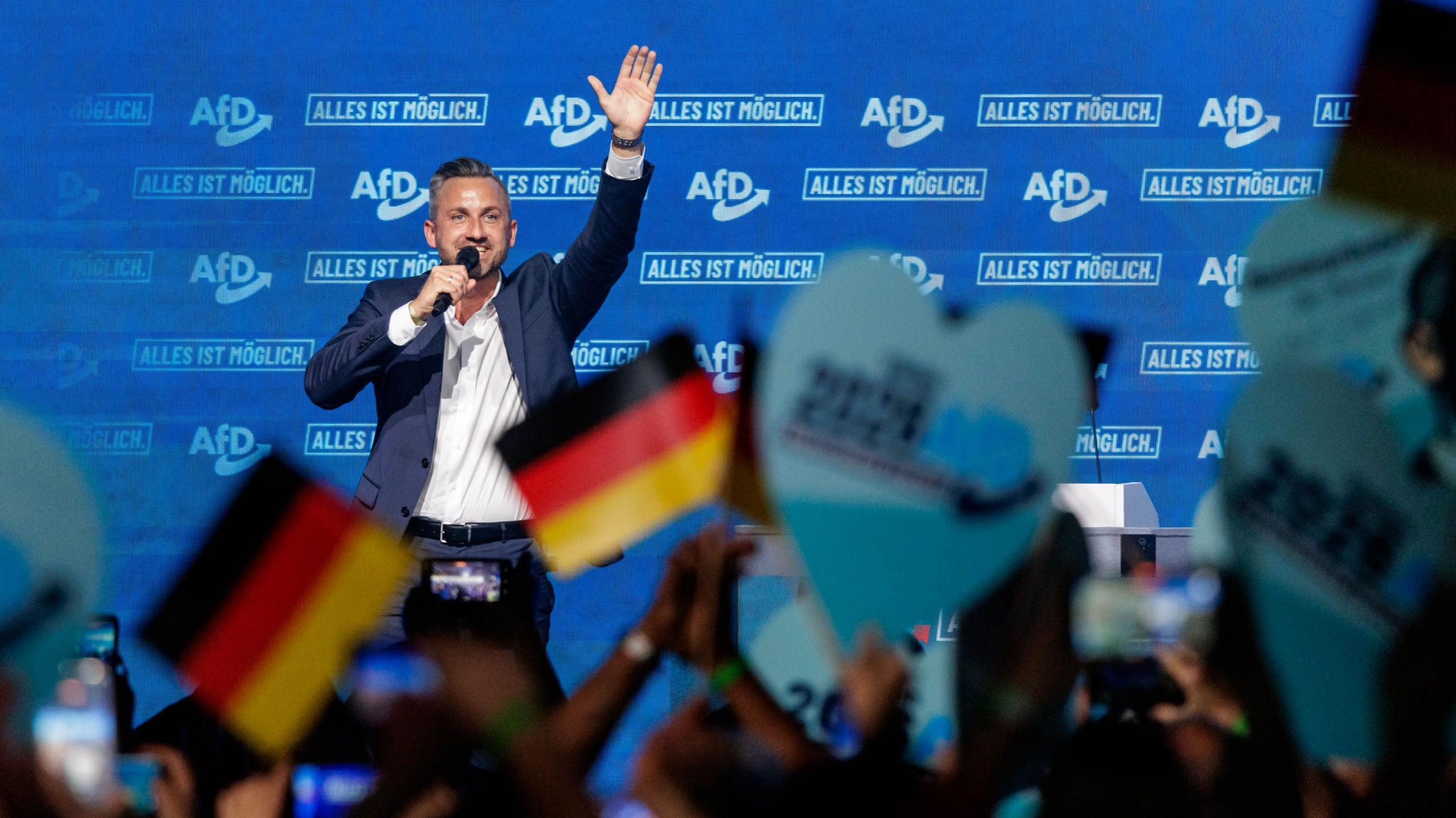
Germany’s Alternative für Deutschland (AfD) is seeking an outright majority in the Saxony-Anhalt state election, a victory that would give a far-right party state-level power for the first time in post-war Germany. The result could strengthen the AfD’s national ambitions while creating serious difficulties for Chancellor Friedrich Merz and his conservative Christian Democrats, whose pledge to halt the far right’s rise has coincided with its growing popularity.
The AfD’s leading candidate, Ulrich Siegmund, has dominated the campaign and attracted support among voters frustrated by immigration, public safety, economic stagnation, high energy prices and aid to countries such as Ukraine. The party also benefits from eastern Germany’s lingering nostalgia for the former communist era and widespread distrust of established political parties.
However, the AfD’s programme is highly controversial. It proposes separate classes for refugee children, restrictions on LGBT-related symbols and education, changes to the teaching of Germany’s Nazi past, and a task force to detain and deport migrants without legal residence. The party’s pro-Russian stance has also raised concerns about intelligence security, especially amid warnings of escalating Russian disinformation campaigns.
Saxony-Anhalt’s government would control important areas including education, policing and culture, while also gaining influence through the Bundesrat. The AfD is officially classified as right-wing extremist in the state, a designation it rejects. Other parties have ruled out coalition cooperation under the so-called Brandmauer, meaning the AfD likely needs a parliamentary majority to govern. Whether it can secure one may depend on smaller parties crossing the five-percent electoral threshold. A decisive victory would force the AfD to govern rather than merely criticize those in power, providing a major test of its credibility and policies.
Entities: Alternative für Deutschland (AfD), Saxony-Anhalt state election, Ulrich Siegmund, Friedrich Merz, Christian Democratic Union (CDU) • Tone: analytical • Sentiment: negative • Intent: analyze
05-09-2026
The article examines what an Alternative for Germany (AfD) state government could mean for Saxony-Anhalt if the party’s strong polling translates into an electoral victory. The AfD, whose state branch is classified by Germany’s domestic intelligence agency as “confirmed far-right,” hopes to form a single-party government under lead candidate Ulrich Siegmund.
Migration policy would be a central area of change. The party’s draft program promises “deportation from minute one,” tougher asylum rules, more detention pending deportation, mandatory work for asylum-seekers, and the abolition of state funding for integration programs. It also proposes excluding children without permanent residency from regular schools and creating a “Remigration Task Force.” However, many of these proposals could be blocked by international, European, or federal law, since deportation policy is primarily controlled by the national government.
The AfD’s anti-immigration agenda also conflicts with Saxony-Anhalt’s demographic and economic challenges. The state’s population has fallen from about 2.9 million after reunification to around 2.1 million today, while employers face serious shortages of skilled workers, especially in nursing and elder care. Economists warn that hostile policies could discourage qualified workers from moving to the state. The AfD instead proposes encouraging Germans living abroad to return through housing, childcare, and financial incentives, though the plan lacks clear budgetary details.
An AfD premier could also influence national debates through the Bundesrat. The party advocates closer relations with Russia, an end to sanctions, expanded Russian-language education, and the return of Ukrainian refugees, although a state government could not independently change federal foreign or deportation policy.
The article also discusses the proposed creation of voluntary citizen patrols, which a legal expert compares to vigilante groups, and sweeping cultural and social changes. These include revising how Nazi-era crimes are taught, banning rainbow flags in schools, rejecting Bauhaus as “globalist,” promoting a patriotic cultural policy, and cutting support for pro-democracy organizations. Overall, the article highlights both the radical scope of the AfD’s platform and the legal and practical obstacles to implementing it.
Entities: Alternative for Germany (AfD), Saxony-Anhalt, Ulrich Siegmund, German domestic intelligence agency, Asylum and deportation policy • Tone: analytical • Sentiment: negative • Intent: analyze
05-09-2026
The article examines the final campaign rally of the Alternative for Germany (AfD) before Saxony-Anhalt’s state election, focusing on lead candidate Ulrich Siegmund and the possibility that the far-right party could enter state government for the first time in Germany’s post-war history. At an AfD “family festival” near Magdeburg, thousands of supporters cheer Siegmund, chant nationalist slogans and boo rival parties. Despite heavy rain, many wait to see him, reflecting his popularity and strong social-media presence, particularly on TikTok.
Siegmund advocates a sharply restrictive migration policy, including a proposed work obligation for asylum seekers. He also highlights issues such as fire-service driving licences and displaying flags in schools. Supporters say the AfD would remove people convicted of serious crimes and reverse what they view as failed state policies. The article notes, however, that Saxony-Anhalt’s Office for the Protection of the Constitution has classified the state AfD as a confirmed far-right extremist organisation.
Polling cited by the article places the AfD at approximately 41%, well ahead of the CDU at 23%. The AfD hopes to govern alone but rejects a coalition with the CDU. The CDU has its own formal “firewall” against cooperation with the AfD, and party official Dennis Radtke warns that such an alliance would destroy the CDU. Other possible coalition combinations also appear difficult, as the CDU rejects cooperation with both the AfD and the Left party. The BSW could theoretically tolerate an AfD-led government but is polling below the five-percent threshold required for parliamentary representation.
The election may therefore produce a complicated coalition situation. Left party candidate Eva von Angern describes an increasingly hostile political environment marked by hate and incitement, but remains optimistic that voters will prevent the AfD from forming a single-party government and will defend diversity in the state.
Entities: Ulrich Siegmund, Alternative for Germany (AfD), Saxony-Anhalt state election, Magdeburg, Germany’s Office for the Protection of the Constitution • Tone: analytical • Sentiment: negative • Intent: analyze
05-09-2026
The article examines the AfD’s prospects of achieving a historic electoral breakthrough in Saxony-Anhalt, Germany, in the regional election scheduled for 6 September 2026. The far-right party is polling at 40% or higher, placing it in a position to potentially win an absolute majority of seats in the state legislature. Such a result would allow the AfD to take charge of a German region and would mark the first time since 1945 that a far-right party has led a German state.
The report focuses not only on the AfD’s strong polling numbers but also on the political strategy behind its campaign. The party is presenting itself as a vehicle for a return to “the Germany of old,” using symbols associated with East Germany, including Simson mopeds and retro visual aesthetics. These cultural references are intended to appeal to voters who feel alienated from contemporary Germany and nostalgic for an earlier era.
France 24 characterizes this approach as a well-established AfD strategy that draws on a long-standing sense of social and economic decline. The party is also benefiting from growing distrust of Germany’s traditional political parties. The article therefore frames the election as a significant test of the AfD’s ability to convert dissatisfaction and nostalgia into a governing majority. Although the report does not discuss the reactions of opposing parties or the potential consequences of an AfD victory in detail, it emphasizes the historical significance of the possible outcome and the broader challenge posed by the party’s rising support.
Entities: Alternative für Deutschland (AfD), Germany, Saxony-Anhalt, 6 September 2026 regional election, German far-right politics • Tone: analytical • Sentiment: negative • Intent: analyze
05-09-2026
The article examines why the Alternative for Germany (AfD), an anti-immigration and Moscow-friendly far-right party, has become particularly strong in the former East Germany. The issue is expected to be highlighted by an election in Saxony-Anhalt, where the AfD is projected to perform strongly and hopes to win state power for the first time in post-war German history.
Elisabeth Kaiser, the government’s commissioner for eastern Germany and a lawmaker from Thuringia, attributes the region’s political distinctiveness partly to the disruptive experience of reunification. After the Berlin Wall fell in 1989 and the communist German Democratic Republic ended, many state-owned businesses in eastern Germany were shut down. This caused widespread unemployment and prompted many people—particularly young women—to leave the region.
According to Kaiser, these economic and demographic upheavals created a lasting collective memory among East Germans. Many experienced reunification not simply as political liberation or economic integration, but also as a period of devaluation, loss and uncertainty. The feeling that established institutions and personal circumstances could change suddenly has persisted across generations.
The article links this historical experience to contemporary support for the AfD, suggesting that economic disruption, depopulation and anti-immigrant sentiment have combined to shape voting patterns in eastern states. More than 30 years after reunification, the political divide between eastern and western Germany remains visible. The Saxony-Anhalt election could therefore demonstrate both the AfD’s growing regional influence and the continuing importance of unresolved east-west differences in German politics.
Entities: Alternative for Germany (AfD), East Germany, Saxony-Anhalt, Elisabeth Kaiser, Thuringia • Tone: analytical • Sentiment: negative • Intent: analyze