04-11-2026
Abu Dhabi-based Ta’ziz has secured $1.39 billion in financing for two industrial projects in Ruwais: a liquid-chemical storage and export terminal and a large ammonia production facility. Both financing transactions were oversubscribed. The terminal raised more than $928 million, including $225 million in Islamic financing, while the ammonia project raised more than $460 million.
The terminal, a joint venture between Adnoc and Advario Star Energy, will serve as the main logistics gateway for the Ta’ziz Industrial Chemicals Zone, providing storage and export capacity for liquid chemicals. The ammonia facility is a joint venture involving Ta’ziz, Fertiglobe, Mitsui and GS Energy. It is designed to produce one million tonnes of ammonia annually, making it one of the region’s largest such facilities.
Ta’ziz was established in 2020 by Adnoc and Abu Dhabi investment company ADQ. Its industrial zone is expected to produce 4.7 million tonnes of chemicals a year—including low-carbon ammonia, methanol and PVC—when its first phase is completed at the end of 2028. That phase is projected to contribute $50 billion to the UAE economy and create 20,000 construction jobs and 6,000 operational roles.
The new funding follows $2 billion raised in April for Ta’ziz’s methanol project, bringing financing secured across the three projects to more than $3.39 billion. Chief executive Mashal Al-Kindi said the investment reflects international lenders’ confidence in Ta’ziz and Abu Dhabi’s industrial ambitions, and will support economic diversification. Construction is advancing: ammonia-project engineering, procurement and construction work awarded to Tecnimont is more than 90 per cent complete, while terminal work by Rotary Engineering is about 70 per cent complete.
MUFG advised on the terminal financing, which involved nine banks. Sumitomo Mitsui Banking Corporation advised on the ammonia financing, supported by seven banks from China, Kuwait, Spain and Singapore. Ta’ziz also signed a deal with Alpha Dhabi in May aimed at attracting $10 billion in capital investment for its industrial chemicals ecosystem.
Entities: Ta’ziz, Ruwais, Abu Dhabi, United Arab Emirates, Adnoc • Tone: analytical • Sentiment: positive • Intent: inform
04-11-2026
Borouge International has raised its target for global annual production capacity to 13.8 million tonnes by 2030, up from 13.6 million tonnes, as it expands manufacturing in the UAE and Europe. The company was formed this year by combining Borouge, Borealis and Nova Chemicals and is backed by Adnoc’s international investment arm, XRG, and Austria’s OMV. Its operations span 30 manufacturing sites.
In the UAE, Borouge International agreed with Germany’s Linde Engineering to expand its second ethane cracker in Abu Dhabi. The project is expected to add 230,000 tonnes of annual ethylene capacity. Linde, which originally licensed the second cracker, has also been awarded a contract to upgrade the third. The company is advancing the Borouge 4 project in Ruwais, which is expected to add 1.4 million tonnes of polyethylene capacity and make the site the world’s largest single-site polyolefin complex when fully operational.
European projects are also progressing. The company’s second propane dehydrogenation plant in Belgium, with annual capacity of 750,000 tonnes, has reached mechanical completion and is expected to begin operations in the first half of 2027. It is expanding a polypropylene project in Germany and recently opened an expanded speciality polypropylene compounding plant in Schwechat, Austria, following a €100 million investment.
Chief operating officer Hasan Karam said the projects would strengthen the company’s global polyolefins platform and create long-term shareholder value. The article also notes a separate export-resilience initiative: Borouge and AD Ports Group agreed in May to study a possible export hub at Fujairah. The proposed location could help the company bypass the Strait of Hormuz, where shipping has been severely disrupted amid the US-Iran war.
Entities: Borouge International, Abu Dhabi, United Arab Emirates, XRG, OMV • Tone: analytical • Sentiment: neutral • Intent: inform
04-11-2026
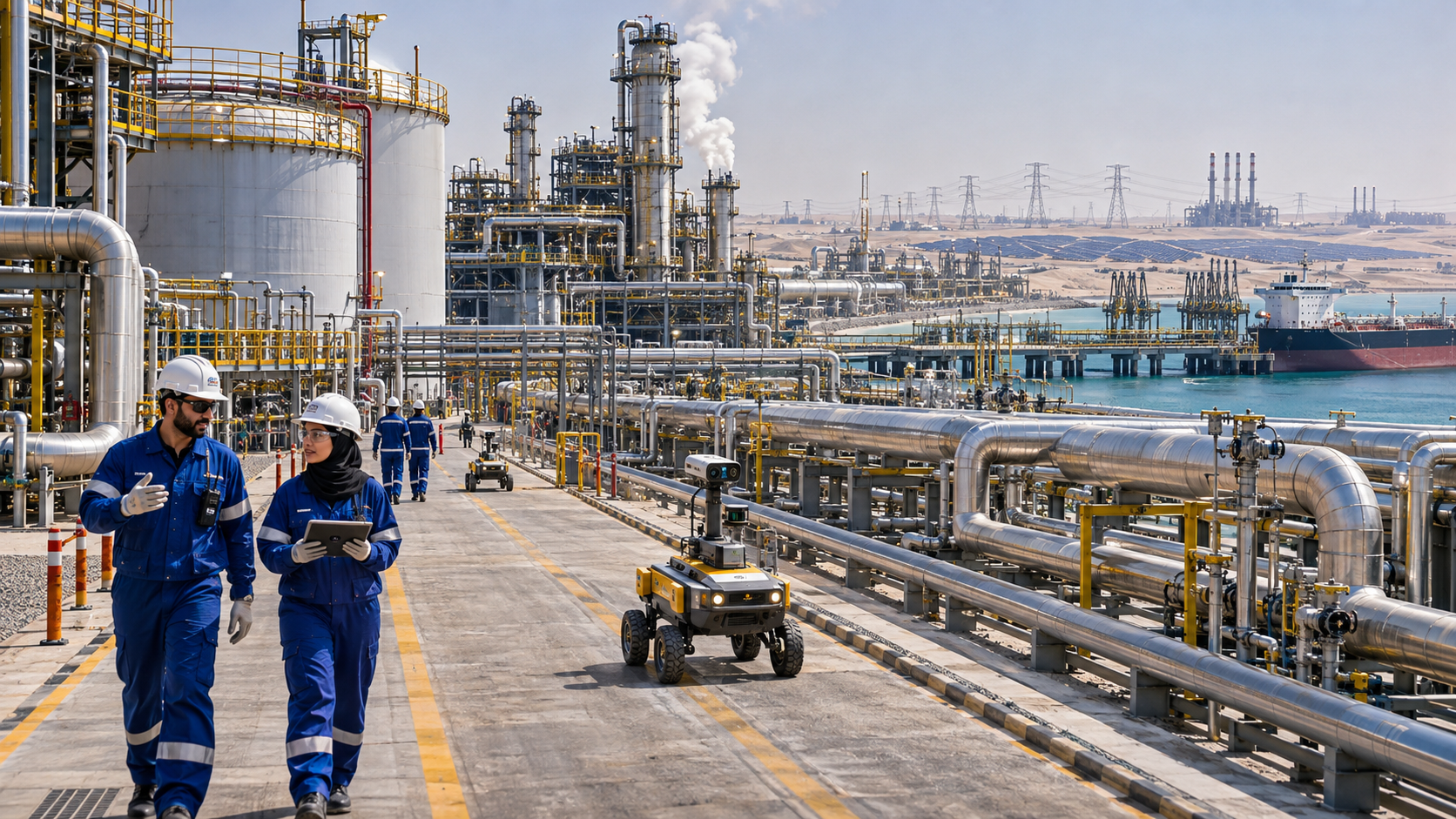
Gecko Robotics is deploying its new Raptor wall-climbing inspection robot at Adnoc energy facilities, where it can identify structural weaknesses and assess damage to critical infrastructure. The move follows attacks on energy assets during the Iran war, which highlighted the importance of quickly understanding damage and returning facilities to operation. Gecko chief executive and co-founder Jake Loosararian said the technology could help operators determine what needs repair and how to do it.
Raptor uses sensors and sound waves to inspect equipment without requiring facilities to shut down. The company says it is three to five times faster than its predecessor, captures millions of data points, and can reduce data-collection costs by a factor of 50 while improving the detail of the information gathered. The collected data feeds into a digital model of the inspected assets.
Gecko is also expanding its military work, including a recently signed $300 million agreement with the US Navy. Loosararian described the military’s use of robotics and AI to improve the readiness of critical assets as relevant to energy infrastructure facing regional conflict. He also argued that energy companies need to adopt AI and robotics or risk falling behind.
As demand grows, Gecko is considering manufacturing robots in the UAE, where it already deploys dozens of machines daily. Local production could bring development and testing closer to the facilities where the robots operate, reducing the risk that technology built in a controlled laboratory will fail in real-world conditions. The plans align with the UAE’s wider effort to develop local robotics manufacturing. A government official said robotics is supporting production across sectors and that interest among young Emiratis in robotics programming and manufacturing is growing. Gecko is also preparing an agreement with Adnoc Onshore to deploy robotics and AI models for critical infrastructure.
Entities: Gecko Robotics, Raptor wall-climbing robot, Adnoc, Adnoc Onshore, Jake Loosararian • Tone: analytical • Sentiment: positive • Intent: inform
04-11-2026
Charles Edouard Mellagui, chief executive of UAE cable manufacturer Ducab, says geopolitical tensions are placing pressure on global energy supplies and disrupting the movement of raw materials and equipment. With demand rising, he argues the world cannot rely on oil and gas alone and must expand solar, wind, nuclear power and battery storage. Supply pressures and higher raw-material costs may eventually be passed on to consumers through higher bills.
Mellagui said Ducab kept its factories operating throughout recent disruptions, in part because the UAE has strong transport infrastructure—including ports, roads, lorries and trains—and because the company can draw on local suppliers. Ducab obtains more than 40 per cent of its raw materials locally, though it still relies on international suppliers. Mellagui said local production is particularly important when imports become difficult, while emphasizing it is only one part of supply security.
The article also describes Adnoc’s plan to offer more than Dh60 billion ($16 billion) in local manufacturing opportunities through 2030. The opportunities cover goods such as electrical and automation systems, pumps, chemicals and piping, with the aim of shortening delivery times and reducing exposure to global supply disruptions.
Growing communities, industrial projects and AI data centres are increasing electricity needs. Ducab has supplied cables for major UAE energy projects, including the Al Dhafra Solar Project, Mohammed bin Rashid Al Maktoum Solar Park and Barakah Nuclear Energy Plant. Mellagui says the industry must both expand generation and reduce electricity losses, and ensure energy remains secure, available and affordable. He also said AI, despite its substantial power consumption, is beginning to help energy companies improve efficiency.
Entities: Charles Edouard Mellagui, Ducab, Adnoc, United Arab Emirates, Abu Dhabi • Tone: analytical • Sentiment: neutral • Intent: inform