04-11-2026
The UK Supreme Court has begun a two-day hearing on an appeal challenging the government’s proscription of Palestine Action as a “terrorist” organisation. The group’s cofounder, Huda Ammori, argues that the ban disproportionately restricts freedom of speech and the right to protest. The government proscribed the direct-action group in July of the previous year, when Keir Starmer was prime minister. The decision has been criticized by rights organizations including Amnesty International and Liberty. Palestine Action describes itself as a movement opposing international involvement in what it calls Israel’s genocidal and apartheid regime. Those convicted of belonging to or supporting the proscribed group face up to 14 years in prison.
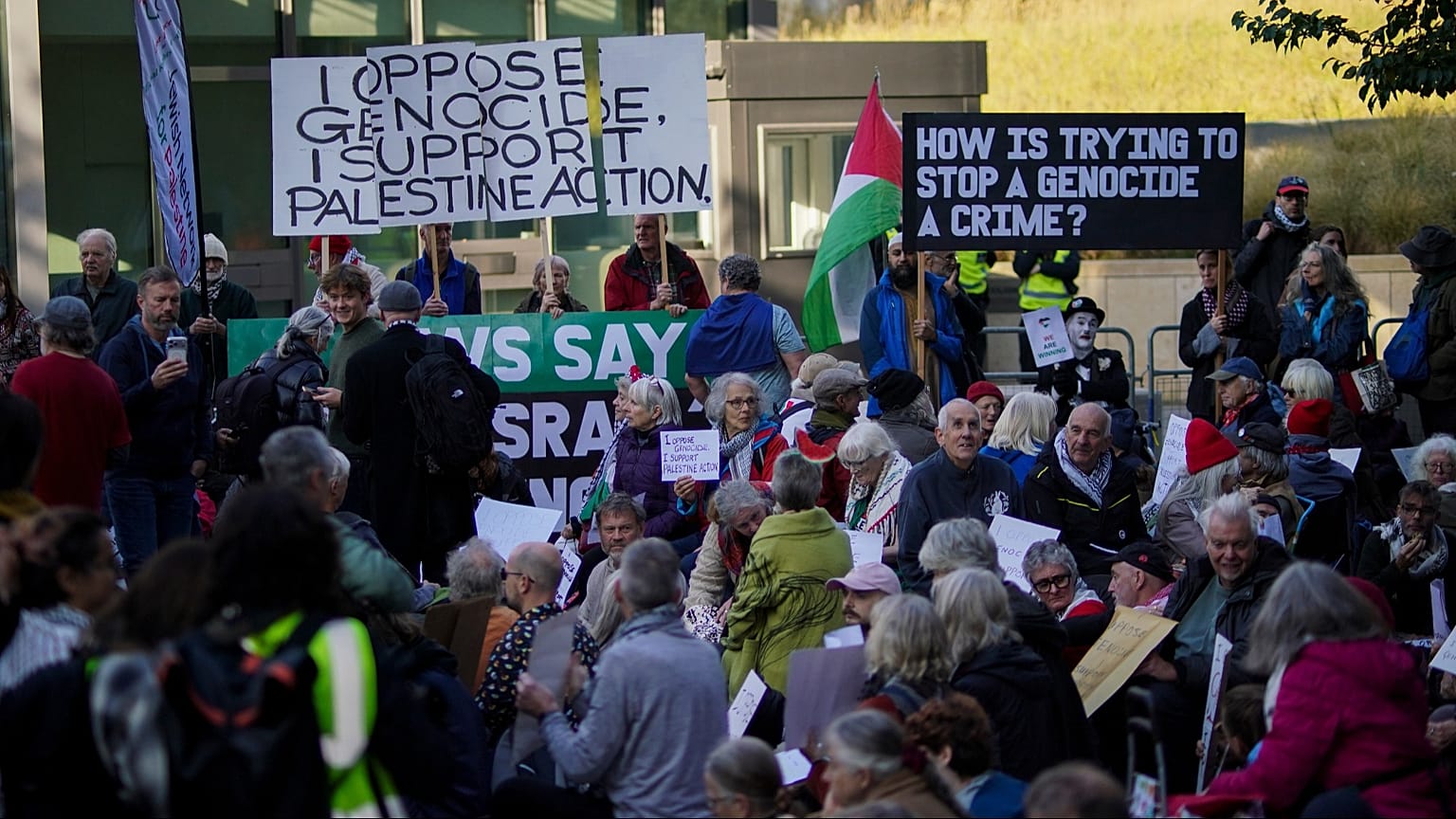
Demonstrators gathered outside the court in central London, both to support Palestine Action and to oppose the ban on civil-liberties grounds. Police arrested about 25 people, according to the Press Association. Some protesters held placards using wording similar to a post by journalist Sarah Helm, who was not arrested. Helm is married to the UK prime minister’s national security adviser. Amnesty International’s Tom Southerden condemned the arrests, arguing that they illustrated the “misuse” of terrorism powers and the vagueness of UK terrorism laws. Amnesty and other organizations are calling for the government to lift the ban.
The article places the case amid wider scrutiny of the UK’s treatment of pro-Palestinian voices following Israel’s war on Gaza. It also notes that Swedish academic Andreas Malm was recently refused entry to the UK on grounds that his presence was “not conducive to the public good.” Andy Burnham, identified in the article as prime minister, had previously said the Labour Party “got it wrong” on Gaza; those remarks have attracted renewed attention after Malm’s exclusion. The Supreme Court’s decision will determine the appeal, while criticism of the proscription and related arrests continues.
Entities: UK Supreme Court, Palestine Action, Huda Ammori, Keir Starmer, Amnesty International • Tone: analytical • Sentiment: negative • Intent: inform
04-11-2026
The UK Supreme Court is scheduled to hear a two-day appeal by Palestine Action co-founder Huda Ammori challenging the government’s decision to designate the group as a terrorist organisation. The government will defend the ban, which was imposed in July 2025. Ammori’s appeal is limited to whether the Home Office followed its own criteria when making that decision. Court documents cited by Ammori say that only three of 385 actions attributed to Palestine Action over five years were assessed as meeting the definition of terrorism.
The prohibition has not ended public support for the group. Defend Our Juries says about 4,200 people have been arrested since the ban, including more than 300 detained during a London protest on 31 October 2026 for displaying a slogan supporting Palestine Action. Those arrested have included pensioners, a priest, a military veteran, a former financial adviser and Swedish climate activist Greta Thunberg. Under the Terrorism Act, publicly expressing support for the group is a criminal offence punishable by up to 14 years in prison. The ban puts Palestine Action in the same legal category as Al-Qaeda and Hezbollah.
Founded in 2020, Palestine Action describes itself as a direct-action movement opposing support for Israel. The ban followed vandalism attributed to the movement, including damage at a Royal Air Force base and actions targeting Israeli arms manufacturer Elbit Systems in August 2024.
The legal case has shifted between courts. In February, the High Court ruled that proscribing the group was disproportionate and substantially interfered with freedom of expression and assembly. The Court of Appeal overturned that ruling in June, finding the ban was not unlawful and describing Palestine Action as a covert organisation operating with secret cells. If Ammori loses at the Supreme Court, she has indicated she will take the case to the European Court of Human Rights.
Entities: Huda Ammori, Palestine Action, UK Supreme Court, UK government, Home Office • Tone: analytical • Sentiment: neutral • Intent: inform
04-11-2026
Palestine Action co-founder Huda Ammori challenged the UK government’s decision to proscribe the campaign group as a terrorist organisation at the Supreme Court on November 4. Her lawyers argued that the ban was disproportionate and undermined counter-terrorism laws. The government says the group’s escalating campaign of property damage justified the decision, pointing particularly to a 2024 raid on Israeli defence company Elbit Systems and a later break-in at RAF Brize Norton that damaged two aircraft.
Ammori’s representatives said officials had assessed that only three of the group’s 385 actions over five years met the definition of terrorism when the ban was imposed in 2025. The Home Office, by contrast, says the Elbit raid involved violence and weapons used against security staff and police; an officer suffered a spinal injury after being struck with a sledgehammer. The Court of Appeal overturned an earlier High Court ruling that the ban was unlawful. At the Supreme Court hearing, Ammori’s lawyer compared Palestine Action’s tactics with those of the suffragettes, including their early 20th-century bombing campaign. The Court of Appeal had rejected that comparison.
The article also describes the consequences of the ban. Home Office statistics recorded more than 3,600 arrests connected to support for Palestine Action between July 2025 and June 2026, over a third of Britain’s terrorism arrests since 9/11. Arrests at demonstrations in London brought the total to more than 4,000, although related charges could be dropped if the ban is overturned. Civil liberties groups and supporters, including Irish novelist Sally Rooney, have criticised the proscription; Rooney’s books can no longer be sold in Britain because of her plans to donate royalties to the group. The United States also designated Palestine Action a terrorist group in August, while President Donald Trump called activists who targeted his Scottish golf resort “terrorists.”
Entities: Palestine Action, Huda Ammori, Raza Husain, Sally Rooney, Donald Trump • Tone: analytical • Sentiment: neutral • Intent: inform