04-11-2026
Josef Braml argues that the 2026 US midterms may not make Donald Trump less consequential for Europe. Although a Democratic swing in Congress could constrain his domestic agenda through legislation, budget decisions, investigations and Senate scrutiny of appointments, Braml says those limits could encourage Trump to demonstrate power in areas where presidents have more freedom: foreign, trade and security policy. He warns that Europe may face the most difficult period of Trump’s second term after the midterms, not an opportunity simply to wait him out.
Braml describes tariffs as a tool of political pressure rather than merely an economic policy. He cites the 15% cap applying to most EU exports, continuing special burdens on steel and aluminium, and Trump’s earlier 25% tariffs on European vehicles. Audi’s announcement of roughly $4 billion in US investment, which Braml connects to the pressure to produce in America, illustrates how tariff policy could redirect European capital and jobs. He expects Trump might intensify this approach to project toughness after an electoral setback.
The article also warns that the administration could use US leverage over Ukraine and NATO, while Trump’s demand for US control of Greenland highlights his transactional view of alliances. The Iran conflict is another source of risk: without a lasting settlement and with the Strait of Hormuz’s vulnerability exposed, escalation could bring Europe higher energy costs, refugee movements, further military obligations and damage to non-proliferation efforts. Braml does not claim Trump will necessarily start or escalate a war, but says the incentive to display strength may persist.
Finally, Braml argues that Trump’s circle is sceptical not only of European defence spending but also of EU integration. Washington could cultivate bilateral ties with parties and governments opposed to Brussels, exploiting divisions within the EU. The article concludes by placing these concerns in the context of the emerging 2028 Republican succession contest, naming Vice President JD Vance and Secretary of State Marco Rubio as prominent figures.
Entities: Donald Trump, Josef Braml, JD Vance, Marco Rubio, United States Congress • Tone: analytical • Sentiment: negative • Intent: analyze
04-11-2026
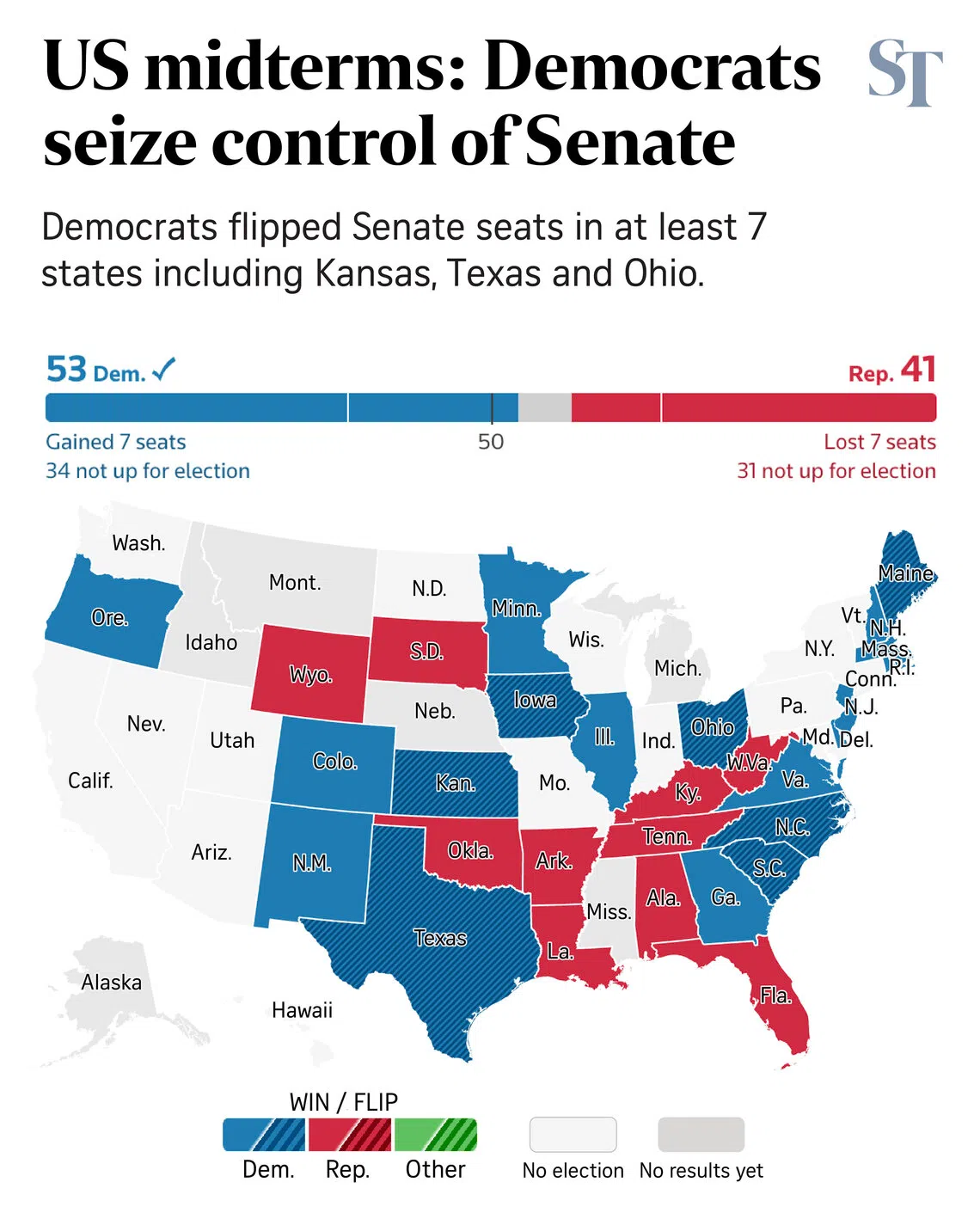
The article examines how a Democratic sweep in the 2026 US midterm elections could affect international conflicts, energy prices, trade and technology markets. Its central point is that Democrats’ new control of Congress may constrain President Donald Trump, but changes to US policy are uncertain and may take time.
On Iran, the result could give Trump greater incentive to seek a peace deal after voters’ frustration with higher fuel costs. Gulf governments reportedly see a full-scale assault as less likely, although an Iranian interpretation of the result as evidence of US weakness could instead encourage escalation. A Democratic-controlled Congress could also increase scrutiny of Israel’s military actions and threaten aspects of longstanding US military support, a development seized upon by Netanyahu’s political rivals.
The conflict’s disruption of Gulf oil and gas supplies has raised energy costs. Oil prices fell after the election as markets anticipated renewed peace efforts, though limited inventories curbed the decline.
For Ukraine, Democrats could propose new aid and legislation opposing Trump’s moves to ease sanctions on Russian energy. A sufficiently large, bipartisan majority might override a veto, but additional support is unlikely to arrive quickly and would not resolve Ukraine’s immediate shortage of US-made Patriot interceptors. The election is not expected to change the administration’s approach to peace talks, which have involved pressure on Ukraine to make concessions.
On trade, Trump’s weakened position may limit his ability to impose tariffs and improve India’s prospects in trade negotiations. Some Asian countries could delay investment pledges, while China may gain a perceived advantage; nevertheless, US-China relations are expected to remain in fragile stability. Potential US-European trade tensions also remain unresolved.
Finally, voter concern about AI data-centre expansion raised expectations of stronger regulation. Asian chip and AI stocks, along with US data-centre operators, fell. Overall, the article presents the election as a source of possible policy constraints and market shifts, rather than an immediate or predictable reversal of US policy.
Entities: Donald Trump, US Democratic Party and Congress, Iran war and US-Iran peace talks, Israel, Benjamin Netanyahu • Tone: analytical • Sentiment: neutral • Intent: analyze
04-11-2026
The article examines how Donald Trump’s midterm defeat may affect US policy toward Asia. Democrats are set to take control of both chambers of Congress in January, giving them greater power to obstruct legislation and investigate the administration, including over military action in Iran and the Trump family’s business dealings. Yet experts expect Trump to respond by asserting presidential authority rather than adopting a conciliatory approach. His signature tariffs are unlikely to be easily reversed: Congress could seek to curb them, but Trump could veto such efforts, and overriding a veto would require substantial Republican support.
The effects of congressional scrutiny could extend to energy, technology and pharmaceuticals. Investigations and political pressure over the Iran war may influence perceptions of oil-market risk, though one energy analyst says near-term prices will depend chiefly on diplomacy and the possibility of military escalation, not the election itself. Potential restrictions on data-centre expansion and increased oversight of artificial intelligence could affect Asian suppliers of hardware and create new compliance burdens, while also encouraging Asia’s own AI development. Pharmaceutical firms that struck drug-pricing deals with the administration may face closer scrutiny.
On China, analysts anticipate continuity more than a major policy reversal. Democrats may challenge Trump’s language of “constructive strategic stability,” but concerns about China are bipartisan. Tariffs could become more negotiable, while restrictions on advanced semiconductors and AI-related technology are expected to remain firmly rooted in national-security priorities. Beijing may see an opportunity in Washington’s political turbulence, but analysts say Xi Jinping is more likely to seek predictability and leverage than a sweeping bargain. The article concludes that Trump may be politically constrained yet remain difficult to predict, with consequential decisions looming at upcoming Asian and global summits.
Entities: Donald Trump, Xi Jinping, Bhagyashree Garekar, Joseph Chinyong Liow, Bob McNally • Tone: analytical • Sentiment: neutral • Intent: analyze