04-11-2026
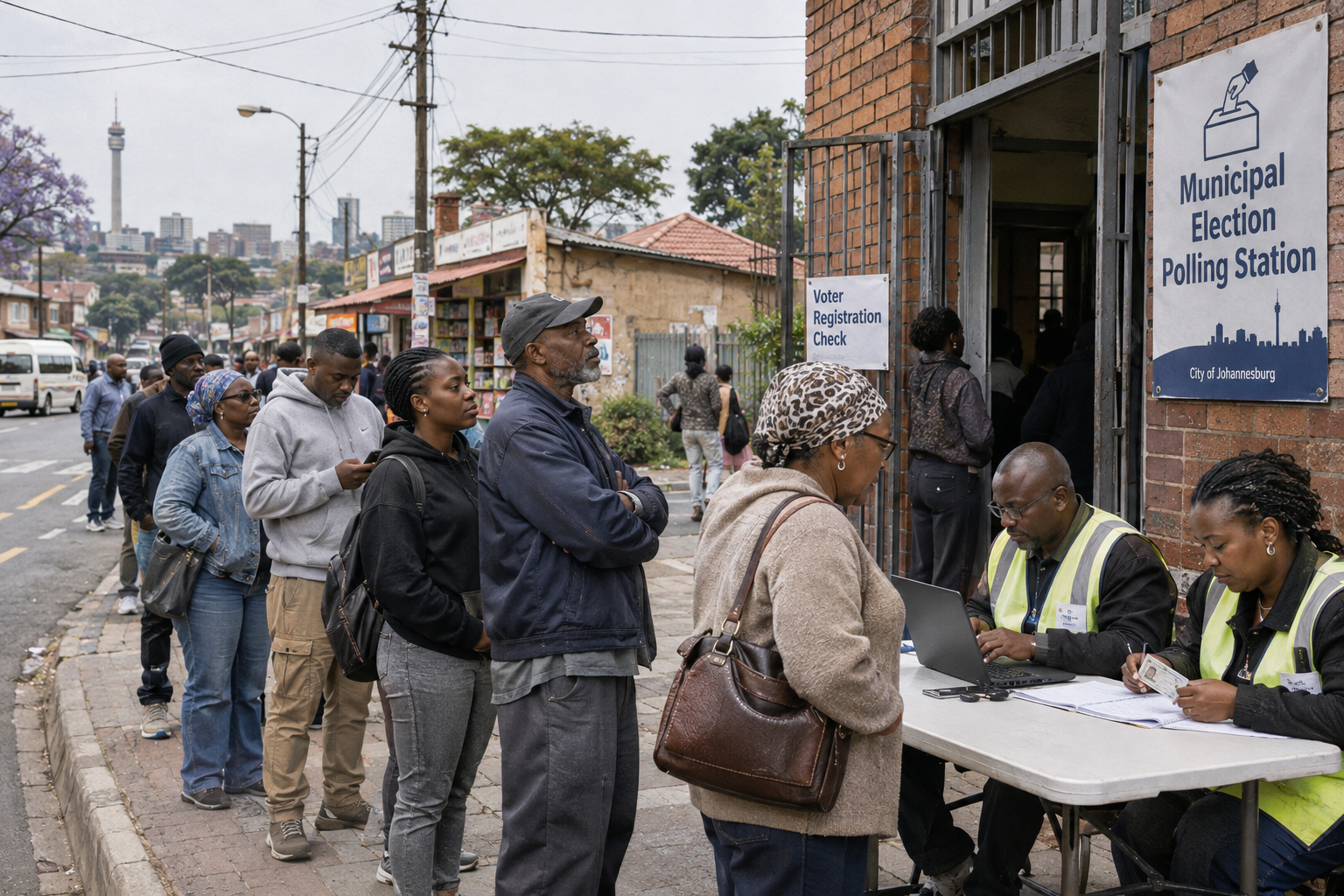
South Africans are voting in a closely watched municipal election that will determine control of major cities and offer an indication of the national political mood ahead of the 2029 general election. The contest takes place amid public frustration over crumbling infrastructure, unreliable water and electricity, persistent inequality, and unemployment above 30 percent. Voters interviewed in Cape Town and Johannesburg said they hoped the election would bring jobs and improvements to daily life. Turnout is a concern: fewer than half of registered voters participated in the 2021 municipal elections, and just 1.4 million of the 2.6 million people approved for special voting cast ballots this time.
The African National Congress (ANC) is still expected to be the largest party nationally, but its support has declined significantly. It fell below 50 percent in the 2021 local elections and won just over 40 percent in the 2024 national vote, requiring it to form a government of national unity with nine other parties. The Democratic Alliance is targeting Johannesburg, while the uMkhonto weSizwe party, led by former president Jacob Zuma, is challenging for Durban after its strong showing in 2024. Anti-migrant sentiment has also featured prominently in the campaign.
Because outright majorities are uncertain in several cities, the results may lead to further coalition negotiations. By February 2026, coalitions or minority administrations already governed 74 of South Africa’s 257 municipalities. Results expected on Sunday will clarify the political landscape and may affect the ANC’s leadership contest at its December 2027 conference. Analyst Kingsley Makhubela says voters are likely to prioritize practical “bread and butter” concerns such as water, electricity, roads, and sewage over party loyalties. He also suggests coalition government could encourage greater political tolerance in an increasingly fragmented political environment.
Entities: Cyril Ramaphosa, Thembinkosi Somana, Andrea Smith, Jacob Zuma, Kingsley Makhubela • Tone: analytical • Sentiment: negative • Intent: inform
04-11-2026
South Africans are voting in closely watched municipal elections that could reveal the country’s political mood ahead of the 2029 general election. The contest is unfolding amid widespread dissatisfaction with failing public services and infrastructure, including unreliable water, electricity, roads and sewage systems, alongside persistent inequality and unemployment above 30 percent. Although more than 29 million people are registered, turnout has been a concern: only 46 percent voted in the 2021 municipal elections, and fewer than 1.4 million of the 2.6 million people approved for special voting cast ballots this time.
The African National Congress (ANC), once the country’s dominant party, is still expected to win the largest national share, but its support has declined sharply. It fell below 50 percent in the 2021 municipal elections and won just over 40 percent in 2024, after which it formed a government of national unity with nine other parties. The Democratic Alliance is targeting Johannesburg, while the uMkhonto weSizwe (MK) party, led by former president Jacob Zuma, is challenging for Durban after winning 14.5 percent nationally in 2024. Anti-migrant sentiment has also featured in the Durban campaign.
Voters elect municipal councillors, who select mayors and establish city administrations. With majorities uncertain in several cities, coalition negotiations may follow; coalitions or minority administrations already govern 74 of South Africa’s 257 municipalities. Analysts say voters’ everyday experiences are likely to outweigh party loyalty, while coalition politics may encourage greater political tolerance. Results expected on Sunday will clarify the political landscape and could influence the ANC’s leadership contest at its December 2027 conference, ahead of the next national election.
Entities: South Africa, African National Congress (ANC), Democratic Alliance (DA), uMkhonto weSizwe (MK), Nelson Mandela • Tone: analytical • Sentiment: negative • Intent: inform
04-11-2026
South Africa’s local elections are testing whether the African National Congress (ANC) can halt a long decline in support, amid widespread frustration with corruption, unemployment, crime and poor municipal services. The party lost its parliamentary majority for the first time in 2024, and polls suggest it may fare even worse in these elections. President Cyril Ramaphosa disputes predictions of further decline, while more than 500 parties are contesting the vote. Election officials say voting is proceeding smoothly, although some polling stations have long queues.
Reporting from Alexandra and Soweto, the BBC describes residents’ varied attitudes towards voting. First-time voter Sanele Ntombela hopes his vote can help bring change, despite rubbish, unreliable water and electricity, and damaged roads in Alexandra. Other young residents have not registered or do not plan to vote, while Zandile Mncube says worsening services have convinced her that voting makes no difference. In Soweto, Mduduzi Makhubo plans to vote against what he calls the arrogance of local leaders and to change the status quo.
The article places these local accounts in the context of weak municipal performance. Auditor-general reports have repeatedly highlighted problems across the country’s 257 municipalities; only 39 received clean audits for 2024–25. Johannesburg’s finances have been described as dire, and its service problems include dirty streets, unreliable electricity and persistent water issues. Analysts expect particular attention on Johannesburg and the other large metros, especially in Gauteng, where coalition governments are common and often unstable.
Polls cited in the article put ANC support at 30%, compared with 46% in the previous local elections, while the Democratic Alliance is forecast to rise from 22% to 25%. DA leader Helen Zille has drawn attention with a theatrical Johannesburg campaign and argues that DA-run cities work best. Political analyst Melanie Verwoerd expects the ANC to record its weakest result yet and says coalitions are likely to remain a feature of Gauteng politics, despite their instability and effects on service delivery.
Entities: African National Congress (ANC), Cyril Ramaphosa, Alexandra, Soweto, Johannesburg • Tone: analytical • Sentiment: negative • Intent: analyze
04-11-2026
South Africans are voting in municipal elections that could further weaken the African National Congress (ANC), the party that has governed since the end of apartheid. The ANC’s popularity has declined over the past decade, and it received less than half the vote in the 2021 local elections. Polls suggest it could fall below 40% in this election. The result is being watched as an indication of public sentiment ahead of national elections in 2029.
Voter concerns include unreliable water and electricity, high crime, unemployment, and the shortage of affordable housing. Undocumented migration has also featured in some campaigns. The elections determine the composition of municipal councils across the country, including those governing eight major cities, 44 district municipalities, and 205 local councils. Councillors, rather than voters directly, select mayors and form municipal administrations.
Johannesburg is a key contest. The city is run by a fragile ANC-led coalition, while polling suggests the liberal Democratic Alliance (DA) could win the most votes. The DA has nominated former national leader Helen Zille for mayor. It is also expected to retain control of Cape Town. Other closely watched contests include Tshwane, which includes Pretoria, and Durban, where former President Jacob Zuma’s MK party is mounting a strong challenge.
President Cyril Ramaphosa acknowledged that municipal failures have damaged public trust in democratic governance, while describing the election as an opportunity to reverse that trend. The ANC’s national political position has already weakened: after losing its parliamentary majority in 2024, it formed a coalition with the DA and other parties. Further local losses could produce unstable coalition governments in several cities. More than 29 million people are registered to vote, though turnout was below 50% in 2021. Polls close at 9 p.m. local time, with results expected Sunday.
Entities: African National Congress (ANC), Democratic Alliance (DA), South Africa municipal elections, Johannesburg, Helen Zille • Tone: analytical • Sentiment: neutral • Intent: inform
04-11-2026
South Africa’s African National Congress (ANC) is expected to suffer a major setback in local elections, with polls suggesting it may receive less than a third of the vote. That would be a steep decline from its 45.6% result in the 2021 municipal elections and 40.2% in the 2024 national elections. Voters interviewed in Johannesburg described repeated water and electricity outages and deteriorating infrastructure as reasons they want change. Some are splitting their votes among parties, while others anticipate that no party will win a clear majority and that coalitions will govern.
Coalition instability is widespread across the country’s 257 municipalities. Analysts say frequent changes in local leadership contribute to poor service delivery. Johannesburg has had 10 mayors in 10 years, while leadership has also changed repeatedly in Ekurhuleni and Tshwane. A recent contaminated-water incident in Bronkhorstspruit sickened more than 800 people.
The article outlines uncertain coalition negotiations in Gauteng, where national ANC leaders may be open to working with the Democratic Alliance (DA), but local ANC leaders reportedly oppose such an arrangement. In Johannesburg, DA mayoral candidate Helen Zille has campaigned prominently, though past remarks about colonialism and housing costs in DA-run Cape Town have made some voters wary. ActionSA leader Herman Mashaba, a former DA mayor, has ruled out working with Zille and called her racist; she denies the allegation. The ANC also has competing mayoral contenders amid internal divisions.
In Durban’s eThekwini metro, Jacob Zuma’s uMkhonto weSizwe (MK) party is polling above 40%, potentially drawing substantial support away from the ANC. The DA is expected to retain Cape Town, although likely with a smaller share than in 2021 as housing affordability concerns grow. The electoral commission is due to announce final results within a week; parties will then have two weeks to form councils and elect mayors, who are not chosen directly by voters.
Entities: African National Congress (ANC), South Africa local elections, Johannesburg, Nelson Mandela, Dada Morero • Tone: analytical • Sentiment: negative • Intent: inform