04-11-2026
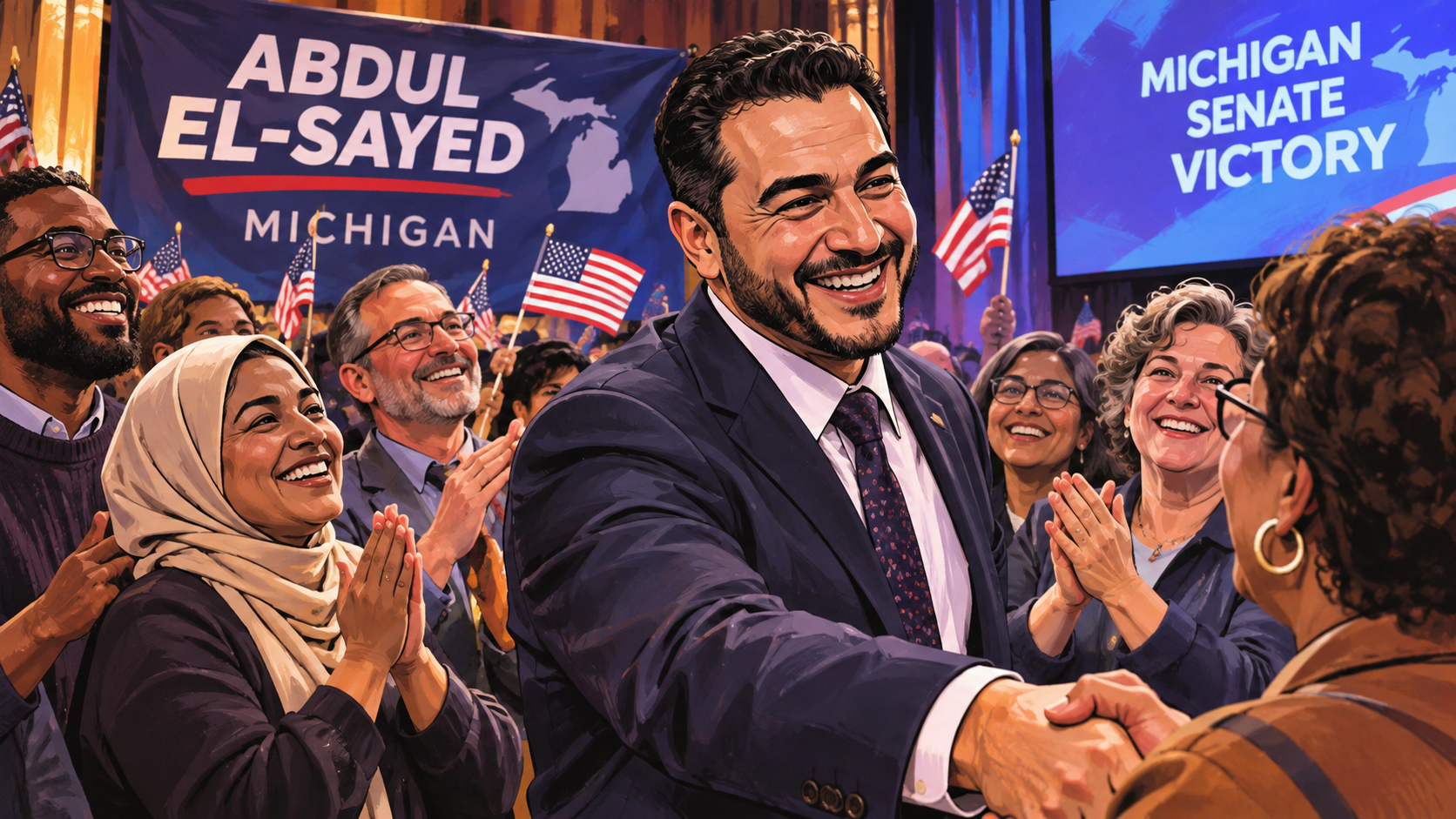
Abdul El-Sayed has won Michigan’s Senate race, becoming the first Muslim elected to the US Senate, according to the article. The left-wing Democrat defeated Republican Mike Rogers in a closely watched contest in a key swing state. Rogers, who was backed by President Donald Trump, attacked El-Sayed over his positions on Israel and his Muslim faith, including portraying him as a communist and making claims that linked him to terrorism. El-Sayed said opponents targeted him because of his name and religion.
A former public health administrator and the son of Egyptian immigrants, El-Sayed campaigned for universal health care, a wealth tax on billionaires, and taking money out of politics. He criticized Israel’s actions in Gaza as genocide and called for an end to US aid to Israel, positions that resonated with some voters in Michigan, which has one of the country’s largest Arab-American populations. Those views also sharpened divisions with Democratic primary rival Haley Stevens, a strong Israel supporter. Stevens endorsed Rogers shortly before the election, prompting condemnation from Democratic leaders and confusion among some voters.
El-Sayed’s victory speech was an emotional moment for supporters, including Muslim and Arab-American voters who said his election made them feel represented and showed younger generations that they could belong in American politics. He condemned what he called an ugly campaign and answered right-wing attacks with humor, using the Arabic phrase “Alhamdullah” before explaining it meant “praise be to God.”
The race drew national attention as a test of the Democratic left’s influence and came amid other Democratic gains. El-Sayed campaigned with progressive leaders Bernie Sanders and Alexandria Ocasio-Cortez, while facing substantial outside spending in favor of Rogers. The Senate seat was open because Democrat Gary Peters was retiring. The article describes Michigan as a crucial swing state and says analysts regarded the race as one of the tightest contests in the midterm elections.
Entities: Abdul El-Sayed, Mike Rogers, Haley Stevens, Donald Trump, Michigan • Tone: analytical • Sentiment: positive • Intent: inform
04-11-2026
Democrat Abdul El-Sayed defeated Republican Mike Rogers in Michigan’s open U.S. Senate race, giving progressives a significant win in a closely contested state. El-Sayed, the son of Egyptian immigrants and a former public health official who has never held elected office, will become the first Muslim senator in U.S. history. He thanked supporters at a Detroit victory event, describing his campaign as a movement built by voters.
El-Sayed ran on a progressive platform that included Medicare for All, reducing the influence of outside money in elections and sharp criticism of Israel. His campaign overcame substantial outside spending in both the Democratic primary and general election. Progressive figures including Bernie Sanders and Alexandria Ocasio-Cortez supported him, and the result may strengthen the case that left-wing candidates can win in competitive states ahead of the 2028 presidential election.
The campaign was marked by disputes over El-Sayed’s comments on Israel and his appearances with political streamer Hasan Piker. El-Sayed apologized after remarks following an attack on a Michigan synagogue drew criticism from some Jewish community members. Two days before the election, Democratic primary opponent Haley Stevens endorsed Rogers, citing concerns raised by some communities. Barack Obama and Kamala Harris campaigned for El-Sayed in Detroit amid concerns about turnout and divisions in the Democratic coalition.
Rogers, a former congressman who narrowly lost a Senate race in 2024, had the support of a cleared Republican field but faced difficulty balancing his alignment with President Donald Trump against voter concerns about rising prices, economic turmoil and tariffs. The article also identifies the war in Iran and its effect on fuel prices as challenges for Rogers. Republicans attacked El-Sayed by questioning his loyalty and attempting to associate him with terrorist organizations, claims the article says had no evidence. The supplied article ends mid-quotation as Rogers discusses the war with Iran.
Entities: Abdul El-Sayed, Mike Rogers, Michigan, U.S. Senate, Democratic Party progressive movement • Tone: analytical • Sentiment: neutral • Intent: inform
04-11-2026
France 24 reports on the Michigan Senate race during the 2026 U.S. midterm elections. Democrat Abdul El-Sayed is competing against Republican Mike Rogers for the seat. The report frames Michigan as a potential Republican pickup after New Hampshire and Georgia remained in Democratic hands, making the state a focus for Republicans seeking to gain ground. France 24 correspondent Jessica Le Masurier reports from a Democratic watch party in Detroit. The supplied article text does not provide further details about the candidates’ platforms, campaign events, polling, or the election result, so the report’s specific analysis and reactions cannot be established from the available content.
Entities: Abdul El-Sayed, Mike Rogers, Jessica Le Masurier, France 24, Michigan • Tone: neutral • Sentiment: neutral • Intent: inform
04-11-2026
The France 24 video report focuses on Abdul El-Sayed’s victory in Michigan’s midterm elections and the significance of his expected place in US history as its first Muslim senator. The article says El-Sayed’s victory came despite racist attacks directed at him, including attacks he denounced as coming from Donald Trump. According to France 24 correspondent Jessica Le Masurier, El-Sayed responded to those attacks with a combination of “humour and hope.” The item is a short video report, issued on November 4, 2026, and modified later that day. The supplied page text does not include a full transcript or further detail about the attacks, El-Sayed’s campaign, the election result, or the specific remarks and actions described as humorous or hopeful. Its central emphasis is therefore the contrast between racist political attacks and El-Sayed’s response, alongside the historic significance attributed to his victory. The article presents the election development as a news item rather than an extended argument: it identifies the candidate, the state, the reported milestone, and the correspondent who characterizes his response. No additional claims about the wider election or its consequences are made in the article text provided.
Entities: Abdul El-Sayed, Donald Trump, Jessica Le Masurier, FRANCE 24, Michigan • Tone: analytical • Sentiment: neutral • Intent: inform
04-11-2026
Abdul El-Sayed, a Democrat who defeated Republican Mike Rogers in Michigan’s Senate race, made history as the first Muslim elected to the U.S. Senate. The 42-year-old former public health official campaigned on lowering costs, Medicare for All and reducing corporate influence in politics. His campaign also became sharply divided over Israel and the war in Gaza. Rogers, who was backed by President Trump, attacked El-Sayed over his faith and his opposition to U.S. military aid to Israel. Haley Stevens, whom El-Sayed defeated in the Democratic primary, endorsed Rogers shortly before the election amid the dispute over Israel.
After the election, El-Sayed found himself aligned with Trump on one issue: Trump announced plans to end about $4 billion in annual U.S. military aid to Israel by year’s end, without explaining how the cuts would work. El-Sayed welcomed the proposal, saying he also wanted the United States to stop selling weapons used in what he described as atrocities, including genocide and apartheid. The article notes that current U.S. aid is $3.8 billion annually under an agreement lasting through 2028.
El-Sayed’s criticism extends beyond Israel. He questioned American military support for Egypt, Saudi Arabia, Jordan and Pakistan, arguing that U.S. tax dollars should be spent at home. His victory does not, however, erase divisions among voters or within his party. NPR had previously heard concerns from some Jewish and Black voters in Michigan. Asked whether he still needed to earn their support, El-Sayed acknowledged that more work and conversations remain, while saying the election results challenge the idea that he lacks support. The article presents his win as both a historic milestone and the beginning of continued debate over affordability, foreign policy and political divisions.
Entities: Abdul El-Sayed, Mike Rogers, Donald Trump, Haley Stevens, Sarah Jukaku • Tone: analytical • Sentiment: neutral • Intent: inform