04-10-2026
Iranian Foreign Minister Abbas Araghchi said there is no military or sanctions-based solution to the war with the United States, arguing that negotiations based on fairness are the only way to end it. His comments came as peace talks appeared stalled and tensions continued over Iran’s efforts to control the Strait of Hormuz, a critical route for Gulf oil and gas. The United States and Israel began their campaign against Iran in late February. After heavy bombardment failed to produce a decisive outcome, Washington reduced its military operations and increased economic pressure, while maintaining a blockade of Iranian ports. The United States has also struck vessels it says violated that blockade; Iran has attacked ships attempting to cross Hormuz without its authorization.
The UK Maritime Trade Operations agency reported that a tanker had been hit by an unidentified projectile in the strait. The crew were safe and there was no reported environmental damage, but the agency did not identify the vessel, its route, or when the incident occurred.
Diplomatic efforts have focused on reopening Hormuz. Iran said it presented seven conditions in recent indirect talks, including a regional ceasefire, the release of frozen Iranian assets, removal of oil-sector sanctions, and an end to the US naval blockade. US President Donald Trump rejected Iran’s proposal but left open the possibility of further talks or renewed military action. Iranian officials said they were reviewing the US response and preparing for other possible scenarios. Tehran’s foreign ministry said the latest US counterproposal repeated earlier positions on nuclear issues, while Iran’s priority remained the strait and the removal of restrictions on its commercial shipping.
The article also reports that Iranian Oil Minister Mohsen Paknejad resigned. President Masoud Pezeshkian accepted the departure after previously asking him to remain, and Hamid Bovard, head of the National Iranian Oil Company, was named as his replacement. The United States has not struck Iran since September 1, though it has recently increased its military presence in the region.
Entities: Abbas Araghchi, Masoud Pezeshkian, Mohsen Paknejad, Hamid Bovard, Kazem Gharibabadi • Tone: analytical • Sentiment: negative • Intent: inform
04-10-2026
Iran’s foreign minister, Abbas Araghchi, said there is no military solution to the war involving the United States and Iran, while warning that Iran would respond more forcefully if its enemies renewed military confrontation. His comments came as negotiations to end the conflict appeared stalled. The article says the United States and Israel launched the war in late February and that a campaign of heavy bombardment did not bring it to a decisive end. In recent weeks, Washington has reportedly reduced military operations and shifted toward applying economic pressure.
The main unresolved dispute concerns Iran’s effort to blockade the Strait of Hormuz, a crucial route for Gulf oil and gas shipments. The maritime situation remains dangerous: a UK maritime agency reported that another tanker was struck by an unknown projectile on Sunday. The report does not identify who fired the projectile or provide further details about the vessel or the incident.
Araghchi made his remarks at a gathering of foreign ambassadors. His statement combined an argument for diplomacy—there is no military solution—with a warning of a stronger defensive response if confrontation resumes. Overall, the article describes stalled talks, continuing pressure around the Strait of Hormuz, and the risk that the conflict could escalate despite Washington’s shift away from recent military operations.
Entities: Abbas Araghchi, Iran, United States, Israel, Strait of Hormuz • Tone: analytical • Sentiment: negative • Intent: inform
04-10-2026
Iranian Foreign Minister Abbas Araghchi said on Oct. 4 that military action and additional sanctions would not resolve the conflict with the United States, arguing that only negotiations based on justice and fairness could end it. His remarks came as US-Iran talks appeared stalled and tensions remained focused on the Strait of Hormuz, a crucial route for Gulf oil and gas. A British maritime security agency reported that a tanker had been struck by an unknown projectile in the strait; its crew was safe, and no environmental damage was reported.
Iran has sought to control passage through the strait since the war began, attacking vessels that transit without its authorization. The United States has responded with a blockade of Iranian ports and strikes on vessels it says violated that blockade. In indirect talks at the UN General Assembly, Iran presented seven conditions for reopening the waterway, including a regional ceasefire, the release of frozen Iranian assets, the removal of oil-sector sanctions, and an end to the US naval blockade. President Donald Trump rejected the proposal but left open the possibility of further talks or renewed military action. Iran said the US counterproposal focused on nuclear issues, while Tehran’s priority was the strait and the restoration of Iranian commercial maritime traffic.
The article says the US and Israel initially justified the war as necessary to prevent Iran from obtaining nuclear weapons, an ambition Tehran denies. The conflict’s focus shifted toward reopening Hormuz after its closure disrupted global energy markets. Although the US had not struck Iran since Sept. 11, it was reinforcing its regional military presence. Reports said additional Patriot missile batteries were sent to Saudi Arabia and Qatar, while an aircraft carrier strike group was heading to the Middle East to join two already there. Senior Trump administration officials also discussed the Iran war and Yemen, where Iran-backed Houthis have fought government forces and attacked Saudi Arabia.
Entities: Abbas Araghchi, Esmaeil Baghaei, Iran, United States, Israel • Tone: analytical • Sentiment: negative • Intent: inform
04-10-2026
Iran says the Strait of Hormuz will remain closed until seven conditions in a June framework agreement, known as the Islamabad memorandum of understanding, are met. Parliament Speaker and lead negotiator Mohammad Baqer Ghalibaf said US proposals delivered through intermediaries conflicted with public statements by US leaders, while describing Iran’s position as definitive. Tehran has called for an end to the fighting, the lifting of a US naval blockade, the release of frozen assets and sanctions relief. Ghalibaf said Iran would continue diplomacy while preparing for war.
Indirect talks between Iran and the United States have stalled publicly, but backchannel diplomacy reportedly continues through Qatar. A Tehran source told The National that Iran was preparing for a major round of fighting and assessed that war was likely to resume, though the door to diplomacy remained open. The US, the source said, had not abandoned the military option.
At the UN General Assembly in New York, Iranian Foreign Minister Abbas Araghchi held Qatar-mediated talks with US envoys Steve Witkoff and Jared Kushner, but they produced no breakthrough. Araghchi also submitted a proposal under which Iran would reopen the strait and resume negotiations if conditions were met. As a possible nuclear concession, Iran offered to dilute its uranium stockpile enriched to 60 per cent and transfer it to a third party under mechanisms recognised by the International Atomic Energy Agency.
The article also reports that the UAE continues to seek a peaceful resolution to its dispute with Iran over the islands of Greater Tunb, Lesser Tunb and Abu Musa, through bilateral talks or the International Court of Justice. Separately, Iran’s Quds Force commander described the US withdrawal from Iraq as a victory and said Tehran-backed groups would retain a role there. Iraq’s plans to bring militia weapons under state control remain uncertain; a disarmament deadline has been postponed to June next year, and Kataib Hezbollah denies reaching an agreement with the Iraqi government.
Entities: Iran, Strait of Hormuz, United States, Islamabad memorandum of understanding, Mohammad Baqer Ghalibaf • Tone: analytical • Sentiment: negative • Intent: inform
04-10-2026
Iran says the Strait of Hormuz will remain closed until the United States accepts Tehran’s seven-day plan, which is based on seven conditions in the Islamabad memorandum. Mohammad Bagher Ghalibaf, Iran’s parliament speaker and chief negotiator, said Washington had sent proposals through a mediator after responding to Iran’s diplomatic proposal. He warned that Iran would not accept delay or unilateral demands and said it was prepared both to fight and to negotiate.
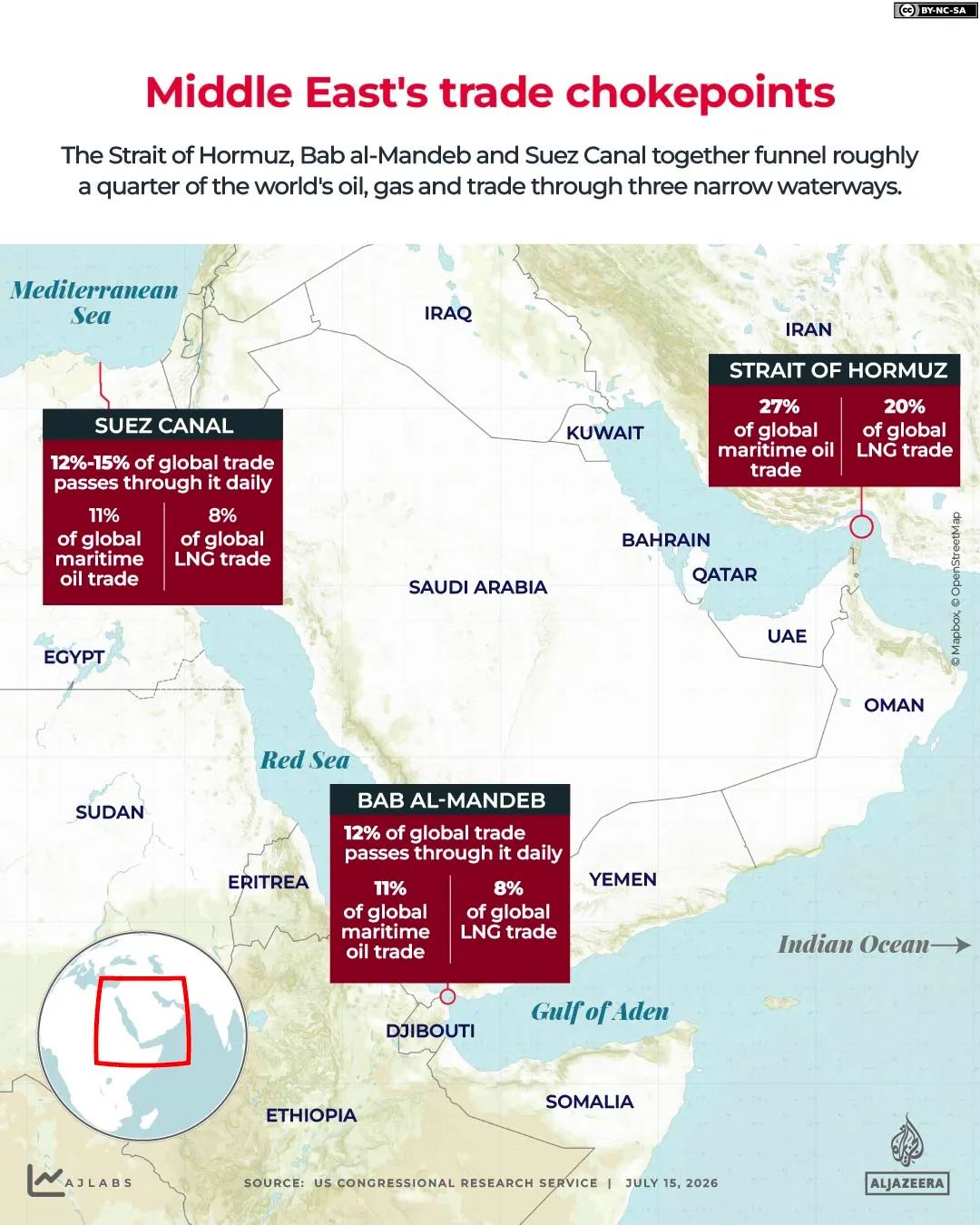
US President Donald Trump rejected Iran’s proposal to reopen the strait last week. The waterway is a major route for global energy shipments: about one-fifth of the world’s oil and natural gas travels through it in peacetime. Trump had also threatened to “annihilate” Iran in a speech to the United Nations General Assembly last month.
Iranian Foreign Minister Abbas Araghchi said Tehran was serious about diplomacy as well as defending itself. Addressing foreign ambassadors and diplomats in Tehran, he urged Washington to choose diplomacy and accept Iran’s terms, while warning that Iran was more prepared than before to respond if the US resumed military action. Foreign Ministry spokesman Esmaeil Baghaei said Iran had used the UN General Assembly to present its position on ending the US-Israel war on Iran. He added that Tehran’s immediate priority was reopening the strait and restoring peace and stability there, while the United States continued to focus on nuclear talks.
The Strait of Hormuz has been largely blocked and disrupted for more than seven months, since US and Israeli strikes on Iran began on February 28. The article describes the resulting maritime disruption as one of the worst in decades and notes that the conflict has created several trade chokepoints.
Entities: Strait of Hormuz, Iran, United States, Mohammad Bagher Ghalibaf, Abbas Araghchi • Tone: neutral • Sentiment: negative • Intent: inform