04-10-2026
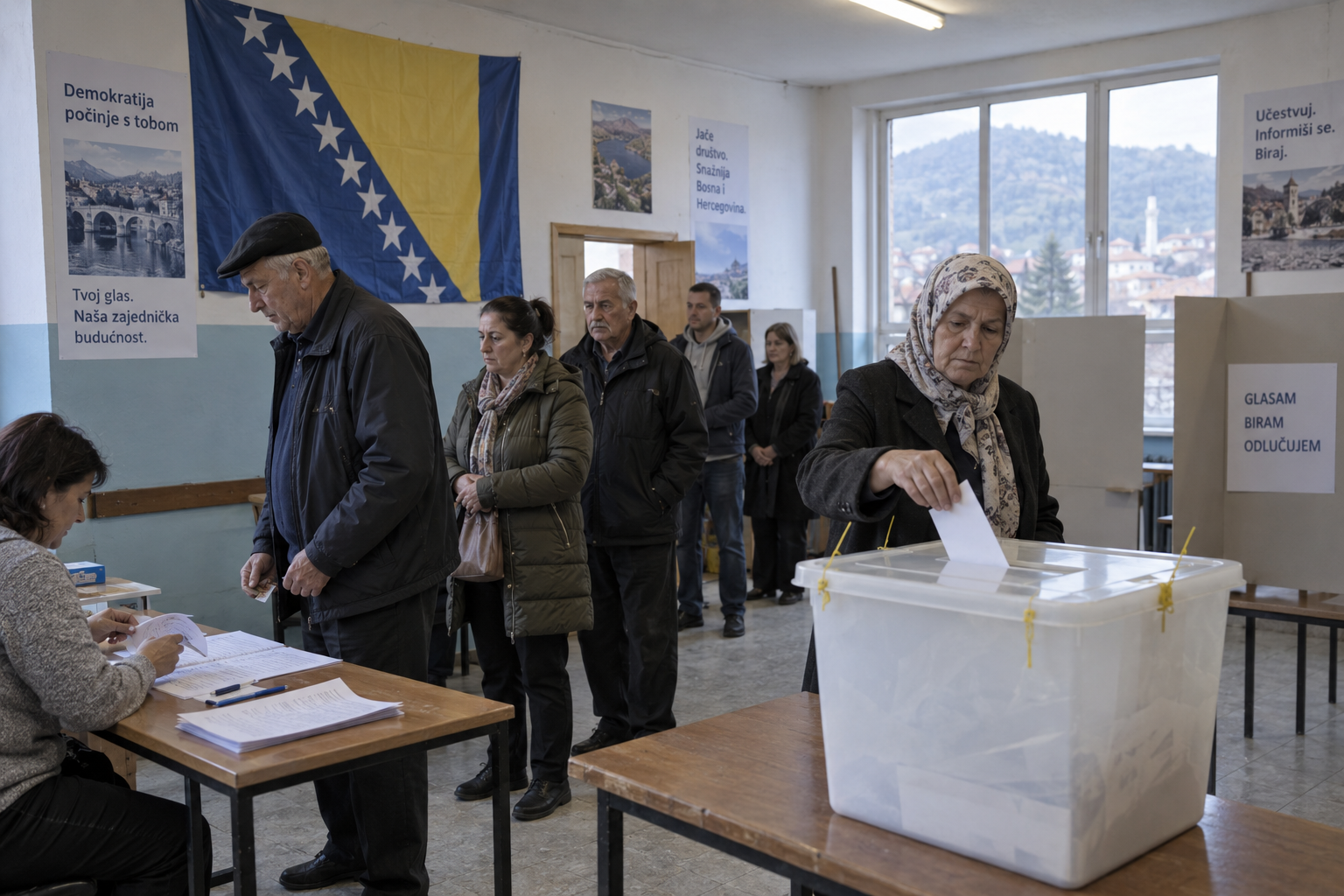
Bosnia and Herzegovina has begun a general election in which about 3.4 million eligible voters are choosing officials at several levels of government. The ballot includes members of the country’s multiethnic, tripartite presidency, federal lawmakers and leaders of its two largely autonomous entities: the Muslim-Croat Federation of Bosnia and Herzegovina and the Serb-run Republika Srpska. Polls are due to close at 7 p.m. local time, with preliminary results expected late Sunday.
The vote takes place amid economic slowdown, stalled progress toward European Union membership and political gridlock. The country’s complex governing structure, established by the 1995 Dayton Peace Accords after the 1992–95 Bosnian war, divides authority among the central government, the Brcko district and the two entities, which are themselves subdivided. Ethnically based parties have kept divisions prominent, despite voters’ stated desire to move beyond wartime rhetoric.
The main ethnic parties—the Bosniak SDA, Serb SNSD and Croat HDZ BiH—are competing with multiethnic opposition coalitions led by the Social Democratic Party. In Republika Srpska, former president Milorad Dodik remains influential despite being barred from public office for six years following his conviction for defying the international envoy overseeing the peace process. His ally Savo Minic is running for the entity’s presidency. Dodik advocates close relations with Serbia and Russia and has described Bosnia and Herzegovina as an “impossible country.”
In the Federation, Bosniak parties are calling for a stronger central state, while many Bosnian Croats support their own ethnic parties. Incumbent Bosniak presidency member Denis Becirovic has promised renewed efforts toward EU and NATO integration. Bosnia and Herzegovina has held EU candidate status since 2022, but membership talks require reforms, including stronger judicial oversight and anti-corruption laws.
Entities: Bosnia and Herzegovina, Milorad Dodik, Savo Minic, Denis Becirovic, Vladimir Putin • Tone: analytical • Sentiment: neutral • Intent: inform
04-10-2026
Bosnia and Herzegovina’s general election is taking place amid persistent ethnic divisions, economic hardship and stalled progress toward European Union membership. About 3.4 million voters are choosing the three members of the country’s multi-ethnic presidency, national lawmakers and leaders of its two entities: the Bosniak-majority Federation of Bosnia and Herzegovina and the Serb-dominated Republika Srpska. The complicated political system was established under the 1995 US-brokered peace agreement. Some polling places experienced delays because of newly introduced digital voting technology, intended to reduce vote tampering and organized manipulation.
Although former Republika Srpska president Milorad Dodik is barred from public office and is not on the ballot, he has dominated the campaign. The pro-Russian separatist recently met Vladimir Putin and leads a party expected to do well in Republika Srpska. At a rally, Dodik called Bosnia “dead” and “an impossible country.” Analyst Dragan Bursac says Dodik remains influential and is exploiting the ban. Meanwhile, parties largely organized along ethnic lines have emphasized questions of national unity and separatism. Bosniak nationalist SDA leader Bakir Izetbegovic is seeking a third term as party president after losing to Denis Becirovic in 2022.
The article describes voters’ frustration with leaders who, they say, focus on nationalism instead of living standards and the departure of young people. Bosnia remains one of Europe’s poorest countries and is still living with the consequences of the 1992–95 war, which killed more than 100,000 people and displaced millions. Separatist rhetoric has prompted Western concerns about renewed instability, while public tributes to convicted war criminal Ratko Mladic have reopened wartime wounds and drawn EU criticism.
Bosnia formally seeks EU membership, but reforms and accession progress have stalled. Russia backs Republika Srpska and opposes EU expansion in the Balkans, while the United States is seeking influence through a proposed $1.5 billion pipeline to import US liquefied natural gas. The election therefore unfolds amid domestic political deadlock and competing international interests.
Entities: Bosnia and Herzegovina, Republika Srpska, Federation of Bosnia and Herzegovina, Milorad Dodik, Vladimir Putin • Tone: analytical • Sentiment: negative • Intent: inform
04-10-2026
Milorad Dodik, a pro-Russia Bosnian Serb nationalist politician, declared victory for his party after an election in Bosnia and Herzegovina. The vote unfolded amid economic pressures, the country’s aspirations to join the European Union, and ethnic tensions rooted in the 1992–95 war. Although Dodik was not on the ballot, the article says he dominated the campaign and heightened divisions with separatist rhetoric, raising fears of renewed instability.
Dodik formerly served as president of Republika Srpska, the Serb-majority entity within Bosnia and Herzegovina. He was barred from public office after being convicted the previous year of defying decisions made by the international envoy responsible for overseeing the 1995 peace agreement that ended the war.
With nearly 90 per cent of votes counted, Dodik’s ally Zeljka Cvijanovic, representing the right-wing Alliance of Independent Social Democrats, had received more than 55 per cent of the vote for one of three seats in Bosnia’s tripartite presidency. She led her nearest opponent by about 30 percentage points. The headline and article introduction also say Dodik credited Donald Trump’s 2024 victory and Vladimir Putin’s support in connection with the election win, though the supplied article text provides no further detail on that claim.
Entities: Milorad Dodik, Zeljka Cvijanovic, Bosnia and Herzegovina, Republika Srpska, Alliance of Independent Social Democrats • Tone: analytical • Sentiment: negative • Intent: inform