04-10-2026
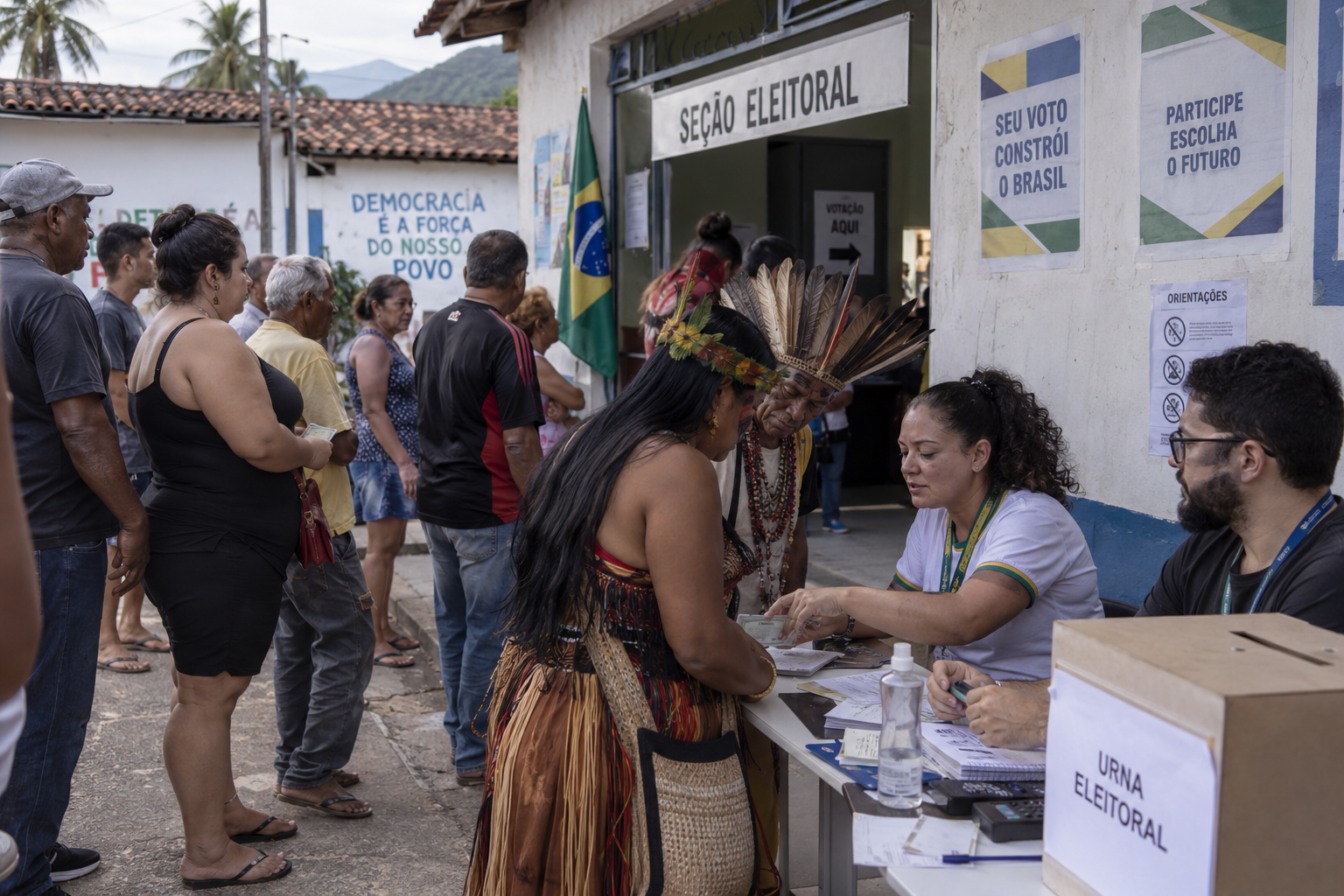
The Al Jazeera news item reports that ballot boxes have reached remote Indigenous communities in Brazil ahead of the country’s presidential election. It places the delivery in the context of a highly consequential contest, describing it as the country’s most important election in years. Flavio Bolsonaro is seeking to unseat incumbent President Lula, and the article identifies Amazon conservation as a key issue in the campaign. The report therefore connects the practical challenge of making voting accessible in remote Indigenous communities with the wider political stakes of the election and debate over the Amazon. The supplied text does not provide further details about where the ballot boxes were delivered, how they were transported, how Indigenous voters view the candidates, or what either candidate proposes on conservation. It also does not describe the election process or predict an outcome. The item is a brief, factual news introduction rather than a detailed account: it highlights the arrival of ballots, names the principal candidates, and singles out conservation as an issue to watch. Its focus is access to voting in remote communities ahead of the election.
Entities: Brazil, Remote Indigenous communities, Ballot boxes, Flavio Bolsonaro, President Lula • Tone: neutral • Sentiment: neutral • Intent: inform
04-10-2026
Brazilian President Luiz Inacio Lula da Silva and Senator Flavio Bolsonaro have concluded their campaigns ahead of a closely contested first-round presidential election. Lula, 80, held a march and closing rally in Sao Paulo, where he predicted a first-round victory and described the contest as a choice between “democracy and barbarism.” He also presented the election as a test of Brazil’s sovereignty, warning against US interference. Flavio Bolsonaro, 45, campaigned in Sao Paulo state and Rio de Janeiro, expressing confidence that he could also win outright. He is the son of former President Jair Bolsonaro, who is serving a 27-year prison sentence for attempting to overturn his 2022 election defeat to Lula.
US President Donald Trump’s interest in the election has become a point of contention. Although Trump has not formally endorsed Flavio Bolsonaro, he said he was watching the vote closely. Lula’s supporters view this as possible US meddling, while some Bolsonaro supporters frustrated by living costs say they would welcome outside pressure if it brought change.
Polls published on Saturday showed Lula still leading, but with a narrowing advantage. Neither candidate was considered likely to secure an outright first-round victory, which would send the contest to a runoff on October 25. The race is tighter than Lula’s 2022 victory, when he defeated Jair Bolsonaro by less than two percentage points.
Flavio Bolsonaro’s campaign has also faced scrutiny over financing for Dark Horse, a film about his father. The project was bankrolled by a jailed banker connected to a major Brazilian financial scandal, and Flavio is under investigation in a separate matter concerning alleged defamatory statements about Lula. He has pledged to seek his father’s release if elected and repeated unsubstantiated doubts about the electronic voting system, which analysts say could help lay the groundwork for challenging a loss. Voters will also elect lawmakers, governors, and senators, amid recent gains for right-wing candidates in Latin America.
Entities: Luiz Inacio Lula da Silva, Flavio Bolsonaro, Jair Bolsonaro, Donald Trump, Brazil • Tone: analytical • Sentiment: neutral • Intent: inform
04-10-2026
Brazil’s presidential election is shaping up as a close contest between incumbent Luiz Inacio Lula da Silva and Senator Flavio Bolsonaro, the son of former president Jair Bolsonaro. The candidates concluded their campaigns in Sao Paulo on Saturday, ahead of Sunday’s first-round vote. Lula, 80, is seeking a fourth, non-consecutive term and presented the election as a struggle between democracy and the far right. His Workers’ Party campaign emphasizes welfare programs, public investment and income redistribution. Organizers said about 150,000 supporters attended his rally in Sao Paulo.
Flavio Bolsonaro, 45, has represented Rio de Janeiro in the Senate since 2019. His campaign has stressed tough security policies, tax cuts and the high cost of living, while criticizing Lula’s record. He has also said he would pardon his father, who is serving a 27-year prison sentence for attempting to overturn his defeat in the 2022 election. Flavio portrays himself as more moderate than his father but has described Jair Bolsonaro as his political compass; the two share positions including relaxed gun laws and skepticism of human-caused climate change.
The campaign has unfolded amid deep political division and bitter online exchanges, including slick videos and AI-generated images. Lula’s team has criticized the Bolsonaros’ ties to US President Donald Trump. The article says Trump imposed a 50% tariff on Brazilian imports in response to Jair Bolsonaro’s coup trial, which Trump called a “witch hunt.” Flavio Bolsonaro is also under investigation over alleged corruption, money laundering and tax evasion connected to financing a biopic about his father; he denies wrongdoing.
Polling cited from Quaest puts Lula at 46% and Flavio Bolsonaro at 45% in the first round, with neither expected to clear the 50% threshold needed to avoid a runoff scheduled for October 25. In a possible runoff, the poll gives Bolsonaro 44% and Lula 42%. Brazil’s 160 million registered voters will also elect lawmakers, governors and some senators. The article recalls that Lula narrowly defeated Jair Bolsonaro in 2022, by 1.8 percentage points.
Entities: Luiz Inacio Lula da Silva, Flavio Bolsonaro, Jair Bolsonaro, Brazilian presidential election, Sao Paulo • Tone: analytical • Sentiment: neutral • Intent: inform