04-10-2026
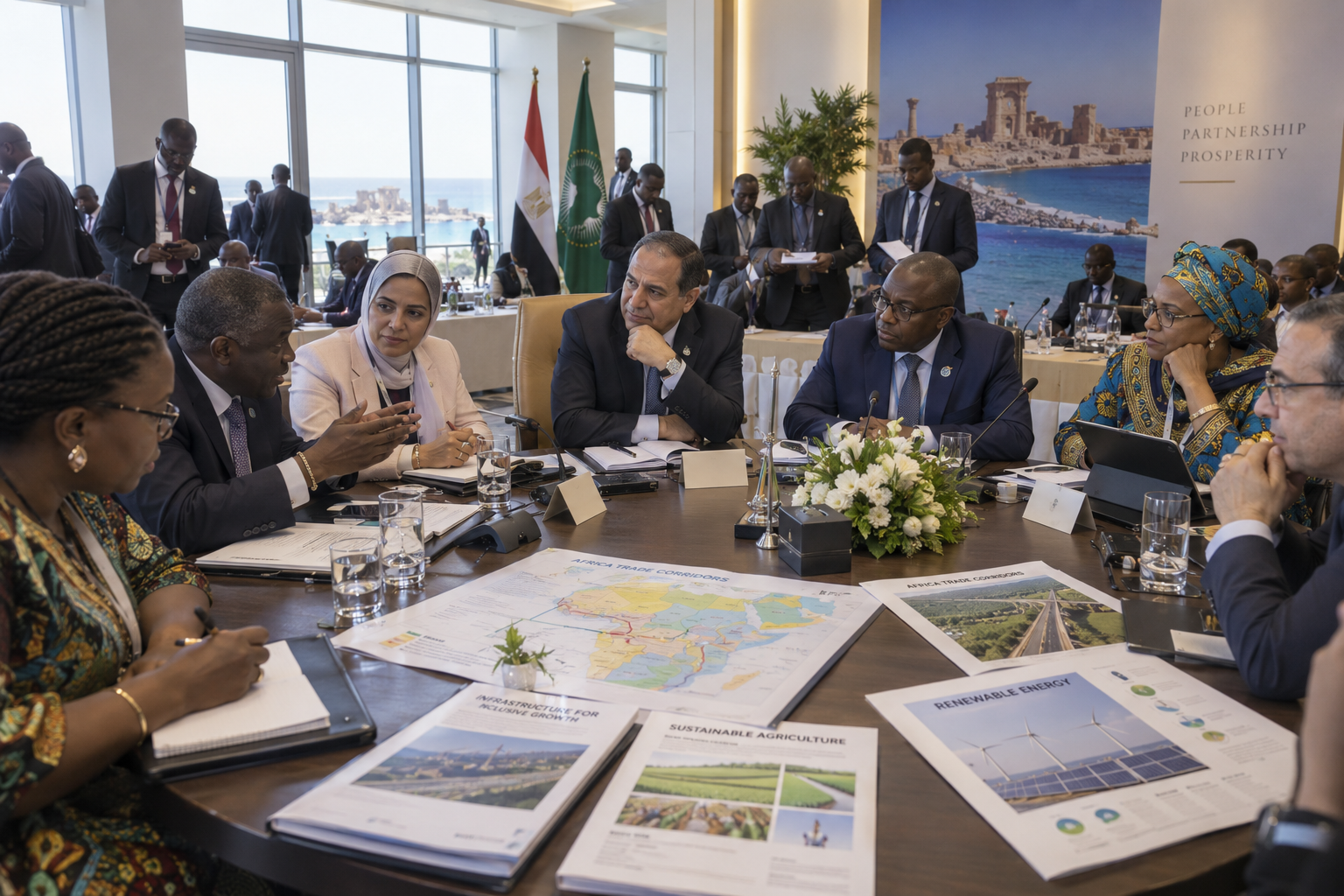
African leaders and business representatives at the inaugural Alamein Africa Forum in Egypt called for greater use of the continent’s own capital to finance economic growth and reduce dependence on external funding. The three-day summit in El-Alamein brought together more than 20 heads of state and government representatives, as well as business leaders, bankers and development institutions.
Egyptian President Abdel Fattah al-Sisi highlighted the importance of the private sector, which he said accounts for more than 70 percent of Africa’s gross domestic product. He also noted that roughly 85 percent of African private-sector transactions are conducted with companies outside the continent, and said the forum could help businesses find opportunities and partners in other African countries. African Union Commission Chairperson Mahmoud Ali Youssouf cited progress in regional trade: intra-African trade reached $220 billion in 2024, or 14.4 percent of the continent’s trade, growing 12.4 percent after contracting the previous year. He welcomed the improvement while stressing that Africa could achieve more.
The forum is set to become a biennial event under an African Union mandate. Its agenda covers infrastructure, trade, agriculture, healthcare, mining, technology and renewable energy. The gathering also reflects Egypt’s growing focus on Africa after years of prioritizing the Middle East and Mediterranean. Cairo is seeking to regain influence as China and Gulf states, particularly the United Arab Emirates, expand their presence. Egyptian investments across Africa are estimated at about $14 billion, including a $3 billion hydropower project in Tanzania.
The summit takes place amid Egypt’s effort to gain African support in its dispute with Ethiopia over the Grand Ethiopian Renaissance Dam. Egypt says the dam threatens its share of Nile waters and wants its operation governed by a binding agreement. Ethiopia, which inaugurated the dam last year, describes it as essential to its economic development.
Entities: Abdel Fattah al-Sisi, Mahmoud Ali Youssouf, African Union Commission, African Union, Alamein Africa Forum • Tone: analytical • Sentiment: neutral • Intent: inform
04-10-2026
At an African Union meeting in Egypt, Burundi’s President Evariste Ndayishimiye warned that persistent violence across Africa is undermining farming, education and development. Speaking at the Alamein Africa Forum, which brought together heads of state and business leaders, he described how insecurity can prevent farmers from working, keep children out of school and stop institutions from planning national development. He singled out the Democratic Republic of the Congo and Sudan, calling the situation there an unprecedented humanitarian catastrophe.
Egyptian President Abdel Fattah al-Sisi urged African countries to respect one another’s rights. His remarks came against the backdrop of Egypt’s long-running dispute with Ethiopia over the Grand Ethiopian Renaissance Dam, which Cairo regards as a threat to its share of Nile waters. Al-Sisi acknowledged that every state has a right to develop and benefit from its natural resources, while emphasizing that this right should be exercised responsibly and without harming other states. He also stressed that shared interests outweigh differences.
The forum is set to become a biennial event under an African Union mandate. Its agenda is intended to address a broad range of development priorities, including infrastructure, trade, agriculture, healthcare, mining, technology and renewable energy. The article thus links conflict-related disruption to the continent’s development challenges, while also highlighting cooperation and responsible resource use as themes raised at the gathering.
Entities: Evariste Ndayishimiye, Abdel Fattah al-Sisi, Burundi, Egypt, Ethiopia • Tone: neutral • Sentiment: negative • Intent: inform
04-10-2026
Egyptian Prime Minister Mostafa Madbouly says Cairo remains committed to resolving its dispute with Ethiopia over the Grand Ethiopian Renaissance Dam through diplomatic and political means. In an interview with CNN Business Arabic, he described the Nile as a matter of “national security and existential importance” for Egypt, which obtains about 95 per cent of its water resources from the river. His comments came as tensions escalated: Egypt and Ethiopia had announced the expulsion of each other’s diplomats, while Egypt, Eritrea, Sudan and Somalia were meeting to strengthen a loose alliance. Madbouly rejected Ethiopia’s portrayal of Egypt as opposing African development, arguing that development should not harm other states and that international law makes river-bordering countries partners in shared water resources. Egypt nevertheless has non-negotiable conditions for the dam, including clear operating regulations and prior consent from Egypt and Sudan. Madbouly emphasized the risk that how the dam is refilled during multi-year droughts could significantly affect downstream water supplies. President Abdel Fattah El Sisi had also said Egypt was making room for diplomacy, but not at the expense of the country and its people. The interview also addressed Egypt’s domestic economic policy. Madbouly defended extensive state-led infrastructure investment, saying political instability after 2011 and limited private-sector investment made government leadership necessary. He cited earlier shortfalls in electricity, energy, water, sanitation, roads, ports and airports. Egypt’s economy grew by 5.1 per cent in fiscal year 2025/26, compared with 4.4 per cent the year before, and the government is targeting 5.4 per cent growth in the current fiscal year. Madbouly attributed growth to productive, sustainable sectors rather than exceptional financing or external factors.
Entities: Mostafa Madbouly, Abdel Fattah El Sisi, Egypt, Ethiopia, Sudan • Tone: analytical • Sentiment: neutral • Intent: inform