02-11-2026
Fighting has resumed in Ukraine’s Kherson region after a six-day ceasefire—the longest since Russia’s full-scale invasion began in 2022—allowed hundreds of people to leave the Russian-occupied town of Oleshky and nearby areas. On Monday, local authorities reported renewed Russian strikes, including an attack on a medical facility in central Kherson and a drone strike that injured two older people travelling in a car. Ukraine said Russian forces used the pause to reinforce positions, rotate troops, and bring in ammunition. Kremlin spokesman Dmitry Peskov said it was reasonable to assume Ukraine had also used the time to regroup.
The truce was brokered by US First Lady Melania Trump. Ukrainian human rights ombudsman Dmytro Lubinets and Russian ombudsman Yana Lantratova jointly monitored it, met residents in Oleshky, and called for similar initiatives. However, the Kremlin described the ceasefire as an isolated case and said there were no plans to repeat it. Russian attacks continued elsewhere in Ukraine throughout the pause, making the agreement a rare exception rather than a broader halt in hostilities.
The article suggests that political considerations may have helped secure compliance. Moscow may have wanted to avoid damaging its relationship with US President Donald Trump, while Trump may have had an interest in presenting the truce as a diplomatic achievement before the US midterm elections. Ukraine, which depends on US intelligence and Patriot air-defence missiles, also had reasons to cooperate. Despite these calculations, the ceasefire enabled hundreds of civilians to escape after years of hardship in a damaged town. Residents who remained were promised monthly aid deliveries. Meanwhile, Ukrainian drones struck energy facilities in several Russian regions, including an oil refinery in Samara. The article concludes that the evacuation brought brief relief but did little to change the course of the wider war.
Entities: Kherson region, Oleshky, Ukraine, Russia, Melania Trump • Tone: analytical • Sentiment: negative • Intent: analyze
02-11-2026
A Russian airstrike on Monday hit a humanitarian aid distribution centre and a neighbouring shelter in Komyshuvakha, in Ukraine’s southern Zaporizhzhia region, killing 26 people, according to Ukraine’s emergency services agency. President Volodymyr Zelenskyy said 10 guided bombs struck the area, including a school used to distribute aid. Around 20 people were reported missing, and officials warned the death toll could rise. Rescue work was complicated by further Russian drone attacks in the area. Zelenskyy described the strike as evidence that Russia did not want to de-escalate, and said Ukraine expected an escalation while facing a shortage of defensive missiles.
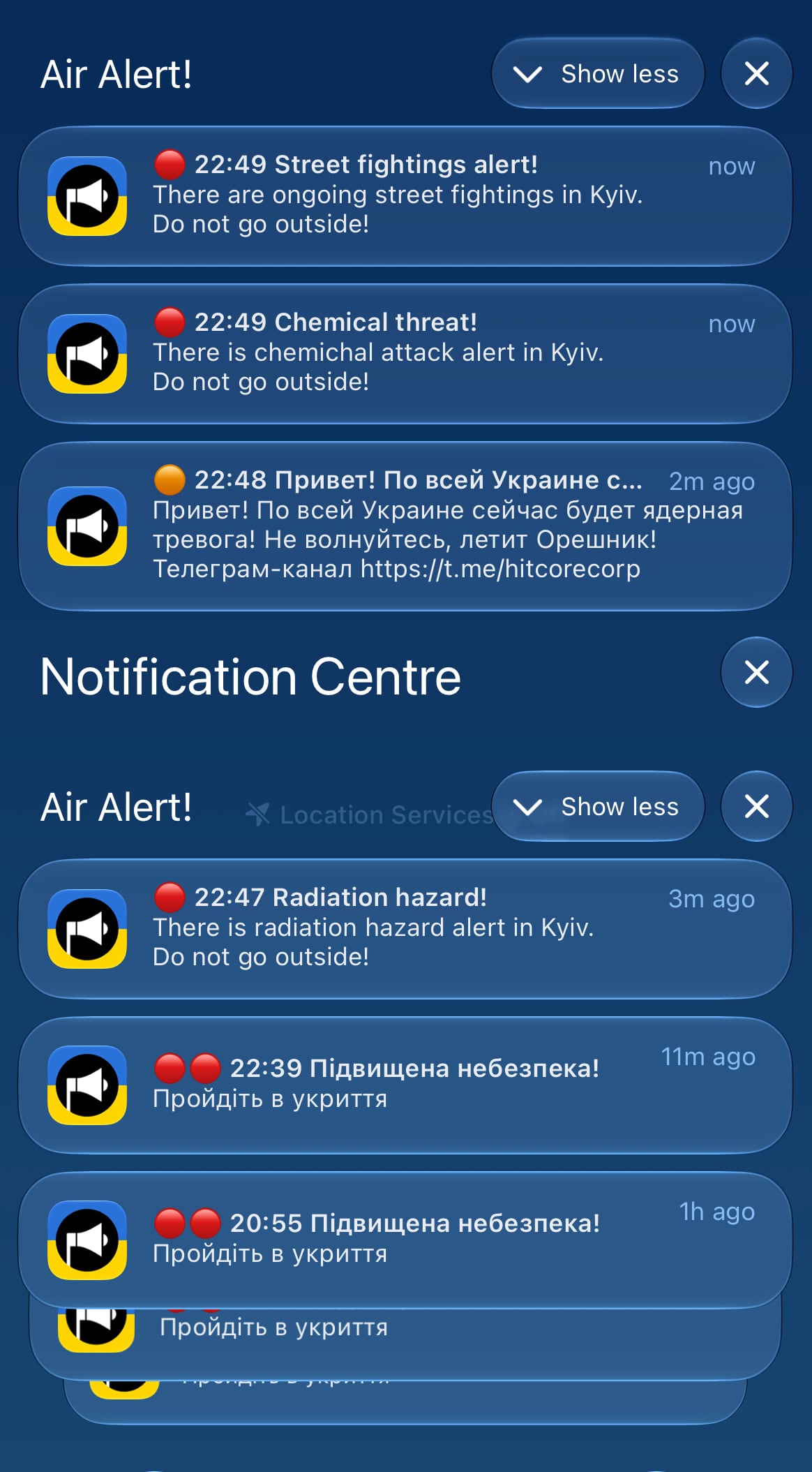
The article also reports cyberattacks on emergency alert apps in both Ukraine and Russia on Sunday. In Ukraine, users received fake warnings about radiation, chemical threats and public disturbances in Kyiv. Authorities temporarily suspended the affected service, then restored it overnight and urged people to rely on official channels and avoid suspicious links. Ukraine’s air force said the breach did not affect military operations because the app is separate from military command systems. A Russian Telegram channel reported that the hacking group Hitcore claimed responsibility for the Ukrainian attack, but the claim could not be independently verified. Russian officials also acknowledged fake alerts in their Emergency Ministry’s app, while saying the broader alert system remained operational.
The strike occurred as a localized ceasefire in Kherson expired. The truce, which began October 27, had supported a humanitarian mission to evacuate residents from Russian-occupied Oleshky and deliver supplies. The evacuation operation ended Saturday; the exact number of people evacuated was withheld for safety reasons. Ukrainian authorities reported further Russian drone attacks in Kherson after the ceasefire ended, injuring two people. Elsewhere, drone strikes injured at least 17 people in Kharkiv and damaged buildings and facilities; five people were reported injured in Odesa. The article presents the strike, cyberattacks and renewed fighting as developments amid continuing danger for civilians and humanitarian operations.
Entities: Komyshuvakha, Zaporizhzhia region, Kherson, Oleshky, Volodymyr Zelenskyy • Tone: neutral • Sentiment: negative • Intent: inform
02-11-2026
Ukrainian President Volodymyr Zelenskyy said a deadly Russian attack on an aid distribution centre in Zaporizhzhia had undermined hopes for progress toward peace after a rare, localized humanitarian truce. Ukraine's State Emergency Service reported that at least 26 people were killed in Monday's aerial bomb attack, including two rescue workers and four police officers; five others were reportedly injured. Regional governor Ivan Fedorov said Russian forces dropped at least nine KAB-3000 bombs on the settlement of Komyshuvakha over the course of the day. Zelenskyy said the attack struck a school being used for humanitarian purposes and described a double-tap strike in which additional bombs hit a shelter where people had taken cover. Emergency services and municipal workers were at the scene, and images released by the State Emergency Service showed extensive destruction, including a ruined building and a burned-out bus. The attack came after evacuees from Russian-occupied Oleshky, in the Kherson region, reached Ukrainian-controlled territory on Saturday via Belarus during a rare humanitarian arrangement between Kyiv and Moscow. Zelenskyy said that operation had briefly raised the possibility that subsequent steps could demonstrate progress toward peace. He argued that the Zaporizhzhia strikes sent the opposite message and called for a strong response from the international community. Separately, Kherson authorities said Russian attacks on their region resumed on Monday, following a drone strike in the Korabelny district. A 62-year-old woman and a 73-year-old man reportedly suffered blast injuries.
Entities: Volodymyr Zelenskyy, Nathan Rennolds, Zaporizhzhia, Komyshuvakha, Oleshky • Tone: neutral • Sentiment: negative • Intent: inform
02-11-2026
A temporary ceasefire in southern Ukraine, brokered by Pope Leo and Melania Trump, lasted several days and enabled hundreds of residents to leave the Russian-occupied town of Oleshky. The truce also gave people in nearby Ukrainian-held Kherson a brief respite from the danger of Russian drones, allowing them to walk outdoors, visit cafes, shop, and see friends more freely than usual. NPR correspondent Joanna Kakissis reports that Kherson remains heavily threatened: protective nets cover many streets and buildings, Russian forces are positioned across the river, and attacks have destroyed numerous buildings. Residents have previously relied on drone detectors and body armor to go outside. During the ceasefire, however, Kakissis saw signs of ordinary life. Two young friends, Olena Soboleva and Anna Hersomenko, described the relief of being able to walk around; Hersomenko used the pause to visit a salon. They usually meet in person only about once a month because of the danger. The truce was intended in part to address the dire situation in Oleshky, where Russian forces occupy the town and land mines have blocked deliveries of food and medicine for months. Some residents had reportedly resorted to eating boiled weeds. Hundreds were evacuated during the ceasefire, with many traveling to northern Ukraine to reunite with family. Although no violations were reported and the truce was described as successful, its end on Sunday night left people in Kherson anxious. Kakissis spoke with oncology nurse Olena Yehorova, who watched the sky for drones and said she could not trust the Russians. She was bracing for renewed attacks after the temporary pause ended.
Entities: Joanna Kakissis, Leila Fadel, Pope Leo, Melania Trump, Kherson • Tone: neutral • Sentiment: negative • Intent: inform
02-11-2026
At least 24 people were killed when Russian forces struck a school in Komyshuvakha, in Ukraine’s Zaporizhzhia region, on Monday, Nov. 2. Ukraine’s emergency service said the school was being used to distribute humanitarian aid, and two of the dead were rescue workers. Ukrainian officials said 27 people remained missing as rescue teams worked to reach residents believed to be trapped beneath the rubble. The threat of further Russian attacks has complicated those rescue efforts, according to Prime Minister Serhii Koretskyi. Regional military administration official Mykhailo Semikin declared Nov. 3 a day of mourning.
President Volodymyr Zelensky described the bombing as a barbaric “double-tap” strike. He said a second attack, involving nine more bombs, hit the shelter where people had gathered after the first airstrike. Zelensky argued that Russian forces would have known that residents who remained in Komyshuvakha regularly received assistance at the school. He characterized the attack as further evidence that Russia did not want de-escalation or justice.
The Russian military had not commented on the strike at the time of the article. The bombing came a day after a localized cease-fire in Russian-occupied Oleshky, which the article says was secured by first lady Melania Trump. Zelensky said that humanitarian operation had offered a moment when subsequent actions might have shown progress toward peace. He said the killings instead sent the opposite message, suggesting Russia was counting on further deaths. The article reports the attack, the ongoing search-and-rescue operation, and Ukrainian officials’ statements; it does not include a response from Russia.
Entities: Volodymyr Zelensky, Melania Trump, Serhii Koretskyi, Mykhailo Semikin, Komyshuvakha • Tone: urgent • Sentiment: negative • Intent: inform