03-11-2026
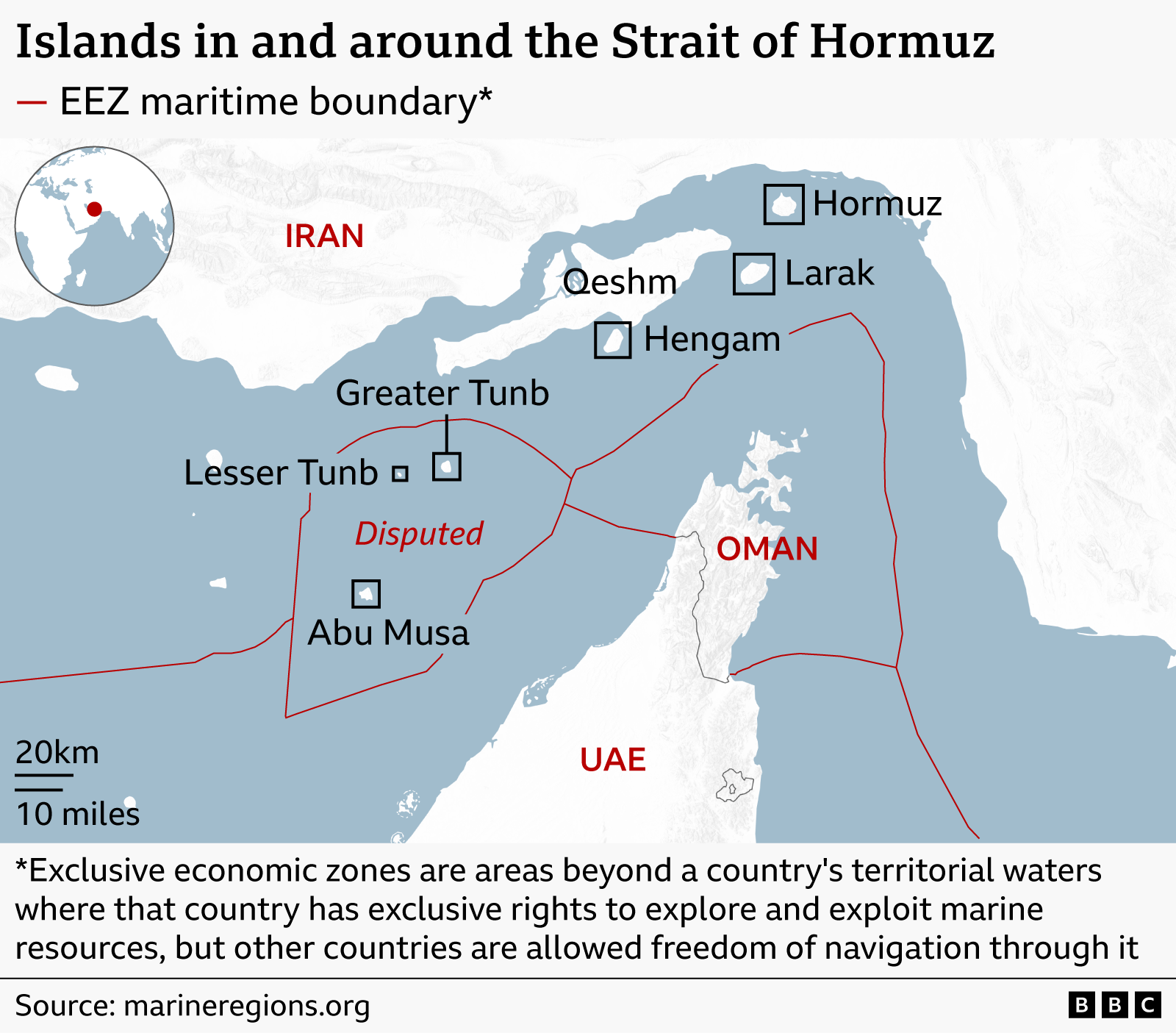
Several explosions were reported late Monday on Iran’s Qeshm Island, near the Strait of Hormuz, amid US media reports that the US military had carried out strikes against Iranian targets in the waterway. Iran’s state news agency IRNA said the blasts occurred in rapid succession, and witnesses reported seeing two aircraft over the island. The semi-official Fars news agency also reported explosions near Bandar Lengeh, apparently coming from the sea.
The Wall Street Journal and Associated Press, citing US officials, reported that US forces conducted what officials described as defensive strikes. The stated aim was to restrict Iran’s ability to attack commercial shipping; one US official said Iranian forces using surface-to-air missiles against US assets were targeted. Reports by Fox News and Axios linked the strikes to an alleged IRGC attack on a US aircraft. A Fox News reporter said the incident did not signal the beginning of expanded US strikes. Neither Iranian nor US authorities had immediately commented.
The reports emerged as US-Iran negotiations and other diplomatic efforts were under way to avert renewed US and Israeli attacks. Earlier Monday, Iran’s Islamic Revolutionary Guard Corps claimed it had captured two US reconnaissance drones near Qeshm and destroyed an MQ-9 drone east of the strait. President Donald Trump said a deal with Iran could happen soon and denied considering an attack after the US midterm elections. Vice President JD Vance also expressed optimism about the prospects for a negotiated settlement.
Iranian Foreign Ministry spokesperson Esmaeil Baghaei said Tehran’s peace demands had been conveyed to Washington and that Iran’s proposal to reopen the Strait of Hormuz could be implemented within two days if the US lifted its naval blockade of Iranian ports and secured an end to hostilities. Separately, the Associated Press reported that Israeli Prime Minister Benjamin Netanyahu was pressing for another wave of strikes after the elections. The reported explosions and strikes thus coincided with both heightened military tensions and continued diplomatic activity.
Entities: Qeshm Island, Strait of Hormuz, Bandar Lengeh, Iran, United States • Tone: analytical • Sentiment: neutral • Intent: inform
03-11-2026
The United States has carried out strikes on Iran’s Qeshm Island in the Strait of Hormuz, according to US officials who spoke to CBS, the BBC’s US partner. Iran’s state news agency IRNA reported several explosions on the island on Monday. The officials characterized the strikes as limited and said they were in response to Iran’s Islamic Revolutionary Guard Corps firing on a US aircraft. The BBC said it had asked US Central Command for comment.
The strikes come as the US approaches midterm elections that will decide which party controls Congress. President Donald Trump has faced declining poll numbers and pressure from members of his own party to end the war, which began with US and Israeli attacks on Iran in February. On Monday, Trump said he was in “no rush” to intensify military action, while also claiming Iran had been financially crippled and its population was tiring of the conflict. In an interview with Fox News, he said the US might target “Pickaxe,” a site linked to Iran’s nuclear programme, describing such an operation as limited and quick.
Speculation has grown that the US could resume major strikes after the midterms. Trump denied that this was the plan when asked by a reporter. Meanwhile, Iranian Foreign Minister Abbas Araghchi said intensive efforts to end the war were proceeding through mediators. He said Iran was prepared for either diplomacy or military action, and argued that Washington must choose between negotiation and what he called military aggression.
Entities: Donald Trump, Abbas Araghchi, Qeshm Island, Strait of Hormuz, Iran • Tone: analytical • Sentiment: neutral • Intent: inform
03-11-2026
The live updates describe a fragile effort to end the eight-month U.S.-Iran conflict alongside continued military and maritime tensions. On Monday evening, U.S. forces carried out limited defensive strikes against Iranian targets near the Strait of Hormuz. One senior U.S. military official said the targets were on Qeshm Island and that the strikes followed fire by Iran’s Revolutionary Guard Corps at a U.S. aircraft. The action came as Qatar-mediated, indirect negotiations continued without an apparent breakthrough. Iran said the next move was up to Washington, while President Donald Trump said a deal could happen and that Iran wanted a settlement soon. Vice President JD Vance also described progress and expressed cautious optimism.
The prospect of an agreement helped drive oil prices down by more than 7%, after Iran’s blockade of the strategic energy corridor had sent prices sharply higher. Trump also discussed the conflict in remarks ahead of the U.S. midterm elections, saying he hoped it would not affect voters and arguing that the United States had acted to prevent Iran from obtaining a nuclear weapon. He also said the situation did not feel like a war because fighting had paused for months.
Other updates underscored the conflict’s broader effects. Tehran residents are turning to cafes for relief from inflation, anxiety and the possibility of renewed fighting, while many say daily expenses and previously affordable purchases have become harder to manage. A maritime security agency reported that an unidentified projectile struck a vessel near Oman; its crew was safe. Separately, officials told the Associated Press that Israeli Prime Minister Benjamin Netanyahu was urging Trump to consider a new campaign of strikes after the U.S. elections. Some regional governments reportedly warned that further attacks could destabilize the region and prompt action by Iran-aligned groups. The article thus presents diplomacy and hopes for a settlement alongside active security risks and economic hardship.
Entities: Donald Trump, JD Vance, Benjamin Netanyahu, Mitra Alipour, United States • Tone: analytical • Sentiment: negative • Intent: inform
03-11-2026
The U.S. military carried out limited defensive strikes against Iranian targets near the Strait of Hormuz, according to three U.S. officials. A senior official said the strikes hit targets on Qeshm Island after Iran’s Islamic Revolutionary Guard Corps fired at an American aircraft. The strikes occurred amid uncertainty over whether President Trump will pursue a negotiated agreement with Iran or resume broader military action. On Monday, Trump said on Truth Social that a deal “could happen” and that Iran wanted a settlement, but later told Fox News that the U.S. still had to address several sites in Iran, including a suspected nuclear site at Pickaxe Mountain. He described that action as something that could be completed in an hour. Israeli Prime Minister Benjamin Netanyahu reportedly urged Trump to conduct sustained strikes during a weekend call, which Trump confirmed without discussing its substance. The conflict is affecting political contests in both countries. In the United States, increased costs associated with the Strait of Hormuz’s closure have coincided with declining support for Trump and Republicans. In Israel, Netanyahu’s party lost its parliamentary majority in the first elections since October 7, 2023. The article also reports a U.S. Central Command estimate that the war had cost the U.S. military at least $47.1 billion by mid-October. That figure includes roughly $29 billion to replace spent munitions, $6.1 billion for lost equipment, and $11.9 billion in incremental costs, such as support for U.S. service members. It excludes damage to U.S. bases in the Middle East, many of which have been targeted by Iranian drones and missiles.
Entities: United States military, Iran, Strait of Hormuz, Qeshm Island, Islamic Revolutionary Guard Corps • Tone: analytical • Sentiment: neutral • Intent: inform
03-11-2026
The United States reportedly struck Iran’s Qeshm Island on Monday, even as Vice President JD Vance said the administration was optimistic about reaching a negotiated settlement with Tehran. The Wall Street Journal, citing U.S. officials, reported that Washington had conducted limited strikes in recent weeks and had deliberately kept the campaign quiet to avoid signaling a major escalation. Qeshm, the largest island in the Persian Gulf and close to the Strait of Hormuz, is considered a potential target because reports say Iran stores anti-ship missiles, mines, drones and attack craft in underground tunnels there.
Vance said he and President Donald Trump felt good about the prospect of a negotiated agreement, while warning that Iran was unpredictable and that the president retained both military and nonmilitary options. He said the U.S. had not established a deadline for a peace deal.
The article also describes Trump’s stated rationale for the war: preventing Iran from obtaining a nuclear weapon. Trump said the United States had already destroyed Iran’s potential nuclear power, but suggested it might attack Pickaxe Mountain, an underground facility south of the Natanz enrichment plant, saying it could be destroyed in an hour. The article places these comments alongside Trump’s earlier statement that the U.S. would not attack Iran before the midterm elections, and reports that support for military action had fallen to 31% in polling ahead of the vote. Secretary of State Marco Rubio had also said Trump preferred a diplomatic resolution. Overall, the report highlights the contrast between public expressions of diplomatic optimism and reported U.S. military action, while noting the administration’s stated focus on preventing an Iranian nuclear weapon.
Entities: JD Vance, Donald Trump, Marco Rubio, Iran, Qeshm Island • Tone: analytical • Sentiment: negative • Intent: inform
03-11-2026
Ahead of the November 3 US midterm elections, President Donald Trump described the vote as the most important “in our lifetime” while acknowledging that incumbent presidents typically lose midterms. He said Republicans had “gave this a very strong shot,” and accused Democrats of nominating the most extreme and dangerous slate of candidates in US history. Senate Minority Leader Chuck Schumer rejected Trump’s closing message as “pathetic,” criticizing the administration over the Iran war, corruption and inflation. Separately, the US Supreme Court rejected Trump’s last-minute attempt to block 20,000 California ballots.
The article also reports, citing the Wall Street Journal and US sources, that the United States struck Iran’s Qeshm Island before the election. US Central Command did not officially confirm the reported attack. The report comes amid renewed US-Iran talks that the administration has characterized optimistically. Vice President JD Vance said the aim remains to prevent Iran from obtaining nuclear weapons and that any agreement would require a firm, verifiable commitment not to rebuild its nuclear program.
Voters are choosing control of Congress for the remainder of Trump’s term, with the cost of living and energy prices—described as consequences of the war in Iran—prominent concerns. Trump argued that voters should consider the danger of Iran acquiring nuclear weapons. Oil prices fell significantly as the two countries resumed talks about ending the war. The midterms are widely viewed as a referendum on Trump’s policies: Democrats are expected to have a strong chance of retaking the House, while the Senate contest is considered close. The result is likely to shape both parties’ strategies for the 2028 presidential election.
Entities: Donald Trump, Chuck Schumer, JD Vance, United States, Iran • Tone: analytical • Sentiment: neutral • Intent: inform
03-11-2026
The United States carried out strikes against Iranian targets in the Strait of Hormuz on Monday, according to an unnamed US official. The official described the operation as defensive, saying it targeted Iranians who were using surface-to-air missiles against a US asset. Iranian media separately reported five explosions on Qeshm Island, though the article does not provide further details about damage or casualties.
The strikes occurred just hours after President Donald Trump said negotiations with Tehran might be progressing. In a post on Truth Social, Trump wrote that Iran wanted a settlement “as soon as possible” and said one could happen. Vice President JD Vance also expressed optimism about the prospects for a negotiated settlement. Iran’s Foreign Minister Abbas Araghchi confirmed that indirect talks were taking place through mediators, with Qatar and Pakistan playing active roles.
The timing is politically significant: the strikes came on the eve of US midterm elections, in which Republicans are seeking to retain control of Congress. The article notes that the war in Iran has become a growing point of political contention and has contributed to declining approval ratings for Trump, amid increasing public disapproval of the conflict and concern about its economic consequences.
The conflict has also disrupted shipping through the Strait of Hormuz, a narrow passage between Iran and Oman that normally carries about one-fifth of the world’s oil. The article presents the military action, diplomatic contacts, election context and shipping disruption as developments unfolding simultaneously, without resolving whether negotiations will produce a settlement.
Entities: United States, Iran, Qeshm Island, Strait of Hormuz, Donald Trump • Tone: analytical • Sentiment: negative • Intent: inform
03-11-2026
The United States reportedly struck Iran’s Qeshm Island on Monday, according to the Wall Street Journal, even as President Donald Trump indicated that negotiations with Tehran might be advancing toward a deal to end the eight-month-old conflict. The newspaper, citing unnamed US officials, described the attack as the latest in a series of limited strikes that Washington has reportedly conducted secretly in recent weeks. Qeshm is the largest island in the Strait of Hormuz, a strategically important route for oil shipments.
Iran’s state news agency IRNA reported hearing five explosions in rapid succession on the island, while some residents said they saw two aircraft in the sky. The Pentagon referred questions to US Central Command, which had not responded to an AFP request for comment by late Monday. The article notes that the US government had not publicly announced the reported strikes. The Journal said officials characterized some of the operations as defensive measures intended to prevent Iran from attacking commercial shipping in the Strait, which has been largely blocked since the conflict began in late February. Keeping the strikes unannounced, the paper reported, was intended to avoid signaling a return to major combat operations.
On the eve of US midterm elections, Trump said a deal with Tehran “could happen.” Expectations of a possible end to the conflict helped push oil prices down by more than seven percent on Monday. Prices had risen sharply because of Iran’s blockade of the Strait of Hormuz energy corridor. The article presents the reported attack and the diplomatic signals as developments unfolding in parallel, while noting that the strike account relied on media reporting and unnamed officials.
Entities: Donald Trump, Iran, United States, Qeshm Island, Strait of Hormuz • Tone: analytical • Sentiment: neutral • Intent: inform
03-11-2026
The article reports, citing the Wall Street Journal and unnamed U.S. officials, that U.S. forces carried out a strike on Iran’s Qeshm Island on Monday. It describes the attack as part of a series of small-scale, undisclosed strikes in recent weeks, which U.S. officials reportedly characterized as defensive and aimed at securing the Strait of Hormuz. The strikes were kept secret, according to an official quoted by the Journal, to avoid suggesting that the United States intended to resume major combat operations.
Qeshm Island lies at the entrance to the Strait of Hormuz. The article says Iran has used it to store ballistic missiles and that it is home to a naval base and a desalination plant. It also reports that U.S. forces have repeatedly targeted the island since the war with Iran began.
The report places the strike amid conflicting signals from President Donald Trump. At a campaign rally in Iowa, Trump said the United States might eventually have to use force against Iran, while also saying the conflict would end soon. Earlier Monday, when asked whether he would resume attacks after the midterm elections, he answered, “No.” In remarks in Washington, he said the United States had won and controlled the Strait of Hormuz, while also claiming fighting had not taken place for months.
Meanwhile, U.S. and Iranian negotiators are pursuing a potential peace deal. Iranian Foreign Minister Abbas Araqchi said consultations through mediators were intensive and that Iran had presented its conditions and proposals, leaving the outcome dependent on Washington’s political judgment. U.S. Central Command had not immediately responded to the New York Post’s request for comment. The article identifies itself as a developing story.
Entities: United States, Iran, Qeshm Island, Strait of Hormuz, Donald Trump • Tone: neutral • Sentiment: neutral • Intent: inform
03-11-2026
The United States carried out strikes on Iran’s Qeshm Island, in the Strait of Hormuz, on Nov. 2, according to a US official. The strikes were first reported by The Wall Street Journal and were described by officials as limited, rather than a resumption of major combat operations. One official said they were defensive measures against Iranians using surface-to-air missiles against US assets. Fox News, citing officials, reported that the action followed Iran firing at a US aircraft. The Pentagon directed questions to US Central Command (CENTCOM), which oversees American forces in the Middle East; CENTCOM did not respond to requests for comment. Iranian state news agency IRNA had reported several explosions on Qeshm Island earlier that day. The article places the strikes amid a series of limited US attacks in recent weeks and uncertainty over whether Washington might renew attacks on Iran. President Donald Trump had hinted at renewed attacks after the US midterm elections scheduled for Nov. 3. However, following a speech at the Lincoln Memorial Reflecting Pool on Nov. 2, he appeared to signal that he might be reconsidering. The report does not provide further details about the targets, damage, casualties, or the precise circumstances of the strikes. It presents the accounts as statements attributed to officials and media reports, while noting that CENTCOM did not comment.
Entities: Qeshm Island, Strait of Hormuz, United States, Iran, Donald Trump • Tone: neutral • Sentiment: neutral • Intent: inform
03-11-2026
The National’s “Trending Middle East” podcast episode for November 3, 2026, presents a concise roundup of regional and international developments. It reports that the US military has reportedly struck Iran’s Qeshm Island in the Strait of Hormuz, prompting concern about renewed escalation and contributing to a rise in oil prices. US President Donald Trump says a deal with Tehran may be possible and denies considering additional strikes after Tuesday’s midterm elections.
The episode also covers comments by OpenAI chief executive Sam Altman, who told The National at the Adipec conference in Abu Dhabi that people must retain control of artificial intelligence. He stressed the importance of preventing serious safety incidents as AI systems become more capable.
Abu Dhabi is due to host another round of US-mediated peace talks between Russia and Ukraine the following week. The talks are expected to focus on security arrangements, de-escalation and humanitarian efforts. In business news, Dubai-based Al Habtoor Group has approved the sale of all its assets and investments in Lebanon. The company had stopped operating there and reported losses exceeding $1.7 billion.
The roundup also describes a government-backed weight-loss programme in Abu Dhabi. More than 6,500 people have lost weight through the programme, with participants reducing their body weight by an average of 14 per cent during the first year. The article notes that the podcast is AI-assisted, drawing on original reporting by The National that is curated and edited by humans.
Entities: The National, Trending Middle East, Qeshm Island, Strait of Hormuz, Iran • Tone: analytical • Sentiment: neutral • Intent: inform