03-11-2026
The article reports that at least 26 people were killed in Russian strikes on a school in Ukraine’s Zaporizhzhia region that was being used as a humanitarian aid centre. It attributes details about the sequence of attacks to Ukraine’s president, who said there were two separate strikes: an initial attack followed by another strike on a building where residents had taken shelter. The report therefore describes both the reported death toll and the danger to civilians seeking refuge at the site. The brief article does not provide the date or circumstances of the strikes beyond its publication date, identify the victims, name the school or aid centre, or include a response from Russia. It also offers no further details about injuries, damage, or the ongoing humanitarian response. The report was published by Al Jazeera on 3 November 2026.
Entities: Russia, Ukraine, Zaporizhzhia region, Al Jazeera, Ukraine’s president • Tone: neutral • Sentiment: negative • Intent: inform
03-11-2026
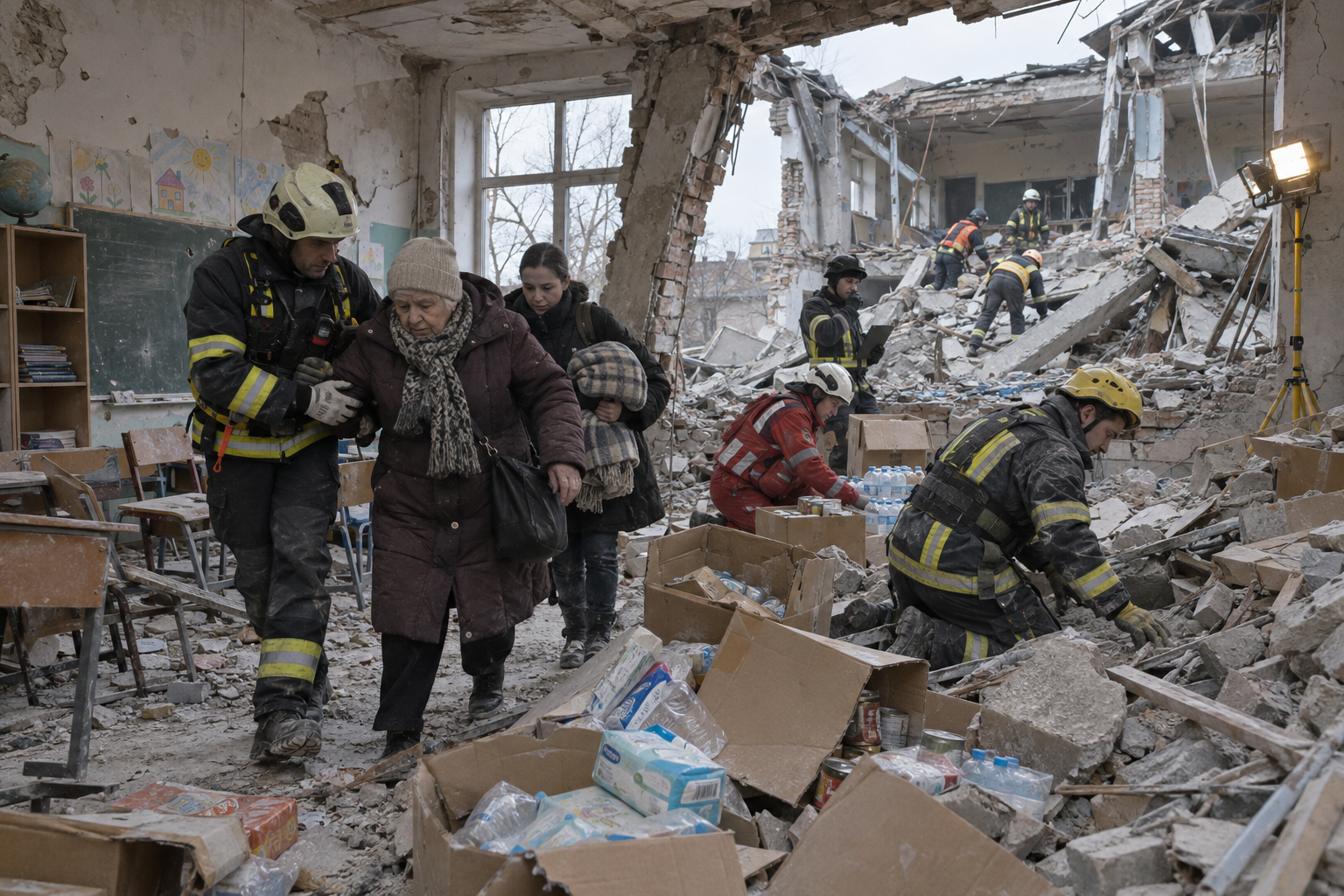
At least 26 people were killed and five injured when Russian bombs struck a humanitarian aid distribution centre in Komyshuvakha, in Ukraine’s southern Zaporizhzhia region, according to Ukrainian officials. Regional head Mykhailo Semikin said at least nine 3,000kg aerial bombs hit the village and that people remained trapped beneath rubble. Officials initially reported 27 people missing. President Volodymyr Zelensky said the first strike hit a local school being used for humanitarian purposes, followed by another attack on a place where people were sheltering. Ukraine’s state emergencies service confirmed that those killed included two rescuers and four police officers. Rescue operations were repeatedly interrupted by Russian drone attacks in the area, and officials warned the death toll could rise. A day of mourning was declared across Zaporizhzhia region.
Zelensky called the attack “utterly horrific” and argued that Russian forces must have known residents gathered at the site to receive weekly aid. He said the strike undermined hopes for peace that had emerged after a recent joint Russian-Ukrainian civilian evacuation from occupied Oleshky during a temporary ceasefire brokered by Melania Trump. Semikin described the bombing as a tragedy for the village.
The article places the attack amid the wider war, launched by Russian President Vladimir Putin in February 2022, and renewed diplomatic efforts. US envoy Steve Witkoff said representatives from Ukraine, Russia and the United States would resume peace talks in Abu Dhabi the following week. Discussions were expected to address post-war security, de-escalation, humanitarian efforts and steps toward peace, while US negotiators were also due to meet European and Nato officials in Brussels. The article notes that talks had been suspended since February, Russia had intensified attacks, and Kyiv had nearly exhausted Western-supplied missile interceptors. It says no major breakthrough was expected.
Entities: Komyshuvakha, Zaporizhzhia region, Ukraine, Russia, Volodymyr Zelensky • Tone: urgent • Sentiment: negative • Intent: inform
03-11-2026
Russian strikes killed at least 26 people in a village in Ukraine’s southeastern Zaporizhzhia region, according to Ukrainian officials. The attack hit a school where humanitarian aid was being distributed. President Volodymyr Zelensky said the first strike came as people arrived to collect aid and that a second strike targeted the shelter. The dead included two rescue workers and four police officers; emergency services named the rescuers as Denys Konovalenko and Oleksy Sushchevsky.
The strikes came hours after a rare local ceasefire ended. The truce, which began Tuesday and concluded Sunday, was arranged to enable an evacuation mission from Russian-occupied Oleshky and was described as the longest pause in fighting between the two countries since Russia’s 2022 invasion. Neither side reported violations during the ceasefire. Kyiv said Russia refused an offer to extend it and accused Moscow of using the pause to strengthen its positions. Kremlin spokesman Dmitry Peskov called fortifying positions normal in such circumstances and said Ukraine had also used pauses to regroup. He described the evacuation mission as successful; evacuees were taken to both Ukrainian-controlled territory and Russian-annexed Crimea.
Zelensky said the attack undermined hopes that the truce might lead to further progress toward peace, and called for a response. Meanwhile, US special envoy Steve Witkoff said US-led talks would resume in Abu Dhabi on November 10 and 11. President Donald Trump has pushed for a settlement, but no breakthrough has been reached, and Kyiv and its European allies are concerned that he has increasingly sided with Moscow.
Both countries also reported cyberattacks on emergency warning apps after the ceasefire ended. Ukraine said false radiation-threat alerts were sent to millions and suspected its air-raid alert system had been compromised. Russia said its emergency situations ministry app was also hacked. The report notes that Russian attacks have intensified this year, including the use of ballistic missiles and fast jet-powered drones.
Entities: Ukraine, Russia, Zaporizhzhia, Kherson, Oleshky • Tone: urgent • Sentiment: negative • Intent: inform
03-11-2026
At least 26 people were killed when Russian forces struck a school in the village of Komyshuvakha, in Ukraine’s southeastern Zaporizhzhia region. The school was being used to distribute humanitarian aid. Ukrainian authorities said two rescue workers and four police officers were among the dead, while five people—including two rescue workers—were hospitalised. About 20 people remained missing, raising concerns that the death toll could increase. President Volodymyr Zelenskyy said the school was hit before a nearby shelter and described the attack as evidence that Russia did not want de-escalation. Rescue teams searching the rubble also faced further Russian drone attacks, according to a Ukrainian military official.
Separately, cyberattacks on government mobile applications in Ukraine and Russia generated false emergency warnings. Ukrainians received fabricated alerts about radiation, chemical threats and an imminent nuclear attack. Ukraine temporarily suspended its emergency app, then restored it; officials said the breach had not affected security or defence operations. Russia’s emergency ministry reported that a false alert was sent to its app across 33 regions, while SMS warnings and sirens continued to work. Kremlin spokesperson Dmitry Peskov called for stronger cybersecurity measures.
The attacks and cyber incidents came as a limited ceasefire in the southern Kherson region expired. The truce, which began October 27, was meant to enable humanitarian aid deliveries and evacuations in Russian-occupied areas. Ukraine’s general staff accused Russia of using the pause to reinforce drone defences and replenish ammunition. Russian drone attacks also injured 12 people in Kharkiv and five in Odesa, damaging buildings and facilities. Russia’s defence ministry said it had downed 212 Ukrainian drones overnight; independent Russian media reported that Ukrainian drones had targeted an oil transport hub in the Samara region.
Entities: Russia-Ukraine war, Volodymyr Zelenskyy, Mykhailo Semikin, Dmitry Peskov, Komyshuvakha • Tone: neutral • Sentiment: negative • Intent: inform