01-09-2026
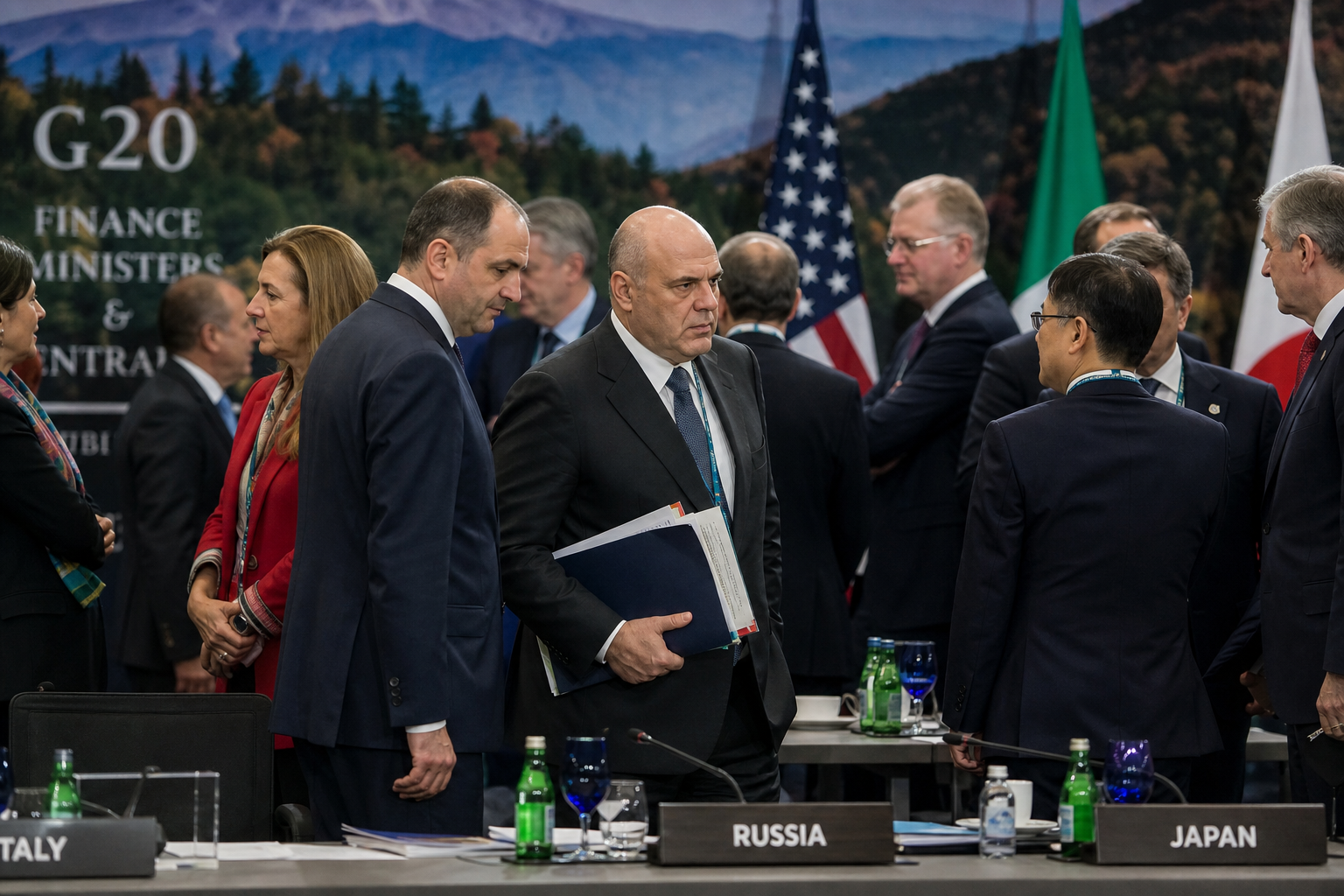
Russian Finance Minister Anton Siluanov made an unexpected in-person appearance at US-hosted G20 finance talks in Asheville, North Carolina, marking his first attendance at a G20 meeting since Russia launched its full-scale invasion of Ukraine in 2022. Siluanov held bilateral discussions with US Treasury Secretary Scott Bessent. Russia said the talks concerned financial cooperation, while a US official said they focused on President Donald Trump’s peace plan for Ukraine.
The invitation angered several European officials. Poland’s Finance Minister Andrzej Domanski said he did not trust Russia and found it difficult to engage in discussions with Moscow, while German Finance Minister Lars Klingbeil described the US decision as a troubling signal. European ministers and central bankers reportedly refused to appear alongside Siluanov in the traditional G20 family photograph, which was taken without him. Klingbeil said officials had wanted to preserve a channel for dialogue while also warning Moscow that Europe continued to support Ukraine and oppose any normalization of Russia’s role.
The article contrasts Siluanov’s return with a 2022 G20 meeting, when officials from Canada, the United Kingdom, the United States and the European Central Bank walked out after his virtual participation. The White House defended the renewed engagement, arguing that discussions with Russia are necessary to pursue an end to the war. However, sources said Bessent had told Moscow that the US would not provide economic relief until the conflict ended.
The meeting took place amid disagreement over Trump’s Ukraine peace efforts, tensions over China’s trade surplus, record global debt, an energy shock linked to the US-Israel war on Iran, and restrictions on media access to the gathering. The United States also excluded South Africa, the previous G20 host, while inviting Poland, a non-permanent member.
Entities: Anton Siluanov, Scott Bessent, Donald Trump, Lars Klingbeil, Andrzej Domanski • Tone: analytical • Sentiment: negative • Intent: inform
01-09-2026
U.S. Treasury Secretary Scott Bessent told Russian Finance Minister Anton Siluanov that sanctions relief and new agreements between Washington and Moscow would not be possible while Russia’s war in Ukraine continues, according to reports. Bessent reportedly summarized the U.S. position by telling Siluanov that “nothing is possible until the war is over” after the Russian official raised other areas of mutual interest.
The two officials met on the sidelines of a G20 finance ministers’ gathering in Asheville, North Carolina, on Aug. 31, 2026. The meeting was notable because it marked Siluanov’s first in-person appearance at the summit since Russia’s 2022 invasion of Ukraine. European governments objected to Russia’s participation and are planning additional sanctions intended to further pressure Moscow’s economy and finances.
According to Axios, discussions between Bessent and Siluanov focused on President Donald Trump’s peace plan for Ukraine and economic growth. Russia’s finance ministry characterized the talks as addressing financial cooperation between the United States and Russia within the G20 framework. The differing descriptions suggest that the meeting combined discussion of the war and possible diplomatic efforts with narrower economic and institutional issues.
The encounter highlighted a contrast between the United States and its European allies. Washington appears willing to reopen high-level diplomatic channels with Moscow, while European governments intend to maintain Russia’s isolation for as long as the conflict continues. Russia’s return to the G20 discussions reportedly caused dismay among European officials, who refused to appear alongside Siluanov in the traditional group photograph. The photo was ultimately taken without the Russian finance minister. Despite the contact between the U.S. and Russian officials, Bessent’s reported warning indicated that any meaningful economic normalization remains contingent on ending the war.
Entities: Scott Bessent, Anton Siluanov, Donald Trump, U.S. Treasury Department, Russian Finance Ministry • Tone: analytical • Sentiment: neutral • Intent: inform
01-09-2026
The G20 meeting of finance ministers and central bank leaders in Asheville, North Carolina, has been overshadowed by tensions involving Russia, media access, the war with Iran, and worsening trade relations between the United States and Canada. The United States, which holds the rotating G20 presidency, invited Russian Finance Minister Anton Siluanov to attend—the first in-person Russian invitation to such a meeting since Russia’s full-scale invasion of Ukraine in 2022.
European officials, including German Finance Minister Lars Klingbeil and Polish Finance Minister Andrzej Domanski, criticized Russia’s participation. Klingbeil said European delegates would not join the traditional G20 “family photo” with Siluanov, reflecting a common European Union position. Siluanov ultimately did not appear in the photograph. European officials also objected to restrictions placed on major American news organizations. Bloomberg News said its team was denied access, while The Wall Street Journal and The New York Times reported that some journalists were refused credentials. Klingbeil called the exclusions unacceptable and defended the press’s right to report freely.
The meeting was also affected by the economic consequences of the conflict with Iran. US Treasury Secretary Scott Bessent sought international support for “Operation Economic Outcast,” a proposed intensification of sanctions designed to pressure Iran and its trading partners. German officials, however, have criticized the US military approach and called for the conflict to end.
Finally, the summit took place amid a sharp deterioration in US-Canada trade talks. New tariffs and hostile rhetoric from President Donald Trump have unsettled allies, although Canadian Finance Minister François-Philippe Champagne said Canada remained committed to constructive discussions and restoring stability in trade.
Entities: G20 finance ministers and central bank heads, Asheville, North Carolina, United States, Donald Trump, Anton Siluanov • Tone: analytical • Sentiment: negative • Intent: inform
01-09-2026
France 24 reports that Russia’s participation in a G20 meeting in Asheville, North Carolina, has drawn strong criticism from European countries. Finance ministers and central bank governors from the world’s 20 largest economies are meeting for two days under the United States’ rotating G20 presidency. Washington is using the gathering to encourage partner countries to increase economic pressure on Iran and to discuss measures aimed at strengthening global economic growth.
The article identifies Russia’s presence as the unexpected and controversial element of the meeting. While the supplied report does not name the European governments or officials who objected, it emphasizes that the US invitation or participation of Russia was “severely criticised” and that the reaction was fierce. The report also does not provide detailed statements from the critics, explain whether the dispute affected the meeting’s agenda, or describe Russia’s response.
The item is primarily a brief video news report rather than a detailed written account. Its focus is the diplomatic tension created by Russia’s inclusion in a high-level forum involving major global economies. The meeting’s economic objectives—coordinating pressure on Iran and finding ways to boost growth—are presented alongside the geopolitical disagreement over Russia. The surrounding France 24 links reference Russia’s war in Ukraine and related European security developments, but those topics are not developed in the main article text provided. Overall, the report conveys that Russia’s presence has complicated the G20 gathering and exposed divisions among the United States’ European partners.
Entities: Russia, Group of 20 (G20), United States, European countries, Asheville, North Carolina • Tone: analytical • Sentiment: negative • Intent: inform
01-09-2026
NPR reports that finance ministers from the Group of 20 major economies are meeting in North Carolina during a week when the United States is serving as host. The gathering brings together senior economic officials from around the world for discussions related to global finance and economic policy. The article highlights the unexpected or notable in-person appearance of Russia’s top economic official, who attended the meeting on Monday and attracted attention by doing so. Although the official is not named in the supplied text, his presence appears to be the central news development emphasized by the report. The meeting’s location in North Carolina and the U.S. role as host are also prominent elements of the story. The article is presented as a short NPR report and includes an audio segment heard on Morning Edition, reported by Scott Horsley and A Martínez. The available text does not provide details about the ministers’ specific agenda, policy disagreements, negotiations, or any decisions reached at the summit. It also does not explain the political or diplomatic significance of Russia’s attendance beyond describing it as causing a stir. As a result, the report primarily establishes the setting and identifies the most notable development at the gathering rather than offering a detailed account of the summit’s proceedings or outcomes. The overall presentation is concise, factual, and focused on international economic diplomacy.
Entities: Group of 20 (G-20), Global finance ministers, United States, North Carolina, Russia • Tone: neutral • Sentiment: neutral • Intent: inform
01-09-2026
The article reports that Russia’s finance minister, Anton Siluanov, attended a G-20 meeting in Asheville, North Carolina, marking his first in-person participation at such a gathering since Moscow launched its full-scale invasion of Ukraine. Siluanov and leaders of Russia’s central bank were invited by the Trump administration to participate in a meeting of G-20 finance ministers and central bankers.
The invitation and Russian officials’ presence immediately generated objections from European participants. The episode highlights the diplomatic tensions surrounding Russia’s continued involvement in major international forums while its war in Ukraine remains ongoing. It also underscores a policy shift by the Trump administration, which chose to invite senior Russian economic officials to a high-level meeting traditionally focused on global financial coordination.
The meeting brought together finance ministers and central-bank leaders from the world’s major economies, but the participation of Russian representatives made the event politically contentious. European officials’ protests indicate that Russia’s inclusion remains divisive among G-20 members, particularly because of the country’s invasion of Ukraine and the broader disagreement over how Moscow should be treated in international institutions.
The provided excerpt does not include the full details of the European objections, the Trump administration’s rationale, or responses from Siluanov and other attendees. It establishes, however, that the Russian delegation’s return to an in-person G-20 finance meeting became a significant diplomatic development and a source of friction among participating countries.
Entities: Anton Siluanov, Trump administration, Russia, Russian central bank, G-20 • Tone: analytical • Sentiment: negative • Intent: inform
01-09-2026
CNBC’s Daily Open reports on several major geopolitical and market developments, led by the unexpected in-person attendance of Russian Finance Minister Anton Siluanov at the G20 finance ministers and central bank governors’ meeting in Asheville, North Carolina. Siluanov’s participation was his first physical appearance at a G20 gathering since Russia’s 2022 invasion of Ukraine and reportedly caught European officials off guard. European representatives declined to participate in the traditional G20 family photograph with Russia, so the image was taken without Siluanov. U.S. Treasury Secretary Scott Bessent met with the Russian minister and reportedly said that sanctions relief or new agreements with Moscow were impossible while the war in Ukraine continued.
The article also highlights Indian Prime Minister Narendra Modi’s call for Russian President Vladimir Putin to end the conflict in Ukraine during a Shanghai Cooperation Organization summit in Kyrgyzstan. At the same time, tensions between the United States and Iran intensified. President Donald Trump threatened a forceful response to attacks on U.S. military bases in the region, while another tanker was struck in the strategically important Strait of Hormuz.
In energy news, the White House said Venezuela had granted U.S.-backed North America Blue Energy Partners 100-year concessions covering 17 oil fields. Trump claimed the agreement would give the United States majority control over 20% of Venezuela’s oil reserves.
The newsletter also covers Shein’s pressured Hong Kong trading debut. The fast-fashion company’s initial public offering valued it at approximately $26.5 billion, far below its $100 billion private-market valuation in 2022, with proceeds intended to support technology and international expansion. The closing feature previews an interview with Anthony Scaramucci, who discusses his business career, ego, mistakes and his 11-day tenure in the Trump administration.
Entities: Anton Siluanov, G20, Asheville, North Carolina, Russia’s invasion of Ukraine, Scott Bessent • Tone: analytical • Sentiment: negative • Intent: inform