01-09-2026
France 24 reports that French pupils returned to school on September 1 amid heightened concern over child safety. The article says that parents faced worries beyond the usual preparations for the new school year because, several months earlier, hundreds of allegations of sexual assault and rape had emerged against monitors working in Paris schools and childcare centres. These monitors are employed by local authorities and provide supervision before classes, during school breaks and after the regular school day.
The allegations have intensified scrutiny of France’s childcare and school-supervision systems. Parents are calling on the government to provide clear guarantees that children will be protected and that appropriate safeguards are in place. The article presents the issue as a major concern accompanying the return to school, linking the start of the academic year with broader questions about institutional responsibility, oversight and accountability.
The report is brief and does not provide detailed information about individual cases, the exact number of accused monitors, the status of investigations or specific government measures. It also does not include responses from the authorities or explain whether new protections have been introduced. Instead, it focuses on the public anxiety generated by the allegations and on parents’ demands for reassurance. The accompanying France 24 video is credited to Eliza Herbert. Overall, the report frames the scandal as an unresolved safeguarding crisis confronting families and public authorities as children resume school and childcare arrangements in Paris and elsewhere in France.
Entities: France, Paris, French pupils and children, Parents, French government • Tone: urgent • Sentiment: negative • Intent: inform
01-09-2026
France 24 reports on changes facing French pupils as millions of students return to school for the 2026–2027 academic year. The report is framed as an examination of new rules and arrangements introduced during what the article describes as the final school year of Emmanuel Macron’s presidency. Its main areas of focus include restrictions on mobile-phone use in schools, changes to exam schedules, and concerns related to sexual violence and child abuse in educational and childcare settings.
The article is presented as a short, 1-minute-36-second video report by Camille Knight. The introduction says the report will explain not only what is changing in the French education system, but also why the measures are being introduced. The headline places the phone issue alongside sexual violence, suggesting that the report covers both everyday school regulation and broader safeguarding concerns affecting children.
The supplied page capture does not include the video transcript or detailed reporting beyond the introductory text. As a result, it does not provide specific information about the precise phone-ban rules, the revised examination timetable, the scale or nature of the abuse concerns, or responses from government officials, schools, parents, pupils, or advocacy groups. The related headlines indicate that mobile-phone restrictions and child-abuse accountability were significant issues in France at the time of publication, but those linked stories are separate from the article itself.
Overall, the available material presents the report as an informative overview of policy changes affecting French pupils, combining school discipline, examinations, and child protection. Its purpose is explanatory rather than argumentative, although the reference to systemic abuse gives part of the subject matter a serious and concerning dimension.
Entities: France, French pupils and students, French school system, Emmanuel Macron, Camille Knight • Tone: analytical • Sentiment: neutral • Intent: inform
01-09-2026
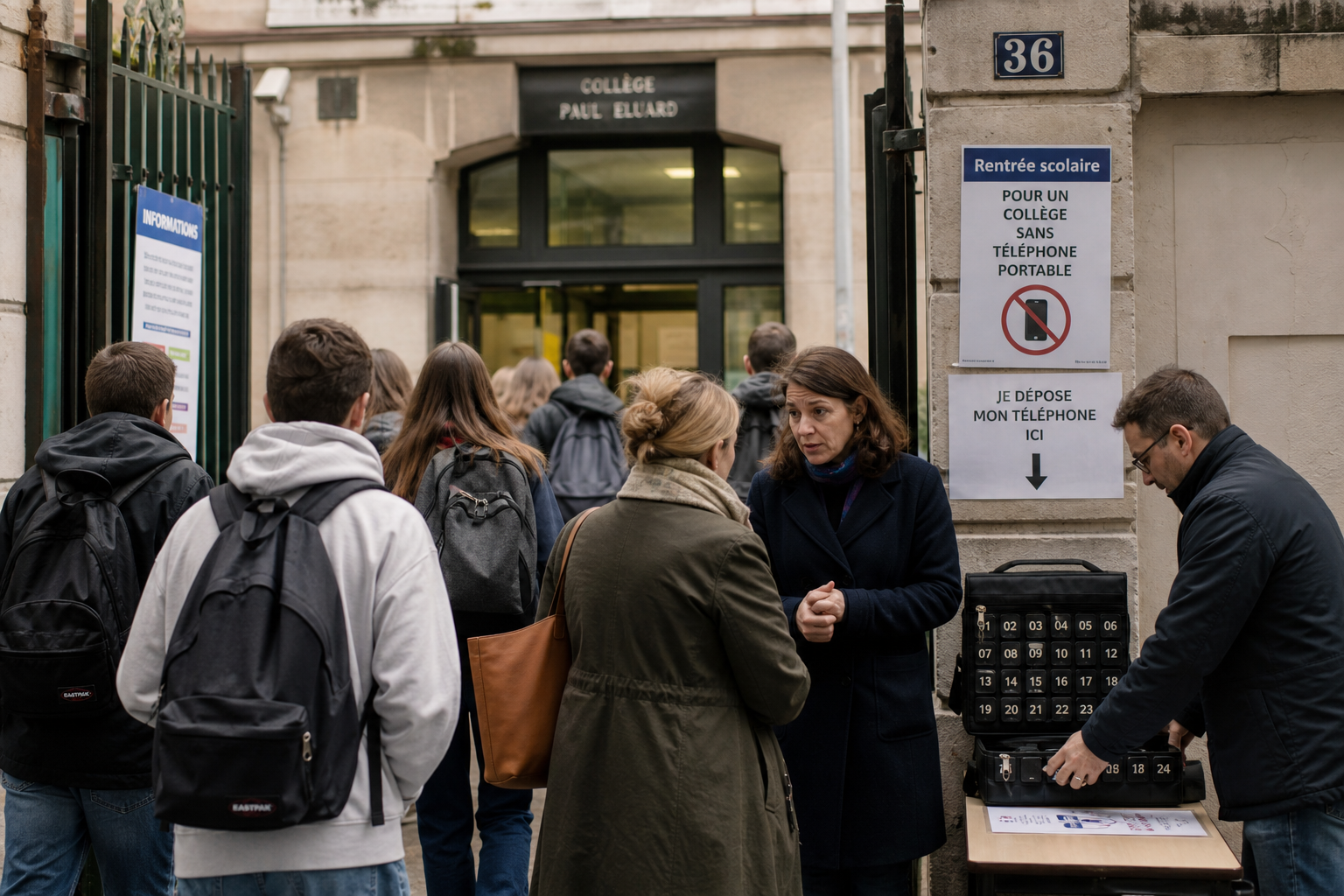
French President Emmanuel Macron defended France’s newly implemented ban on mobile phones in high schools, arguing that phones distract students and interfere with learning. Speaking to pupils during a visit to a school in Mende in southern France on Sept 1, the first day of the academic year, Macron said that having phones on school grounds was incompatible with paying attention in class.
Macron also said he followed a similar practice at the Elysee Palace, where attendees are asked to hand in their phones before meetings. He argued that adults, as well as children, have become overwhelmed by constant phone use and that participants otherwise spend meetings looking at their devices. During his visit, students placed their phones in a numbered storage unit attached to a classroom wall. While some students accepted the ban, others criticized it as “infantilising” in a society where mobile phones are ubiquitous.
France already prohibits mobile-phone use in primary and middle schools, covering children up to about age 15. The extension of the policy to high schools has raised concerns among teachers’ unions, which say it could be difficult to implement quickly.
Macron also reiterated his support for restricting social-media access for children under 15. Although Parliament approved a bill, France’s top court rejected the measure on freedom-of-expression grounds. Macron’s office said he would continue pursuing the policy and that the government would prepare a new draft law. He cited concerns that social media causes addiction, dependency and attention disorders, and said extensive screen exposure makes it harder to concentrate and sustain attention while reading.
Entities: Emmanuel Macron, France, Elysee Palace, Mende, southern France, French high school mobile-phone ban • Tone: analytical • Sentiment: neutral • Intent: inform