01-09-2026
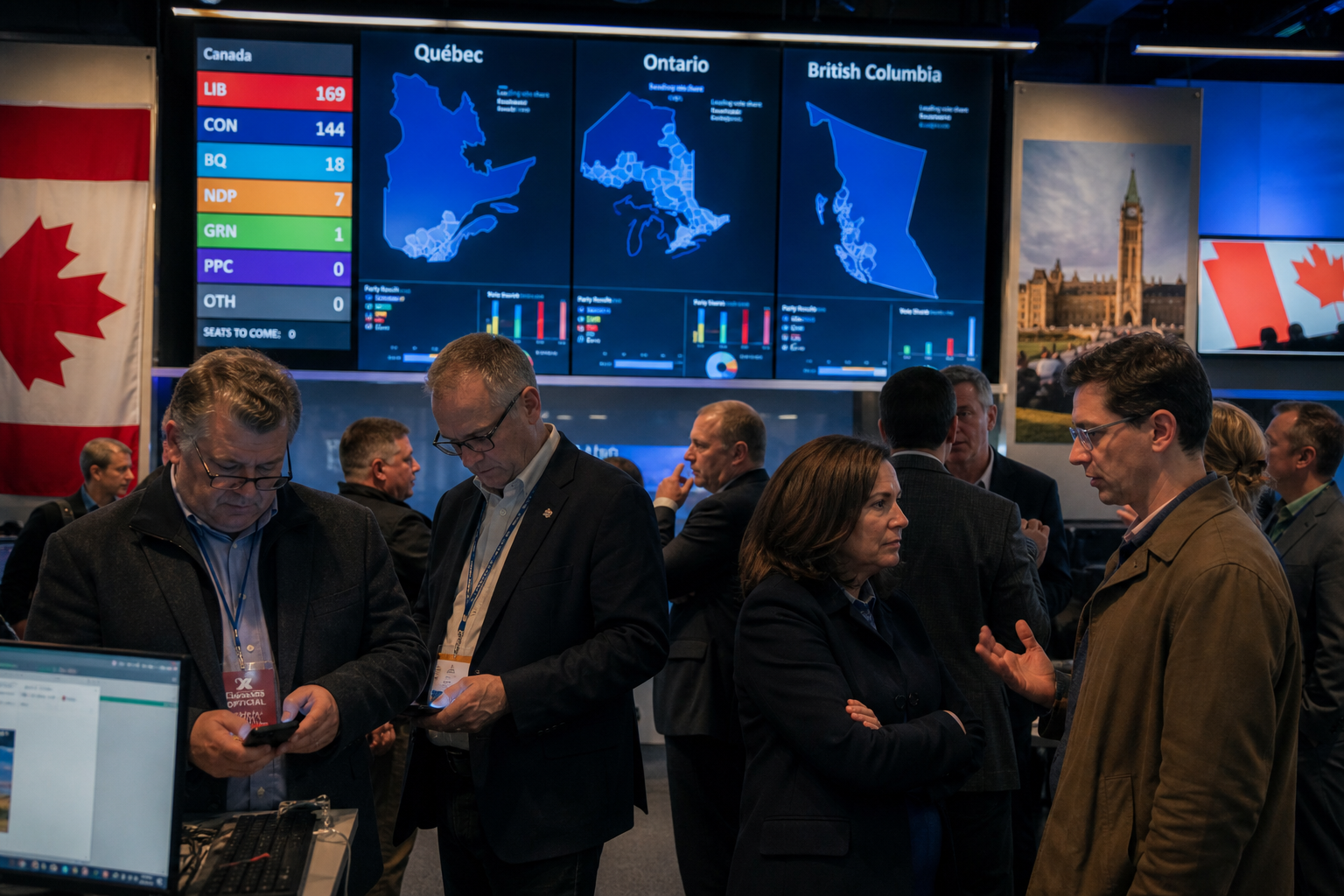
Canadian Prime Minister Mark Carney’s Liberal Party won all three seats contested in special elections, strengthening the government’s position in Parliament as tensions with the United States intensify. The Liberals captured Chicoutimi–Le Fjord in French-speaking Quebec from the opposition Conservatives, while retaining two other districts in Ontario and British Columbia that had previously been held by the party. The results provide a domestic boost for Carney as he manages a deteriorating relationship with Canada’s former close ally and defends the government’s trade policies.
Carney said the election results showed that voters had placed their trust in his government during a consequential period for the country. In a post on X, he argued that Canada was being tested by a changing international environment and expressed confidence in Canadians’ ability to respond.
The elections took place amid an escalating trade dispute between Ottawa and Washington. Trade negotiations broke down the previous month, and Carney said US negotiators had sought restrictions on Canada’s trade agreements with other countries. He also alleged that American officials had made unacceptable threats involving the French language and Quebec culture, issues that carry particular political sensitivity in Canada.
The United States subsequently imposed 50 per cent tariffs on Canadian goods, prompting Ottawa to announce retaliatory tariffs. Against this backdrop, the Liberal victories could give Carney greater political room to confront Washington and present a united domestic front. Although the election results do not resolve the trade conflict, they reinforce the prime minister’s parliamentary standing while Canada faces significant economic and diplomatic pressure from the United States.
Entities: Mark Carney, Liberal Party of Canada, Canada, United States, Donald Trump • Tone: analytical • Sentiment: neutral • Intent: inform
01-09-2026
The latest rupture in US-Canada trade relations is being presented as a warning and a potential opportunity for China and other countries that depend heavily on the US market. Analysts and former US trade officials say Ottawa’s resistance to President Donald Trump’s pressure campaign could reveal the limits of Washington’s leverage and influence how trading partners approach future negotiations.
The dispute escalated after Canadian Prime Minister Mark Carney ended negotiations with the United States, accusing Washington of introducing unfair and economically damaging changes late in the process and acting in bad faith. The US responded by claiming that Canada had abandoned earlier commitments. Trump then intensified the confrontation by publicly insulting Canadian negotiators and Ontario Premier Doug Ford, who had responded defiantly to the president’s criticism.
Trump’s decision to issue an executive order unilaterally renaming Lake Ontario as Lake America further underscored the confrontational and disruptive character of the dispute. The article argues that such behavior could deepen distrust of Washington and encourage countries to diversify their economic relationships, seek greater negotiating leverage and question the reliability of US agreements.
Wendy Cutler of the Asia Society Policy Institute said that if Canada withstands US retaliation while defending its national interests, other countries may adopt a similarly tough stance. She also suggested that China would likely welcome the conflict and could increase efforts to strengthen ties with Ottawa. Overall, the dispute is portrayed as another front in Trump’s challenge to established global institutions, with consequences extending well beyond North America. It may either produce a backlash against US pressure or encourage governments to pursue more independent trade strategies.
Entities: China, United States, Canada, Donald Trump, Mark Carney • Tone: analytical • Sentiment: negative • Intent: analyze
01-09-2026
Canadian Prime Minister Mark Carney’s Liberal Party won three special elections on September 1, preserving the government’s slim parliamentary majority. The victories came in ridings in British Columbia, Ontario and Quebec, after the Liberals secured a majority government in the April general election. While the British Columbia and Ontario seats were traditionally Liberal strongholds, the Quebec contest was closely fought and particularly important because the riding had previously been held by the Conservatives.
The results give Carney’s government continued legislative stability as Canada faces growing tensions with the United States. Carney has called for national unity amid what the article describes as a worsening trade war with US President Donald Trump. In a statement following the results, Carney said voters had endorsed his government’s plan and emphasized efforts to strengthen Canada domestically and diversify its international trade relationships.
The election outcome also comes as Quebec prepares for a provincial election on October 5. Separatist parties are favoured to win that contest, even though support for independence has declined. The federal Liberal victory in Quebec may therefore carry broader political significance amid renewed questions about the province’s relationship with Canada.
Relations between Ottawa and Washington have deteriorated sharply. Carney ended trade talks with the Trump administration the previous month, accusing the United States of attacking Canada and failing to respect its sovereignty. The article also notes that Trump recently signed an executive order renaming Lake Ontario “Lake America” and again called for Canada to become the 51st US state—claims and actions presented as part of the escalating dispute.
Six additional special elections are expected in the coming months to fill other vacant parliamentary seats.
Entities: Mark Carney, Liberal Party of Canada, Donald Trump, Canada, United States • Tone: analytical • Sentiment: neutral • Intent: inform
01-09-2026
Canada’s ruling Liberal Party won all three special elections held on Monday, strengthening Prime Minister Mark Carney’s position amid an escalating dispute with the United States. The Canadian Press projected Liberal victories in Chicoutimi-Le Fjord in Quebec, Beaches-East York in Toronto, and North Vancouver-Capilano in British Columbia. Carney described the results as an endorsement of his government’s plan at a consequential moment for Canada, particularly after trade negotiations with the US collapsed on 21 August.
The most significant result came in Chicoutimi-Le Fjord, a district previously held by the Conservatives since 2018. Liberal candidate Daniel Gobeil was projected to win decisively in the region, whose economy includes aluminium production, dairy farming, and other industries affected by US tariffs and the broader trade conflict. In the two other ridings, which had previously been represented by Liberals, Carney’s former deputy chief of staff Braeden Caley won in North Vancouver-Capilano. Liberal MP Hedy Fry said the results sent Washington a message that Carney retained the support of Canadians.
The victories come as US President Donald Trump continues to threaten Canada with tariffs and has repeatedly discussed making it the 51st US state. After trade talks failed, Trump imposed 50% tariffs on approximately $20bn of Canadian goods, while Canada prepared retaliatory measures. Carney has responded by seeking stronger economic relationships with Europe and other international partners.
The results would give the Liberals 173 of the House of Commons’ 343 seats. McGill University political scientist Daniel Béland said the sweep demonstrated Carney’s broad regional support, while highlighting the Conservative collapse in Chicoutimi-Le Fjord. The party’s support reportedly fell from about 41% in last year’s federal election to roughly 13% and third place in the special election, creating further pressure on Conservative leader Pierre Poilievre.
Entities: Mark Carney, Liberal Party of Canada, Donald Trump, Canada–US trade dispute, Chicoutimi–Le Fjord, Quebec • Tone: analytical • Sentiment: positive • Intent: inform
01-09-2026
The article reports that Prime Minister Mark Carney’s Liberal Party won all three special elections held in Canada late Monday. The results are presented as an important early political test of whether Canadian voters support Carney’s firm approach toward U.S. President Donald Trump during an ongoing trade war. The Liberal sweep suggests that, at least in these contests, the governing party was able to maintain or strengthen its position while emphasizing resistance to pressure from the Trump administration.
The article places the elections within the broader context of Canada-U.S. tensions over trade. Carney’s stance toward Trump is characterized as tough, implying that the special-election results may offer an indication of public opinion on the government’s handling of the dispute. The elections therefore carry significance beyond the individual seats: they are portrayed as a measure of voter confidence in the Liberal Party’s leadership and its response to the trade conflict.
However, the supplied text is only a brief excerpt and does not identify the three electoral districts, provide vote totals or winning margins, describe the candidates, or include reactions from Carney, Trump, opposition parties, or voters. It also does not explain the specific trade measures involved or indicate how the results may affect the balance of power in Parliament. Based on the available material, the central news is the Liberal Party’s three-election sweep and its potential political meaning amid strained Canada-U.S. relations.
Entities: Mark Carney, Liberal Party of Canada, Canada, Donald Trump, United States • Tone: analytical • Sentiment: neutral • Intent: inform