28-10-2026
Supporters of Gadi Eisenkot celebrated after preliminary exit-poll projections showed Israel’s anti-Netanyahu bloc with a narrow lead over Prime Minister Benjamin Netanyahu’s allies. The bloc was projected to win 52–53 seats, compared with approximately 50 for Netanyahu’s side. Neither camp appeared close to the 61 seats required to command a majority in the 120-seat Knesset. Likud was projected to remain the largest individual party, with 24–25 seats, while Eisenkot’s Yashar party was projected to finish second with 21–23. Despite the uncertain arithmetic, Eisenkot declared victory and claimed the first opportunity to form a government. The projections prompted chants at his supporters’ gathering, including calls for Netanyahu to leave office and slogans presenting Eisenkot as the next prime minister. In Tel Aviv, Pink Front activists also celebrated at Habima Square, waving pink heart flags, entering the reflecting pool and drinking sparkling wine as results emerged. Ohad Ben Ami, a former hostage held by Hamas and an honorary candidate on Yashar’s list, attended the party’s rally. He criticised the government’s conduct of negotiations and said captives had been abandoned. The reported figures were preliminary, so they did not settle who would govern. The article notes that coalition negotiations were expected to take weeks before a prime minister could be confirmed. The gap between the two blocs, the lack of a projected majority and the need for negotiations leave the political outcome unresolved, even as opposition supporters treated the early projections as cause for celebration.
Entities: Gadi Eisenkot, Benjamin Netanyahu, Likud, Yashar, Pink Front • Tone: analytical • Sentiment: neutral • Intent: inform
28-10-2026
Israel's first election since Hamas's October 2023 attack has produced no clear winner, raising the prospect of prolonged negotiations to form a government. The vote was widely viewed as a referendum on Prime Minister Benjamin Netanyahu's handling of the conflict and drew the highest turnout in at least 25 years. Partial results showed Netanyahu's Likud-led bloc with 55 seats, an opposition bloc led by former military chief Gadi Eisenkot with 49, and Arab parties with 16, after 51.8% of ballots had been counted. A majority in Israel's 120-seat parliament requires 61 seats, so neither main bloc appears able to govern alone.
The Arab parties' projected gains could give them substantial influence over coalition formation. An agreement between Eisenkot's opposition and the Arab parties could provide a parliamentary majority, but Eisenkot has said he would not govern with Israeli Arab lawmakers, a position also held by Netanyahu. The resulting impasse may benefit Netanyahu in the short term because he would remain caretaker prime minister until a successor government is formed. Full results were expected by Thursday evening or Friday morning.
The election took place amid Israel's growing international isolation, which the article links to the war in Iran, the military campaign in Gaza, expanding settlement construction, and violence against Palestinians in the occupied West Bank. Eisenkot shares many of Netanyahu's security positions and has supported the Gaza offensive, but has promised a more inclusive domestic atmosphere and measures to curb violent West Bank settlers. The article presents an unsettled political outcome shaped by coalition arithmetic, divisions over Arab parties' role, and ongoing conflict.
Entities: Israel, Benjamin Netanyahu, Gadi Eisenkot, Likud, Hamas • Tone: analytical • Sentiment: neutral • Intent: inform
28-10-2026
Exit polls in Israel’s October 28 election suggest that Arab-led parties could win a record combined 19 seats in the 120-member Knesset, amid exceptionally high participation by Palestinian citizens of Israel. With more than a third of votes counted, the Joint List had won more than 9 percent, while the opposition bloc led by former military chief Gadi Eisenkot’s Yashar party was trailing Prime Minister Benjamin Netanyahu’s Likud-led coalition in preliminary results. Turnout among Palestinian citizens was estimated at about 80 percent, while overall turnout reached 77.7 percent—the highest since 1999, according to the Central Elections Committee.
Ra’am leader Mansour Abbas said the preliminary numbers did not yet give either side a governing majority. He hopes the anti-Netanyahu bloc, which includes Ra’am, can reach the 61 seats needed to form a government. Abbas said both major blocs had contacted his party. Ra’am currently holds five seats and participated in Israel’s governing coalition from 2021 to 2022.
Former Israeli ambassador Alon Pinkas said parties that campaigned against forming coalitions with Arab parties may find it difficult to assemble a government. He argued that Arab parties cannot be excluded and then approached only when their votes are needed, while noting that their demands could be unacceptable to a Jewish-led coalition.
The article also describes Netanyahu and his far-right allies’ efforts to mobilize voters by drawing attention to turnout in Arab communities. Arab politicians condemned the tactic as racist and inflammatory. Witnesses reported cars displaying Likud flags driving through Jerusalem and urging people to vote because “Arabs are voting”; Netanyahu also shared images of queues at Arab polling stations and warned against a government involving Mansour Abbas and Ahmad Tibi.
Al Jazeera correspondent Nour Odeh characterized the election as an “existential moment” for Palestinian citizens, saying high turnout included people who usually boycott elections or doubt voting can change their circumstances. She pointed to systemic discrimination, including more than 100 laws passed by the Knesset that she said discriminate against Palestinian citizens, as well as unequal access to state funding.
Entities: Palestinian citizens of Israel, Joint List, Ra’am (United Arab List), Mansour Abbas, Gadi Eisenkot • Tone: analytical • Sentiment: neutral • Intent: inform
28-10-2026
Israel’s parliamentary election remains inconclusive, with partial official results and exit polls showing Prime Minister Benjamin Netanyahu’s bloc and the opposition led by Gadi Eisenkot short of the 61 seats needed for a Knesset majority. With 55 percent of votes counted, Netanyahu’s bloc had 56 seats and Eisenkot’s alliance 49, while earlier exit polls produced varying projections. Likud appeared likely to be the largest single party, and Arab-led parties were projected to win a combined 19 seats.
The vote was widely viewed as a referendum on Netanyahu’s leadership and a response to the October 7, 2023 Hamas-led attacks and Israel’s subsequent war on Gaza. It took place amid escalating violence in the occupied West Bank and tensions with neighbouring countries. Eisenkot and other opposition figures interpreted the results as a demand for political change, while Netanyahu asserted that the right-wing bloc had a majority. Far-right leaders Bezalel Smotrich and Itamar Ben-Gvir also welcomed their parties’ projected performances; Smotrich pledged to continue settlement expansion.
Turnout reached 77.7 percent, the highest since 1999, and was up 7.1 percentage points from 2022. Arab parties could be pivotal: neither leading bloc appeared able to govern without additional partners, yet both Netanyahu and Eisenkot have previously rejected forming coalitions with Arab parties. Former ambassador Alon Pinkas said excluding Arab parties while seeking their votes could carry political costs.
After the final count, parties will negotiate to assemble a government. President Isaac Herzog will consult party leaders and nominate the candidate he considers most likely to succeed; that person will have up to 42 days to form a government. Options include a minority government or a power-sharing arrangement. If negotiations fail, Netanyahu’s cabinet would continue as a caretaker government and new elections would be called. The final tally was expected by Friday, with formal results due November 4.
Entities: Benjamin Netanyahu, Gadi Eisenkot, Central Elections Committee, Knesset, Likud • Tone: analytical • Sentiment: neutral • Intent: inform
28-10-2026
The Al Jazeera Newsfeed report covers comments by Israeli opposition leader Gadi Eisenkot after polls closed in Israel’s 2026 election. In his first public remarks following the close of voting, Eisenkot said that millions of Israelis had voted for change. He characterized voters as tired of what he called Benjamin Netanyahu’s “lies,” presenting dissatisfaction with the incumbent as a major theme of the election. Eisenkot also warned Netanyahu against using Israel’s security to serve his own political interests. The report therefore highlights two elements of Eisenkot’s message: his claim that the election reflected a public desire for political change, and his criticism of Netanyahu’s conduct and use of security issues. The supplied article does not provide vote totals, election results, further statements from Netanyahu, or additional details about the campaign. Its focus is limited to Eisenkot’s immediate reaction after voting ended. Overall, it is a brief, news-style account of an opposition leader’s post-poll comments rather than a detailed analysis of the election or its outcome.
Entities: Gadi Eisenkot, Benjamin Netanyahu, Israel, Israeli opposition, Israel election 2026 • Tone: neutral • Sentiment: neutral • Intent: inform
28-10-2026
Israel’s election has left both the governing and opposition blocs short of the 61 seats needed to form a coalition, while Arab-led parties hold enough seats to potentially determine the outcome. With most votes counted, Prime Minister Benjamin Netanyahu’s Likud-led bloc had 54 seats, the opposition bloc associated with former military chief Gadi Eisenkot had 49, and Ra’am and the Joint List together had 17. Final results were still pending, and the article explains the constitutional process for appointing a prime minister and forming a government, including the possibility of another election if coalition talks fail.
Turnout reached 77.7 percent overall, its highest level since 1999, and Palestinian citizens of Israel also voted at unusually high rates. Analysts attribute their participation to the government’s treatment of the Palestinian minority, the effects of the war following the October 7, 2023 Hamas-led attack, and more effective campaigning by Arab parties. The article also notes that both major blocs faced criticism for racist campaign tactics or positions that excluded Arab parties from coalition possibilities.
Several outcomes remain possible: a new election, Likud recruiting defectors from the opposition, a broad unity government, or an opposition-led minority government supported by Arab parties. Such cooperation remains uncertain. Eisenkot’s priorities—including a state inquiry into the October 7 security failures and universal military conscription—make partnership with Netanyahu’s allies difficult. Naftali Bennett and Avigdor Lieberman may be more flexible, though their political positions and past decisions complicate the calculations. The article presents the election as a polarized contest shaped by anti-Palestinian sentiment, coalition arithmetic, and unresolved questions about military service and accountability.
Entities: Benjamin Netanyahu, Gadi Eisenkot, Isaac Herzog, Itamar Ben-Gvir, Bezalel Smotrich • Tone: analytical • Sentiment: negative • Intent: analyze
28-10-2026
The brief Al Jazeera Newsfeed item reports that Israeli Prime Minister Benjamin Netanyahu described the prospect of forming a government with Arab parties as “a disgrace and a shame.” The report places his statement in the context of election projections: exit polls indicate that neither Netanyahu’s party nor the opposition is expected to win the 61 seats in the Knesset required to secure a parliamentary majority. That result could make coalition-building necessary, although the item does not say what arrangements will ultimately be made or whether Netanyahu will work with any Arab parties. The central issue is therefore the tension between Netanyahu’s rejection of such a partnership and the projected parliamentary arithmetic, which may leave both major political camps short of a majority. The item is a short video-news description rather than a detailed account. It offers no additional explanation of the polls, identifies no specific Arab parties, and gives no further comments from political figures. It also does not provide results beyond the exit-poll projections. Its focus is limited to Netanyahu’s characterization of a possible coalition and the potential difficulty of forming a government without the necessary Knesset seats. The item is dated October 28, 2026.
Entities: Benjamin Netanyahu, Israel, Arab parties, Knesset, Israeli government formation • Tone: neutral • Sentiment: neutral • Intent: inform
28-10-2026
Israel’s election exit polls and partial vote count point to a closely divided Knesset, with neither of the main political blocs clearly positioned to form a government. Citing the Times of Israel, Al Jazeera reports that results from just over 55 percent of ballot boxes counted give Prime Minister Benjamin Netanyahu’s Likud-led coalition 56 seats, while the opposition bloc led by former military chief Gadi Eisenkot has 49. Arab-led parties not aligned with either bloc are projected to hold 15 seats in the 120-seat parliament.
Opposition leaders portrayed the projections as a decisive repudiation of Netanyahu’s government. Eisenkot said the early figures showed a “complete lack of confidence in Netanyahu and the October 7 government,” while Yair Lapid described the result as a “crushing defeat” and called on the government to leave office. Supporters at Eisenkot’s Tel Aviv gathering cheered as reported voter turnout reached 77.7 percent, according to Israel’s Central Elections Committee.
Netanyahu’s allies rejected the opposition’s claims as premature. Foreign Minister Gideon Saar argued that the final count could alter the balance and noted that Likud remained the largest individual party. Meanwhile, Arab political leaders emphasized that their parties could influence coalition negotiations. United Arab List leader Mansour Abbas said his party intended to turn its mandate into change, while Joint List candidate Faten Gattas linked strong participation among Palestinian citizens of Israel to opposition to the return of Netanyahu’s nationalist coalition.
With neither bloc holding a governing majority, smaller parties may determine the outcome of coalition talks, which are expected to begin in the coming days. The article presents competing interpretations of uncertain election projections and highlights the pivotal role that Arab-led and other smaller parties could play.
Entities: Benjamin Netanyahu, Gadi Eisenkot, Yair Lapid, Gideon Saar, Mansour Abbas • Tone: analytical • Sentiment: neutral • Intent: inform
28-10-2026
Benjamin Netanyahu told supporters that Israel needs a right-wing government to protect its long-term security, rejecting reliance on Arab parties he described as opposed to Israel’s existence. He spoke at Likud headquarters in West Jerusalem after polls closed in Israel’s legislative election and early projections were released. With more than half of ballots counted, one projection gave Netanyahu’s bloc 56 seats and Gadi Eisenkot’s alliance 49, leaving neither with an apparent straightforward route to a governing majority. Likud was projected to win about 27 seats, ahead of Eisenkot’s Yashar party with 21, making Likud the largest party. Netanyahu cautioned that the final results would take another day or two to emerge.
In his speech, Netanyahu highlighted actions taken during his current term, which began in 2022. He claimed Israel had killed senior figures including Mohammed Deif, Ismail Haniyeh, Yahya Sinwar, Hassan Nasrallah, and Iran’s Supreme Leader Ali Khamenei; established security zones in Gaza, Lebanon, and Syria; and weakened Iran. He described Israel as stronger than ever and said the country had a historic opportunity, alongside US President Donald Trump, to eliminate the Iranian threat.
The article also reports uncertainty about how a government could be formed. Former Israeli ambassador Alon Pinkas said the party with the most seats might have to pursue an uncomfortable coalition arrangement, while opposition voters would resist a deal with Netanyahu’s bloc. Al Jazeera analyst Marwan Bishara characterized Netanyahu’s remarks as an effort to project success despite difficulty forming a coalition, adding that Likud’s projected standing would represent its weakest result since 2009. Political analyst Dan Perry likewise said Netanyahu was trying to spin the election situation after the exit polls. The article therefore presents Netanyahu’s claims alongside projections and critical assessments of his electoral prospects.
Entities: Benjamin Netanyahu, Likud, Gadi Eisenkot, Yashar, Israel’s legislative election • Tone: analytical • Sentiment: neutral • Intent: inform
28-10-2026
Israel’s Arab-led parties are projected to win a record combined 17 seats in the 120-member Knesset, while partial results leave Prime Minister Benjamin Netanyahu’s bloc with 54 seats and the opposition alliance led by Gadi Eisenkot with 49. The arithmetic suggests that an alliance between Eisenkot’s bloc and Arab parties could command a majority—one estimate puts it at 66 seats—and potentially remove Netanyahu from power. But analysts caution that this does not make the Arab parties “kingmakers”: opposition from Jewish-led parties to relying on Arab votes sharply limits their practical influence.
The article describes that resistance as ideological and rooted, according to Palestinian analysts, in a political system that treats Arab citizens’ representatives as illegitimate governing partners. Eisenkot has rejected relying on Arab parties, while setting conditions for potential partners that include recognition of Israel as a Jewish and democratic state and support for national service. Prospective allies Naftali Bennett and Avigdor Lieberman also pose obstacles, and Bennett has said he wants only “Zionist” parties in government. By contrast, Ra’am leader Mansour Abbas has indicated willingness to join an Eisenkot government under certain conditions, and Joint List leaders have offered support to efforts to oust Netanyahu, though formal coalition membership remains uncertain.
There is precedent: Ra’am’s support helped form the Bennett–Yair Lapid government after the 2021 election, and Arab parties have supported Israeli governments from outside coalitions in the past. The article outlines possible outcomes including another election, an opposition minority government backed externally by Arab parties, defections, or a national unity government. Netanyahu condemned reliance on Arab parties, while centre-left leader Yair Golan urged his allies to abandon what he called a racist division between Jewish and Arab votes. The article presents the election as both a test of coalition arithmetic and a reflection of enduring ideological barriers in Israeli politics.
Entities: Arab-led parties, Joint List, Ra’am, Knesset, Gadi Eisenkot • Tone: analytical • Sentiment: neutral • Intent: analyze
28-10-2026
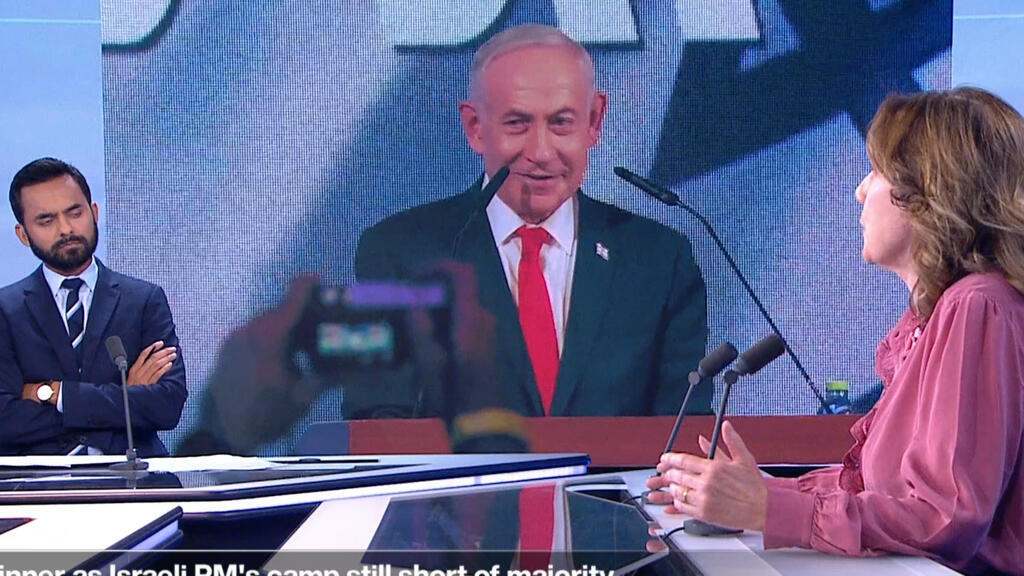
Israel’s election produced a close, inconclusive result despite turnout exceeding 77%, a historically high level. The contest had been widely expected to end in a dramatic deadlock, and neither of the main political camps has secured a clear majority. Prime Minister Benjamin Netanyahu says he wants to form a “strong” right-wing government. His Likud party is projected to be the largest party in the Knesset, Israel’s parliament, but that alone does not guarantee it can assemble a governing majority. Netanyahu’s principal rival, former army chief Gadi Eisenkot, argues that voters chose to end Netanyahu’s time in office. The competing claims underline the uncertainty over who can form the next government and what the result means for Israel’s political future. BBC correspondent Yolande Knell reports from Jerusalem on the unresolved outcome and its implications. The article’s central point is that high participation has not translated into a decisive mandate: negotiations and political alignments will determine whether Netanyahu remains prime minister or an alternative government can be formed.
Entities: Israel, Israeli election, Benjamin Netanyahu, Gadi Eisenkot, Likud • Tone: analytical • Sentiment: neutral • Intent: inform
28-10-2026
Israel’s election has produced no clear winner, leaving the country facing coalition negotiations and the possibility of another election. With 85% of votes counted, Prime Minister Benjamin Netanyahu’s Likud party had 20.8% of the vote, while Gadi Eisenkot’s Yashar party had 16.1%. Local media projections put Likud and its allies at 53 seats, Eisenkot’s bloc at 48, and Arab-led parties at 19—short of the 61 seats needed for a majority in the 120-member Knesset.
Yair Golan, head of Israel’s main left-wing party, urged opposition parties to work with Arab parties to form a government and remove Netanyahu. Netanyahu rejected that possibility, calling instead for a right-wing, nationalist government and warning against relying on Arab parties. Arab parties won more seats than in any previous election, amid increased turnout among Arab citizens, who make up about 20% of Israel’s population. Both political camps had previously ruled out depending on Arab parties, although breaking such election promises is not unprecedented.
Other possible outcomes include defections by lawmakers, a minority government supported or tolerated by Arab parties, or a unity government between the main blocs. If no coalition can be formed, Israel may hold another election, as it did five times between 2019 and 2022.
The vote is the first since Hamas’s October 7, 2023, attacks and takes place while Israel remains engaged in conflicts involving Gaza, Lebanon, and Syria, following direct clashes with Iran. Netanyahu argues that he needs more time to pursue the military campaigns, and U.S. President Donald Trump endorsed him, warning that he might not continue the joint effort against Iran if Netanyahu loses power. Eisenkot, a former military chief and leader of the diverse anti-Netanyahu “change bloc,” presents himself as a unifying figure. The result leaves the prime ministership and the shape of any future government uncertain.
Entities: Benjamin Netanyahu, Gadi Eisenkot, Yair Golan, Likud, Yashar party • Tone: analytical • Sentiment: neutral • Intent: inform
28-10-2026
Israel’s election produced no clear winner, leaving both Prime Minister Benjamin Netanyahu’s bloc and challenger Gadi Eisenkot’s bloc short of an apparent path to a governing majority. Partial vote counts put Netanyahu’s party at 20.8% and Eisenkot’s at 16.4%, while exit polls suggested Arab-led parties could win about 18 seats. Eisenkot declared victory based on preliminary exit-poll results and argued that his bloc should get the first opportunity to form a government, but official results were not expected until November 4. Turnout reached 77.7%, the highest for a Knesset election in 27 years.
Markets reacted negatively to the uncertainty: the shekel fell 2% against the dollar, the Tel Aviv 35 index dropped 2.3%, and government bond yields rose. The election was Israel’s first national vote since Hamas’s October 7, 2023 attack and the wars that followed in Gaza, Lebanon, and Iran. It was widely viewed as a referendum on Netanyahu’s long period in power. His supporters credit his wartime leadership, while critics cite his corruption trial, judicial overhaul efforts, and handling of the Gaza war. Netanyahu also faces an International Criminal Court arrest warrant related to the Gaza campaign, which he rejects.
Arab-led parties may shape coalition negotiations. Their positions appear closer to Eisenkot’s, but he has not committed to including them, and Avigdor Liberman has ruled out relying on them. Analysts say Eisenkot could struggle to form a majority without Arab and left-wing support. Netanyahu may meanwhile use the negotiating period to delay a rival government’s formation and preserve his position. Israel’s history of repeated electoral stalemates makes prolonged negotiations plausible, and commentators caution that it is too early to conclude Netanyahu has been politically defeated.
Entities: Benjamin Netanyahu, Gadi Eisenkot, Mansour Abbas, Ahmad Tibi, Avigdor Liberman • Tone: analytical • Sentiment: neutral • Intent: analyze
28-10-2026
Supporters of Gadi Eisenkot celebrated in Tel Aviv after preliminary exit polls showed Israel’s opposition bloc with a narrow lead over Benjamin Netanyahu’s camp. The projections gave the anti-Netanyahu bloc 52–53 seats, compared with about 50 for Netanyahu’s allies. Neither side was projected to reach the 61 seats needed for a majority in the 120-seat Knesset, leaving the election without a clear winner and making coalition negotiations likely to determine who forms the next government.
Likud was projected to remain the largest single party with 24–25 seats, while Eisenkot’s Yashar party was forecast to take 21–23. Eisenkot declared victory and said the results gave him the first right to form a government. At his rally, supporters chanted slogans calling for Netanyahu to leave and hailing Eisenkot as the next prime minister.
Elsewhere in Tel Aviv, Pink Front activists gathered at Habima Square, waving pink heart flags, entering the reflecting pool and celebrating with sparkling wine as results emerged. Ohad Ben Ami, a former hostage held by Hamas and an honorary candidate on Yashar’s list, attended the party rally. He criticised the government’s handling of negotiations and said the captives had been abandoned.
The article stresses that the projections are preliminary. Despite the opposition bloc’s narrow lead, both camps appear short of a parliamentary majority, and weeks of coalition negotiations are expected before a prime minister is confirmed.
Entities: Gadi Eisenkot, Benjamin Netanyahu, Ohad Ben Ami, Tel Aviv, Israel • Tone: analytical • Sentiment: neutral • Intent: inform
28-10-2026
Benjamin Netanyahu’s political bloc gained ground as votes were counted in Israel’s first national election since the Oct. 7, 2023, Hamas massacre, but the partial results left him short of the seats needed to form a government. With about 70% of votes counted, his right-wing and religious bloc had 54 seats in the 120-seat Knesset, compared with 47 for the main opposition and 19 for Arab parties. Likud led the individual parties with 27 seats, while Gadi Eisenkot’s Yashar party had 20.
The results differed from the initial exit polls, which had prompted celebrations at Eisenkot’s campaign headquarters. Eisenkot urged Netanyahu to accept the results and step aside; Netanyahu emphasized Likud’s position as the largest party and called for a strong right-wing government. Although Netanyahu’s bloc was ahead, parties outside it collectively held 66 seats, potentially giving the opposition a route to power if it can cooperate with Arab lawmakers. The article says the next stage is likely to be a difficult process of coalition-building.
President Donald Trump credited his endorsement with helping Netanyahu perform better than expected. Trump said exit polls were wrong and described the outcome as possibly a stalemate or a win for Netanyahu. His comments echoed a statement he shared on Truth Social arguing that his endorsement had shifted the race’s momentum.
Arab parties are presented as pivotal. The Joint List held 13 seats and Mansour Abbas’s Ra’am held six. Abbas said political figures from both sides had approached him, indicating possible negotiations. Yair Golan, leader of the Democrats, called for a government formed in cooperation with Arab parties and argued that the opposition had a numerical advantage. The supplied article ends mid-sentence while describing Golan’s response, so the remainder of his remarks and the final outcome are not included.
Entities: Benjamin Netanyahu, Donald Trump, Gadi Eisenkot, Mansour Abbas, Yair Golan • Tone: analytical • Sentiment: neutral • Intent: inform
28-10-2026
France 24 reports that Israel’s election results remained uncertain as votes were being counted on Wednesday, October 28, 2026. Turnout was the highest in more than a quarter-century, and the results had not produced a clear winner. The uncertainty left Prime Minister Benjamin Netanyahu and opposition parties seeking to unseat him facing the prospect of weeks of negotiations over forming a government. The report’s description emphasizes the anxious mood among Israelis as the results took shape. France 24 correspondent Noga Tarnopolsky reports from Jerusalem; the supplied article text does not provide further details about seat totals, party positions, or the negotiations themselves. The central point is therefore the inconclusive outcome and the likelihood that government formation would depend on post-election bargaining, rather than an immediate determination of who would govern. The page identifies the item as a video report, issued at 12:32 on October 28, 2026, with a duration of 3 minutes and 49 seconds.
Entities: Israel, Israeli election, Benjamin Netanyahu, Noga Tarnopolsky, Jerusalem • Tone: analytical • Sentiment: neutral • Intent: inform
28-10-2026
The France 24 video report concerns Israel’s election, with votes still being counted on Wednesday, October 28, 2026. The article says exit polls showed no clear winner in what it describes as pivotal elections. It reports that Prime Minister Benjamin Netanyahu’s bloc appeared to have lost a significant number of seats compared with the previous election in 2022. The result was therefore unsettled at the time of publication, and the article does not declare a winner or provide final seat totals.
France 24’s International Affairs Editor, Angela Diffley, provides further insights in the video. The page identifies the report as a 4-minute, 39-second video, issued at 12:56 and modified at 15:32 on October 28. It offers no transcript or additional detail in the supplied text about the parties’ specific results, negotiations, or the reasons for changes in support. Accordingly, the article’s central point is limited to the early picture: Netanyahu’s bloc seemed to have lost ground since 2022, while exit polls had not produced a clear overall winner and vote counting was continuing.
The page’s surrounding links point to other France 24 coverage of the same election, including reports on the lack of a clear winner, Netanyahu’s prospects of forming a government, and gains by Arab parties. Those headlines are related material rather than further reporting contained in this article. Overall, this is a concise video-news item presenting a preliminary election assessment, not a complete account of the final results.
Entities: Israel, Israeli election, Benjamin Netanyahu, Netanyahu’s bloc, Angela Diffley • Tone: analytical • Sentiment: neutral • Intent: inform
28-10-2026
France 24’s video segment examines the uncertainty surrounding the formation of a governing coalition after an Israeli election. Oliver Farry speaks with Tamar Sebok, a correspondent for the Israeli daily Yedioth Ahronoth based in France. The discussion emphasizes that the election’s outcome cannot be judged simply by which party wins the most seats: in Israel’s parliamentary system, the decisive test is whether a leader can secure enough support from other parties to form a viable government.
Sebok describes the disproportionate leverage smaller parties may gain when larger parties need their votes to reach a majority. This creates a paradox in which parties with fewer seats can have greater influence over coalition negotiations than the leading parties themselves. The segment also considers the role of Arab parties. Although politicians may publicly rule out cooperation with them, Sebok cautions against treating such declarations as final. Drawing on the 2021 coalition negotiations, she argues that political positions and boundaries can change when campaigning ends and the practical work of forming a government begins.
The article notes an election marked by political uncertainty, unusually high voter participation and significant mobilisation among Arab voters. It does not identify a definitive winner or claim that a particular coalition has been formed. Instead, its central conclusion is that the possible arrangements remain unsettled: as Sebok puts it, “everything is open.” The segment’s focus is therefore on coalition arithmetic and political flexibility, rather than on seat totals alone. (The headline mentions Orthodox parties, but the supplied segment text does not discuss them in detail.)
Entities: Tamar Sebok, Oliver Farry, Israel, France 24, Yedioth Ahronoth • Tone: analytical • Sentiment: neutral • Intent: analyze
28-10-2026
Partial official results from Israel’s October 2026 parliamentary election showed Prime Minister Benjamin Netanyahu ahead of opposition leader Gadi Eisenkot, but neither side had a clear path to victory. Although Netanyahu’s right-wing bloc was leading as votes were counted, opposition groups collectively had more votes, including a strong showing by two Arab-led parties. Turnout exceeded 77%, its highest level in more than two decades, in the first election since Hamas’s October 7, 2023, attack and the subsequent Gaza war.
The election has exposed divisions over Netanyahu’s leadership, Israel’s security, the war in Gaza, and the country’s international standing. Critics question the government’s handling of warnings before the Hamas attack and point to the devastation and Palestinian deaths in Gaza, as well as strained relations with other governments. Netanyahu’s supporters argue that his military campaigns have improved Israel’s security; some have also expressed a defiant commitment to continuing the fighting.
Forming a government requires a coalition of at least 61 of the Knesset’s 120 members. The Arab-led United Arab List and Joint List could prove pivotal, but both Netanyahu and Eisenkot have been reluctant to partner with them. A member of Eisenkot’s bloc has urged cooperation, while mistrust of Arab political leaders has grown since the 2023 attack. Officials expected to finish counting, including soldiers’ ballots, by Thursday afternoon. The leading candidate would then have six weeks to assemble a coalition. If neither bloc succeeds, Netanyahu could remain caretaker prime minister and a new election could be held next year.
Entities: Benjamin Netanyahu, Gadi Eisenkot, Yashar party, Likud party, United Arab List (Raam) • Tone: analytical • Sentiment: neutral • Intent: inform
28-10-2026
With 70.7% of ballots counted, Benjamin Netanyahu’s Likud party was leading Israel’s parliamentary election and was projected to win 27 seats. The count remained far from settled, however, after early election-night projections from three major Israeli television networks put Netanyahu’s right-wing coalition at only 50 seats in the 120-member Knesset—11 short of the majority required to form a government. Those initial projections gave the opposition 52 or 53 seats, while Arab parties were expected to win another 17 or 18, potentially making them pivotal in coalition talks.
Officials were still processing hundreds of thousands of special ballots, including votes cast by soldiers and people away from their assigned polling stations. At the Central Elections Committee’s control center in the Knesset, operations desk head Rotem Kalero described unexpectedly long lines, with some voters reportedly waiting two and a half hours. She said the lines reflected strong voter participation, and officials added voting positions at some polling stations to address overcrowding.
The committee also investigated an allegation that a voter had been given an envelope that already contained a ballot. Kalero said officials determined the claim was false. She described the center’s role as overseeing the election and providing transparency by collecting information from polling stations across the country.
Because neither political camp was assured of the 61 seats needed to govern, the final results could lead to difficult coalition negotiations or another election. The outcome could have major consequences for Netanyahu’s political future.
Entities: Benjamin Netanyahu, Likud, Gadi Eisenkot, Israel, Jerusalem • Tone: analytical • Sentiment: neutral • Intent: inform
28-10-2026
Benjamin Netanyahu’s coalition was leading Israel’s election count with 53 seats, compared with 49 for Gadi Eisenkot’s Change bloc, after more than 90% of votes had been counted. Neither side was near the 61 seats needed for a parliamentary majority, and Arab parties were projected to hold a 17-seat bloc. The result left open the possibility of weeks of negotiations or another election, despite Netanyahu’s apparent recovery from exit polls that had shown him trailing.
The article argues that Netanyahu’s political position could make renewed Israeli-US military action against Iran more likely. Iran specialist Beni Sabti says Tehran fears Netanyahu because he has openly advocated attacking Iran again. Netanyahu has made regime change a strategic goal, while Eisenkot agrees that Iran must not acquire nuclear weapons but considers overthrowing its government unrealistic. Another expert, Yossi Mansharof, says the difference between the candidates’ positions makes the identity of Israel’s leader consequential.
The report cites a Wall Street Journal account that the Trump administration told Sunni Gulf countries the US military would resume its war against Iran after the American midterms. It also notes that the US sent a Patriot air-defense system from Texas to Israel. Before the Israeli election, a senior Israeli defense official warned that conflict could recur as long as Iran’s current government remained in power, potentially every year or more often.
The article describes two earlier stages of the conflict: a 12-day US-Israeli campaign against Iranian nuclear facilities in June 2025, and major strikes in late February that reportedly damaged Iran’s navy and missile bases. It also says US economic pressure is worsening Iran’s predicament. Netanyahu’s supporters believe he is better equipped to confront Tehran; the article suggests an Eisenkot-led government might instead seek a nuclear agreement involving concessions and economic benefits for Iran.
Entities: Benjamin Netanyahu, Gadi Eisenkot, Beni Sabti, Yossi Mansharof, Hallel Rosenberg • Tone: analytical • Sentiment: negative • Intent: analyze
28-10-2026
The live-election update reports that vote counting in Israel is nearing completion, but the partial results described in the supplied text do not show a clear path to a governing majority. The Netanyahu-led bloc is reported at 53 seats, while Arab parties are projected to hold 19. Because a majority in the 120-seat Knesset requires 61 seats, coalition negotiations and the willingness of parties to work together are central to what happens next.
President Isaac Herzog urges the parties to avoid another election, underscoring the risk of continued political deadlock. The Joint List says parties seeking to remove Benjamin Netanyahu from power must engage with the Arab faction. Separately, Golan urges the change bloc to form a government with Arab parties. The update also says Donald Trump claimed credit for Netanyahu’s lead in the polls.
The supplied page content consists primarily of these short live-update points, alongside video headlines about voter views, Arab parties’ projected gains, turnout, exit polls and coalition negotiations. It does not provide detailed vote totals by party, a final result, or a full account of the leaders’ statements. Accordingly, the central picture is an unsettled election in which neither the reported bloc position nor the partial results establish who can command the Knesset. The article’s practical focus is the looming coalition arithmetic and the possibility that parties may need to cooperate across political lines to form a government and avoid another election.
Entities: Isaac Herzog, Benjamin Netanyahu, Donald Trump, Golan, Joint List • Tone: analytical • Sentiment: neutral • Intent: inform
28-10-2026
The article examines the record performance of Palestinian-Israeli parties in Israel’s 2026 general election. With most votes counted, the Arab Joint List—made up of Hadash, Ta’al and Balad—and Mansour Abbas’s Ra’am party together secured 18 of the Knesset’s 120 seats, surpassing the previous record of 15 seats set in 2020. The result comes amid a close contest between Benjamin Netanyahu’s Likud and Gadi Eisenkot’s Yashar, with neither expected to form a government without coalition negotiations.
The article outlines the parties’ different positions. Hadash is a left-wing Arab-Jewish party; Ta’al is secular, nationalist and anti-Zionist, and supports a two-state solution; Balad is secular and further to the left, advocating a one-state arrangement. Ra’am is a religious Muslim party that runs separately. Its leader, Mansour Abbas, made history in 2021 as the first Palestinian-Israeli to serve as a minister in a government coalition, though the article notes that his pragmatic focus on local issues has drawn criticism from some Palestinians.
Analysts attribute the high Arab turnout to a sense of existential threat amid increased violence, incitement and persecution of Palestinian citizens of Israel since October 2023. Voter mobilisation included appeals from elders and Palestinians in Gaza and the occupied West Bank. The article argues that, even if Arab parties do not become coalition kingmakers, their seats may make it harder for Netanyahu to reach the 61-seat majority required to govern. This could push him toward a unity government with opposition members and potentially keep far-right politicians Itamar Ben-Gvir and Bezalel Smotrich out of cabinet. If confirmed, the result would make Arab representation in the Knesset more proportionate to the community’s roughly 20 per cent share of Israeli society.
Entities: Arab Joint List, Hadash, Ta’al, Balad, Ra’am • Tone: analytical • Sentiment: neutral • Intent: inform
28-10-2026
Israeli voters turned out in record numbers for the country’s first general election since the Hamas-led attacks of October 7, 2023. The vote was framed as a wartime judgment on Prime Minister Benjamin Netanyahu, whose government has since faced criticism over the security failures preceding the attacks, its conduct of wars involving Gaza, Lebanon and Iran, and policies that have deepened Israel’s international isolation. The Central Elections Committee reported that 66.7% of eligible voters had cast ballots within the first nine hours, a record pace with six hours of voting still remaining.
Netanyahu, Israel’s longest-serving leader, urged supporters to vote, arguing that turnout was high among his opponents and Arab Israelis. His principal challenger, former military chief Gadi Eisenkot, sought support from right- and centre-wing parties and the weakened left. Polls indicated a close contest, while Israel’s fragmented parliamentary system could make it difficult for either side to form a government. If no coalition can be formed, Netanyahu could remain caretaker prime minister pending another election.
For many opponents, the election centred on accountability for October 7. Eisenkot promised a new direction and said his government would seek to dismantle Hamas’s military and governing power in Gaza within 18 months. Opposition groups also pledged a national inquiry into the security failures, something Netanyahu’s government has resisted. Arab Israeli participation was described as potentially decisive, though Eisenkot ruled out a formal partnership with Arab parties; some scenarios could still see them support a minority government. Netanyahu has previously portrayed Arab Israeli voters as a threat, language critics have called racist.
The article also notes that Eisenkot, like nearly all major Jewish party leaders, opposes a two-state solution, while criticizing settler violence in the occupied West Bank and opposing Netanyahu’s far-right coalition partners. The election therefore combines questions of security, wartime leadership, accountability and coalition-building.
Entities: Benjamin Netanyahu, Gadi Eisenkot, Ruth Epstein, Ahmed Tibi, Israel • Tone: analytical • Sentiment: neutral • Intent: inform
28-10-2026
Vote counting is underway after Israel’s October 27 parliamentary election. Early indications suggest that Prime Minister Benjamin Netanyahu’s Likud-led bloc may emerge as the largest grouping in the 120-seat Knesset, but neither it nor the opposition alliance led by Yashar chief and former army chief Gadi Eisenkot is expected to win a clear majority. The outcome therefore depends on the final count and subsequent coalition negotiations, which could take weeks; if no government can be formed, Israel may hold another election.
The Central Election Committee was still counting ballots on Wednesday, including hundreds of thousands cast by soldiers and diplomats voting abroad. Television exit polls offer an initial picture of party strength but cannot reliably establish the final seat distribution. The count was expected to conclude by October 30, with official results due to be published on November 4.
Israel’s proportional representation system adds uncertainty: Knesset seats are allocated according to each party’s share of the national vote, and parties must reach a 3.25% threshold to win seats. Because roughly a dozen parties are competing to cross that threshold, the number that qualify will affect how seats are distributed.
After the results are finalized, President Isaac Herzog will consult party leaders and ask the candidate he considers most likely to form a government to try. That nominee has up to 42 days. No party has ever won an outright Knesset majority, so governments are built through coalitions, where smaller parties can be pivotal. If the first nominee fails, another candidate may get an opportunity. If all efforts fail, another election could follow, while the incumbent cabinet remains in place as a caretaker government.
Entities: Israel, October 27 parliamentary elections, Benjamin Netanyahu, Likud-led bloc, Knesset • Tone: analytical • Sentiment: neutral • Intent: inform
28-10-2026
Israel’s currency and stock market weakened after an inconclusive election left the makeup of the next government uncertain. On Wednesday, the shekel fell about 2 per cent against the US dollar—its steepest intraday drop in two weeks—while the Tel Aviv stock index declined about 3 per cent. Bank Hapoalim shares fell around 4 per cent and Phoenix Financial lost more than 5 per cent.
The article argues that the economic consequences will depend significantly on which parties form a government. Naser Mufrej, a professor at the Arab American University in Ramallah, warns that a Benjamin Netanyahu-led coalition with right-wing parties could increase uncertainty, weaken the shekel and economic growth, discourage investment in high technology, and prompt skilled workers to leave. He also points to the risk of boycotts and international isolation reducing exports and foreign capital, and says a lower credit rating could increase financing costs. By contrast, an opposition-led government supported by Arab parties could restore investor confidence, strengthen the currency and stock market, lower inflation, and encourage foreign investment and trade.
Vijay Valecha of Century Financial says the new government will need a comprehensive economic emergency plan. Israel faces the effects of more than three years of war, including structural damage, a high deficit, rising defence spending and a high cost of living. Public debt is approaching 70 per cent of GDP, while annual defence needs are estimated at about 200 billion shekels. Nevertheless, Valecha describes the economy as diversified and resilient, with strong external finances.
Capital Economics says the election may have limited impact on near-term growth and fiscal conditions but could matter considerably over the medium term. The IMF’s July 2026 forecast projected growth of 3.5 per cent in 2026 and 4.4 per cent in 2027, assuming regional ceasefires largely hold. It also warned that geopolitical uncertainty, defence spending and labour shortages would hinder recovery. Ultimately, investors will watch whether the next government can reduce uncertainty and rebuild international economic ties, determining whether market losses persist or reverse.
Entities: Israel, Benjamin Netanyahu, Naser Mufrej, Arab American University in Ramallah, Vijay Valecha • Tone: analytical • Sentiment: negative • Intent: inform
28-10-2026
The France 24 program Perspective features a segment about the results of an election in Israel. The article description presents the vote as pivotal but does not provide vote totals, seat counts, party-by-party results, or details about possible coalition arrangements. Instead, it previews an interview offering expert analysis of the outcome. The guest is Yossi Mekelberg, identified as a senior consulting fellow in Chatham House’s Middle East and North Africa Programme. Mekelberg’s central assessment, as quoted in the description, is that there is “no clear winner” from the election. The segment is presented by Charles Pellegrin and was issued on October 28, 2026. The available page text does not include a transcript or further explanation of Mekelberg’s reasoning, so it cannot establish which parties or leaders gained or lost, or what the result might mean for government formation. A notice that the requested content may no longer be available appears after the article description; it is website messaging rather than substantive election coverage. Overall, the item is a short program preview directing viewers to an expert discussion, not a detailed report of the election or its consequences.
Entities: Israel, Israeli election, Yossi Mekelberg, Charles Pellegrin, Chatham House • Tone: analytical • Sentiment: neutral • Intent: analyze
28-10-2026
The live update reports on the political, military and economic consequences of the Iran war, with particular attention to Israel’s election and escalating fighting in Yemen. Exit polls from Israel’s Tuesday election indicate that a majority voted against Prime Minister Benjamin Netanyahu’s coalition, although his Likud party remained the largest. Neither Netanyahu’s bloc nor the opposition appears to have a clear majority in the 120-seat Knesset, making coalition formation difficult. Arab parties achieved an unprecedented number of seats amid historically high turnout among Arab citizens, though both major political camps have ruled out relying on them to form a government.
The U.S. military’s estimated cost of the war reached $47.1 billion by mid-October, according to an estimate from Central Command obtained by CBS News. Replacing expended munitions accounts for about $29 billion; the estimate excludes damage to U.S. bases in the region. A Congressional Budget Office report had estimated the conflict could cost $2 billion to $3 billion monthly while it continues. Oil prices dipped slightly, with Brent crude near $113 a barrel, following diplomatic talks involving Saudi Arabia, Turkey and Pakistan aimed at preventing renewed escalation.
The article also describes renewed clashes in Yemen between Iran-backed Houthi forces and Saudi-backed government troops. Military sources reported 97 combatant deaths, mostly near the strategically important Bab el-Mandeb Strait. Saudi airstrikes and ground fighting followed a Houthi territorial advance, while a government counteroffensive backed by Saudi Arabia had made limited progress. The conflict has caused severe devastation and a major humanitarian crisis.
Separately, International Atomic Energy Agency chief Rafael Grossi urged Iran to grant inspectors access to nuclear materials and facilities. The agency has lacked access to key sites since U.S. and Israeli strikes in 2025. Finally, Russian President Vladimir Putin and Iranian President Masoud Pezeshkian discussed broader cooperation, including oil and gas projects, as Iran faces a U.S. blockade on its ports.
Entities: Iran war, Israel's 2026 national election, Benjamin Netanyahu, Likud, Knesset • Tone: analytical • Sentiment: negative • Intent: inform