28-10-2026
The live-update article reports developments in the Iran war and related regional tensions. A senior Iranian official rejected reports that Qatar had delivered a new peace proposal to Tehran, saying the ideas were “unacceptable.” The article also notes that Israeli exit polls showed Prime Minister Benjamin Netanyahu’s coalition facing opposition in a closely contested election, and that the war had cost the U.S. military at least $47.1 billion by mid-October, according to a U.S. Central Command estimate obtained by CBS News.
Other updates describe Iran’s plans to finalize a protocol with Russia for joint development of small modular nuclear reactors. Iranian official Behrouz Kamalvandi said the cooperation would support reactor construction and argued that nuclear energy could meet rising electricity demand while limiting emissions. Iran’s foreign minister, Abbas Araghchi, warned that an Israeli-instigated attack in the Persian Gulf could have a devastating effect on international markets. Separately, Iran’s embassy in Kuwait denied Kuwaiti allegations that an Iranian citizen was involved in an assassination plot, while Kuwaiti courts sentenced three men to death and imposed prison terms on eight others in connection with alleged espionage and hostile activity.
The updates also report escalating violence involving Yemen’s Houthis. The group blamed Saudi Arabia for strikes in Jawf that it said killed 14 people and wounded 10, and claimed a missile landed within Aden airport’s perimeter. The Houthis called for the airport to be evacuated, alleging that a Saudi military cargo aircraft was carrying weapons. Finally, The Wall Street Journal reported that the U.S. had advised Gulf allies to prepare for a brief, intense campaign against Iran after the midterm elections. The report cited military preparations, including air-defense deployments, troop movements, replenished munitions, and additional naval and Marine forces in the region.
Entities: Iran, Qatar, Russia, United States Central Command, Benjamin Netanyahu • Tone: analytical • Sentiment: negative • Intent: inform
28-10-2026
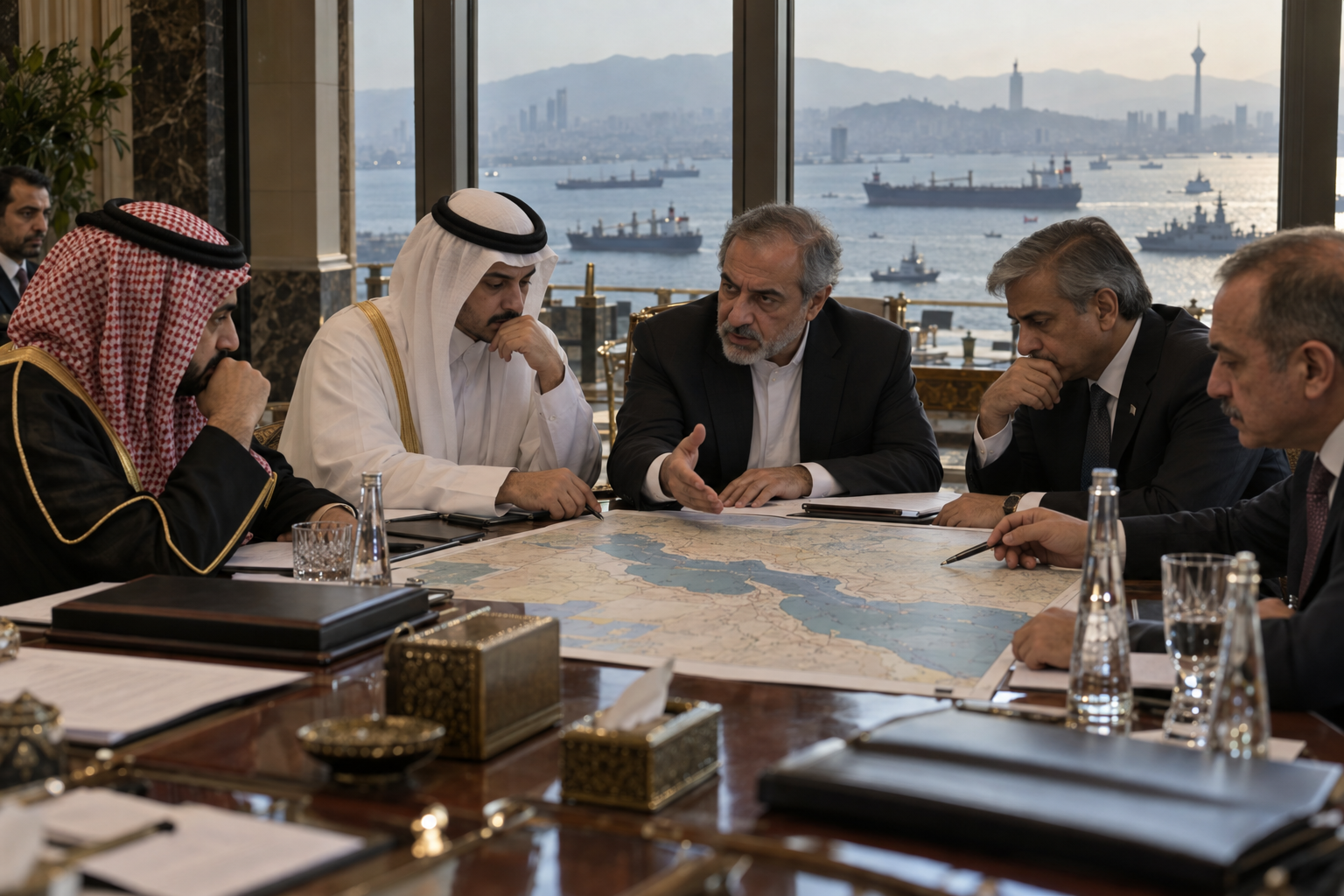
A coordinated visit to Tehran by senior officials from Pakistan, Saudi Arabia and Turkey has highlighted the uncertain role of the newly formed Mecca defense pact as fears grow of renewed US and Israeli attacks on Iran. The envoys met President Masoud Pezeshkian and other Iranian leaders, reportedly discussing a regional non-aggression network, US-Iran negotiations, Houthi attacks on Saudi Arabia, the Strait of Hormuz and the US naval blockade. Pakistan may have presented a proposal intended to give both Washington and Tehran something they could accept, with the Mecca states and Qatar acting as mediators. The talks produced no announced breakthrough, but Iranian officials described their atmosphere as positive and portrayed the contacts as evidence that Iran remains diplomatically engaged rather than isolated.
The visit also demonstrated the alliance’s coordination and potential deterrent capacity. Its members’ agreement treats an attack on one as an attack on all, while Saudi Arabia is increasingly concerned about Houthi attacks on its infrastructure. Analysts quoted by DW stress, however, that the pact is primarily defensive and does not mean its members intend to fight Iran. Saudi Arabia has strong economic reasons to avoid a wider conflict, Pakistan has an established mediation role and security concerns involving India, and Turkey’s choice to send its intelligence chief rather than a foreign or defense minister suggests caution.
Iran, meanwhile, is pursuing diplomacy while preparing for possible fighting. An adviser to Pezeshkian rejected the idea that the visit amounted to an ultimatum, arguing that negotiations remain possible if Iran’s political standing and national dignity are respected. Analyst Babak Dorbeiki says Tehran may be prolonging talks without making concrete commitments, particularly regarding Houthi attacks. Iran could seek concessions, including reduced US military pressure, in exchange for using its influence. The meeting’s clearest result was keeping dialogue open; whether that leads to de-escalation or changes if tensions rise remains uncertain.
Entities: Masoud Pezeshkian, Asim Munir, Khalid bin Salman, Ibrahim Kalin, Donald Trump • Tone: analytical • Sentiment: neutral • Intent: analyze
28-10-2026
Iran has signalled that it is open to negotiations after Qatar reportedly presented Tehran with a draft agreement intended to end the conflict with the United States. An official briefed on the talks said the proposal was delivered on Sunday and sets out a seven-day schedule of daily confidence-building measures addressing concerns on both sides. Iran was considering the draft and expected to respond by the end of the week; several countries could act as guarantors. An Iranian official told The National that Tehran welcomes negotiations and described recent regional discussions as a step in the right direction, although Iran had not publicly commented on the draft itself.
The report comes after a delegation from Saudi Arabia, Pakistan and Turkey visited Tehran. Led by Saudi Defence Minister Prince Khalid bin Salman, the delegation discussed Houthi attacks on Saudi Arabia and the Strait of Hormuz. Regional sources said the visit produced no clear breakthrough. The visitors reportedly asked Iran to use its influence to stop Houthi attacks, but Tehran said it lacked leverage over the group. Iran instead urged the delegations to persuade Washington to accept a two-week pause in hostilities, in exchange for gradual reopening of the Strait of Hormuz and a resumption of negotiations.
Separately, US Naval Forces Central Command advised vessels without an operational need to travel between the Gulf of Oman and the Strait of Hormuz to avoid the area. It cited increased traffic and military blockade enforcement, while advising ships that do transit to allow extra time. The reason for the notice was unclear. The article also reports that Yemen’s Houthis called for the immediate evacuation of Aden airport, where the internationally recognised government is based. Overall, the article describes diplomatic efforts alongside heightened regional security risks, without reporting a confirmed agreement or breakthrough.
Entities: Iran, Qatar, United States, Saudi Arabia, Pakistan • Tone: analytical • Sentiment: neutral • Intent: inform
28-10-2026
The supplied page is a live-news landing page titled “Middle East latest: US warns Gulf allies of possible renewal of Iran war, report says.” Its central headline reports that the United States has warned Gulf allies about the possibility that the Iran war could resume. The page does not include the underlying report, identify its sources, or provide details about what prompted the warning, so those aspects cannot be assessed from the supplied text.
Other listed updates depict a tense regional situation alongside diplomatic activity. They say a Saudi-led coalition intercepted a ballistic missile launched by the Houthis towards Taif, while debris from the interception of two Houthi missiles caused damage in the Saudi capital. The Houthis also claimed an attack on a Saudi airport. Separately, a UN envoy said the US and its allies would never allow Iran to develop nuclear weapons, and Iranian President Masoud Pezeshkian was reported to have met Russian President Vladimir Putin in Moscow.
The page also promotes related video coverage on Gulf diplomacy, the risk of further US-Israeli military escalation, Houthi weapons and attacks, and regional responses. These are teasers rather than full reports, and the supplied material gives no additional evidence or context for their claims. Overall, the page presents a fast-moving mix of security developments, statements about Iran’s nuclear programme, and diplomatic efforts amid heightened Gulf tensions. Because only the headline and a list of updates are provided, this summary reflects those brief items and should not be taken as a detailed account of the reported warning or the broader conflict.
Entities: United States, Iran, Gulf allies, Houthis, Saudi-led coalition • Tone: analytical • Sentiment: neutral • Intent: inform
28-10-2026
The available page extract identifies a live Middle East news article published by The National, updated on October 28, 2026, at 2:22 PM. Its headline reports that Yemen said the Houthis attacked Aden airport twice using ballistic missiles. The supplied text does not include the article’s full report, details about the alleged attacks, or independent confirmation, so it is not possible to establish from this extract when the attacks occurred, whether they caused damage or casualties, or what responses followed.
The page also displays a set of other regional headlines and video items, indicating a broader focus on military tensions, maritime security, and diplomatic efforts. These include a US military advisory for vessels to avoid the Gulf of Oman and Strait of Hormuz; remarks by UAE official Anwar Gargash supporting dialogue; reports of negotiations involving Iran and a draft deal mediated by Qatar; and diplomatic discussions between Egypt and Saudi Arabia. Other listed items concern nuclear inspectors’ findings, Houthi weapons, and possible further US-Israeli escalation. These are separate headlines or teasers, not substantiated details within the visible report about Aden airport.
Because the extract consists mainly of a headline, update time, and related-content listings surrounded by website navigation and sharing controls, the article’s full substance cannot be summarized reliably. The visible headline presents a reported attack in the context of wider regional uncertainty, while the accompanying items point to parallel diplomatic and security developments. The page’s apparent purpose is to provide a live-news update, but the supplied material is insufficient to assess the report’s evidence or conclusions.
Entities: The National, Yemen, Houthis, Aden airport, ballistic missiles • Tone: neutral • Sentiment: neutral • Intent: inform