31-08-2026
Algerian President Abdelmadjid Tebboune has ordered legal changes that would allow the death penalty for people convicted of deliberately setting forest fires. The directive follows a recent wave of wildfires in several eastern provinces that killed 12 people and caused extensive damage to homes and public infrastructure.
During a high-level meeting on the government’s response, attended by senior civilian and military officials, Tebboune instructed the justice minister to submit an amendment to the penal code by September 15. The proposed amendment would introduce capital punishment for anyone found to have intentionally set fire to forested areas. Any death sentence would be subject to all legal appeals before it could be carried out.
Algeria’s criminal code already includes the death penalty for several offenses, but the country has maintained a de facto moratorium on executions since 1993. Under the current law, deliberately starting forest fires can lead to a prison sentence of up to 30 years, or life imprisonment in certain circumstances.
Tebboune also directed provincial governors to provide security authorities with all available information about the fires. He cited videos showing several blazes beginning at approximately 1 a.m. as a reason to investigate whether some fires were intentionally started.
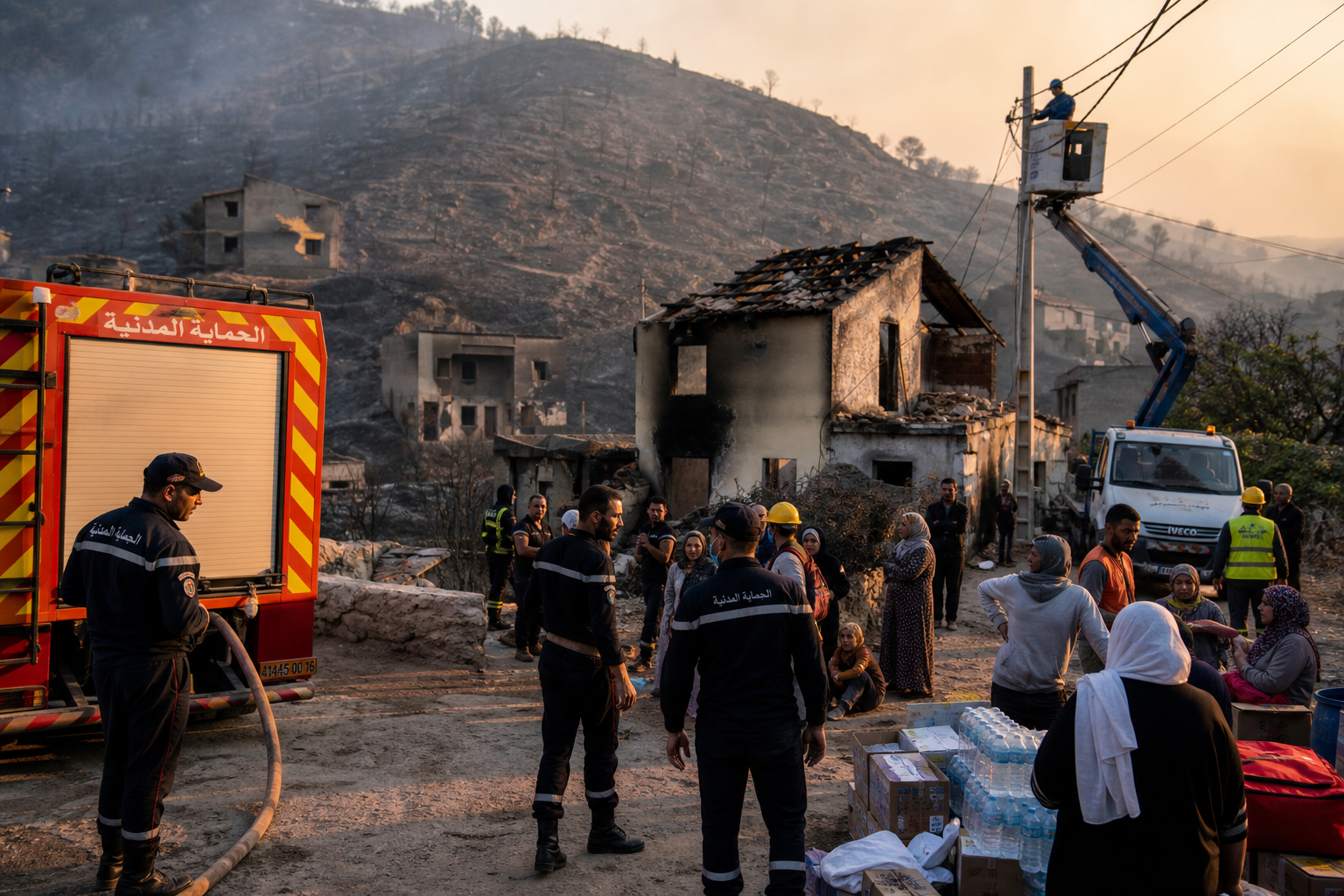
In addition to the proposed legal response, the president ordered immediate assistance for affected families. Committees will assess damage and determine compensation for destroyed or damaged property. Authorities were instructed to restore electricity, gas, water and telecommunications services by the following Saturday, while the housing minister was told to coordinate repairs to damaged homes with construction companies. Tebboune said normal life should resume in affected areas within a week. Algeria’s Interior Ministry confirmed that 12 people had died in the latest wave of wildfires, according to local media.
Entities: Algeria, Abdelmadjid Tebboune, Algeria’s Justice Ministry, Algeria’s Interior Ministry, Algerian penal code • Tone: urgent • Sentiment: negative • Intent: inform
31-08-2026
Algerian President Abdelmadjid Tebboune has ordered the Justice Ministry to draft amendments that would allow the death penalty for people convicted of deliberately starting forest fires. He set 15 September as the deadline for the proposed changes. Algeria’s penal code already allows capital punishment for some offences, but the country has not carried out an execution since 1993. Under the current law, intentionally starting a forest fire can result in up to 30 years in prison or, in certain circumstances, life imprisonment.
The announcement follows a wave of more than 100 wildfires in north-eastern Algeria, which have killed at least 12 people, injured dozens, displaced thousands and caused extensive damage. Most of the fires had been extinguished, although civil authorities were still responding to some blazes. The Algerian Press Service reported that 18 of the 19 fires recorded during a 24-hour period had been put out by Sunday afternoon.
Tebboune has not ruled out arson or other deliberate causes, saying investigations would be necessary because of the intensity of the fires. He also ordered compensation for affected families and repairs to damaged homes and essential services, alongside investigations into the total losses.
The fires occurred during an intense heatwave affecting North Africa, particularly Algeria and Tunisia. Although forest fires are common in Algeria during the summer, climate change has increased the intensity and severity of recent outbreaks. The proposed death penalty represents a significant escalation in the government’s response, while the investigations will determine whether the fires were intentionally started or were primarily driven by extreme weather conditions.
Entities: Abdelmadjid Tebboune, Algeria, Algerian Justice Ministry, Algerian Press Service, Northern and north-eastern Algeria • Tone: urgent • Sentiment: negative • Intent: inform
31-08-2026
Algerian President Abdelmadjid Tebboune is seeking to reinstate the death penalty for people convicted of deliberately starting fires, following a deadly wildfire outbreak in the country’s northeast. He has ordered an amendment to the Criminal Code by 15 September, despite Algeria’s moratorium on executions, which has been in place since 1993.
Tebboune also declared three days of national mourning after the fires killed at least 12 people and injured dozens. Interior Minister Saïd Sayoud said five people died in Jijel province, four in Béjaïa and three in Tizi Ouzou. Fifty-four people were being treated in hospital for burns, including six in critical condition.
Algeria’s civil protection agency reported that 46 fires remained active on Thursday morning, out of 193 recorded during the preceding 24 hours. Unverified videos circulating online showed extensive fires trapping residents in their homes. The national gendarmerie closed three major highways connecting eastern regions because of fires near Béjaïa, Jijel and Sétif.
The president described the deaths as “a great tragedy,” while authorities continued emergency operations and maintained the official casualty figures. Summer forest fires are common in northern Algeria, but increasingly frequent droughts and extreme heat are intensifying their spread and severity. The country experienced another major disaster in July 2023, when fires near Béjaïa destroyed hundreds of homes, burned thousands of hectares of forest and farmland, and killed more than 30 people. Authorities also recorded nearly 2,000 fires nationwide in July 2026 alone. The article links the proposed legal change to concerns over arson while placing the current crisis within a broader pattern of worsening wildfire conditions.
Entities: Abdelmadjid Tebboune, Saïd Sayoud, Algeria, Jijel province, Béjaïa • Tone: urgent • Sentiment: negative • Intent: inform