29-10-2026
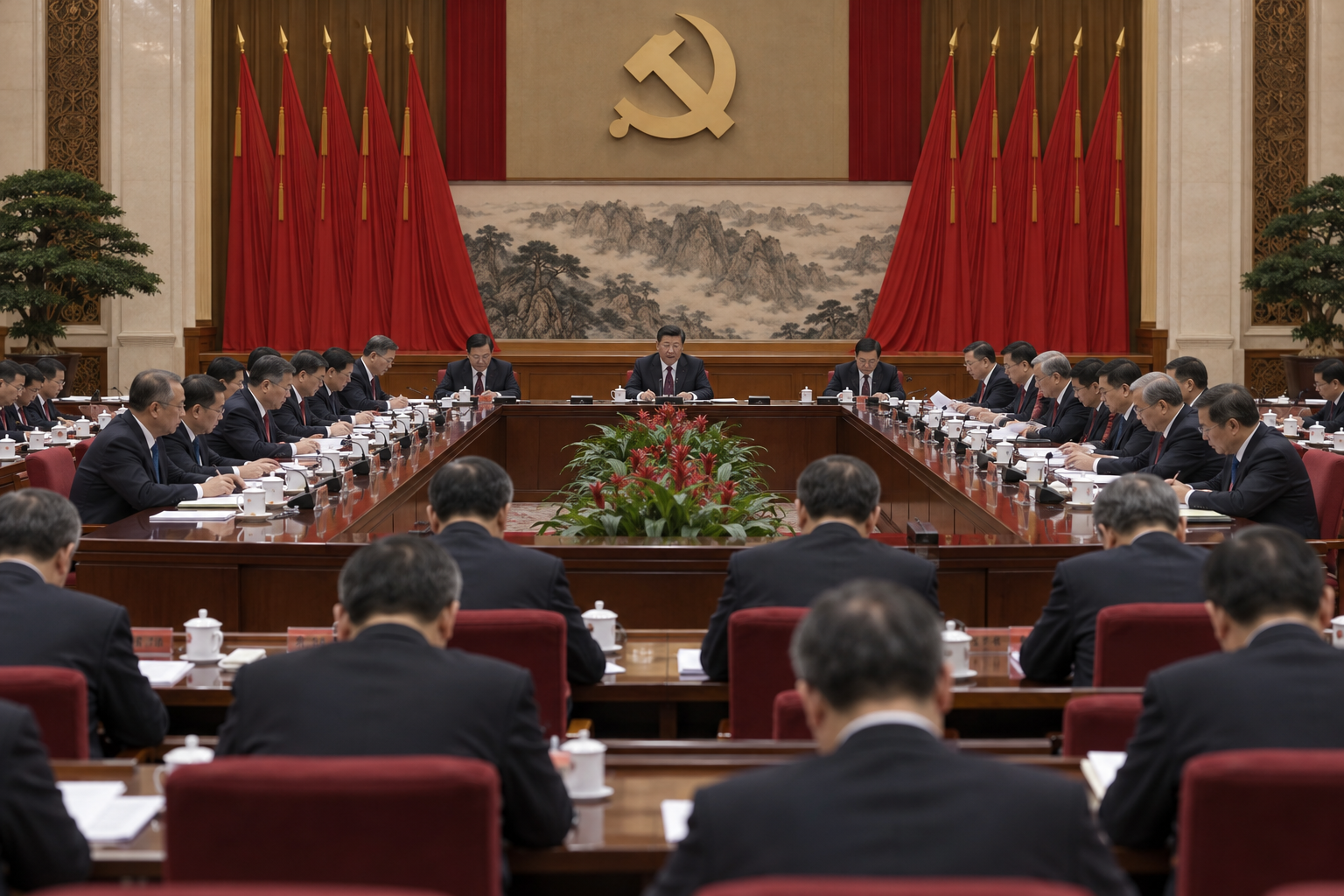
China’s Communist Party expelled a record 33 Central Committee members during its fifth plenum, a four-day closed-door gathering in Beijing that also had the lowest attendance of any plenum under Xi Jinping. Only 279 members attended, down from 315 at the 2025 gathering and 364 in 2024. Sixteen of those expelled were from the military. The party cited “serious disciplinary and legal violations,” without specifying charges, while observers say Xi’s anti-corruption campaign increasingly serves to consolidate authority and enforce political loyalty, not just combat graft.
The expulsions bring the number of members removed during Xi’s third term to 51, compared with 35 in his first term and five in his second. Separately, 680,000 people across the party apparatus were disciplined in the first nine months of the year. Major figures removed include former Xinjiang party chief Ma Xingrui, former generals Zhang Youxia and Liu Zhenli, and diplomat Liu Jianchao. The purge of senior military leaders has raised questions about the armed forces’ leadership and readiness. The Central Military Commission, which controls the military, has been reduced to Xi and vice-chairman Zhang Shengmin.
Analysts interpret the heightened emphasis on party discipline as a focus on loyalty ahead of the 2027 Party Congress, when a leadership reshuffle is expected. Many expect Xi to seek a fourth term, a tenure that would exceed that of any Chinese leader other than Mao Zedong. Observers say Xi is likely to shape the selection of the next generation of leaders and remain at the centre of the party for the foreseeable future. However, one analyst warns that concentrating power around Xi could create a more serious succession-related power vacuum as he ages.
Entities: Xi Jinping, Chinese Communist Party (CCP), Fifth Plenum, Central Committee, Anti-corruption campaign • Tone: analytical • Sentiment: negative • Intent: analyze
29-10-2026
A four-day closed-door meeting of China’s top Communist Party leadership focused on party discipline, corruption and governance. Xi Jinping, who leads both the state and the Chinese Communist Party (CCP), is seeking to deepen the anti-corruption campaign while requiring officials to show greater loyalty and initiative. A party statement praised Xi’s leadership and called for comprehensive, strict party governance.
Analysts say the policy reflects the leadership’s concern about instability amid international tensions and domestic economic difficulties. Kerry Brown of King’s College London argues that Xi sees party unity and discipline as essential to the CCP’s survival. Xi has also called for removing “two-faced” officials who publicly profess loyalty but pursue their own goals or fail to act when problems arise.
The push creates a tension: officials are expected to act decisively, but tighter central control may discourage independent judgment. Brown warns that encouraging initiative could weaken oversight and create opportunities for corruption, while intensifying discipline could suppress initiative across the party and potentially affect the military. Chong Ja Ian of the National University of Singapore says the initiative Xi wants is limited: officials may act proactively to carry out assigned tasks, but are not expected to question the leadership’s agenda. Brown says Xi appears willing to trade some operational flexibility for greater control and stability, an approach he describes as working for now despite China’s economic challenges.
Succession is another source of concern. Xi is expected to remain party general secretary for years, potentially until 2032, following the 2018 removal of term limits. Brown says a future succession debate could divide the party. Chong notes the dilemma: naming a successor could undermine Xi’s authority, while failing to prepare one could create a destabilizing power vacuum. The article portrays Xi as firmly in control while highlighting the risks inherent in maintaining that control and managing an eventual transition.
Entities: Xi Jinping, Chinese Communist Party (CCP), Beijing, Kerry Brown, Lau China Institute • Tone: analytical • Sentiment: neutral • Intent: analyze
29-10-2026
China’s Communist Party has elevated Gen. Zhang Shengmin, vice chairman of the Central Military Commission (CMC), to the Politburo, the party’s top governing body. Zhang is the commission’s only remaining member besides President Xi Jinping, after Xi purged two senior generals. His appointment also means the Politburo again has a military representative, after previously having none from the People’s Liberation Army. Zhang additionally oversees internal discipline in the military as deputy secretary of the CMC Commission for Discipline Inspection.
The appointment and a resolution on party self-governance were announced after a four-day, closed-door meeting of top party leaders. The resolution calls for stronger discipline, anti-corruption efforts, ideological purity, and closer ties with the public. The party described its responsibilities—including safeguarding China’s sovereignty, security, and development interests—as increasingly arduous. The meeting took place about a year before Xi is widely expected to secure a fourth five-year term as party leader.
Xi has made anti-corruption a prominent priority since taking power in 2012, and the campaign has continued for more than a decade. Analysts say the current focus also encompasses officials judged to be underperforming. At the meeting, party members reviewed and confirmed earlier purges of senior party members and military officials. Neil Thomas, a senior fellow at Asia Policy who studies Chinese politics, said the scale of removals was wider than expected. He calculated that attendance at the meeting was 74%, the lowest since the era of Mao Zedong, who regularly conducted political purges.
Entities: Xi Jinping, Zhang Shengmin, Mao Zedong, Neil Thomas, Communist Party of China • Tone: analytical • Sentiment: neutral • Intent: inform