29-10-2026
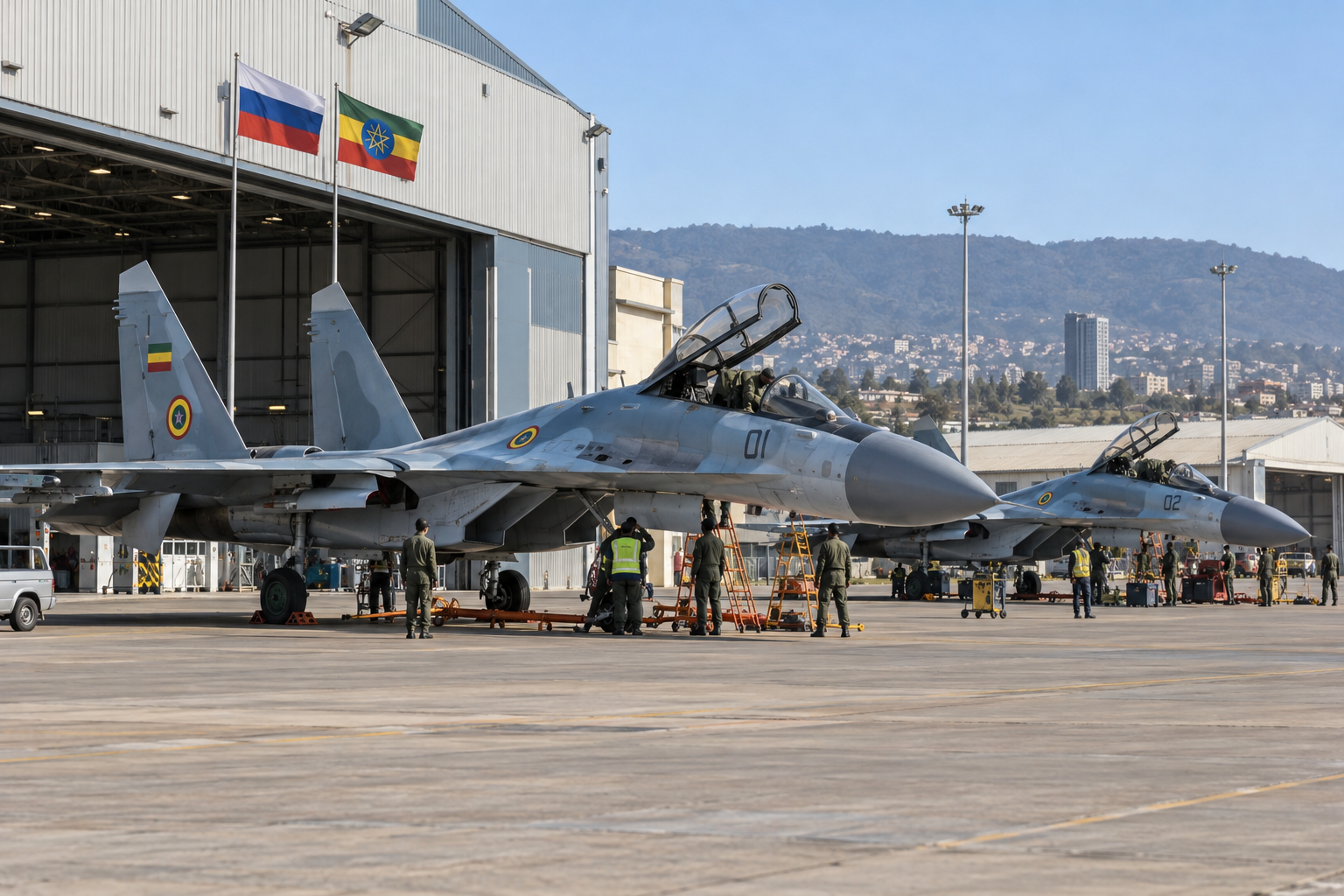
Ethiopia has received 12 Russian Su-35 fighter jets and agreed to acquire four S-400 air-defence batteries, Prime Minister Abiy Ahmed announced during a visit to Moscow for the Russia-Africa Summit. Analysts say the deal strengthens Ethiopia’s military while extending Russia’s influence in the Horn of Africa. It builds on a relationship dating back to Soviet support for Ethiopia’s former communist government and on later military agreements involving technology, training and expertise. Arms sales also generate revenue for Russia and foster longer-term ties through maintenance and replacement needs.
The S-400s could help counter conventional air threats, including aircraft and drones, particularly in a possible confrontation with Eritrea. However, the systems cannot protect against every threat: small, inexpensive drones can overwhelm conventional air defences. The jets expand an air force that already operates Russian aircraft. Abiy said the Su-35s arrived a year ahead of schedule, though no delivery date was given for the air-defence batteries.
The agreement comes as Ethiopia faces renewed fighting in Tigray, a separate rebellion in Amhara and heightened concerns about Eritrea. The article cautions that the timing does not establish that current fighting prompted purchases that may have been negotiated earlier. Aircraft could nevertheless be useful in conflicts where Ethiopia relies heavily on air power.
The relationship is not presented as an exclusive turn away from Western countries. Ethiopia is seeking to widen its options and benefit from competition among global powers, while maintaining Chinese ties and Western investment. Putin and Abiy also discussed nuclear energy, health and trade. Putin said bilateral trade exceeded $1.3bn in January–September, more than twice the total for all of 2025. The article also reports SIPRI figures showing Russia supplied 15 percent of African major-weapons imports in 2021–2025, behind the United States and China.
The article closes with the renewed Tigray conflict: fighting intensified in late September, undermining the 2022 Pretoria peace agreement. Both sides blame one another. After TPLF fighters withdrew from Mekelle, federal and allied forces entered the city and Addis Ababa installed a six-month caretaker administration; rebel commanders say they will continue fighting.
Entities: Ethiopia, Russia, Abiy Ahmed, Vladimir Putin, Caolán Magee • Tone: analytical • Sentiment: neutral • Intent: analyze
29-10-2026
Ethiopia has received 12 Russian Su-35 fighter jets as fighting has resumed in the northern Tigray region and tensions with neighbouring Eritrea remain high. Prime Minister Abiy Ahmed, speaking at the Russia-Africa summit in Moscow, called the delivery a milestone for Ethiopia’s defence capabilities. He said the agreement to acquire the aircraft had been made several years ago and that the jets arrived earlier than expected. Ethiopia also plans to acquire four Russian S-400 air defence systems.
Abiy described the equipment as necessary to protect Ethiopia from external threats, and said the country’s ability to survive in the region depended on building military capability. He characterised Russian President Vladimir Putin as a close friend and said Ethiopia was the first sub-Saharan African country to possess this kind of advanced combat technology. Ethiopia and Russia have signed several military agreements in recent years, including a 2021 agreement on military training and technology.
Abiy said the Su-35 can conduct air-to-air and air-to-ground operations and detect and neutralise incoming cruise missiles at distances of up to 200 kilometres. Military intelligence analyst Qalaab Segatu said the purchase suggested Ethiopia was preparing for possible conflict with other countries, not only internal opponents. He said the aircraft’s manoeuvrability and radar capabilities could help establish air superiority and protect cities and strategic infrastructure, including the Grand Ethiopian Renaissance Dam. Abiy also emphasised the role of drones, which Ethiopia has used extensively and sourced from Turkey and China.
The acquisition comes amid renewed fighting between Ethiopia’s government and the Tigray People’s Liberation Front (TPLF). Both sides accuse the other of breaching the 2022 agreement that ended a civil war. Ethiopia says Eritrea supports the TPLF; Eritrea denies the accusation. Relations are also strained by Abiy’s description of Ethiopia’s lack of direct sea access as an existential issue, which Eritrea sees as a threat to its sovereignty. Eritrea became independent in 1993, leaving Ethiopia without access to the sea.
Entities: Ethiopia, Russia, Tigray, Eritrea, Abiy Ahmed • Tone: analytical • Sentiment: neutral • Intent: inform
29-10-2026
France 24 reports that Russian President Vladimir Putin hosted dozens of African leaders in Moscow on Wednesday, October 29, 2026, for a Russia-Africa summit. The meeting is presented as part of Moscow’s renewed effort to strengthen relationships across Africa and expand Russian influence on the continent. The article emphasizes the strategic significance of the outreach, noting that Africa has nearly 1.6 billion people and is becoming increasingly assertive on the global stage.
The report’s focus is on the summit’s diplomatic context and broader geopolitical purpose, rather than on individual leaders’ remarks, specific agreements, or detailed outcomes. It does not identify which African countries or representatives attended, nor does it describe particular initiatives announced at the gathering. The available text therefore frames the event as an effort to bolster ties, without establishing how successful the effort was or how participating governments responded.
The page presents the item as a short video report, with a runtime of 2 minutes and 11 seconds. Its accompanying text is brief and factual: it identifies Putin as host, characterizes the summit as a Kremlin initiative, and situates the gathering within Africa’s growing international influence. Overall, the article provides a concise overview of the summit’s significance while leaving most details of its proceedings and outcomes unstated.
Entities: Vladimir Putin, Russia, Africa, Moscow, Russia-Africa summit • Tone: analytical • Sentiment: neutral • Intent: inform