29-10-2026
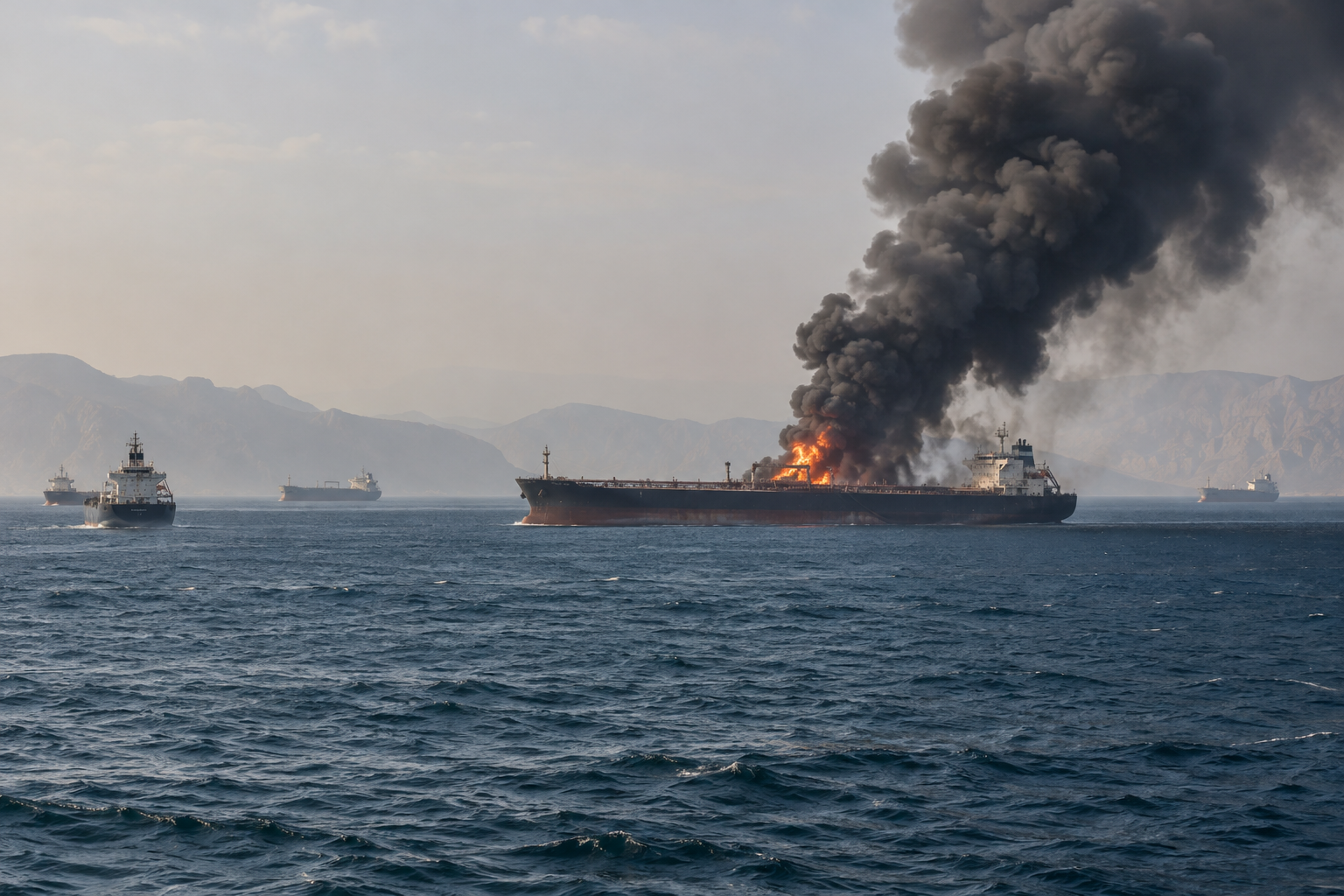
The live update reports escalating military activity and diplomatic uncertainty amid the Iran war. A British maritime agency said a ship was burning in the Strait of Hormuz, with the crew’s condition unknown. Iran’s Islamic Revolutionary Guard Corps (IRGC) subsequently claimed three oil tankers had been disabled by sea mines and challenged U.S. Central Command to independently prove that it had cleared mines from the shipping lanes. CENTCOM has said the lanes were safe for commercial traffic after U.S. forces cleared mines allegedly laid by the IRGC.
The article also reports that Defense Secretary Pete Hegseth fired Lt. Gen. Brett Sylvia, the Pentagon’s top military planner, after allegations that he leaked classified information about the war. Separately, Vice President JD Vance reportedly sent a letter to Iranian security chief Mohsen Rezaei seeking to restart peace negotiations. President Donald Trump characterized the outreach as limited to facilitating medical supplies for Iran, rather than reviving peace talks.
Other developments include a Houthi claim that a Saudi strike killed 12 people in Yemen’s Taiz province, amid renewed fighting after a four-year truce. Reuters reported that Iran has relied on a network of about 5,000 agencies to evade sanctions and the U.S. naval blockade, bringing in at least $2 billion in components and equipment for drone and missile programs. Iran’s Intelligence Ministry said it had arrested 16 people and dismantled four alleged militant cells linked to the U.S. and Israel, and detained three others accused of gathering information about security sites. Iran’s IRGC Navy also claimed it captured a U.S. reconnaissance drone near the Strait of Hormuz. Several of the claims in the updates are attributed to the governments or armed groups making them.
Entities: Strait of Hormuz, Iran war, Pete Hegseth, Lt. Gen. Brett Sylvia, JD Vance • Tone: neutral • Sentiment: negative • Intent: inform
29-10-2026
The article reports that Defense Secretary Pete Hegseth has removed Lieutenant General Brett Sylvia from his role as head of strategy, plans and policy on the Joint Chiefs of Staff. The Associated Press reported the dismissal, but no reason was provided and no successor was named. ABC News, citing two people familiar with the matter, reported that Sylvia has retired. The personnel change comes amid uncertainty about whether the United States might resume military strikes against Iran after the midterm elections. The AP also reported that U.S. officials have warned some Middle Eastern countries to prepare for possible renewed action and potential Iranian retaliation.
Diplomatic efforts are also in question. The Wall Street Journal reported that Vice President JD Vance sent a letter to an influential Iranian hard-liner to try to revive peace negotiations. President Donald Trump, however, played down the prospect of talks, saying Iran needs medical supplies and other assistance and that he had told the Iranian interlocutor it was acceptable to pursue that. Trump had also recently said he was weighing whether to make a deal with Iran or “finish it off,” while denying that peace talks were underway.
Iranian Foreign Minister Abbas Araghchi said Iran was continuing to give diplomacy a chance and remained in contact with intermediaries. He said those contacts were reviewing ideas to implement Tehran’s proposed seven-day plan in less than a week. The plan, proposed the previous month, reportedly envisaged reopening the Strait of Hormuz to normal commercial shipping and resuming negotiations with Washington, provided conditions were met. Those conditions reportedly included an end to hostilities and the release of frozen Iranian assets. The article presents competing signals of possible military escalation and ongoing diplomatic engagement, without confirming that either renewed strikes or formal negotiations are imminent.
Entities: Pete Hegseth, Brett Sylvia, Donald Trump, JD Vance, Abbas Araghchi • Tone: analytical • Sentiment: neutral • Intent: inform
29-10-2026
A vessel was reported on fire in the Strait of Hormuz, according to the United Kingdom Maritime Trade Operations (UKMTO), amid rising tensions in the US-Iran conflict. The agency said a ship captain reported seeing the blaze about nine nautical miles north of Khasab, Oman. It did not identify the cause, report casualties, or provide information about the crew, damage, or environmental effects. Iran’s Revolutionary Guards Corps (IRGC) separately claimed that three tankers had struck sea mines and caught fire in the previous 24 hours while using what it called an unauthorized route; it was unclear whether any of those ships was the vessel reported to UKMTO.
Iran has sought to control the strategic waterway since the conflict began with US and Israeli attacks on Iran in February, and has targeted ships it considers unauthorized. Shipping data showed oil exports through the strait fell again the previous week, while the Washington Institute for Near East Policy said attacks on ships there had reached their highest level since the war began. The US Navy, which is enforcing a blockade of Iranian vessels, has also escorted tankers through the area.
The report came as Iran said it had downed a drone east of the strait using a new air-defense system. Iranian claims about the number and types of drones destroyed have not been independently verified, though the US Congressional Research Service has reported losses or damage to dozens of US aircraft and drones.
The article also describes concerns about further US strikes. President Donald Trump has suggested the US might launch another operation, while a third US aircraft carrier and additional troops were heading to the region. Separately, reports said Defense Secretary Pete Hegseth had removed the Pentagon’s top military planner, Army Lieutenant General Brett Sylvia, without giving a reason or naming a replacement.
Entities: Strait of Hormuz, Oman, Khasab, UK Maritime Trade Operations (UKMTO), British Royal Navy • Tone: analytical • Sentiment: negative • Intent: inform
29-10-2026
US Vice President JD Vance has reportedly contacted Mohsen Rezaei, head of Iran’s Supreme National Security Council, in an effort to explore restarting negotiations and avert further US military action against Iran. The Wall Street Journal reported that Vance sent a letter at President Donald Trump’s direction, while Axios reported that the letter said negotiations would need to address Iran’s nuclear programme. The contacts are described as an attempt to establish a framework for possible talks, not to set out a detailed peace agreement.
The accounts of the outreach differ. Trump has repeatedly warned that new strikes could be imminent and recently said his administration was not negotiating with Iran. On Wednesday, he denied instructing Vance to pursue peace negotiations, saying instead that the contact was mainly intended to help arrange medical supplies. A US official told Axios that Vance proposed sending the letter and that Trump welcomed the initiative, but did not say when it was delivered.
Iranian Foreign Minister Abbas Araghchi said Iran’s armed forces were prepared to defend the country, while diplomacy remained an option. He also said Iran was in continuous contact with mediators to consider proposals that could ensure implementation of its seven-day plan, potentially in less than a week.
The reported initiative comes amid warnings to some Gulf Arab countries to prepare for a possible US campaign after the 3 November midterm elections. Trump has not made a final decision on further strikes. The conflict began with US and Israeli strikes in late February and has disrupted Gulf energy shipments; restrictions on shipping through the Strait of Hormuz have contributed to broader economic effects.
Entities: JD Vance, Mohsen Rezaei, Donald Trump, Abbas Araghchi, Iran • Tone: analytical • Sentiment: neutral • Intent: inform
29-10-2026
The Pentagon has removed Army Lt. Gen. Brett Sylvia, its senior officer responsible for military strategy and planning, from his role directing the Joint Staff’s J5 directorate. A US defence official confirmed the departure but gave no reason, and no successor had been named. The change comes as President Donald Trump considers whether to resume attacks on Iran after the November 3 midterm elections. US officials have reportedly warned regional partners to prepare for possible military action and Iranian retaliation, though Trump has made no final decision. The Pentagon has deployed the USS Theodore Roosevelt and amphibious ships carrying Marines toward the Persian Gulf, adding about 9,000 troops and potentially expanding US options.
Regional governments are concerned that renewed hostilities could threaten energy facilities and other infrastructure, and that Iranian counterattacks or actions by allied groups could prolong the conflict. Iran’s foreign minister, Abbas Araghchi, said Tehran was still pursuing diplomacy and reviewing proposals intended to restore a ceasefire; the United Arab Emirates also urged political solutions. Trump has publicly alternated between suggesting the war could end soon and threatening further bombing, while saying Iran must never obtain a nuclear weapon. The conflict is also creating domestic pressure ahead of the elections: gasoline prices have risen, and the Pentagon estimates the war has cost US taxpayers $47.1 billion.
Sylvia is the second general to leave the J5 director’s post under Defence Secretary Pete Hegseth. His departure adds to a broader turnover of nearly two dozen senior military leaders during Hegseth’s tenure, alongside plans to cut senior officer positions. Hegseth describes the reductions as accountability, while critics, including Senator Mark Kelly, warn that removing experienced leaders could damage military leadership for years.
Entities: Brett Sylvia, Donald Trump, Pete Hegseth, Abbas Araghchi, Mark Kelly • Tone: analytical • Sentiment: neutral • Intent: inform
29-10-2026
Oil prices fell Thursday as reports of renewed diplomatic efforts to end the conflict involving Iran, the United States and Israel reduced some concern about potential disruptions to crude supplies. Brent crude futures declined 2% to $112.99 per barrel, while U.S. West Texas Intermediate (WTI) futures fell 2.8% to $99.91. The reported outreach by U.S. Vice President JD Vance to Iranian Security Council chief Mohsen Rezaei, along with a new proposal from Qatari mediators, raised the possibility of restarting peace negotiations. But a senior Iranian official reportedly called the proposals unacceptable, and Iran’s foreign minister’s statement that Tehran remained open to diplomacy offered only a tentative prospect of progress. The article says investors continue to consider the risk of Houthi attacks and possible U.S. military action against Iran after the Nov. 3 midterm elections. Ongoing threats to supply have kept oil prices high, adding to inflation and complicating expectations for global monetary policy. José Torres, a senior economist at Interactive Brokers, said expensive crude remained the leading contributor to above-target inflation, although broader price pressures were relatively contained. He argued that energy-driven inflation supports a patient Federal Reserve approach, since raising rates too aggressively in response to an oil supply shock could weaken employment and worsen credit vulnerabilities. At the same time, Torres suggested that a geopolitical resolution could ease inflationary pressures and alter the Fed’s rate outlook. He said a decline in WTI toward $70 per barrel could materially strengthen the case for eventual interest-rate cuts.
Entities: Brent crude, West Texas Intermediate (WTI), JD Vance, Mohsen Rezaei, José Torres • Tone: analytical • Sentiment: neutral • Intent: inform