29-10-2026
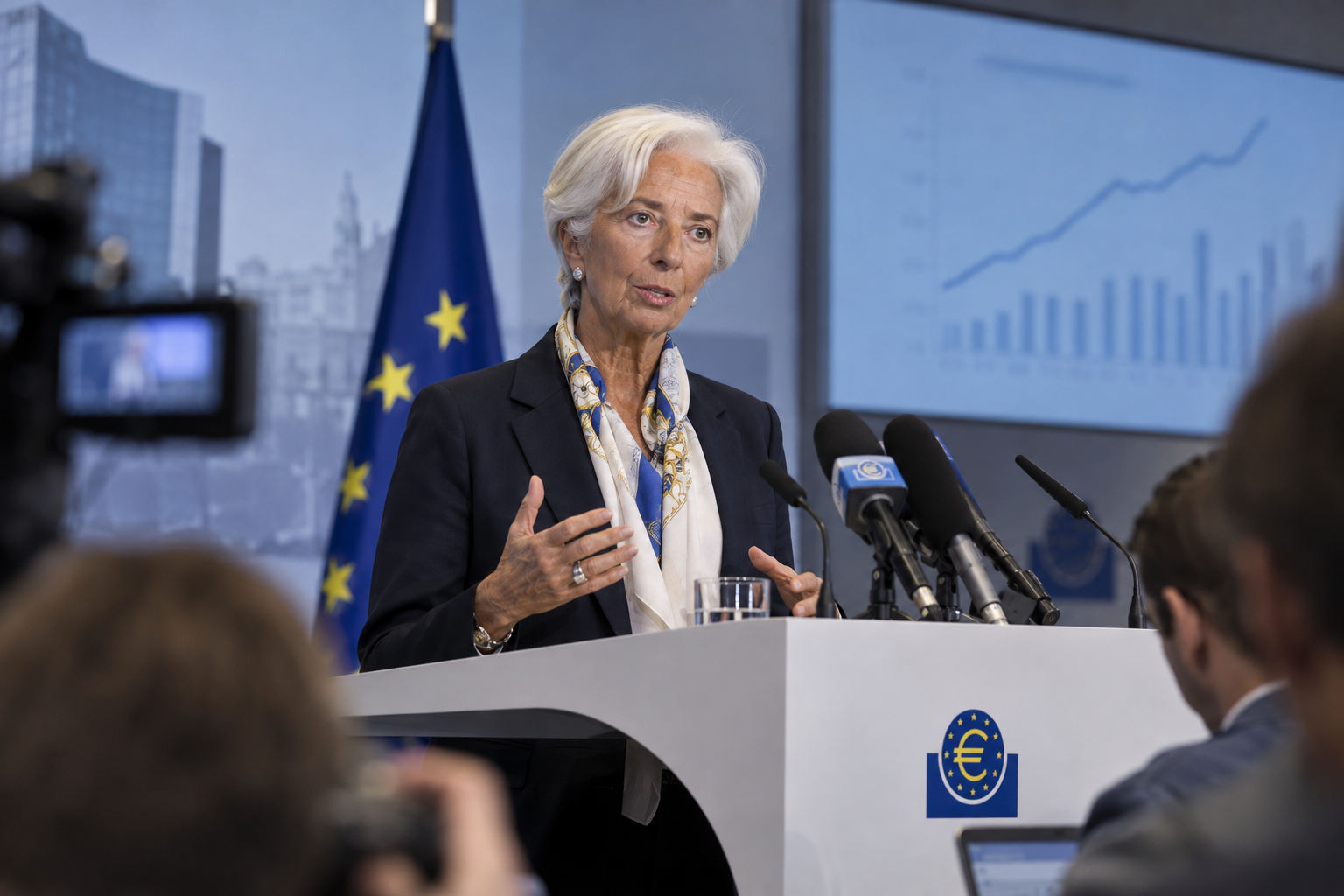
The European Central Bank kept its deposit rate at 2.5%, as markets expected, following a 25-basis-point increase in September. The decision came as euro zone headline inflation rose to 3.8%, its highest level since September 2023, largely because of surging energy prices. Energy inflation reached 18.8% amid continuing Middle East turmoil. The ECB’s Governing Council said higher energy costs create upside risks to inflation and downside risks to growth, but judged that underlying inflation and wage growth remained broadly stable. President Christine Lagarde said policymakers were not yet seeing additional second-round effects beyond those included in the ECB’s September projections. The Council unanimously concluded that it was sufficiently well positioned to hold rates and take a measured approach amid increased uncertainty. Lagarde also highlighted higher long-term financing costs, including an approximately 35-basis-point increase in the average 10-year sovereign yield. The euro area economy continued to expand in the third quarter. AI-related investment was supporting manufacturing, digital services and exports, while government infrastructure and defense spending supported business activity. However, higher energy costs could weaken consumer confidence, and increased financing costs could weigh on growth. Markets interpreted the decision as a hawkish pause: money markets priced in a 67% probability of a December rate hike, and Deutsche Bank economist Mark Wall expected another increase to 2.75%, potentially ending the hiking cycle. UBS economist Dean Turner likewise described the decision as a hawkish pause, emphasizing the ECB’s concern that energy-driven inflation could become persistent. Lagarde also said the bank was monitoring rising French borrowing costs and broader increases in long-term yields, which she linked partly to inflation and interest-rate expectations and bond issuance by large technology companies. The article additionally reports that Lagarde announced her impending departure as ECB president, raising questions about the institution’s policy decisions next year.
Entities: European Central Bank (ECB), Christine Lagarde, Annette Weisbach, Mark Wall, Dean Turner • Tone: analytical • Sentiment: neutral • Intent: inform
29-10-2026
Christine Lagarde says she will leave her post as European Central Bank president on February 7, 2027, almost nine months before her term was scheduled to end. She said the early departure would give her freedom to speak publicly about political and other non-monetary issues without the neutrality expected of an ECB president. The timing places her exit before France’s presidential election next spring, though Lagarde has denied suggestions that she plans to run for office. An early departure also means the next French president will not take part in choosing her successor.
The succession process will unfold amid other anticipated ECB leadership departures: Chief Economist Philip Lane and Executive Board member Isabel Schnabel are also due to leave next year. Although the ECB is institutionally independent, appointments to its senior positions are made by the European Council after consultations, and negotiations can reflect political bargaining over national representation and influence.
Klaas Knot, former head of the Dutch central bank, and Pablo Hernández de Cos, former governor of Spain’s central bank and now general manager of the Bank for International Settlements, are viewed as leading contenders. The choice matters as France faces worsening fiscal concerns, rising bond yields and increased uncertainty ahead of its election. Analysts say the ECB may need to assess who would be best suited to handle possible market turbulence, while emphasizing that it has neither a mandate nor an appetite to finance unsustainable French fiscal policies.
Knot is generally seen as the more hawkish candidate. His appointment could be interpreted as a tougher stance on inflation and potentially support the euro, but could also put pressure on French and other peripheral bond spreads. Hernández de Cos is seen as a continuity-oriented choice with a stronger focus on financial stability, potentially offering markets more reassurance amid pressure on French debt and inflation above target. National political support will also influence the contest. Lagarde received a standing ovation from the ECB Governing Council as she thanked colleagues for their support; European Council President Antonio Costa praised her stewardship.
Entities: Christine Lagarde, European Central Bank (ECB), Klaas Knot, Pablo Hernández de Cos, Marine Le Pen • Tone: analytical • Sentiment: neutral • Intent: inform
29-10-2026
Christine Lagarde will leave her post as president of the European Central Bank on February 7, 2027, earlier than expected, the ECB announced. Her term began on November 1, 2019, and was due to end in October 2027. No reason has been provided for her early departure. The announcement comes before a key ECB meeting and amid speculation that leaving early could allow European Union leaders to appoint a successor before French elections in the spring, where a possible far-right, eurosceptic victory could affect the choice. European Council President Antonio Costa said the appointment process would begin immediately and praised Lagarde’s leadership through the pandemic, war in Europe, energy crises and inflation shocks. Lagarde said she was leaving with a sense of work completed and confidence that the ECB was prepared for the future. Before leading the ECB, she served as France’s finance minister and headed the International Monetary Fund from 2011 to 2019. The leaders of the 21 eurozone countries choose the ECB president.
The ECB is also expected to discuss interest rates and France’s worsening fiscal and political situation at its meeting. The bank is widely expected to keep its deposit rate at 2.5%, while signaling that rates may rise again before year-end. It has raised rates twice since June to counter inflation associated with the energy shock caused by the Iran war. France’s budget deadlock has pushed government bond yields to their highest level in 25 years, while recent protests over public services have involved considerable violence. The article notes speculation that the ECB might use its Transmission Protection Instrument, which permits bond purchases if a member country’s yields rise uncontrollably and threaten to spread financial stress. Most observers, however, believe France’s current difficulties do not meet the tool’s strict criteria.
Entities: Christine Lagarde, European Central Bank (ECB), European Council, Antonio Costa, European Union • Tone: analytical • Sentiment: neutral • Intent: inform
29-10-2026
The European Central Bank kept its deposit rate unchanged at 2.5%, a widely expected decision made against a backdrop of rising inflation, higher borrowing costs and uncertainty over the eurozone’s economic outlook. Inflation reached 3.8% in September, up from 3.2% in August and nearly twice the ECB’s 2% target. The bank also left its main refinancing and marginal lending rates unchanged at 2.65% and 2.90%. It cited rising energy prices, linked in the article to the Iran war, as a risk that could increase inflation while weakening growth. The ECB said underlying inflation and wages had so far remained broadly stable, but warned that the energy shock’s scale and duration could worsen both outcomes. It also noted that financing conditions had tightened and said it was not committing to a particular future path for rates.
The meeting was overshadowed by President Christine Lagarde’s announcement that she would leave on 7 February 2027, about nine months before her eight-year term was due to end. The ECB gave no reason for the early departure; reports have connected its timing to France’s April 2027 presidential election. Lagarde described the institution as fit for the future. Her departure begins a leadership succession contest, with Spain’s Pablo Hernández de Cos and the Netherlands’ Klaas Knot identified as frontrunners. Two other Executive Board positions, including chief economist Philip Lane’s, will also become vacant in the first half of next year.
France’s political and fiscal difficulties are adding pressure to the outlook. French 10-year borrowing costs rose above 5% for the first time since 2002 and stood around that level on Thursday, while the yield spread over German debt was about 155 basis points. Moody’s retained France’s Aa3 rating but assigned it a negative outlook as parliament struggled to pass the next budget. ING estimated that the rise in yields had had an effect comparable to an ECB rate increase, particularly in France. Lagarde has said that France’s primary solution lies in its own fiscal policies. The ECB reiterated that its Transmission Protection Instrument remains available for disorderly market movements, while keeping its policy of allowing bond holdings to shrink unchanged.
Entities: European Central Bank (ECB), Christine Lagarde, Eurozone inflation, ECB deposit rate, Iran war and energy prices • Tone: analytical • Sentiment: neutral • Intent: inform
29-10-2026
Christine Lagarde announced that she will leave her position as president of the European Central Bank on 7 February 2027, almost nine months before her mandate is scheduled to end. Her early departure is notable because it comes only a few months before France’s presidential election, planned for April 2027, and has renewed speculation about whether she might take a political role in France.
In an exclusive interview with Euronews in July, Lagarde rejected the idea that she was seeking elected office. “I’m not a candidate for anything,” she said, while emphasizing that she wanted Europe to be protected and to remain the framework in which member states, including France, operate. She also expressed hope that reason would prevail before the election and underscored France’s importance within the European Union.
The article places her comments in the context of her career. Before becoming ECB president, Lagarde led the International Monetary Fund. Earlier, she served as France’s finance minister under former president Nicolas Sarkozy. In that role, she became the first woman to serve as finance minister in a G7 country and guided France through the 2008 financial crisis.
The story connects Lagarde’s stated lack of political ambition with the timing of her ECB departure and the approaching French election, but it does not report that she has declared a candidacy or accepted another position. Its central point is the contrast between her early exit from the ECB and her earlier statement that she was not a candidate for political office.
Entities: Christine Lagarde, European Central Bank (ECB), Euronews, France, 2027 French presidential election • Tone: analytical • Sentiment: neutral • Intent: inform
29-10-2026
European Central Bank President Christine Lagarde announced she will resign on February 7, ending months of speculation about her future. Her departure comes as Europe faces rising economic volatility, including inflation risks linked to an Iran-driven oil shock and sharply higher government bond yields, particularly in France. The bond-market turmoil has raised borrowing costs for households and businesses and threatens to weaken growth.
The timing gives European Union leaders an opportunity to select a successor before France’s presidential election, in which polls cited by the article show far-right candidate Marine Le Pen favored to win. A source familiar with the matter said Lagarde wanted to be free to weigh in on political issues in France and internationally; as ECB president, she was expected to maintain political neutrality to protect the bank’s independence. Her term had been due to end in October 2027, and the World Economic Forum had been discussed as a possible next destination.
European Council President Antonio Costa said the succession process would start immediately. Former central bank governors Klaas Knot of the Netherlands and Pablo Hernandez de Cos of Spain are viewed as leading candidates. Market analysts said either would be a competent choice and that the ECB’s established institutional practices are likely to continue regardless of who leads it. Markets showed little reaction to the resignation announcement.
The ECB is in a rate-hiking cycle intended to stop higher oil prices from spreading into other prices and wages. It must also respond to persistent inflation and worsening financing conditions. The bank was widely expected to hold its deposit rate at 2.5 per cent on Thursday, while leaving open the possibility of another increase, potentially in December. Oxford Economics’ Oliver Rakau said higher energy prices could prompt an upward revision to the ECB’s inflation forecast, making a December hike more likely. The ECB’s rate decision and Lagarde’s press conference were scheduled for later Thursday.
Entities: Christine Lagarde, European Central Bank (ECB), European Union, France, Marine Le Pen • Tone: analytical • Sentiment: neutral • Intent: inform
29-10-2026
Christine Lagarde’s decision to leave the European Central Bank presidency before her eight-year term ends concludes a turbulent seven-year tenure and gives European Union leaders the opportunity to choose her successor before France’s next election. Lagarde, a former French finance minister and International Monetary Fund chief, arrived in 2019 without formal economics training or central banking experience. Although some initially regarded her as a credibility risk, commentators say the ECB performed relatively well under her leadership, bringing inflation down faster than Britain and the United States after the pandemic, energy shocks and a historic euro-zone inflation surge.
Her record includes both missteps and consequential responses. In March 2020, her remark that the ECB was “not here to close spreads” sparked a bond-market selloff, though she quickly reversed course and the bank subsequently launched emergency bond purchases to stabilise markets. The ECB later raised interest rates rapidly in response to inflation following Russia’s invasion of Ukraine, while acknowledging it had underestimated the impact of rising energy prices. Earlier in her career, Lagarde guided French banks through the 2008 financial crisis and led the IMF during Europe’s debt crisis. The IMF’s large 2018 loan to Argentina, however, failed to prevent economic collapse and became a major setback.
The article portrays Lagarde as a politically skilled outsider who relied on plain speaking, consensus-building and pragmatism rather than technocratic style. She worked to mend divisions among euro-zone central bank leaders and was more willing than her predecessor, Mario Draghi, to engage in political disputes. Yet her early departure has drawn criticism as politically motivated and potentially damaging to the ECB’s independence, particularly given the French election and the prospect of a far-right victory. Her legacy is presented as paradoxical: political diplomacy helped her steer the central bank through historic shocks, while the timing of her exit highlights the political instincts that defined her leadership.
Entities: Christine Lagarde, European Central Bank (ECB), European Union, Frankfurt, France • Tone: analytical • Sentiment: neutral • Intent: analyze