28-08-2026
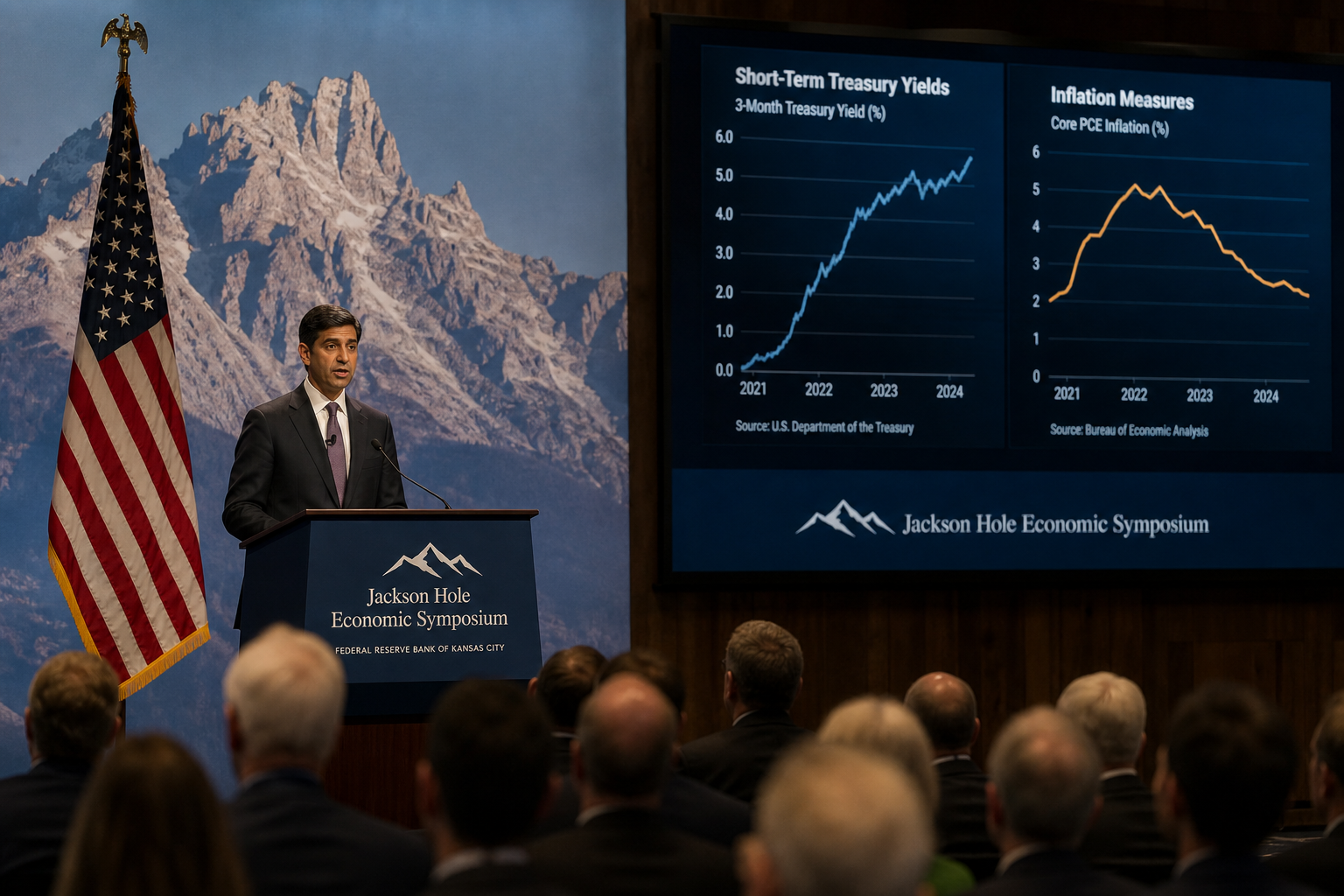
U.S. Federal Reserve Chair Kevin Warsh said inflation remains too high and suggested the central bank may need to raise interest rates in the coming months. Speaking at the Fed’s annual economic conference in Jackson Hole, Wyo., Warsh acknowledged that inflation had cooled somewhat in recent reports but said the data did not show a meaningful improvement in underlying price pressures. He said the Fed must be confident that inflation is moving toward its two per cent target at a sufficient pace; otherwise, policymakers still have more work to do.
Warsh did not indicate that a rate increase at the Fed’s next meeting in mid-September is imminent, nor did he provide the type of specific forward guidance used by previous Fed chairs. Instead, he emphasized that interest rates may not yet be restrictive enough to bring inflation down. He also pointed to strong consumer spending and robust business investment in artificial-intelligence equipment and infrastructure as evidence that current rates are not significantly limiting economic activity.
The remarks appeared to reassure investors that inflation remains the Fed’s priority. The two-year Treasury yield rose from 4.22 per cent to 4.30 per cent, reflecting increased expectations of a near-term rate hike, while longer-term Treasury yields were largely unchanged. Futures markets placed the probability of a hike at the September meeting at roughly 50 per cent, up from about one-third previously.
Economists differed on the significance of Warsh’s speech. Jon Faust said Warsh communicated a tougher inflation stance without committing to a specific policy path, while Michael Strain argued that the comments offered little clarity about the timing of any action. Warsh’s approach reflects his stated preference for preserving the Fed’s flexibility rather than promising future rate decisions.
Entities: Kevin Warsh, U.S. Federal Reserve, Jerome Powell, Jackson Hole economic conference, U.S. inflation • Tone: analytical • Sentiment: neutral • Intent: inform
28-08-2026
Federal Reserve Chairman Kevin Warsh is scheduled to deliver the keynote address at the Fed’s annual Jackson Hole symposium in Wyoming, where markets are watching for clues about the central bank’s future approach to interest rates and monetary policy. Unlike some predecessors, Warsh has offered limited forward guidance and has emphasized allowing markets to interpret economic data rather than using carefully calibrated communications to steer expectations.
The symposium’s theme is “Financial Innovation: Implications for Payments and Policy,” and analysts are uncertain whether Warsh will discuss broad structural issues or provide specific details about inflation, the Fed’s reaction function, and the conditions that would prompt rate increases or cuts. Luke Tilley of M&T Bank and Wilmington Trust expects a high-level discussion of the Fed’s five task forces, which are examining inflation, the balance sheet, decision-making data, technology and communications.
The speech comes as Treasury yields rise and markets face additional uncertainty from Treasury Secretary Scott Bessent’s plan to at least double the department’s weekly buybacks of previously issued debt. RSM economist Joseph Brusuelas said fiscal actions have complicated Warsh’s position and raised expectations for the speech.
Market participants are particularly concerned that a vague or overly dovish speech could trigger a sell-off in long-dated Treasurys. Bank of America’s Mark Cabana expects Warsh to indicate that the Fed could raise rates again if inflation fails to moderate. He warned that a focus only on structural themes such as productivity or demographics could push the 30-year Treasury yield to 5.5% or higher. Analysts therefore argue that Warsh will need to be more direct and specific than he has been during his first months as chair.
Entities: Kevin Warsh, Federal Reserve, Jackson Hole symposium, Jackson Hole, Wyoming, Financial Innovation: Implications for Payments and Policy • Tone: analytical • Sentiment: neutral • Intent: analyze
28-08-2026
U.S. Treasury yields moved higher after Federal Reserve Chairman Kevin Warsh delivered a hawkish keynote speech at the Jackson Hole Economic Policy Symposium in Wyoming. Warsh said the central bank still has “work to do” to bring inflation under control, arguing that recent improvements in the summer’s personal consumption expenditures (PCE) and consumer price index (CPI) readings were not enough to demonstrate a meaningful improvement in underlying inflation trends.
The comments were reflected most sharply at the short end of the Treasury curve, which is particularly sensitive to expectations for Federal Reserve policy. The two-year Treasury yield rose more than 12 basis points to 4.356%. Longer-term yields also increased: the benchmark 10-year yield gained more than five basis points to 4.726%, while the 30-year yield rose two basis points to 5.211%. The 30-year yield has climbed significantly in recent weeks and is close to multi-decade highs.
Warsh’s comments increased market expectations for a September interest-rate hike. According to the CME FedWatch Tool, the implied probability rose to 57.5%, up from 35.4% the previous day. His remarks also appeared to reassure bond investors following the recent sell-off in longer-dated Treasury securities.
BMO U.S. rates strategist Vail Hartman characterized the speech as deliberately hawkish, saying it should resolve doubts about the Federal Reserve’s willingness to raise rates if necessary to restore price stability. The article explains that one basis point equals 0.01% and notes that bond prices move inversely to yields. Overall, the report presents the speech as an important shift in rate expectations and a signal that the Fed remains focused on controlling inflation, even at the risk of maintaining or increasing borrowing costs.
Entities: Kevin Warsh, Federal Reserve, Jackson Hole Economic Policy Symposium, Jackson Lake Lodge, Moran, Wyoming • Tone: analytical • Sentiment: neutral • Intent: inform
28-08-2026
Federal Reserve Chairman Kevin Warsh used his speech at the Jackson Hole economic symposium to present a clearer and more hawkish view of inflation than he offered at the Federal Open Market Committee’s July meeting. After his July news conferences left markets uncertain about the future path of interest rates, Warsh emphasized that elevated prices remain the Fed’s primary concern and that inflation is still running well above the central bank’s 2% target.
Warsh reaffirmed the Fed’s commitment to a “firm, fixed target” of 2% inflation as measured by the personal consumption expenditures price index. He cited several indicators to support his assessment, including July PCE inflation of 3.7%, consumer price index inflation of 3.4%, and the fact that substantial shares of PCE components had recorded annualized inflation above 3% over the past six and 12 months. Although these figures are below pandemic-era levels, Warsh said they remain above the long-term trend.
The chairman also stated that short-term interest rates remain the Fed’s main tool for fulfilling its dual mandate, directly countering interpretations that he would rely on other policies to address inflation. He said the Fed’s work on artificial intelligence was encouraging but had no immediate impact on monetary-policy decisions, and he gave no indication that balance-sheet reductions would soon affect rates.
Warsh did not explicitly signal a September rate increase, but his remarks suggest that a hike is under consideration if inflation fails to improve. That stance places him increasingly at odds with President Donald Trump, who continues to demand lower interest rates. The speech may help restore confidence among Fed colleagues that Warsh has a coherent inflation strategy, though questions remain about political pressure and whether he will take concrete action at the September meeting.
Entities: Kevin Warsh, Federal Reserve, Jackson Hole economic symposium, Jackson Hole, Wyoming, Donald Trump • Tone: analytical • Sentiment: neutral • Intent: analyze
28-08-2026
Federal Reserve Chair Kevin Warsh used his first address at the Jackson Hole symposium to present a hawkish assessment of the US economy and inflation. Speaking on his 100th day in office, Warsh said the economy had strengthened despite recent shocks, financial conditions were not restrictive, and the labour market remained consistent with full employment. He argued that inflation, rather than growth or employment, should be the Fed’s dominant concern.
Warsh cited persistent price pressures, noting that the personal consumption expenditures (PCE) index had risen 3.7% over 12 months and 4.1% over six months. He also highlighted the broad-based nature of inflation, with 54% of the index’s components increasing by more than 3% over the past year. In his view, recent readings that exceeded expectations did not demonstrate meaningful improvement in underlying inflation. He said the Fed should act unless it became confident that inflation was returning to its 2% target at a sufficient pace.
Although Warsh did not announce what he would do at the Fed’s September meeting, his remarks increased market expectations for a 0.25 percentage-point rate increase. Traders raised the implied probability of a hike from roughly 35% to 55%. Treasury yields fell while the dollar strengthened after the speech.
Warsh also discussed artificial intelligence as a potentially transformative factor for productivity, investment and employment, while stressing that its policy implications remain uncertain. He defended his rejection of forward guidance, arguing that markets had become too dependent on predicting the Fed and that a mechanical reaction function was unsuitable for an uncertain economy. Instead, he endorsed data-dependent policymaking, a firm 2% inflation target, reliance on short-term interest rates, and attention to monetary conditions. He concluded that he was committed to a policy discipline rather than a predetermined decision, leaving the next move to the 16 September meeting.
Entities: Kevin Warsh, Federal Reserve, Kansas City Federal Reserve symposium, Jackson Hole, Wyoming • Tone: analytical • Sentiment: neutral • Intent: analyze
28-08-2026
Federal Reserve Chairman Kevin Warsh said the US central bank may need to take further action, potentially including raising interest rates, if it cannot establish that underlying inflation is moving back toward the Fed’s 2 per cent target at a sufficient pace. Speaking at the Jackson Hole economic symposium in Wyoming, Warsh said the Fed would “have work to do” if policymakers lacked confidence that inflation was returning to its objective. His comments represented his clearest acknowledgement so far that higher rates could be necessary to contain persistent price pressures.
Warsh’s remarks prompted applause from central bankers attending the event and influenced financial markets. Investors increased their expectations of a rate hike at the following month’s policy meeting, which had previously been viewed as relatively unlikely. Warsh did not, however, offer a timetable for any increase.
The speech largely addressed long-term economic issues, including the potential influence of artificial intelligence, but it also contained several significant comments about current monetary policy. Warsh stated that short-term interest rates remain the main tool for fulfilling the Federal Reserve’s dual mandate. He also emphasized that recommendations from five task forces examining longer-term challenges would not affect decisions made under current economic conditions.
Warsh did not directly discuss recent market interventions by US Treasury Secretary Scott Bessent. He did say the Federal Reserve requires clear and largely unfiltered market signals in order to set monetary policy appropriately. The remarks appeared to address concerns raised after Warsh’s first two press conferences, when some observers believed he had not sufficiently explained how the central bank would respond if inflation remained above target. Overall, the speech signaled a more forceful stance on inflation while stopping short of announcing an imminent rate increase.
Entities: Kevin Warsh, Federal Reserve, United States, Jackson Hole Economic Symposium, Wyoming • Tone: analytical • Sentiment: neutral • Intent: inform