25-10-2026
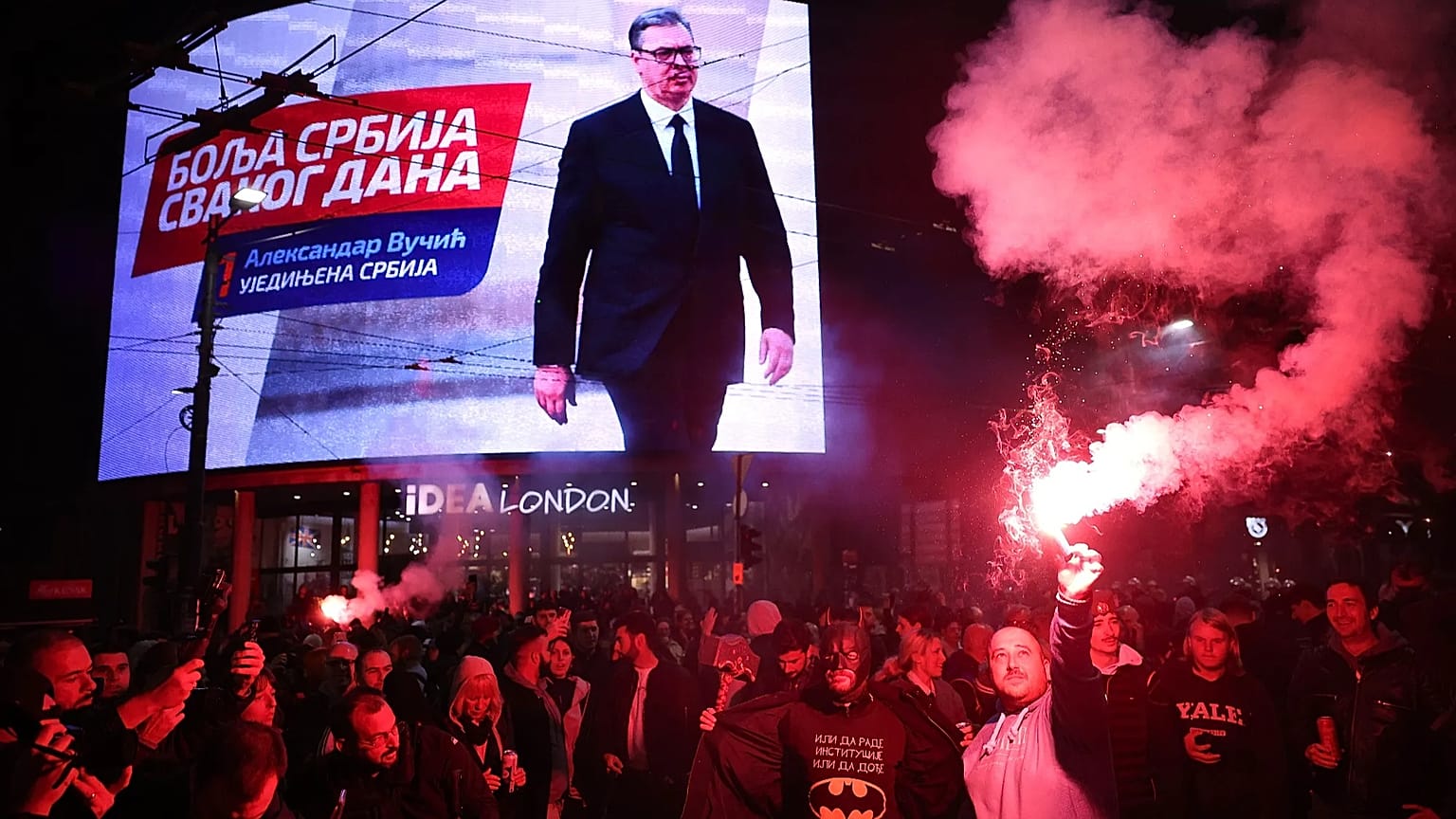
Supporters of Serbia’s student-backed opposition movement celebrated in Belgrade after President Aleksandar Vučić conceded defeat on Sunday. The concession marked a major political turning point following nearly two years of demonstrations against his government and the governing party’s long-standing dominance of Serbian politics. The election was a closely watched contest between the governing party and a broad opposition movement. As polling ended, election officials began counting ballots at stations across the capital. Preliminary figures from Serbia’s election commission showed the highest parliamentary election turnout in more than three decades, indicating unusually broad public participation. The vote followed a prolonged protest movement that began after a concrete canopy collapsed at Novi Sad railway station in November 2024, killing 16 people. The disaster prompted widespread anger over alleged corruption and failures of public oversight. Students became the central force behind demonstrations that spread throughout Serbia. Over time, their movement drew people from varied political backgrounds who shared demands for accountability and political change. Vučić’s concession brought the electoral contest to a dramatic close, while celebrations in Belgrade reflected the opposition supporters’ response to the defeat of a party that had dominated the country’s politics for years. The article presents the election and its aftermath as the culmination of sustained public protest, while noting both the deadly incident that helped spark the demonstrations and the high turnout that accompanied the election.
Entities: Aleksandar Vučić, Serbia, Belgrade, Novi Sad railway station, Serbia's election commission • Tone: neutral • Sentiment: neutral • Intent: inform
25-10-2026
Serbians are voting in a parliamentary election that could challenge the long-standing rule of Aleksander Vucic, according to the article. The report describes voters turning out in large numbers and frames the election as a potential turning point in the country’s politics. A student-led bloc is challenging Vucic, whose leadership has endured for years. The vote follows months of student-led anti-government protests focused on corruption and accountability. The article links those demonstrations to the election’s broader political context, but provides no polling figures, results, detailed accounts of the protests, or further information about the candidates and parties. It therefore presents the contest as consequential without establishing whether Vucic’s position will actually be brought to an end. The report’s central point is that a parliamentary vote is taking place amid significant public participation and sustained protest activity, with students playing a leading role in opposition to the government. It offers a brief news update rather than an extended analysis of the election or the issues behind the protests. The article does not report an outcome; it describes the vote as underway and the possibility of a change in leadership as uncertain. Its emphasis is on the electoral challenge to Vucic and the months of protests over corruption and accountability that preceded the vote.
Entities: Serbia, Aleksander Vucic, Serbian voters, Student-led bloc, Parliamentary election • Tone: neutral • Sentiment: neutral • Intent: inform
25-10-2026
Serbia is holding snap parliamentary elections amid a student-led protest movement challenging longtime leader Aleksandar Vucic. The demonstrations began after a railway station canopy collapsed in Novi Sad in 2024, killing 16 people. Protesters have blamed government corruption and what they describe as creeping authoritarianism, and the movement has since attracted widespread public support. A defeat for Vucic could represent a major political shift in the Balkan country, though he remains a strong incumbent with supporters who credit him with economic development and modernization.
Vucic called the election in September and resigned as president to run again for prime minister. His campaign has promised higher pensions and public-sector salaries, investment in state healthcare, and subsidies for young couples. In foreign policy, he has maintained ties with China and Russia while keeping open the possibility of Serbia joining the European Union. However, relations with the EU have deteriorated over what the bloc sees as insufficient progress on judicial reform, the rule of law, and corruption.
The opposition Student List focuses on tackling corruption and improving education, while offering few details about its international policy. Its 250 candidates include professors, actors, and farmers, and it is led by cardiologist Ilija Srdanovic. Polls suggest a close contest: one Ipsos survey gave Vucic’s Serbian Progressive Party 47 percent and the student movement 40 percent, while other polls have placed the students ahead. About 150,000 people attended a student movement rally in Belgrade. Rights groups and activists say repression has increased since the Novi Sad collapse, while Vucic and his party deny allegations of repression, corruption, and spying. Vucic has also accused the movement of receiving foreign support, which the students deny.
Entities: Serbia, Aleksandar Vucic, Student List, Ilija Srdanovic, Novi Sad train station canopy collapse • Tone: analytical • Sentiment: neutral • Intent: inform
25-10-2026
Aleksandar Vučić conceded defeat in Serbia’s parliamentary election, ending a decade-long period in which he dominated the country’s politics as president or prime minister. The student-backed Student List won the vote after nearly two years of demonstrations, initially sparked by a train-station canopy collapse in Novi Sad that killed 16 people. Protesters had called for Vučić to step down, citing perceived corruption and growing authoritarianism; rights groups and activists say repression worsened during the protests. Vučić and his Serbian Progressive Party denied accusations of corruption, repression and surveillance, and he claimed the student movement was supported by foreign agents, an allegation the students rejected.
Preliminary figures cited by Vučić gave the Student List between 135 and 140 seats in the 250-seat parliament, compared with 105 for his party. Turnout was close to 70 per cent, the highest since Yugoslavia’s breakup in 1992. Vučić’s concession was followed by celebrations in Belgrade, where students and supporters described the result as a victory and a source of hope for democratic change.
The result marks a major political shift, but the opposition’s next steps remain uncertain. Its candidate list includes largely unfamiliar figures from fields such as academia, acting and farming, and it is not yet clear who will become prime minister. The students have pledged to address corruption and improve education, while analysts anticipate possible changes to Vučić’s allies in government institutions. Their foreign-policy direction is less defined: Serbia will need to manage ties with China, Russia and the European Union, each important to its investment, energy supply or trade. The article also frames the result as a possible example for student movements elsewhere in Europe.
Entities: Aleksandar Vučić, Student List, Serbian Progressive Party (SNS), Serbia, Belgrade • Tone: analytical • Sentiment: positive • Intent: inform
25-10-2026
Aleksandar Vucic conceded defeat in Serbia’s parliamentary election, ending the 14-year dominance of his Serbian Progressive Party (SNS) and marking a major political shift. Vucic said his party’s projections gave the student-backed Students’ List between 135 and 140 of Parliament’s 250 seats, compared with about 105 for the SNS. He also estimated that the opposition list had received around 2.2 million votes, against roughly 1.7 million for his party. Although he acknowledged the loss, Vucic blamed independent media and alleged foreign interference.
The Students’ List grew out of a two-year protest movement that accused the government of corruption and weakening democracy. Student demonstrations intensified after 16 people died in 2024 when a concrete canopy collapsed at a Novi Sad train station. Protesters connected the disaster to corruption and cronyism in the station’s renovation. The movement ran a nonpartisan campaign focused on rebuilding the economy and restoring democracy, using candidates from varied professions rather than putting students themselves on the ballot. Its members also travelled through rural areas, traditionally strong territory for Vucic, to reach voters disillusioned with established politicians.
High turnout and tense conditions characterized voting. Monitors anticipated participation near 70%, while observers reported alleged ballot photographing, possible voter pressure, and attempted vote buying. The European Union was watching the election, amid broader concerns about media control, detentions, surveillance, and attacks on activists and journalists. Police and groups of black-clad men were visible in Belgrade as results emerged. Supporters of the Students’ List celebrated in Belgrade and other cities. The result echoed a recent youth-influenced electoral defeat of Vucic’s ally Viktor Orbán in Hungary and may resonate across Europe, where student protests have challenged governments.
Entities: Aleksandar Vucic, Students’ List, Serbian Progressive Party (SNS), Serbia, Belgrade • Tone: analytical • Sentiment: neutral • Intent: inform
25-10-2026
Serbia’s parliamentary election is presented as a close contest that could weaken or end the long-running political dominance of Aleksandar Vucic and his Serbian Progressive Party (SNS). The main new challenger is the youth-backed Students’ List, which grew out of a mass protest movement and is seeking to turn street demonstrations into an electoral alternative to both the government and established opposition parties. The protests began after a train-station canopy collapsed in Novi Sad in 2024, killing 16 people. The disaster prompted anger over alleged corruption, poor construction standards and lack of accountability. Demonstrations that initially centered on justice for the victims expanded into a wider challenge to Vucic’s rule, attracting students, teachers, farmers and other members of society. Authorities have rejected accusations that corruption and political patronage contributed to the safety failures. Vucic, whose party has dominated Serbian politics since 2012, called snap elections and stepped down as president to run for prime minister. He cannot seek a third presidential term under Serbia’s constitution. Critics accuse him of concentrating power, undermining independent media and weakening democratic institutions; he and his party deny those claims. The election is also significant for Serbia’s relationship with Europe. The country is an EU candidate, but accession has been hindered by concerns about democracy and the rule of law. Vucic has maintained close relations with Russia and declined to join Western sanctions over Russia’s invasion of Ukraine. The article situates the vote in a wider regional context, noting the recent victory of Peter Magyar over Vucic ally Viktor Orban in Hungary, and reports that Serbian polling stations are scheduled to close at 8 p.m. local time.
Entities: Aleksandar Vucic, Serbian Progressive Party (SNS), Students' List, Serbia, Novi Sad train-station canopy collapse • Tone: analytical • Sentiment: neutral • Intent: inform
25-10-2026
Serbia began voting in a pivotal election as a student-led protest movement sought to end the long rule of Aleksandar Vucic and his Serbian Progressive Party (SNS). Polls indicated a close contest between the SNS and the newly formed, youth-backed Students' List. The election followed nearly two years of demonstrations sparked by the deadly 2024 collapse of a train station canopy in Novi Sad. Calls for accountability over the disaster grew into Serbia's largest protest movement since the fall of Slobodan Milosevic in 2000.
Vucic, who has dominated Serbian politics for more than a decade, called snap elections the previous month. He stepped down as president to run for prime minister; Serbia's constitution bars him from seeking a third presidential term. The Students' List aimed to end 14 years of SNS rule in the vote. The student movement also hoped to emulate Peter Magyar's April victory in Hungary over Vucic's ally, Viktor Orban. Polling stations were scheduled to close at 8 p.m. local time (1900 GMT).
The article presents the election as a test of whether a sustained, youth-backed protest movement can translate public pressure into a change in government. It links the immediate political contest to the unresolved demand for accountability after the Novi Sad disaster, while noting the SNS's entrenched position and the close polling. It does not report the election result.
Entities: Serbia, Belgrade, Novi Sad, Aleksandar Vucic, Slobodan Milosevic • Tone: analytical • Sentiment: neutral • Intent: inform
25-10-2026
Aleksandar Vucic conceded defeat after Serbia’s parliamentary election, acknowledging that the student-backed Students’ List was projected to win 135–140 seats, compared with about 105 for his Serbian Progressive Party (SNS). The result would end more than a decade of SNS rule and marks a major shift in Serbian politics. Vucic blamed independent media and alleged interference by unnamed European countries and the “American deep state.” His concession prompted celebrations in Belgrade and among Students’ List supporters.
The election outcome follows nearly two years of protests sparked by the 2024 collapse of a train station canopy in Novi Sad, which killed 16 people. Demonstrators alleged that corruption, political patronage and poor construction standards contributed to the disaster and demanded accountability; authorities rejected the accusations. Student blockades and marches grew into a wider movement that drew support from teachers, farmers and others, becoming a significant challenge to Vucic’s political dominance.
The SNS has governed since winning parliamentary elections in 2012. Vucic became prime minister in 2014 and president in 2017. He stepped down as president to run for prime minister after calling snap elections. Critics have accused him and his party of concentrating power, weakening democratic institutions and undermining independent media, while they deny those claims. Turnout was nearly 70%, the highest since Yugoslavia’s breakup in 1992.
The vote attracted attention across Europe because Serbia is an EU candidate country, and its accession bid has faced concerns about democratic standards and the rule of law. European Commission President Ursula von der Leyen congratulated the Students’ List and offered support for reforms. The Council of Europe also said it was ready to work with Serbia’s elected leadership on human rights, democracy and the rule of law. Vucic has maintained close ties with Russia and declined to join Western sanctions over Russia’s invasion of Ukraine.
Entities: Aleksandar Vucic, Students’ List, Serbian Progressive Party (SNS), Serbia, Belgrade • Tone: analytical • Sentiment: neutral • Intent: inform
25-10-2026
Serbia’s snap parliamentary election on 25 October is presented as a possible turning point after nearly two years of political tension and protests. The vote will fill all 250 seats in the National Assembly, with more than 6.45 million eligible voters and 18 electoral lists. The election followed President Aleksandar Vučić’s dissolution of parliament, but the article says its deeper context is the student movement that grew after the November 2024 collapse of a canopy at Novi Sad railway station killed 16 people. Students initially demanded accountability and disclosure of reconstruction documents, then broadened their protests into a challenge to corruption, political responsibility and the functioning of state institutions.
The contest is framed chiefly as a choice between the ruling Serbian Progressive Party (SNS), campaigning under Vučić’s name, and the Student List, “Students Win.” Vučić resigned from the presidency in September to lead the SNS campaign and seek the premiership. The student list, assembled through student plenums and including candidates from varied professional backgrounds, aims to turn a protest movement into a parliamentary force. Other participants include the Socialist Party of Serbia, right-wing and pro-European lists, and minority parties that could matter in government formation.
The article describes competing accounts of the protests: authorities stress stability, development and alleged foreign interference, while students emphasize accountability, anti-corruption measures, rule of law and institutional independence. Traditional opposition parties, which won about 24% of the vote and 65 seats in 2023 as the “Serbia Against Violence” coalition, have since fragmented; the student movement has taken up much of their political momentum. Turnout, undecided voters and whether smaller parties clear the 3% threshold may affect the result. The SNS retains a strong organizational network, so the outcome remains uncertain. The wider context includes polarization over national identity and foreign policy, Serbia’s stalled EU path, relations with Russia and China, and normalization talks with Kosovo. The supplied article ends mid-sentence while discussing the possible consequences of a Student List victory.
Entities: Aleksandar Vučić, Serbia, Novi Sad railway station, Student List – “Students Win”, Serbian Progressive Party (SNS) • Tone: analytical • Sentiment: neutral • Intent: inform
25-10-2026
Serbia’s Student List has won a parliamentary election, marking a major political breakthrough for a movement that grew out of months of student protests. Outgoing President Aleksandar Vučić conceded defeat, citing preliminary figures that put the Student List at 2.2 million votes and roughly 135–140 parliamentary seats, compared with about 1.72 million votes and 105 seats for his Serbian Progressive Party. The article notes that final results and the status of smaller parties remain uncertain, but says these are unlikely to change the winner or the overall outcome. It describes the result as a rejection of the political model that has dominated Serbia for more than a decade. The movement’s origins were in protests against political institutions, corruption allegations, media conditions and a perceived lack of accountability. Its apparent support extended beyond students to urban middle-class voters, opposition supporters and citizens dissatisfied with established parties. The election is presented as a setback for a ruling establishment whose influence relied on strong party organisation, media presence and Vučić’s personal political profile. The article cautions, however, that winning is only the first challenge. The Student List must now show it can govern and address the economy, public finances, institutions, foreign policy, Kosovo, security and energy. Potential consequences include generational change, institutional reforms and a reassessment of Serbia’s relationships with the EU, the United States, Russia and China. Vučić’s own political influence may also diminish, even if he remains president. The article concludes that the movement’s central test is whether it can turn electoral legitimacy into effective governance and define what kind of Serbia it intends to build.
Entities: Serbia, Student List, Aleksandar Vučić, Serbian Progressive Party, Alliance of Vojvodina Hungarians (SVM) • Tone: analytical • Sentiment: neutral • Intent: analyze
25-10-2026
Crowds gathered in Belgrade to celebrate after Serbian President Aleksandar Vučić conceded defeat for his ruling party in a snap parliamentary election. The concession marked a major political turning point after nearly two years of student-led demonstrations against his government. Supporters of the student-backed opposition movement celebrated the result, while election officials had begun counting ballots after polling stations closed. Preliminary figures from Serbia’s election commission indicated that turnout was the highest in more than three decades, underscoring the public engagement in a closely watched contest between the governing party and a broad opposition movement.
The election followed protests sparked by the November 2024 collapse of a concrete canopy at Novi Sad railway station, which killed 16 people. The disaster fueled public anger over alleged corruption and failures of public oversight. Students became the driving force behind demonstrations that spread across Serbia, and their movement gradually united people from varied political backgrounds around demands for accountability and political change.
Vučić’s concession on Sunday brought the electoral contest to a dramatic close. The article presents the celebrations as the culmination of a prolonged period of protest and a significant challenge to a party that had dominated Serbian politics for years. It reports the election developments and their immediate context, including the turnout figures and the events that helped bring the student-backed movement together.
Entities: Aleksandar Vučić, Belgrade, Serbia, Serbia's election commission, Student-backed opposition movement • Tone: analytical • Sentiment: neutral • Intent: inform
25-10-2026
Serbia’s Aleksandar Vucic conceded defeat in a snap parliamentary election, ending the long dominance of his Serbian Progressive Party (SNS) and marking a major political shift. Preliminary estimates gave the student-led Student List between 135 and 140 seats in the 250-member parliament, while the SNS was projected to win about 104 or 105; ethnic-minority parties were expected to take the remaining seats. Turnout was nearly 70%, the highest since Yugoslavia broke apart in 1992. Voters queued across Serbia and at polling places abroad, reflecting widespread demand for change.
The election followed almost two years of student-led demonstrations against perceived corruption and growing authoritarianism. The protests began after 16 people died in 2024 when a canopy at a train station in Novi Sad collapsed. After Vucic acknowledged the result, celebrations erupted in Belgrade, where students and other supporters described the outcome as a victory and a chance to build a different future.
Voting took place amid tension. Police in riot gear cordoned off an area around the election commission headquarters, local media reported several violent incidents, and special police vehicles were seen near a park where Vucic supporters had camped for more than a year. Before polls closed, a student representative urged citizens to remain calm. The article characterizes the previously leaderless youth movement as a formidable opponent to Vucic, who had repeatedly outmaneuvered a divided opposition during his party’s 14 years in office.
The result may carry significance beyond Serbia, echoing a recent defeat of a Vucic ally in Hungary and broader youth-led protests across Europe. Vucic had earlier said his party would respect the result, invoking the principle that the people’s will should prevail.
Entities: Aleksandar Vucic, Serbia, Belgrade, Novi Sad, Student List • Tone: analytical • Sentiment: neutral • Intent: inform
25-10-2026
Serbia is holding parliamentary elections in which the student-led “Students Win” movement is challenging the political dominance of longtime leader Aleksandar Vucic. The movement grew out of protests following the November 2024 collapse of a canopy at the Novi Sad railway station, which killed 16 people. It is campaigning for accountability and transparent public procurement, with the Democratic Party and Kreni Promeni backing it rather than running separate lists.
Vucic, who resigned as president on September 27, is seeking to become prime minister on the Serbian Progressive Party-led United Serbia list. The list promises economic growth, higher wages and pensions, infrastructure investment and political stability; SNS leader Milos Vucevic has pledged 4% economic growth in 2027. Other major contenders include the Socialist Party of Serbia-led coalition, a longtime SNS ally that emphasizes social justice, workers’ rights, welfare and national interests, and the pro-European European Serbia opposition alliance, which supports closer European integration, sanctions against Russia and democratic reforms.
Voters choose among electoral lists rather than individual candidates. The election commission approved 18 lists, each of which may include up to 250 candidates. Corruption and government accountability have dominated the campaign. Protesters accuse Vucic and his allies of corruption, media control and mistreatment of demonstrators; the authorities deny the allegations. Living standards, economic development and electoral fairness are also central concerns.
The outcome could shape Serbia’s domestic politics and international alignment. A Vucic victory that brings him to the premiership would extend his leadership and might preserve the country’s effort to balance its ambition to join the European Union with close relations with Russia and China. A defeat could open the way to broad domestic reforms, including stronger institutions and anti-corruption measures.
Entities: Aleksandar Vucic, Milos Vucevic, Ivica Dacic, Marinika Tepic, Zdravko Ponos • Tone: analytical • Sentiment: neutral • Intent: inform