25-10-2026
More than 1,300 people had been arrested after hundreds of thousands joined protests across France on Saturday, according to officials. Interior Minister Laurent Nuñez said the arrest total was likely to rise as further cases were counted. Demonstrations were mostly peaceful during the day, but clashes broke out in Paris, Marseille and other locations as night fell. Police used tear gas and water cannon to disperse crowds. A substantial security presence helped authorities avoid, for the most part, the scale of rioting and looting seen the previous weekend.
Estimates of turnout differed. Nuñez put the nationwide figure at 410,000, while the CGT union, which helped organize some of the protests, said participation was nearly twice as high. The largest demonstration took place on the outskirts of Paris, where more than 110,000 people gathered to protest rising living costs and growing inequality.
The protests began about a month earlier with concerns over school funding, then expanded to include other grievances, increasing pressure on President Emmanuel Macron’s government. The demonstrations are unfolding amid growing political polarization ahead of next year’s presidential election. The far-right National Rally has accused the government of failing to protect the public and urged voters to turn their anger into support for the party. Similar issues also prompted protests in several other European cities on Saturday.
Entities: France, Laurent Nuñez, Emmanuel Macron, National Rally, CGT union • Tone: analytical • Sentiment: neutral • Intent: inform
25-10-2026
More than 1,300 people were arrested after another day of demonstrations across France, where officials estimated 410,000 people took part and unions put attendance at about 800,000. The protests, driven by the cost of living and concerns about school conditions, were largely peaceful at first, but later clashes occurred in several cities. Police used tear gas and water cannon, while protesters set fire to barricades and damaged property. Marseille, Bordeaux, Lyon and Paris all saw confrontations. The Interior Ministry said 53 officers were injured, and Interior Minister Laurent Nuñez reported two people seriously hurt. One 20-year-old protester in Toulouse reportedly lost several fingers when an explosive went off nearby. Authorities said the arrest total could rise; 142 people were arrested in Paris, fewer than half the number detained there the previous Saturday.
The government deployed about 70,000 police and restricted demonstrations in some cities. President Emmanuel Macron had decreed that only marches organised by recognised trade unions would be permitted. Officials sought to prevent a repeat of the previous weekend’s much larger unrest, which led to more than 2,500 arrests, extensive looting and damage to more than 2,000 businesses. The French Chambers of Commerce and Industry estimated the losses at hundreds of millions of euros.
Protesters described frustration over taxation, poverty and perceived police violence, while some criticised looting but said the demonstrations would continue until their demands received a response. Separately, about 13,000 people attended a peaceful rally against the hard-right National Rally in Orléans. The unrest is unfolding amid political polarisation ahead of France’s presidential election next spring, with contenders from the National Rally and France Unbowed among those blaming Macron for the crisis. The article also reports unrest at demonstrations in Barcelona, Tirana and Brussels, while a major security operation prevented protesters from gathering in Milan.
Entities: France, Emmanuel Macron, Laurent Nuñez, Marine Le Pen, Jean-Luc Mélenchon • Tone: analytical • Sentiment: negative • Intent: inform
25-10-2026
France saw widespread demonstrations over the cost of living and the education system, with authorities reporting 1,314 arrests and 53 injured officers. The Interior Ministry estimated that about 410,000 people attended nearly 300 protests nationwide, while union organizers estimated participation at 800,000. Officials said most marches were peaceful, but confrontations involving groups they described as “ultra-left” activists broke out later in several cities. Looting and property damage were reportedly less extensive than during protests the previous week, which authorities attributed partly to faster police action and better protection for businesses.
In Paris, a large march proceeded without incident at its front, but clashes later continued for roughly two hours. Police reported 110,000 participants, compared with the unions’ estimate of 250,000. The Paris prosecutor’s office said 64 people were arrested, including six minors. In Orleans, thousands protested against a National Rally congress and Marine Le Pen’s presidential ambitions; the event ended peacefully. Elsewhere, police used tear gas, water cannons, and other measures in cities including Lyon, Nantes, Marseille, and Nice. Authorities also reported street fires, arrests, and serious injuries, including a person with a severe injury in Clermont-Ferrand and a man who reportedly lost fingers in Toulouse. Officials said far-right activists had also appeared in some cities, sometimes seeking confrontations with left-wing demonstrators.
Authorities had deployed extensive security resources, including up to 70,000 officers, helicopters, armored vehicles, and water cannons. The protests, which began in September with high school students demanding better conditions, have spread nationwide. The Yellow Vests announced plans for further demonstrations on October 31, calling for rallies and sit-ins against what they described as the government’s “authoritarian drift.”
Entities: Laurent Nuñez, Emmanuel Macron, Marine Le Pen, France, Paris • Tone: analytical • Sentiment: negative • Intent: inform
25-10-2026
France’s latest wave of protests and unrest is intensifying investor concerns about the country’s public finances, political stability and growth outlook. While rallies across the country were largely peaceful during the day, clashes broke out in Paris and Marseille at night. The Interior Ministry counted 410,000 protesters nationwide, while unions estimated roughly twice as many. Moody’s kept France’s sovereign rating at Aa3 but retained a negative outlook, citing the risk that political fragmentation will impair legislative institutions; it said the outlook could return to stable if France’s institutions make progress in narrowing the budget deficit.
The government is targeting a deficit of 5% of GDP in 2027, down from a projected 5.4% in 2026, but opposition lawmakers are resisting proposed budget measures. Analysts say political deadlock could make it difficult to pass a budget capable of delivering the planned savings. The 10-year French government bond yield rose to its highest level since 2002, and the spread over German Bunds reached its widest point since 2011.
The unrest also threatens an already weak economic outlook. ING expected French growth of 0.3% in 2026 and 0.6% in 2027, but said continued disruption, falling confidence or further market tensions could weaken growth. Past protests and strikes have reduced quarterly growth, and prolonged unrest could deter shoppers and tourists and delay business investment. Additional demonstrations and a nationwide strike are planned.
Retail, hospitality, tourism, transport and logistics are among the sectors most directly exposed. Carrefour cited unrest and higher energy costs when cutting its profit outlook; its shares fell more than 14% on Wednesday. Banks could also be affected by higher funding costs, slower loan growth and credit risks. Luxury companies have less direct domestic exposure, but could be hurt if protests reduce tourism and tax-free shopping. Overall, investors are watching whether unrest persists, confidence deteriorates and political pressure derails deficit-reduction plans.
Entities: France, Paris, Marseille, French protests and unrest, French public finances and budget deficit • Tone: analytical • Sentiment: negative • Intent: analyze
25-10-2026
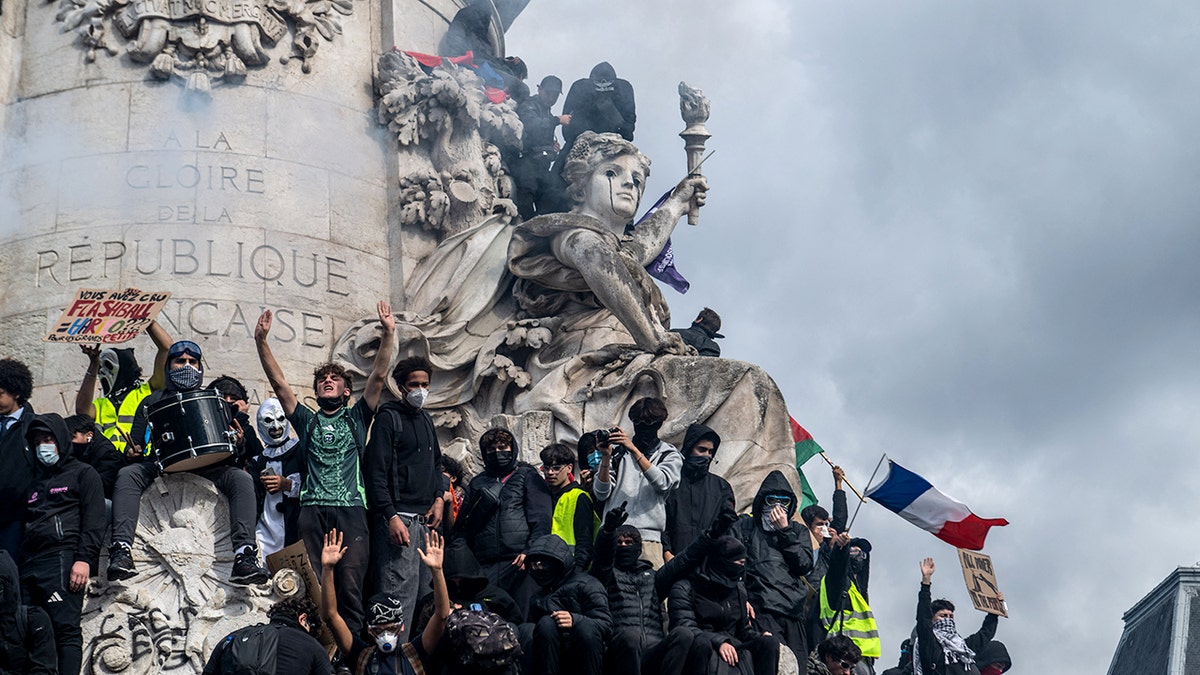
France saw another nationwide round of demonstrations on Saturday, October 24, 2026, driven by concerns over the cost of living, inequality, education funding and public services. The Interior Ministry estimated that 410,000 people protested, including about 110,000 in Paris, while the CGT union put participation at roughly 800,000 nationwide and 250,000 in the capital. Most marches were peaceful, but clashes occurred in Paris, Marseille, Lyon, Bordeaux, Grenoble and other cities. In Paris, police used tear gas and water cannon against a group of hooded youths who threw stones. In Marseille, demonstrators blocked a street, set rubbish bins alight and threw objects at police; authorities also reported looting at two jewelry shops. Police used tear gas in several other cities. Despite the disorder, violence was less severe than the previous weekend, when looters and vandals caused extensive damage, including a fire at Limoges’ historic city hall and attacks on businesses in Lyon. The movement began last month with high school students protesting poor conditions, teacher shortages and inadequate facilities in a Paris suburb. It has since broadened into a nationwide campaign involving students, unions, politicians and Yellow Vest supporters, with demonstrations also calling for better purchasing power and social and fiscal justice. The protests unfolded amid France’s economic and political difficulties. Government borrowing costs have risen, with the 10-year bond yield exceeding 5% for the first time since 2002 and settling at about 5.03% on Friday. Some investors worry that France’s debt troubles could affect the wider euro zone. The accompanying photographs show confrontations between police and protesters, signs expressing discontent, and families and young people taking part in the marches.
Entities: France, Paris, Marseille, Limoges, Lyon • Tone: neutral • Sentiment: negative • Intent: inform
25-10-2026
Marine Le Pen launched her French presidential campaign at a rally in Orléans, where she addressed thousands of National Rally supporters and promised a “rebirth of France” and a change of political direction. With the May 2027 election six months away, she is leading in the polls. She emphasized national identity, security, and what she described as restoring the rule of law, criticizing the justice system under President Emmanuel Macron as too lenient. Her proposals include ensuring that cases are brought and sentences carried out, expelling foreign offenders, and establishing what she called a “double border: French and European.” She also said France should not send its young people to fight in wars she considers reckless or unrelated to French interests, without explicitly naming Ukraine.
National Rally president Jordan Bardella introduced Le Pen, sharply criticizing the government’s handling of recent violence and accusing the left-wing France Unbowed party and its leader, Jean-Luc Mélenchon, of encouraging insurrection. Bardella’s speech was briefly interrupted by Jewish student activists displaying a banner about allegations that he had deleted antisemitic messages from an old Facebook account. The allegations were attributed to reporting by Mediapart; Bardella rejects them. The Union of French Jewish Students later confirmed its activists had staged the protest.
The rally followed Bardella’s re-election as party leader, with 98.98% of the vote. The article describes the pair’s roles as a “winning ticket”: Le Pen will run for president, while Bardella could become prime minister in a National Rally government. Le Pen said she wants a national-unity government led by Bardella and has stepped down as head of the party’s parliamentary group to focus on campaigning.
Organisers said 8,500 supporters attended the rally. Supporters interviewed cited security, jobs, housing, and purchasing power, while protests elsewhere against living costs, fuel prices, and education funding drew between 410,000 and 800,000 people, according to the article. Most demonstrations were peaceful, though sporadic clashes led to 1,314 arrests. The supplied article ends mid-sentence while describing a small unauthorised march in Orléans.
Entities: Marine Le Pen, Jordan Bardella, Emmanuel Macron, Jean-Luc Mélenchon, Sébastien Chenu • Tone: neutral • Sentiment: neutral • Intent: inform
25-10-2026
More than 1,300 people were arrested across France on Saturday as over 400,000 people joined a new wave of mass protests. The demonstrations followed violent cost-of-living protests and riots the previous weekend, prompting authorities to significantly increase security. About 70,000 law enforcement officers were mobilised, with military personnel from Opération Sentinelle also deployed to protect key locations and support police.
Most demonstrations proceeded peacefully, but clashes occurred in several cities, including Paris, Marseilles, Lyon, Bordeaux, Toulouse and Rennes. In Paris, a Euronews journalist witnessed riot police firing tear gas and charging crowds near Porte de Vincennes, while some protesters launched fireworks at officers. Police also used a water cannon and checked people near Nation square.
Interior Minister Laurent Nuñez thanked officers and authorities for their work, while accusing far-left and radical far-left individuals of trying to cause disorder as marches dispersed. He described the reported acts as unacceptable and cited several cities where incidents occurred. The Yellow Vests movement has called for further demonstrations on 31 October.
Authorities were also monitoring a National Rally party congress in Orléans, where supporters and counterprotesters gathered. The party planned a major rally for Sunday to launch Marine Le Pen’s presidential campaign. Regional authorities said 3,000 law enforcement and emergency personnel were deployed in the city as 13,000 demonstrators marched there.
Entities: France, Paris, Orléans, Laurent Nuñez, Marine Le Pen • Tone: analytical • Sentiment: negative • Intent: inform
25-10-2026
The article describes how European governments are responding to protests and clashes that began in France in mid-September and spread to other countries. It says the initial demonstrations involved students protesting school conditions, while protests elsewhere have reflected local concerns. U.S. President Donald Trump attributed France’s unrest to immigration and called for border closures; French President Emmanuel Macron rejected foreign commentary as “unacceptable and even stupid,” accusing outsiders of exploiting the crisis for political purposes.
In France, Macron promised accountability for looting and property destruction. Authorities deployed 70,000 police officers as demonstrations took place in Paris and other cities, including Lyon, Lille, Toulouse and Nantes. Police used tear gas, sound grenades and water cannons, and the Interior Ministry reported more than 1,300 arrests. Although most union-organized marches were peaceful, clashes occurred later in several cities. A French intelligence assessment reportedly identified Antifa and other far-left groups as instigators of some violence.
Italy adopted a particularly firm approach. Prime Minister Giorgia Meloni condemned violent demonstrators, sent 500 additional soldiers to Milan after looting and clashes, and approved tougher penalties for minors involved in vandalism. In Greece, officials affirmed the right to lawful protest while condemning violence and maintaining a visible police presence; demonstrations there had largely remained peaceful. In Belgium, protests against education reforms and budget cuts led to clashes, injuries, damage and nearly 200 arrests. Interior Minister Bernard Quintin accused far-left activists, including people linked to Antifa, of encouraging violence.
The article also reports that protests in Albania’s capital, Tirana, broadened from student-led demonstrations into demands for Prime Minister Edi Rama’s resignation, amid accusations of corruption and neglect of schools. Overall, it focuses on the varied responses of European leaders and police as unrest and public demonstrations spread.
Entities: France, Emmanuel Macron, Donald Trump, Italy, Giorgia Meloni • Tone: analytical • Sentiment: negative • Intent: inform
25-10-2026
French police arrested 1,314 people during protests held across the country on Saturday, October 24, according to the interior ministry. The demonstrations, driven by rising living costs and held in major cities, were largely calm, but clashes and other violence occurred on their margins. The ministry reported that 53 officers were injured, police responded to 75 fires, and 24 shops were looted. It did not provide a total for injured protesters. The arrests came during a second consecutive weekend of unrest, as France prepares for presidential elections in April and May to choose a successor to President Emmanuel Macron, who is reaching his two-term limit.
Authorities said several investigations had been opened but did not give further details. Interior Minister Laurent Nuñez said late Saturday that two protesters had suffered serious injuries, one in Toulouse and one in Clermont-Ferrand. The Toulouse prefecture said a 20-year-old man had a serious hand injury. A street medic told AFP anonymously that the man had lost several fingers. Officials in the Clermont-Ferrand area said another man injured his hand but did not lose any fingers.
La Nouvelle République also reported that a 19-year-old man in Poitiers was injured in his left eye during a riot-police charge involving stun grenades and tear gas. Its photographer told AFP about the incident. The article notes that people have been maimed by police stun or tear-gas grenades at several student protests in recent weeks, but says it was not known whether Saturday’s reported injuries were caused by those weapons. Officials said investigations were underway in at least some cases.
Entities: France, French interior ministry, Laurent Nuñez, Emmanuel Macron, Toulouse • Tone: analytical • Sentiment: negative • Intent: inform
25-10-2026
The France 24 item reports on the second day of the National Rally’s party congress in Orléans, south of Paris. Marine Le Pen was expected to deliver a speech later that afternoon officially launching her presidential campaign, while Jordan Bardella was set to be re-elected as party leader. The item also notes that a large counter-demonstration against the far right had taken place in the city on Saturday. Reporter Antonia Kerrigan was following developments. The headline frames the report around Le Pen’s claim that visible policing helps protests proceed smoothly, but the supplied article text does not include the underlying quote or further details about policing, protest conditions, or any clashes. As presented, the item is a brief video-news introduction rather than a full account: it establishes the political setting, identifies the main figures and events, and directs attention to the accompanying video. It provides no additional explanation of the counter-demonstration or the expected campaign speech.
Entities: Marine Le Pen, Jordan Bardella, Antonia Kerrigan, National Rally, Orléans • Tone: neutral • Sentiment: neutral • Intent: inform
25-10-2026
France experienced another nationwide day of protests on Saturday, October 25, 2026, as more than 400,000 people took to the streets over the rising cost of living and school funding. According to the report, most demonstrations remained peaceful. The protests took place one week after riots and looting had affected several cities, providing a tense backdrop to the marches.
Despite the largely peaceful character of the demonstrations, violence broke out on the sidelines of some protests. Police said more than 1,300 people were arrested across the country. The headline gives the figure as 1,314 arrests. The report does not specify the locations or circumstances of individual arrests, nor does it provide further detail about injuries or property damage.
The France 24 item is a brief video report presented by Caroline Baum. Its focus is the contrast between the large turnout and peaceful majority of the marches, and the violence and arrests reported at their margins. The stated causes of the demonstrations are the cost of living and school funding; the supplied article does not identify particular organizers, policy proposals, or government responses. Related links on the page refer to other French political and protest coverage, but they are not part of this article.
Entities: France, Caroline Baum, France 24, Paris, nationwide protests • Tone: neutral • Sentiment: negative • Intent: inform
25-10-2026
Marine Le Pen, leader of France’s far-right National Rally, launched her presidential campaign with a rally in Orléans on Sunday, addressing approximately 10,000 supporters. The event took place one day after cost-of-living protests across France flared into violence. The report says Le Pen, described as the election frontrunner, appears to be gaining support in opinion polls amid the weeks of unrest. Andrew Smith, a lecturer in Liberal Arts at Queen Mary University of London, is introduced as providing further analysis. The supplied article text does not include Smith’s analysis or additional detail about the protests, the campaign speech, or the polling figures. It frames the campaign launch around the relationship between public unrest and Le Pen’s political position, without presenting further evidence or commentary in the excerpt.
Entities: Marine Le Pen, National Rally, France, Orléans (Orleans), Andrew Smith • Tone: analytical • Sentiment: neutral • Intent: analyze
25-10-2026
Marine Le Pen, leader of France’s far-right National Rally (RN) and the polling frontrunner, launched her presidential campaign in Orleans on October 25, 2026, addressing around 10,000 supporters. The event took place amid weeks of unrest over the rising cost of living, including nationwide demonstrations the previous day in which more than 400,000 people marched. Clashes followed after masked groups broke away from protests; police made more than 1,300 arrests, and Interior Minister Laurent Nuñez blamed much of the violence on “ultra-left” extremists. Protests the week before had also turned violent, following student demonstrations about the state of French schools. Unions and Yellow Vest activists say they will continue street action as the election approaches.
Le Pen has accused President Emmanuel Macron’s centrist government of lacking authority and being too soft on violent protesters. The RN has emphasized its support for police and law-and-order credentials. In Orleans, police managed traffic as anti-fascist counter-protests took place. A Saturday march drew an estimated 13,000 people according to police, while organizers put the figure at twice that. Protesters voiced concern about the atmosphere and policies that could follow a National Rally victory.
Le Pen has promised measures to reduce living costs, including capped household energy bills, tax cuts, and a reduction in France’s contribution to the European Union. She is also critical of NATO and French support for Ukraine. An Ipsos poll published Saturday put her at 32–34 percent in the first round, while also finding widespread anger over the unrest and a majority assigning responsibility for the crisis to the government.
The article notes that the next president will have little room for new spending because France’s debt and deficit already exceed EU limits, while Macron’s government is struggling to pass a cost-cutting budget. Macron faces pressure to restore order while continuing dialogue with unions and students. Rights groups and protesters say the government is restricting the right to demonstrate. The Yellow Vests have called for another protest day the following Saturday, and the CGT union is urging strikes from November 5.
Entities: Marine Le Pen, Emmanuel Macron, Laurent Nuñez, Antonine Rochet, National Rally (RN) • Tone: analytical • Sentiment: negative • Intent: inform
25-10-2026
A New York Post reporter describes how a large protest in Paris began as an orderly march but ended in a violent confrontation after dark. The reporter was among mostly masked demonstrators in eastern Paris when tear gas suddenly caused coughing and a burning, constricted feeling in the throat. The march had started at Porte d’Italie after police changed its approved route the previous night, citing concerns about securing the original route through central Paris. The new path passed mainly through residential blocks rather than commercial streets, and residents watched tens of thousands of marchers from their balconies.
The reporter says the demonstration remained largely peaceful during its nearly three-hour journey to Porte de Vincennes. At the endpoint, riot and military police appeared ready to intervene quickly if the crowd became disorderly. For close to another hour, demonstrators chanted, danced, and jumped, and the reporter considered moving elsewhere to see what was happening. The atmosphere changed as many marchers boarded the metro to leave and a different group arrived. These newcomers wore face coverings and gas masks, carried no visible signs identifying a cause, and appeared purposeful.
The violence began with loud bangs after masked rioters threw rocks and fireworks at police. Officers responded with tear gas and sound grenades. Smoke filled the streets as police tried to push the masked group back, transforming what had been a peaceful march into a chaotic clash. The article situates the protest within demonstrations that began the previous week over France’s high cost of living and notes that unrest had also occurred during the preceding weekend.
Entities: Paris, Porte d’Italie, Porte de Vincennes, Place de la Bastille, Place de la Nation • Tone: emotional • Sentiment: negative • Intent: inform
25-10-2026
French protest groups and trade unions called for more demonstrations after nationwide rallies on Oct 24, where 410,000 people participated, according to the Interior Ministry. A deployment of 70,000 police helped prevent a repeat of the widespread looting and vandalism seen during protests on Oct 17. Authorities reported 1,314 arrests and about 50 injured police officers on Oct 24—both substantially lower figures than the previous week—though clashes still occurred in Paris, Marseille and other cities.
Labour leaders urged people to demonstrate again on Oct 31 and called for a nationwide strike on Nov 5. They said anger over wages, the cost of living and public services had spread beyond the students who first mobilised in September. The SUD Education union plans to join the Oct 31 march, while the CGT had yet to decide. The Yellow Vests, a movement that began in 2018 in opposition to fuel taxes, also called for rallies and sit-ins.
President Emmanuel Macron faces limited options to meet protesters’ demands. Unlike in 2019, when he could fund measures to reduce fuel costs, strained public finances now constrain his response. His mandate expires next April, and his centrist party lacks a parliamentary majority to pass major legislation. Government talks with unions and student representatives have begun, but protest leaders say proposed measures are inadequate. Police unions also warned that they cannot sustain the unusually large deployment for long.
The unrest is part of a broader wave of demonstrations in Europe. Belgian police used tear gas and pepper spray during clashes with anti-government protesters in Brussels, while protests in Albania and Italy have also involved violence or ongoing skirmishes.
Entities: Emmanuel Macron, Murielle Guilbert, Azelma Sigaux, France, Paris • Tone: analytical • Sentiment: negative • Intent: inform
25-10-2026
The article reports on two linked developments: US President Donald Trump’s criticism of France’s immigration policies and mass protests in France over the cost of living and education funding. Speaking at a campaign rally for Republican candidates in Perry, Georgia, Trump said France was “burning down” because it had opened its borders to people who hate the country. He used the unrest to argue for restrictive US immigration policies as early voting began for the November 2026 midterm elections.
In France, Interior Minister Laurent Nunez said nearly 1,000 people had been arrested during demonstrations on Saturday, with the total expected to rise. The French government estimated turnout at 410,000, while organisers put it closer to 800,000. Although some gatherings started peacefully, confrontations with police intensified in Paris and other cities, including Lyon, Lille, Marseille, Montpellier, Nantes and Toulouse. Police used water cannons and tear gas after projectiles were thrown, and authorities reported rioting near the end of the Paris march.
The article also describes a dispute over foreign leaders’ comments on the unrest. French President Emmanuel Macron criticized leaders who, he said, were exploiting events in France for political purposes, and rejected claims of visible foreign interference while condemning misinformation circulated afterward. He confirmed that Trump was among those he had in mind. Israeli Prime Minister Benjamin Netanyahu separately accused France of failing to confront what he called extremist Islam.
The protests began more than a month earlier with students’ concerns about school conditions, teacher shortages, schedules and educational inequality. They later widened into a national movement involving unions, left-wing political groups, students, activists, nongovernmental organizations and the Yellow Vests. The article presents the unrest as both a domestic response to economic and education concerns and a subject of international political controversy.
Entities: Donald Trump, Emmanuel Macron, Benjamin Netanyahu, Laurent Nunez, France • Tone: analytical • Sentiment: negative • Intent: inform