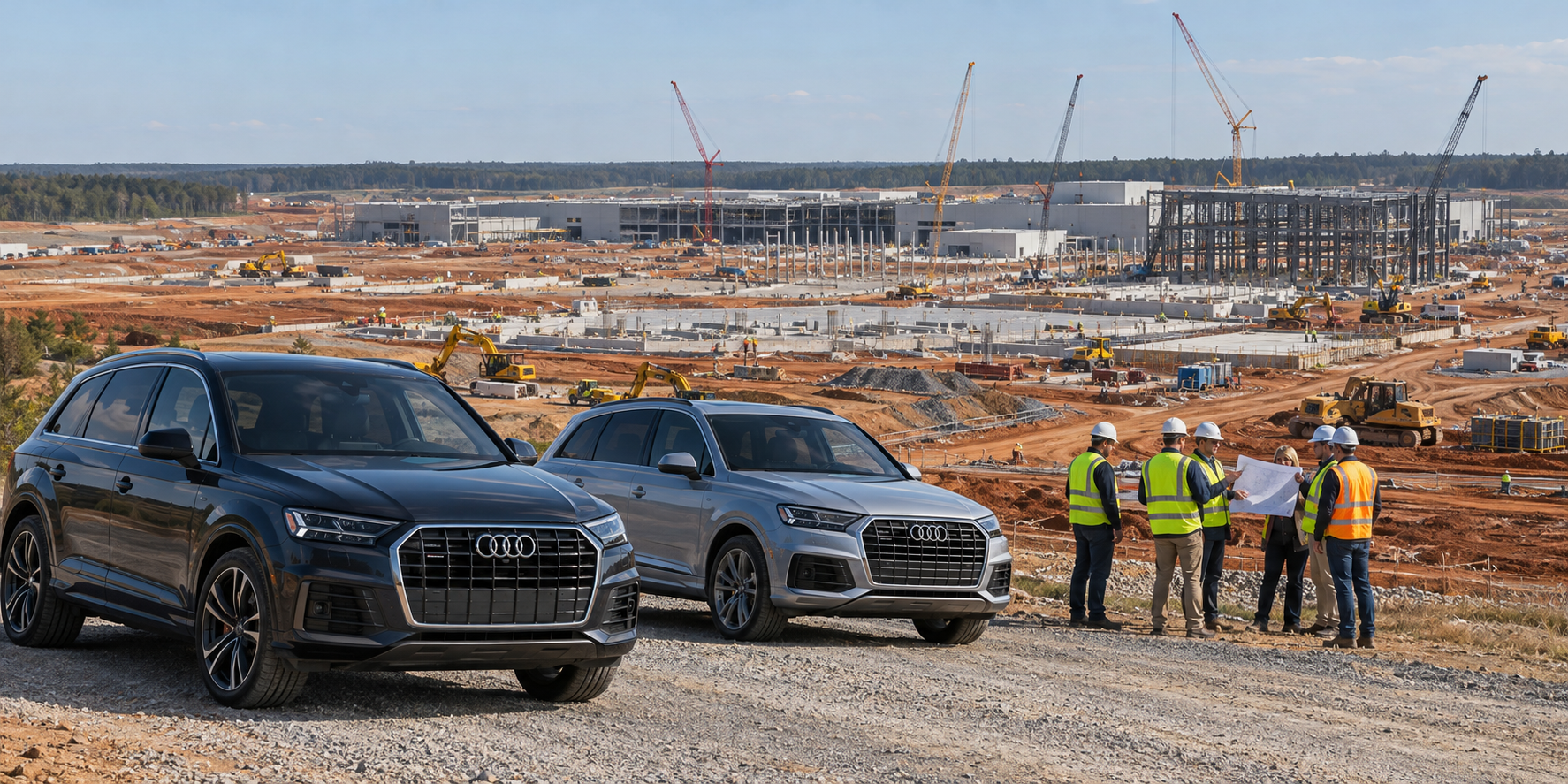
Audi premium SUVs displayed beside a vast Georgia manufacturing site under development, engineers and construction crews surveying the Middle Georgia Megasite as cranes, earthmoving equipment, and factory foundations signal a planned automotive investment, documentary photojournalism with realistic industrial details, wide-angle 35mm lens, clear natural daylight and soft shadows, conveying measured progress and economic transformation in Peach County.
Summary
Audi plans to invest about $4 billion in its first company-owned U.S. manufacturing plant at the Middle Georgia Megasite in Peach County, Georgia. Preparatory work is expected to begin in 2027, with production targeted for the early 2030s—Georgia officials cite 2031—and capacity of up to 200,000 vehicles annually. The factory is expected to assemble premium SUVs, including the Q7, Q8 and Q9, and create about 4,500 jobs; Audi says roughly half of its output could be exported. The investment is intended to expand Audi’s presence in the important U.S. premium-car market and reduce exposure to tariffs, currency movements, and supply-chain disruption. Tariffs reportedly cost the company about €1.2 billion last year, but Audi also cited market access, infrastructure, suppliers, and workforce as factors in choosing Georgia. President Donald Trump presented the project as evidence that his tariff policies are attracting manufacturing, while Audi CEO Gernot Döllner characterized it as the result of a multiyear business process rather than a political decision. Audi says the U.S. plant will complement, not replace, Germany’s role in vehicle development and technology, as the Volkswagen Group faces restructuring and planned job cuts and plant closures in Germany. The project also requires approval from relevant Volkswagen bodies.
Key Points
- Audi plans a roughly $4 billion Georgia factory with capacity for up to 200,000 vehicles a year and approximately 4,500 jobs; production is targeted for the early 2030s.
- The plant is expected to build the Q7, Q8 and Q9 SUVs, with Audi indicating that about half of production may be exported.
- Local production could help Audi avoid some import tariffs and reduce currency and supply-chain risks; tariffs cost the company about €1.2 billion last year, but were not the sole factor behind the decision.
- Trump announced the project at a Georgia rally and credited tariffs, while Audi described the investment as a multiyear commercial decision involving market access and Georgia’s industrial advantages.
- Audi says Germany will remain central to its operations even as the investment raises questions about Volkswagen Group’s allocation of manufacturing and employment between the United States and Germany.