25-06-2026
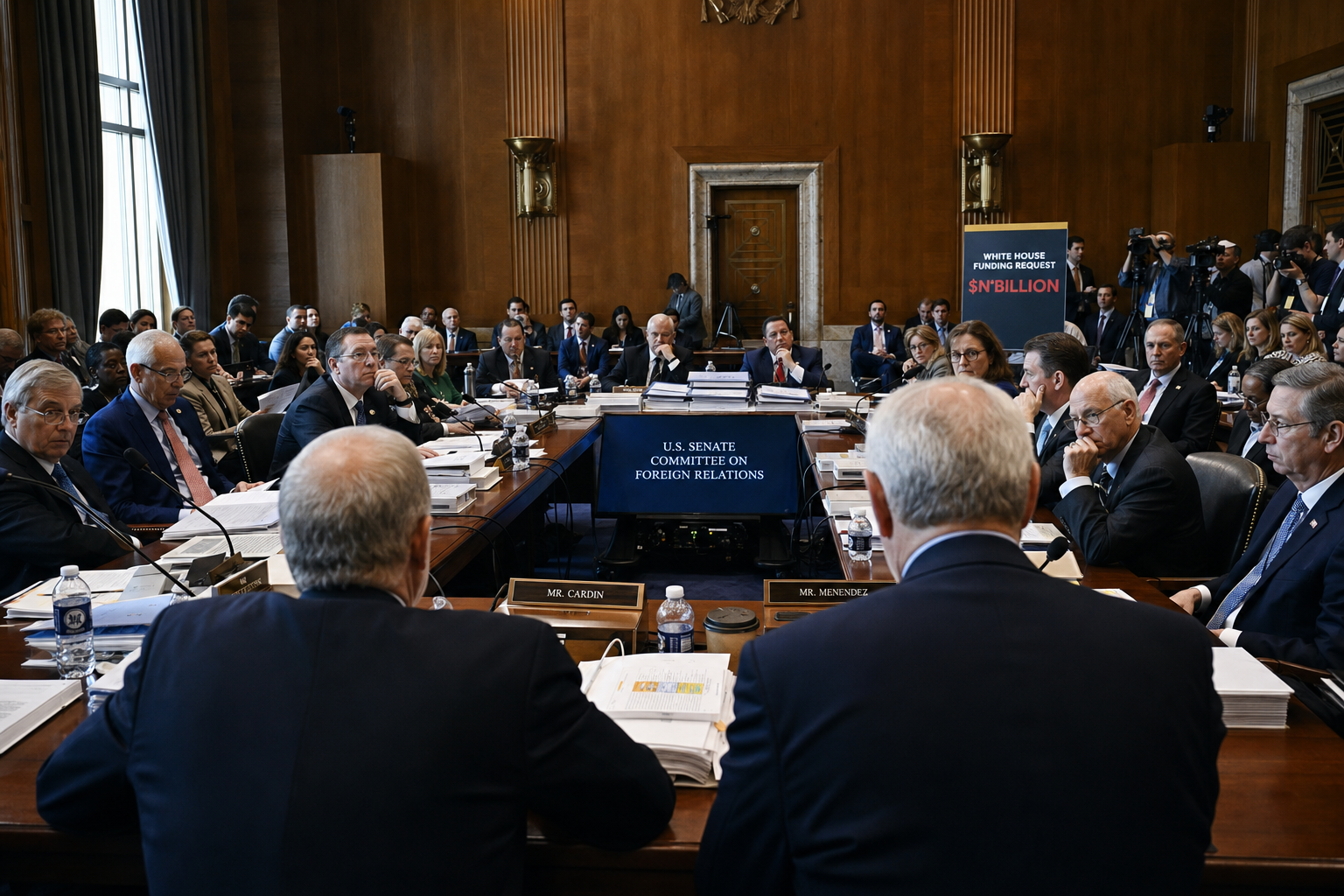
The article reports that the White House has asked Congress to approve $87.6 billion in additional funding, most of it tied to the costs of the US war on Iran and related military needs. The largest share, $67 billion, would go to the Defense Department for munitions, operational costs, classified programs, and embassy security in the Middle East and South Asia. The request also includes money for unrelated domestic and international priorities, such as support for US farmers and Ebola response efforts in Central Africa.
The funding request arrives amid political friction in Washington. Congress recently passed a largely symbolic resolution rebuking the war and attempting to restrict the president’s war powers, and the White House faces an uphill battle in securing approval because the conflict is unpopular with voters and midterm elections are approaching. The article also describes tension between Trump and congressional Republicans, including a heated exchange at a Capitol Hill luncheon and Trump’s criticism of senators who voted with Democrats. Meanwhile, officials say the ceasefire with Tehran is holding, but the Pentagon still needs to rebuild stocks after military strikes. The piece notes that the war’s cost has already reached about $29 billion, though lawmakers and analysts believe the true financial burden is much greater.
Entities: Donald Trump, Congress, White House, Mike Johnson, US Department of Defense • Tone: analytical • Sentiment: negative • Intent: inform
25-06-2026
The Senate approved a House-passed war powers resolution aimed at limiting President Trump’s military actions involving Iran, making it the first such measure to clear both chambers of Congress. The 50-48 vote exposed a rare bipartisan break with the president: four Republicans joined most Democrats in support, while one Democrat opposed and two Republicans were absent. The resolution directs the president to remove U.S. forces from hostilities against Iran unless Congress formally authorizes military force or declares war. Although the measure carries legal significance under the War Powers Resolution of 1973, the article notes that it is likely to remain largely symbolic because the Trump administration argues U.S. forces are not currently engaged in hostilities with Iran and has questioned the constitutionality of the War Powers Resolution itself. Trump responded angrily on Truth Social, calling the vote “poorly timed and meaningless.”
The article places the Senate vote in a broader political context, describing it as the tenth time Senate Democrats have forced a war powers vote since the conflict began in late February. House and Senate Democrats, led by Rep. Gregory Meeks and Sen. Chuck Schumer, framed the measure as a necessary assertion of congressional authority over war powers and a way to pressure Republicans to take a public stand. The House had already passed the measure on June 3 after multiple earlier failed attempts and after GOP leaders briefly delayed the vote when they lacked the support to block it. The article also notes that a separate war powers measure led by Sen. Tim Kaine remains alive in the Senate and could be brought up again if Democrats continue to win over more Republican support.
Entities: Senate, House of Representatives, President Trump, Iran, War Powers Resolution of 1973 • Tone: analytical • Sentiment: neutral • Intent: inform
25-06-2026
The Senate rejected a Democratic measure aimed at limiting President Donald Trump’s authority to use military force against Iran, delivering a win for the White House and Senate Republican leadership. The procedural vote failed 50-47, after some Republicans who had previously supported similar efforts changed their positions or abstained. Sens. Susan Collins and Lisa Murkowski again voted with Democrats to advance the resolution, while Sen. Rand Paul voted present and Sen. John Fetterman voted no.
The defeated resolution, led by Sen. Tim Kaine, would have required Trump to remove U.S. armed forces from hostilities involving Iran unless Congress authorized continued action. Unlike a separate House-passed war powers measure, the Kaine resolution would have required the president’s signature if it had cleared both chambers. Its practical effect remained uncertain, since Trump was likely to veto it and his administration argued that the U.S. was no longer engaged in hostilities after a ceasefire. The administration also continued to challenge the constitutionality of the 1973 War Powers Resolution.
The vote came amid rising tensions between Trump and senators over Iran policy. Trump reportedly clashed with GOP senators during a Capitol Hill lunch, including a heated exchange with Sen. Bill Cassidy. However, some senators later softened their positions after briefings from Vice President JD Vance and special envoy Steve Witkoff. Rand Paul said he wanted to give Trump more space to negotiate a lasting peace, and Cassidy said the White House briefing addressed many of his concerns. Senate GOP leaders, including Majority Whip John Barrasso, worked to secure enough votes to defeat the measure. Trump later praised the Senate result on Truth Social, saying it put Iran on notice.
Entities: Donald Trump, Tim Kaine, Susan Collins, Lisa Murkowski, Rand Paul • Tone: analytical • Sentiment: neutral • Intent: inform
25-06-2026
The article reports that the Trump administration has sent Congress a supplemental funding request totaling about $87.6 billion to cover costs tied to the Iran war, Ebola response efforts in Central Africa, and aid for U.S. farmers. The bulk of the request, roughly $67 billion, would go to the Pentagon for munitions, operational costs, and classified programs, with additional funds for the Department of Energy and State Department related to Iran and embassy security. The package also includes $11.1 billion in farm aid, $1.4 billion for Ebola response in the Democratic Republic of the Congo, Uganda, and elsewhere, and a proposal to permanently allow year-round E15 ethanol sales in order to help lower gas prices. The request is expected to face serious resistance in Congress, especially from Democrats and some Republicans who are wary of further support for an unpopular war. Senate Minority Leader Chuck Schumer and Sen. Patty Murray sharply criticized the proposal as an attempt to funnel money into unrelated Pentagon priorities and continue a costly war, while GOP Sen. Roger Wicker defended the funding as necessary to accelerate production of weapons systems and drones. The article frames the request as politically difficult and uncertain to pass, particularly in the Senate.
Entities: Donald Trump, Trump administration, Congress, Pentagon, Iran war • Tone: analytical • Sentiment: negative • Intent: inform
25-06-2026
CNN’s article describes a heated confrontation at the U.S. Capitol between President Donald Trump and Sen. Bill Cassidy, one of the Louisiana senator’s last major public clashes with Trump after Trump effectively ended Cassidy’s congressional career in a primary fight. During a closed-door lunch with Senate Republicans, Trump angrily confronted Cassidy and other GOP senators over a recent vote to limit Trump’s war powers in Iran. Cassidy said he challenged Trump on the lack of transparency about the Iran operation, and the exchange escalated into a shouting match, with Trump calling Cassidy a “lunatic” and Cassidy shouting back before eventually sitting down to de-escalate.
The article places the confrontation in the broader context of growing frustration among Senate and House Republicans over Trump’s unpredictable behavior and his tendency to pursue personal priorities that do not align with the party’s legislative strategy. GOP leaders are trying to focus on kitchen-table issues and the midterms, but Trump remains fixated on a sweeping elections overhaul measure, the SAVE America Act, which lacks enough Senate support. Trump also expressed anger over Republicans who voted to rebuke his Iran policy, including Cassidy, while later softening slightly and saying the meeting went “really great.”
The piece also shows internal Republican divisions: some senators and aides believe Trump is receiving bad advice, while loyalists like Sen. Rick Scott and Sen. Tommy Tuberville tried to support Trump’s push for the elections bill. Yet even Scott acknowledged the reality that the votes are not there. Overall, the article portrays a party struggling to manage Trump’s influence, an increasingly strained relationship between Trump and Senate Republicans, and a GOP trying to avoid public conflict while navigating a volatile political and legislative environment.
Entities: Donald Trump, Bill Cassidy, U.S. Capitol, Senate Republicans, Iran • Tone: analytical • Sentiment: negative • Intent: inform
25-06-2026
The article reports that the U.S. Senate, one day after narrowly adopting a war powers resolution aimed at limiting President Donald Trump’s military authority over Iran, reversed course by voting down an attempt to advance a similar measure. The late-night vote, 47-50-1, reflected changing positions among some Republicans after Trump publicly criticized GOP lawmakers who supported earlier Iran-related war powers actions. Sens. Rand Paul and Bill Cassidy, both of whom had previously backed efforts to rein in Trump’s war powers, altered their votes on Wednesday: Paul voted present, while Cassidy voted against advancing the resolution.
The article describes a tense political standoff between Trump and Senate Republicans, including a luncheon on Capitol Hill where Cassidy confronted the president over what he said was a lack of transparency about the Iran conflict and the administration’s objectives. Later, Cassidy said he had received a detailed briefing from Vice President JD Vance and special envoy Steve Witkoff, suggesting his concerns were partially addressed. Paul said his underlying view on executive power had not changed, but he voted present to give Trump “more space and leverage” in negotiations and to account for the president’s request that he consider the administration’s position.
The piece also notes Trump’s public anger at Republicans who supported war powers measures, including criticism of absent senators and disparaging language toward lawmakers who backed the earlier Senate and House resolutions. At the same time, Democrats such as Sen. Tim Kaine continued to argue that Congress should assert its authority over military action involving Iran, even amid a preliminary agreement. Overall, the article highlights an ongoing struggle over constitutional war powers, Senate party discipline, and the scope of Trump’s authority in U.S.-Iran policy.
Entities: Donald Trump, Rand Paul, Bill Cassidy, Susan Collins, Lisa Murkowski • Tone: analytical • Sentiment: neutral • Intent: inform
25-06-2026
The article describes how Senate Republicans, after angering President Trump by joining Democrats in backing a war powers resolution related to the war in Iran, quickly moved to reverse course in a largely symbolic procedural vote. The reversal came after a tense private lunch in which Trump berated GOP senators, singled out several by name, and sparred with Senator Bill Cassidy over the administration’s handling of the war and the lack of a full briefing. Hours later, Cassidy changed his vote after a White House briefing with Vice President JD Vance and special envoy Steve Witkoff, while Senator Rand Paul switched to “present,” saying Trump’s arguments affected his vote, though not his views on Congress’s war powers.
Despite Republican leaders’ efforts to stage a “re-vote,” the new vote did not erase Tuesday’s successful war powers resolution, which remains adopted. Senator Tim Kaine emphasized that the procedural maneuver did not change the status of his measure and could not simply undo the earlier vote. The sequence highlighted Republican leaders’ attempts to contain a public rupture between Trump and Senate Republicans skeptical of the war. The day also included Trump canceling a ceremonial bipartisan housing bill signing and instead pressing Republicans to advance an elections bill that lacked the votes to pass. The article ends by noting that tensions are likely to continue, especially after Trump requested an additional $87.6 billion in war-related and other spending, a proposal that appeared unlikely to advance in the Senate.
Entities: Donald Trump, Senate Republicans, Democratic senators, Bill Cassidy, Rand Paul • Tone: analytical • Sentiment: neutral • Intent: inform