25-06-2026
France’s record-breaking heatwave has reignited a long-running political and cultural debate over air conditioning, or "la clim," as temperatures near 40C force schools, hospitals, and households to confront conditions that many can no longer tolerate. The article explains how air conditioning has traditionally been viewed with suspicion by much of the French environmental movement, which argues that it treats the symptoms rather than the cause of global warming and can itself worsen emissions through electricity use, refrigerant gases, and urban heat discharge. But the scale and intensity of the current heatwave, which made Tuesday France’s hottest day on record, is pushing even some former opponents to accept that cooling systems may now be unavoidable in schools, hospitals, and other essential public spaces.
The debate has taken on a sharp political dimension. Marine Le Pen and the National Rally are calling for a nationwide, subsidized rollout of air conditioning, including interest-free loans for households and mandatory cooling in schools and hospitals. More centrist and conservative figures, such as Valérie Pécresse, also argue that the state must treat cooling as part of public infrastructure. On the left, some environmental leaders have softened their position, with Ecologists party head Marie Tondelier acknowledging that certain places can no longer do without air conditioning. The article presents this as evidence that France is moving toward a new consensus: while air conditioning is not a complete solution to climate change, it may be necessary to protect health, maintain schooling and public services, and prevent breakdown during extreme heat.
Entities: France, Europe, Paris, Brittany, Nantes • Tone: analytical • Sentiment: neutral • Intent: inform
25-06-2026
A severe heatwave has swept across western Europe, shattering temperature records and prompting widespread red and orange weather alerts, school closures, early museum shutdowns, and warnings about health and wildfire risks. France reported its hottest day ever, with the national temperature indicator reaching 30C and temperatures in parts of western France ranging from 39C to 43C. The heat caused major disruption in Paris, where the Louvre and Eiffel Tower closed early, while officials warned of increased dangers from heat-related drownings and forest fires. In the UK, June temperature records were broken as Gosport, Hampshire reached 36.1C, with even higher temperatures forecast. Spain also logged its highest daily average June temperatures on record, and Italy, Germany, the Netherlands, Belgium, and several eastern European countries issued or prepared heat alerts. The article links the extreme weather to climate change, noting Europe is warming twice as fast as the global average, and describes growing concerns over drought, water shortages, and the need for societies to adapt to more intense summer heatwaves.
Entities: France, United Kingdom, Spain, Italy, Germany • Tone: urgent • Sentiment: negative • Intent: inform
25-06-2026
France and much of Europe are enduring a severe, early-summer heat wave that has disrupted daily life, strained infrastructure, and contributed to deadly consequences. In France, officials reported 40 drowning deaths over the previous week, with many of the victims described as young people who sought relief from the extreme heat by swimming in unsupervised areas. French leaders warned that such behavior is dangerous, while the national weather service, Meteo France, said the heat had reached a ‘plateau of severity’ and that more record-breaking temperatures were likely, with highs above 104 degrees Fahrenheit in many places.
The heat wave has affected schools, public transportation, sporting events, and major cultural sites such as the Eiffel Tower and the Louvre, which adjusted schedules to cope with the conditions. France has already recorded its hottest June day and night on record, and officials compared the event to the deadly 2003 heat wave that killed an estimated 15,000 people in the country.
Elsewhere, the United Kingdom, Spain, Italy, and other parts of Europe are also facing dangerous temperatures. The U.K. issued red extreme heat warnings and saw train cancellations and school closures, while Spain issued red alerts for temperatures exceeding 110 degrees Fahrenheit in some areas. The article places the heat wave in the broader context of climate change, noting that Europe is warming faster than the global average and that heat-related deaths across the continent have been substantial and often preventable. Scientists and climate agencies warn that such extreme heat events are becoming more frequent, longer-lasting, and more intense.
Entities: France, Europe, Sébastien Lecornu, Marina Ferrari, Meteo France • Tone: urgent • Sentiment: negative • Intent: inform
25-06-2026
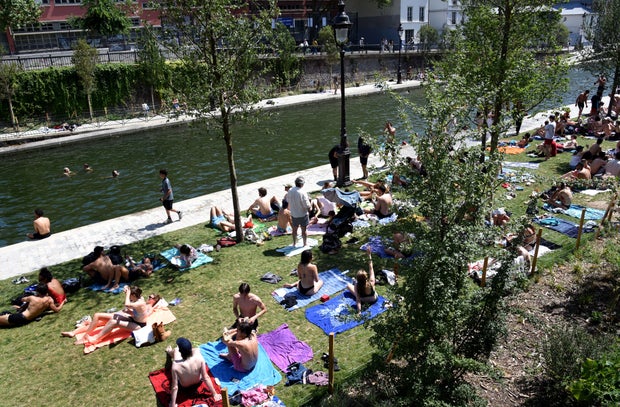
Paris is enduring an exceptionally severe heat wave, with temperatures in France reaching record June highs above 40 degrees Celsius. As people search for relief, many Parisians and visitors are jumping into the Canal Saint-Martin and other waterways, despite safety concerns and the fact that swimming is officially restricted in most of the canal. The article uses this scene to show how extreme heat is reshaping daily life in France, where infrastructure, schools, hospitals, and homes are not built for prolonged periods of intense heat.
The piece contrasts the improvisational, almost festive atmosphere along the canal with the seriousness of the broader crisis: the French government says 40 people drowned in heat-related accidents in just a few days, and officials are meeting repeatedly to manage the emergency. Public landmarks like the Louvre and the Eiffel Tower are adjusting hours, and a nuclear plant near Toulouse was shut down because river water became too hot for cooling. City officials in Paris have extended the time allowed for swimming in a short supervised stretch of the canal and added a shower for bathers, even as the waterway remains an industrial canal with risks such as debris and sewage overflow.
Through interviews with families, teachers, and tourists, the article shows how people are balancing danger against unbearable indoor heat. It also highlights the longer-term debate over climate adaptation in France, including calls for more resilient infrastructure, tree planting, cooling measures, and even paid time off for those most exposed to climate disruptions. Overall, the article presents the canal swimming trend as both a practical coping mechanism and a symbol of a country confronting the realities of climate change.
Entities: Canal Saint-Martin, Paris, France, Sébastien Lecornu, Météo France • Tone: analytical • Sentiment: neutral • Intent: inform
25-06-2026
The CNN video article explains that the United Kingdom is facing a rare and intense heatwave, with temperatures reaching around 100 degrees Fahrenheit, and is struggling because much of its infrastructure was not designed for extreme heat. The piece frames the heatwave as an example of how the UK’s buildings, transport systems, and broader public infrastructure are poorly adapted to conditions that are becoming more common as temperatures rise. CNN reports through Nada Bashir, emphasizing the unusual nature of the event and the pressure it places on daily life. The article is brief and video-driven, focusing less on detailed statistics and more on the core idea that the UK’s historical climate has left it vulnerable to heatwaves. The surrounding page includes other CNN video teasers, but the main story centers on the mismatch between UK infrastructure and increasingly severe summer heat.
Entities: United Kingdom, heatwave, extreme heat, temperature around 100 degrees Fahrenheit, infrastructure • Tone: analytical • Sentiment: neutral • Intent: inform