23-07-2026
The article reports that the United States and Saudi Arabia have signed a landmark nuclear cooperation agreement that would open the door to a civilian nuclear program in the kingdom and give American companies major access to Saudi Arabia’s nuclear energy sector. Although the full text of the deal was not released, media reports suggest it may eventually allow Saudi Arabia to enrich uranium domestically, a sensitive capability because it can be used both for civilian reactor fuel and, potentially, for nuclear weapons. That possibility has raised alarm among nuclear experts, former officials, and critics in Israel and the U.S., who argue it could set a precedent the United States has never before accepted and could increase proliferation risks in an already volatile Middle East.
The U.S. Energy Department said the agreement, together with a bilateral safeguards deal, creates a legal foundation for a decades-long, multi-billion-dollar partnership while maintaining nonproliferation standards. Saudi Arabia described it as an extension of existing energy cooperation. The announcement comes amid heightened regional tensions, including conflict with Iran and Houthi threats against Saudi Arabia. The article notes that the deal will be reviewed by Congress, where opposition is expected from lawmakers in both parties, despite Republicans controlling both chambers. Secretary of State Marco Rubio defended the agreement, insisting the United States would not enter any deal that creates proliferation risk.
The story also highlights the geopolitical significance of the agreement: Saudi Arabia has sought such a deal for years, and Washington had previously tied it to Saudi recognition of Israel. That condition now appears to have been dropped. The article concludes that the agreement may reshape Middle East power dynamics over time and underscores the role of nuclear policy in the broader U.S.-Iran-Saudi-Israel regional contest.
Entities: United States, Saudi Arabia, Donald Trump, Mohammed bin Salman, Marco Rubio • Tone: analytical • Sentiment: neutral • Intent: inform
23-07-2026
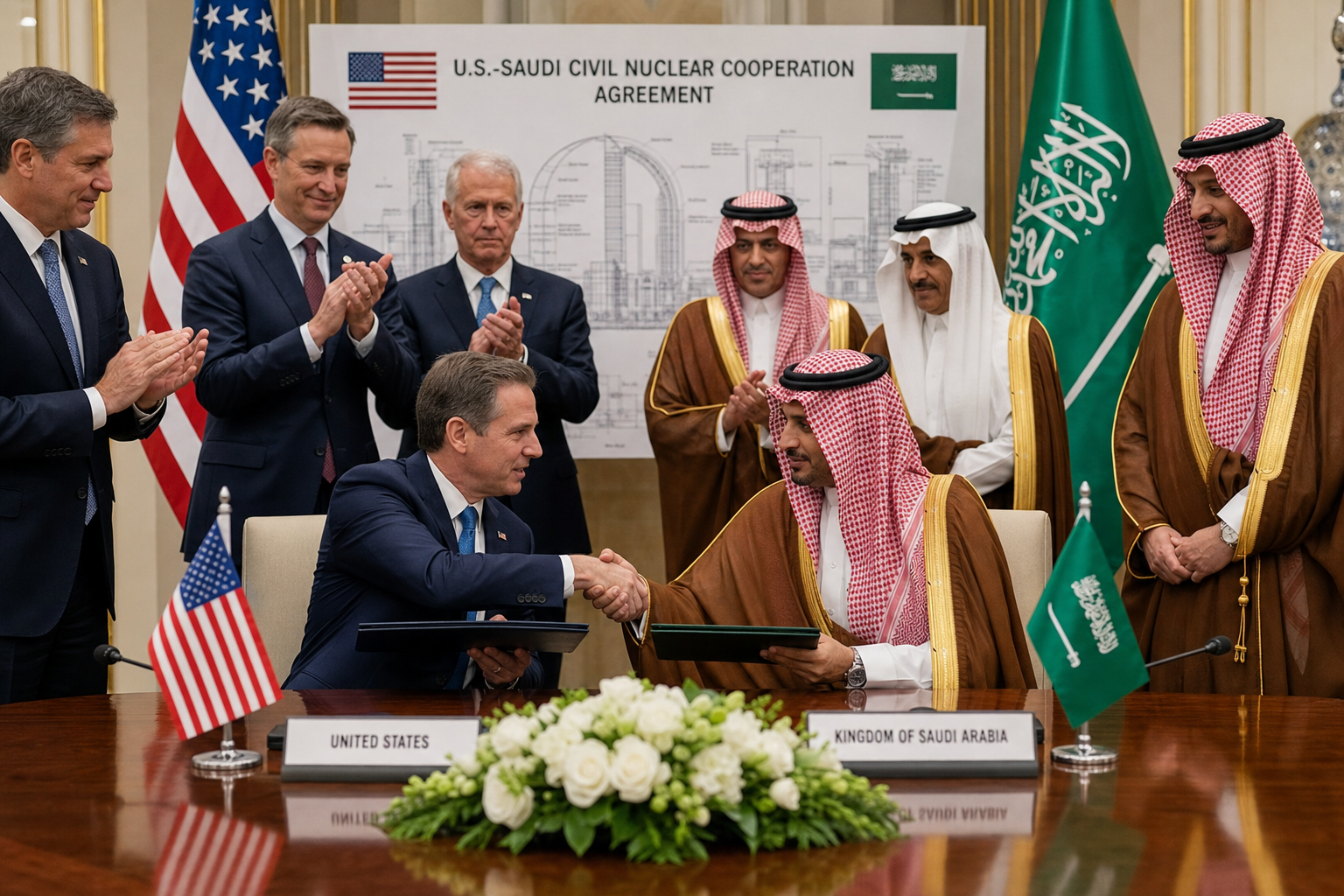
The article reports that the United States and Saudi Arabia have signed a commercial nuclear cooperation agreement that could pave the way for a civilian nuclear program in Saudi Arabia, potentially including uranium enrichment on Saudi soil under strict conditions. The deal was announced by the U.S. Department of Energy after Energy Secretary Chris Wright and Saudi Energy Minister Prince Abdulaziz bin Salman signed both a peaceful nuclear cooperation agreement and a safeguard agreement. According to the Energy Department, the pact is meant to establish the framework for a multibillion-dollar partnership, support Saudi energy capacity, and involve U.S. companies such as Westinghouse Electric Company. Officials emphasize that the arrangement is intended for civilian energy uses, not nuclear weapons, and that it will still require congressional review under a 1954 law governing nuclear cooperation agreements.
The article places the deal in broader geopolitical context. A similar framework was previously pursued under the Biden administration, when U.S. nuclear cooperation was tied to Saudi normalization with Israel and to Palestinian issues, but that effort stalled after Hamas’s Oct. 7, 2023 attack and the war in Gaza. The Trump administration’s version appears less directly tied to diplomatic conditions, though it is being framed as strengthening U.S.-Saudi ties and regional security amid tensions with Iran. The article also notes that the agreement could irritate Iran, which has long defended its right to a civilian nuclear program under the Non-Proliferation Treaty. Finally, it notes that Saudi Arabia would not be the first Gulf state to pursue civilian nuclear energy, citing the United Arab Emirates’ 2009 agreement with the Obama administration as an earlier precedent.
Entities: United States, Saudi Arabia, U.S. Department of Energy, Chris Wright, Prince Abdulaziz bin Salman • Tone: analytical • Sentiment: neutral • Intent: inform
23-07-2026
CNN’s Stephen Collinson argues that the new U.S.-Saudi civilian nuclear agreement is a vivid illustration of President Donald Trump’s presidency: transactional, disruptive, and willing to take major geopolitical risks with limited regard for long-term consequences. The article says the multi-billion-dollar, 30-year deal could strengthen U.S.-Saudi ties, boost the American nuclear industry, and prevent China from gaining influence in Riyadh. But it also raises serious proliferation concerns because the agreement may allow Saudi Arabia to enrich uranium without the stricter International Atomic Energy Agency Additional Protocol safeguards. Critics warn this could set a precedent for other states to seek similar exemptions, weaken global nonproliferation norms, and potentially accelerate a regional nuclear arms race, especially given Saudi Arabia’s rivalry with Iran and its stance that it would pursue a weapon if Iran did. The article places the deal in the broader context of Trump’s Middle East policy, including his escalated confrontation with Iran, his support for hardline Israeli policies, and his willingness to break from prior U.S. diplomatic conventions. Supporters argue Trump is correcting failed old policies through bold deals and deterrence, but the piece concludes that the long-term fallout of such risk-taking is uncertain and may prove dangerous.
Entities: Donald Trump, Saudi Arabia, Riyadh, Iran, Israel • Tone: analytical • Sentiment: neutral • Intent: analyze
23-07-2026
The article reports that the Trump administration has agreed to a nuclear technology deal with Saudi Arabia that loosens long-standing U.S. nonproliferation standards. In contrast to the hardline nuclear demands Trump has imposed on Iran—ending enrichment for decades and allowing highly intrusive inspections—the Saudi agreement would let the kingdom begin enriching its own nuclear fuel after a two-year study period and would exempt it from the Additional Protocol inspection regime used by more than 140 countries. The deal is intended to help American firms, including Westinghouse, win a major role in building two reactors in Saudi Arabia, with more business likely to follow.
The article argues that the decision could set a precedent with significant proliferation risks, especially in a Middle East already under extreme tension. Saudi officials have repeatedly signaled that they may seek a nuclear weapons capability if Iran advances toward a bomb, and experts warn that the arrangement could create a pathway to a Saudi bomb or encourage other countries to demand similar terms. Administration officials say the U.S. involvement will prevent diversion of nuclear material and that American technology offers the best safeguards. But critics note that nuclear history is full of examples where countries promised compliance and later pursued weapons in secret.
The piece places the deal in historical context by comparing it with stricter agreements such as the United Arab Emirates' “gold standard” deal and South Korea’s temporary restrictions. It concludes that the Saudi accord increases pressure on Trump to secure a hard, verifiable nuclear resolution with Iran, or else risk a broader proliferation cascade in the region.
Entities: Donald Trump, Saudi Arabia, Iran, Westinghouse, Chris Wright • Tone: analytical • Sentiment: negative • Intent: analyze