23-07-2026
New York City Mayor Zohran Mamdani has walked back an earlier campaign pledge that he would arrest Israeli Prime Minister Benjamin Netanyahu if Netanyahu visited New York City, saying he lacks the legal authority to do so. In a video posted Tuesday, Mamdani said his team had reviewed possible legal avenues and concluded that the city does not have independent power to enforce the International Criminal Court’s arrest warrant. He said the federal government does have such authority and urged US officials to join the ICC and carry out the warrant. The article explains that the ICC issued an arrest warrant for Netanyahu in 2024 over alleged war crimes in Gaza, and notes that the court’s jurisdiction applies to states party to the Rome Statute. It also places Mamdani’s reversal in the context of his prior campaign rhetoric, in which he repeatedly called Netanyahu a war criminal and said he would direct police to arrest him if he came to the city. The piece includes President Donald Trump’s response, in which he defended Netanyahu and said the Israeli leader would not be arrested in the United States. It also notes broader political context: rising concern among Democratic voters about US support for Israel and criticism from Israel’s UN ambassador, Danny Danon, who accused Mamdani of promoting Hamas propaganda.
Entities: Zohran Mamdani, Benjamin Netanyahu, International Criminal Court (ICC), New York City, Donald Trump • Tone: analytical • Sentiment: neutral • Intent: inform
23-07-2026
The article reports on a press exchange involving New York City Mayor Zohran Mamdani, who was asked whether he would have sought the arrest of Hamas leaders responsible for the October 7, 2023 attacks in Israel. The question was prompted by scrutiny over Mamdani’s earlier campaign vow to enforce the International Criminal Court’s arrest warrant for Israeli Prime Minister Benjamin Netanyahu if Netanyahu were to come to New York City. The piece notes that Mamdani has since acknowledged he does not have the legal authority to carry out such an arrest. The article frames the exchange as part of ongoing political pressure and debate surrounding Mamdani’s stance on international legal accountability, the Gaza/Israel conflict, and the practical limits of mayoral power. The content is presented as a short video news item, with the core focus on the reporter’s question and the contradiction between Mamdani’s campaign rhetoric and his later legal concession. Overall, it highlights the political and legal tension around selective enforcement claims and raises the broader issue of how elected officials address alleged war crimes and international arrest warrants within the constraints of local authority.
Entities: Zohran Mamdani, New York City, Hamas, October 7, 2023 attacks, Israel • Tone: analytical • Sentiment: neutral • Intent: inform
23-07-2026
Fox News reports on a sharp exchange between Israel’s UN ambassador Danny Danon and New York City Mayor Zohran Mamdani after Mamdani called for federal authorities to arrest Israeli Prime Minister Benjamin Netanyahu if he comes to New York for the UN General Assembly. Danon condemned Mamdani’s comments as a political “stunt,” calling him a “clown” and arguing that the mayor should focus on local issues such as homelessness, garbage, and protecting New York’s Jewish community amid rising antisemitism. The article says Mamdani had described Netanyahu as a “war criminal” and accused him of genocide, mass killings, attacks on hospitals, and blocking aid to Gaza, citing the International Criminal Court warrant as justification. Danon rejected those allegations as “blood libels,” insisted that humanitarian aid is entering Gaza, and argued that the ICC warrant has no legal force in the United States because the U.S. is not a member of the court. Netanyahu’s office likewise dismissed the ICC as lacking jurisdiction. The piece frames the dispute as part of a broader political and legal fight over the Gaza war, the ICC’s authority, and the limits of local versus federal power in enforcing international warrants.
Entities: Zohran Mamdani, Danny Danon, Benjamin Netanyahu, United Nations, United Nations General Assembly • Tone: negative • Sentiment: negative • Intent: inform
23-07-2026
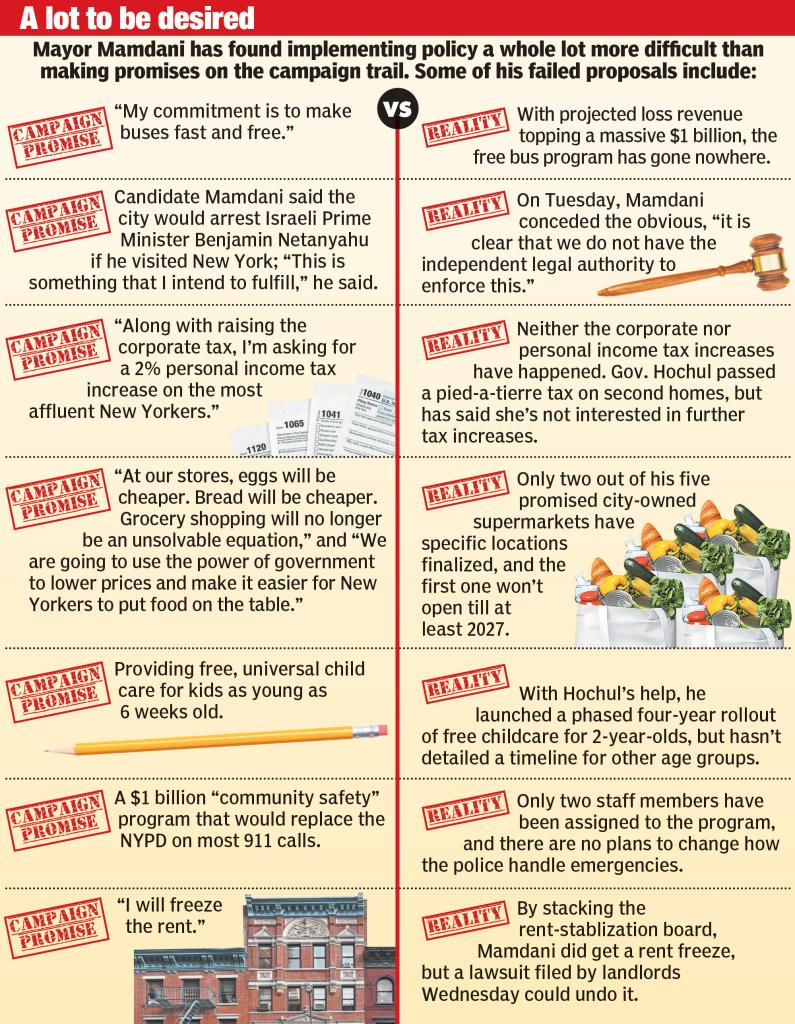
The article criticizes New York City Mayor Zohran Mamdani for what it portrays as a pattern of politically appealing but impractical promises and a focus on social media-driven activism rather than governing. Its central example is Mamdani’s reversal on his vow to arrest Israeli Prime Minister Benjamin Netanyahu if he visited New York City; the article says Mamdani ultimately admitted he lacked the legal authority to do so. The piece argues this episode illustrates a broader gap between Mamdani’s online persona and his real-world performance as mayor.
The article says several of Mamdani’s campaign promises have not materialized, including free bus rides, higher taxes on wealthy New Yorkers, city-owned grocery stores, a community safety program meant to replace police on most 911 calls, and a rent freeze. It frames these as unrealistic or stalled initiatives. The article also links its criticism to a separate public-health crisis: a Legionnaires’ disease outbreak on the Upper East Side that has killed five people and infected dozens, alleging Mamdani has not responded forcefully enough. City Council Speaker Julie Menin is quoted pushing for stronger action, and Democratic consultants and political strategists are cited debating whether Mamdani’s online appeal can sustain him if his administration fails to deliver tangible results. Overall, the story presents Mamdani as a mayor whose attention to ideological and online battles is distracting him from urgent local problems.
Entities: Zohran Mamdani, Benjamin Netanyahu, New York City, Israeli Consul General, City Council Speaker Julie Menin • Tone: negative • Sentiment: negative • Intent: critique
23-07-2026
This opinion piece argues that New York City Mayor Zohran Mamdani’s public criticism of Israeli Prime Minister Benjamin Netanyahu is not really about Netanyahu at all, but is instead a vehicle for a broader effort to weaken U.S. sovereignty and normalize the application of International Criminal Court (ICC) authority over Americans. The author says Mamdani first acknowledged he lacked legal power to order Netanyahu’s arrest, but then escalated by saying Netanyahu was “not welcome in New York City” and urging federal action on an ICC warrant. The piece frames this as a dangerous attempt to replace American constitutional authority with a “globalized law” that could be used against U.S. citizens and military personnel.
The article leans heavily on constitutional and legal arguments, noting that the United States never joined the Rome Statute, that successive administrations have rejected ICC authority over Americans, and that the Constitution and federal law place foreign affairs under federal control rather than local authority. It cites the American Servicemembers’ Protection Act and past statements from U.S. officials to argue that the ICC is corrupt, illegitimate, and potentially weaponized by adversarial nations. The author warns that if Mamdani’s approach gains traction, local leaders could legitimize a foreign court and expose Americans—especially service members—to politically motivated prosecutions.
The piece broadens its critique beyond Netanyahu to accuse Mamdani of using the issue as a “smokescreen” for a larger political project that could threaten First Amendment activity, citing an incident at Park East Synagogue as evidence that Mamdani’s allies and rhetoric are hostile to Jewish and pro-Israel expression. Overall, the article portrays Mamdani as a threat to constitutional order, American sovereignty, and personal freedom.
Entities: Zohran Mamdani, Benjamin Netanyahu, International Criminal Court (ICC), New York City, United States Constitution • Tone: negative • Sentiment: negative • Intent: critique