21-09-2026
Oil prices fell to their lowest level in roughly 10 to 11 days on Monday, with Brent crude and U.S. West Texas Intermediate approaching $100 per barrel. The decline was attributed to investor hopes that diplomatic efforts surrounding the conflict between Iran and the United States could produce progress during the United Nations meetings scheduled for the week. Market participants also anticipated a partial recovery in Saudi Arabian oil shipments.
The price movement came despite renewed threats exchanged by Iran and the United States on Sunday. U.S. President Donald Trump said he would be willing to meet his Iranian counterpart, who is expected to attend the UN General Assembly. Iran has reportedly communicated conditions to mediators for re-engaging in negotiations, although fighting across the region has continued.
The article reports that Yemen’s Iran-backed Houthi movement claimed to have attacked Saudi Arabia’s capital and an Aramco facility in Yanbu, a Red Sea city. Attacks on Aramco’s east-west pipeline reportedly prompted Saudi Arabia to increase exports through the Strait of Hormuz after some shipments through Yanbu were halted. The Houthis are also described as seeking to cut off parts of the Red Sea coast from areas still controlled by Saudi-backed forces.
China has urged Tehran to assist in efforts to counter the Houthis. The developments underscore the tension between hopes for diplomatic de-escalation and the continuing risk of attacks on energy infrastructure and shipping routes. While the article’s headline refers to a 10-day low, its opening paragraph describes prices as reaching an 11-day low; both indicate that oil had fallen to its lowest point since September 10.
Entities: Iran–United States conflict, Oil prices, Brent crude, U.S. West Texas Intermediate (WTI), Donald Trump • Tone: analytical • Sentiment: negative • Intent: inform
21-09-2026
Iran’s economy contracted sharply during the first quarter of the Persian calendar as the country faced the economic and military consequences of its war with the United States and Israel. Government data showed that gross domestic product fell 10.1 percent year-on-year between March 21 and June 20, with the oil and gas sector suffering a much steeper 26.4 percent decline. GDP excluding oil fell 4.6 percent, indicating that the damage extended beyond the energy industry.
Industry and mining contracted 14.7 percent, services declined 4.8 percent, and manufacturing fell 2.5 percent. Agriculture was the only major sector to expand, growing 2.3 percent. The contraction came amid severe inflation, a weakening rial, and rising unemployment. Twelve-month average inflation reached 69.9 percent, while the rial lost more than half its value against the US dollar over the previous year.
Iran’s oil exports were particularly affected by a US naval blockade. Crude and condensate loadings fell from approximately two million barrels per day in March to between 220,000 and 255,000 barrels per day in August. Dozens of tankers carrying Iranian crude were reportedly trapped in the Strait of Hormuz, while the volume of Iranian oil held at sea also declined. Trade fell by 25 to 35 percent, according to President Masoud Pezeshkian, with imports suffering more than exports. An additional trade embargo imposed by the United Arab Emirates further disrupted Iran’s commercial ties.
The article presents the economic contraction as evidence that Washington’s pressure campaign is damaging Iran, while questioning whether Tehran can endure the downturn longer than the United States can tolerate higher energy prices. Iranian officials have linked an end to the war to the release of frozen funds and the lifting of the blockade. Despite continued military threats and hostile rhetoric, diplomatic channels involving Qatar and Pakistan remain active, suggesting that both sides may still be seeking a negotiated settlement.
Entities: Iran, United States, Israel, US-Israel war on Iran, Iranian GDP contraction • Tone: analytical • Sentiment: negative • Intent: inform
21-09-2026
The supplied material does not contain the substantive body of the Al Jazeera liveblog. It includes the headline, a URL, the label “22 Updates,” and several advertising messages, but none of the individual updates or reported developments. As a result, the available text provides only a high-level indication of the article’s subject rather than enough information for a comprehensive account of events.
According to the headline, the live coverage concerns the ongoing US-Israel war on Iran. It highlights a warning from Tehran to the United States against carrying out additional strikes and reports that fighting is continuing in Yemen. The headline suggests that the article covers multiple connected theaters of conflict, including Iran, the United States, Israel, and Yemen. The “22 Updates” label indicates that the original page contained a sequence of live updates, presumably covering statements, military developments, and other breaking news, but those updates are not present in the supplied content.
Because the article text is missing, it is not possible to verify the timing, locations, actors, casualties, military claims, diplomatic reactions, or the sequence of events. Nor is it possible to assess the accuracy or context of the warnings and reports mentioned in the headline. The available material supports identifying the story as urgent, conflict-focused, and primarily informative, with a negative emotional backdrop associated with war and the threat of further strikes. The advertisements and notification prompt have been excluded from the cleaned version because they are website clutter rather than journalistic content.
Entities: Iran, Tehran, United States, Israel, Yemen • Tone: urgent • Sentiment: negative • Intent: inform
21-09-2026
Iranian President Masoud Pezeshkian is traveling to New York to attend the United Nations General Assembly, where he is expected to address Iran’s position on international developments and meet with foreign leaders. His visit has renewed hopes for diplomacy and a possible resolution to the conflict involving Iran, the United States and Israel. Those hopes briefly improved market sentiment, contributing to higher stock prices, lower oil prices and falling global bond yields.
However, the diplomatic opening is accompanied by severe threats and military warnings. U.S. President Donald Trump said he would consider meeting Pezeshkian but warned that Iran faced either the destruction of its economy or the elimination of its leadership if it failed to reach a deal. Iran’s military, meanwhile, warned that it had intelligence indicating a large-scale U.S. and allied strike could be imminent and threatened painful attacks against U.S. interests and regional countries supporting such an operation.
The security situation has also deteriorated after Iran-backed Houthi militants claimed missile and drone attacks on Riyadh. Saudi Arabia said its air defenses intercepted a ballistic missile, while a Saudi-led coalition official said other attacks targeting civilians and infrastructure were thwarted. The U.S. State Department issued a security alert warning of possible escalation, flight cancellations and airspace closures.
Although oil prices have recently eased on hopes that Saudi energy shipments could recover, Eurasia Group analysts expect Brent crude to remain between $90 and $110 per barrel through the rest of the year. They said any improvement in oil flows through the Strait of Hormuz would not eliminate the broader market deficit. Iran is reportedly using military proxies and tanker attacks to pressure Washington and has said it will not reopen the strait until the U.S. fulfills commitments involving sanctions, Iranian assets, port access and military threats. Iranian parliamentary speaker Mohammad Bagher Ghalibaf said Iran should continue fighting and negotiating, pursuing diplomacy only from a position of strength.
Entities: Masoud Pezeshkian, Donald Trump, Mohammad Bagher Ghalibaf, Iran, United States • Tone: urgent • Sentiment: negative • Intent: inform
21-09-2026
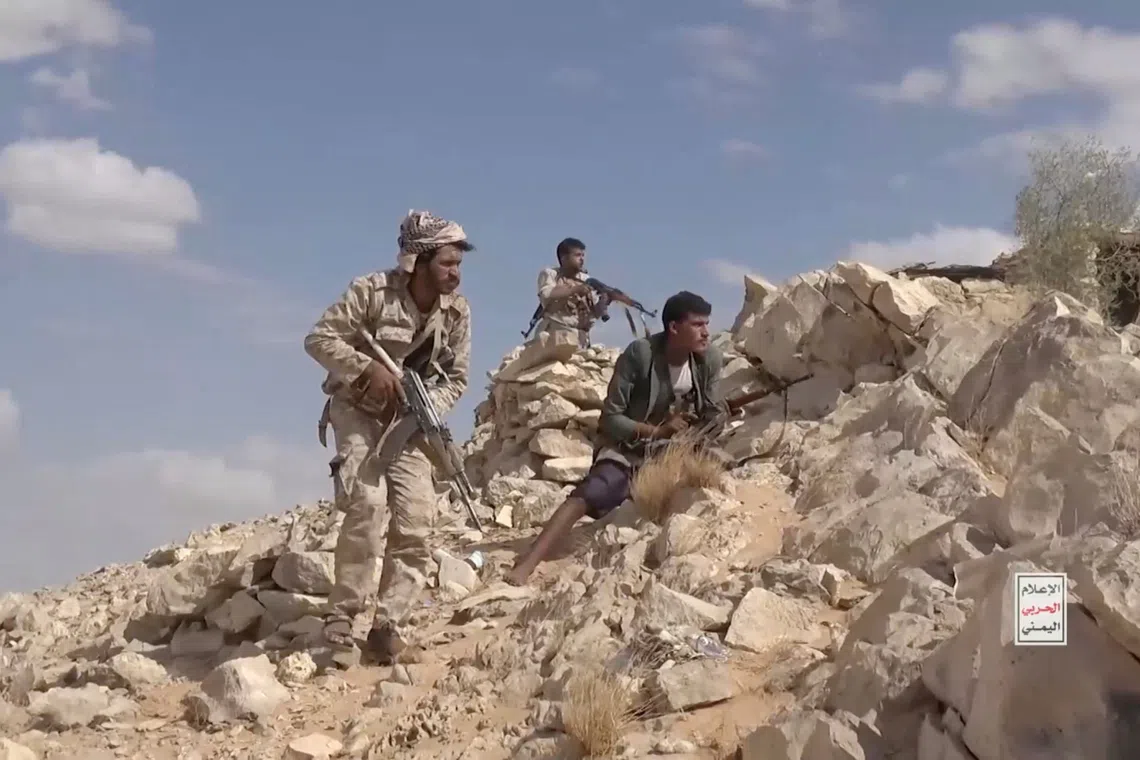
Houthi forces are advancing through Yemen’s strategic highlands in an effort to consolidate their control of the Red Sea coast and separate it from territory held by Saudi-backed government forces in the south. The offensive follows a rapid September advance in which the Iran-backed group captured parts of the coast, including areas near the Bab el-Mandeb Strait and Perim Island. The Houthis are now seeking to take the Kahboub Mountains in Taiz and Lahij provinces, whose heights would provide defensive advantages and enable them to open new fronts around the strategically important waterway.
Saudi Arabia has responded with hundreds of air strikes against Houthi positions, but the campaign has reportedly failed to halt the group’s progress as government forces have retreated. The United Nations estimates that nearly 700 people have been killed, thousands injured, and more than 120,000 displaced within Yemen, while others have crossed the Red Sea to Africa.
The escalation has also created a dilemma for US President Donald Trump. The New York Times reported that the United States prepared air strikes against the Houthis on Sept 20 after Saudi Crown Prince Mohammed bin Salman appealed for assistance, but that Trump cancelled the operation at the last minute. Reuters could not independently verify the report, and US Central Command did not comment. Washington has otherwise resisted joining Saudi Arabia’s campaign, partly because Trump is reluctant to expand the war against Iran.
Houthi control or disruption of the Bab el-Mandeb Strait threatens Saudi Arabia’s main alternative oil-export route, forcing more shipments through the riskier Strait of Hormuz. The resulting transport costs and security risks are contributing to record refined-fuel prices, including a US diesel price above US$6.51 a gallon. The conflict is therefore worsening Yemen’s humanitarian crisis while increasing risks to global energy supplies and maritime trade.
Entities: Houthis, Yemen, Saudi Arabia, Donald Trump, Mohammed bin Salman • Tone: analytical • Sentiment: negative • Intent: inform
21-09-2026
The provided excerpt from The Washington Post reports that Iran is enduring intensified economic hardship as a result of what it describes as a renewed U.S. naval blockade of Iranian ports. The blockade has lasted two months and is said to have sharply restricted Iran’s ability to export oil, a central source of government income. As a result, Tehran has lost billions of dollars in state revenue, weakening its capacity to manage the economy and fund essential imports.
The article also emphasizes the threat posed by Iran’s dwindling access to foreign currency. Because the country relies on foreign exchange to pay for imports, the shortage could create severe difficulties in obtaining goods from abroad. The opening presents Iran as economically damaged but not yet defeated: despite the pressure associated with President Trump’s economic warfare, the country is described as “suffering yet surviving.”
The excerpt frames the situation as a major test of Iran’s economic resilience. It highlights the immediate effects of the blockade—reduced oil exports, lost public revenue, and pressure on foreign-currency reserves—while suggesting that the longer-term consequences could be more serious if Iran becomes unable to finance necessary imports. The supplied text does not include further reporting about how Iranian authorities, businesses, or civilians are responding, nor does it provide additional details about the blockade’s enforcement or international reaction. This summary therefore reflects only the article material included in the prompt.
Entities: Iran, United States, Donald Trump, Tehran, Susannah George • Tone: urgent • Sentiment: negative • Intent: inform
21-09-2026
US President Donald Trump spoke by phone with Yemeni President Rashad al-Alimi on Sunday about the recent advances of the Iran-backed Houthi movement near the Bab al-Mandeb strait, according to four people familiar with the conversation. The waterway is a strategically important global shipping route. During the call, Alimi requested US assistance for Yemen’s Saudi-backed government in its conflict with the Houthis. The group reportedly seized key areas along the strait earlier in September in a rapid offensive.
However, two sources—one Yemeni and one Western—said Trump did not make a direct commitment to provide military support during the conversation. The White House and Yemen’s information minister did not immediately respond to requests for comment, leaving the account based primarily on the sources cited by Reuters.
The report places the call within the broader context of shifting US policy toward the Houthis. Trump has publicly said that Washington is communicating with the group and that the Houthis have indicated they will not attack US shipping. At the same time, the United States has designated the Houthis as a terrorist organization. Trump has also reportedly rejected Saudi requests for military assistance against the group, according to earlier Reuters reporting.
The article therefore suggests that, despite discussions about the Houthi advance and a formal request from Yemen’s president, the call did not result in a publicly known US military commitment. It also highlights the uncertainty surrounding Washington’s response to the Houthis’ territorial gains and their potential implications for shipping through the Bab al-Mandeb strait.
Entities: Donald Trump, Rashad al-Alimi, Houthis, United States, Yemen • Tone: neutral • Sentiment: negative • Intent: inform