21-09-2026
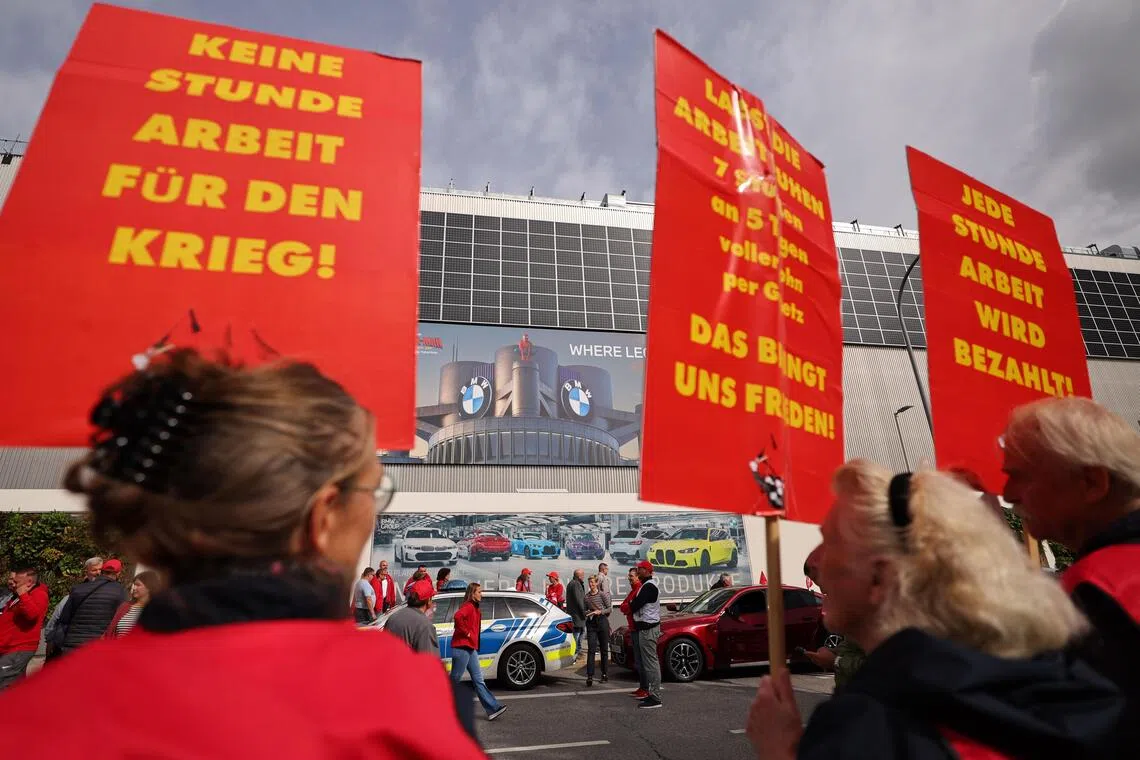
Nearly 180,000 German automotive workers joined nationwide protests on Sept 21 at more than 280 locations, demanding action to protect jobs and factories threatened by the industry’s worsening conditions. The protests, organised by the IG Metall union, were driven by growing competition from Chinese carmakers, weak domestic demand and US tariffs. Germany’s major manufacturers are downsizing: Volkswagen plans to eliminate 100,000 jobs by the end of the decade, while Mercedes-Benz and BMW are also reducing their workforces. Four Volkswagen plants, including the Hannover facility where assembly-line worker Janik Hitzemann is employed, have been identified as potentially facing closure or major changes.
Workers and union leaders called on company management to find alternative uses for threatened sites and distribute the costs of restructuring fairly. IG Metall leader Christiane Benner criticised the management of Volkswagen and other major companies, arguing that they had moved too slowly to adopt electric vehicles and invest in software. She urged the German government to reduce energy costs, support suppliers that need to retool, and promote European production through “Made in EU” rules.
The article also presents wider concerns about the competitiveness of Europe’s auto sector. Some industry observers blame Chinese state support for creating global overcapacity and giving Chinese manufacturers an unfair advantage. German Finance Minister Lars Klingbeil said the European Union should provide stronger protection against Chinese competition.
Daniela Cavallo, head of Volkswagen’s works council, warned that Europe’s auto industry would be fundamentally reshaped, with some established manufacturers failing and others merging. Political scientist Wolfgang Schroeder described the protests as an unusual sector-wide expression of genuine fear, because they were not tied to a specific wage dispute or individual company but to the future of the entire industry.
Entities: German automotive workers, IG Metall, Volkswagen, Mercedes-Benz, BMW • Tone: urgent • Sentiment: negative • Intent: inform
21-09-2026
Volkswagen shares extended their losses after the German automaker sharply reduced its forecast for annual operating return on sales. The company now expects a margin of approximately 1%, down from its previous projection of 4% to 5.5%. Volkswagen attributed the downgrade to a challenging market environment, particularly in China, restructuring expenses and an impairment linked to its substantial holding in Porsche. It also said that faster-than-expected shifts in consumer demand toward battery-electric vehicles were hurting expectations for its Volkswagen Passenger Cars and Audi brands.
The profit warning came as Volkswagen was removed from the Euro Stoxx 50, an index tracking the euro area’s largest companies. Its shares fell 0.5% in mid-morning trading after dropping 8.3% on Friday, and they are down 27.5% for the year, close to their lowest level since 2010. Finland’s Nokia replaced Volkswagen in the index, benefiting from investor enthusiasm over its role in data-center connectivity and artificial-intelligence growth.
Volkswagen is also undertaking a major restructuring and streamlining program expected to eliminate 100,000 jobs. The company is facing declining profitability, stronger Chinese competition, tariff-related uncertainty and the costly transition to electric vehicles. Deutsche Bank analysts said the warning appeared severe but argued that it overstated the deterioration in Volkswagen’s underlying operations. They estimated that €10 billion in one-time effects would weigh on earnings this year, while underlying margins remain around 4% and cash generation is still intact.
Volkswagen’s removal from the index highlights broader problems across Europe’s auto industry, where manufacturers are coping with higher costs, international competition and rapidly changing demand for electric and hybrid vehicles. Stellantis, the maker of Jeep and Dodge vehicles, was similarly removed from the index a year earlier amid its own restructuring challenges.
Entities: Volkswagen, Porsche, Audi, Deutsche Bank, Euro Stoxx 50 • Tone: analytical • Sentiment: negative • Intent: inform
21-09-2026
Germany’s automotive industry is facing a severe structural crisis caused by high production and energy costs, US tariffs, growing Chinese competition, weak demand and the difficult shift to electric vehicles. Major manufacturers including Volkswagen, Mercedes-Benz and BMW are cutting production, reducing costs and eliminating jobs. Volkswagen plans to reduce its global workforce by about 100,000 positions by the end of the decade, while BMW expects to cut up to 8,000 jobs by 2027. Suppliers such as Bosch and ZF Friedrichshafen are also announcing large-scale reductions.
Employment in Germany’s automotive sector has already fallen from about 830,000 workers in 2018 to fewer than 700,000 today. Ferdinand Dudenhöffer of the Center for Automotive Research projects that the figure could drop to 500,000 by 2030. Industry executives argue that German labor costs are uncompetitive and want employees to work 40 hours per week instead of the established 35 hours, without additional pay. They claim this would reduce personnel costs by approximately 13 percent.
IG Metall strongly rejects the proposal, arguing that factories are underused and demand—not a shortage of working hours—is the central problem. The union says employees have already accepted billions of euros in wage cuts and other concessions and is organizing nationwide demonstrations against job cuts and deteriorating working conditions.
Experts agree that extending working hours alone cannot restore Germany’s competitiveness. Carmakers must produce attractive, affordable electric vehicles, invest in software and artificial intelligence, improve manufacturing and development efficiency, and operate within a more favorable environment for energy, taxes, infrastructure and regulation. The article concludes that difficult reforms are necessary, warning that the industry’s problems will worsen if Germany relies on past prosperity and maintains the status quo.
Entities: Germany, German automotive industry, Volkswagen, Mercedes-Benz, BMW • Tone: analytical • Sentiment: negative • Intent: analyze