21-07-2026
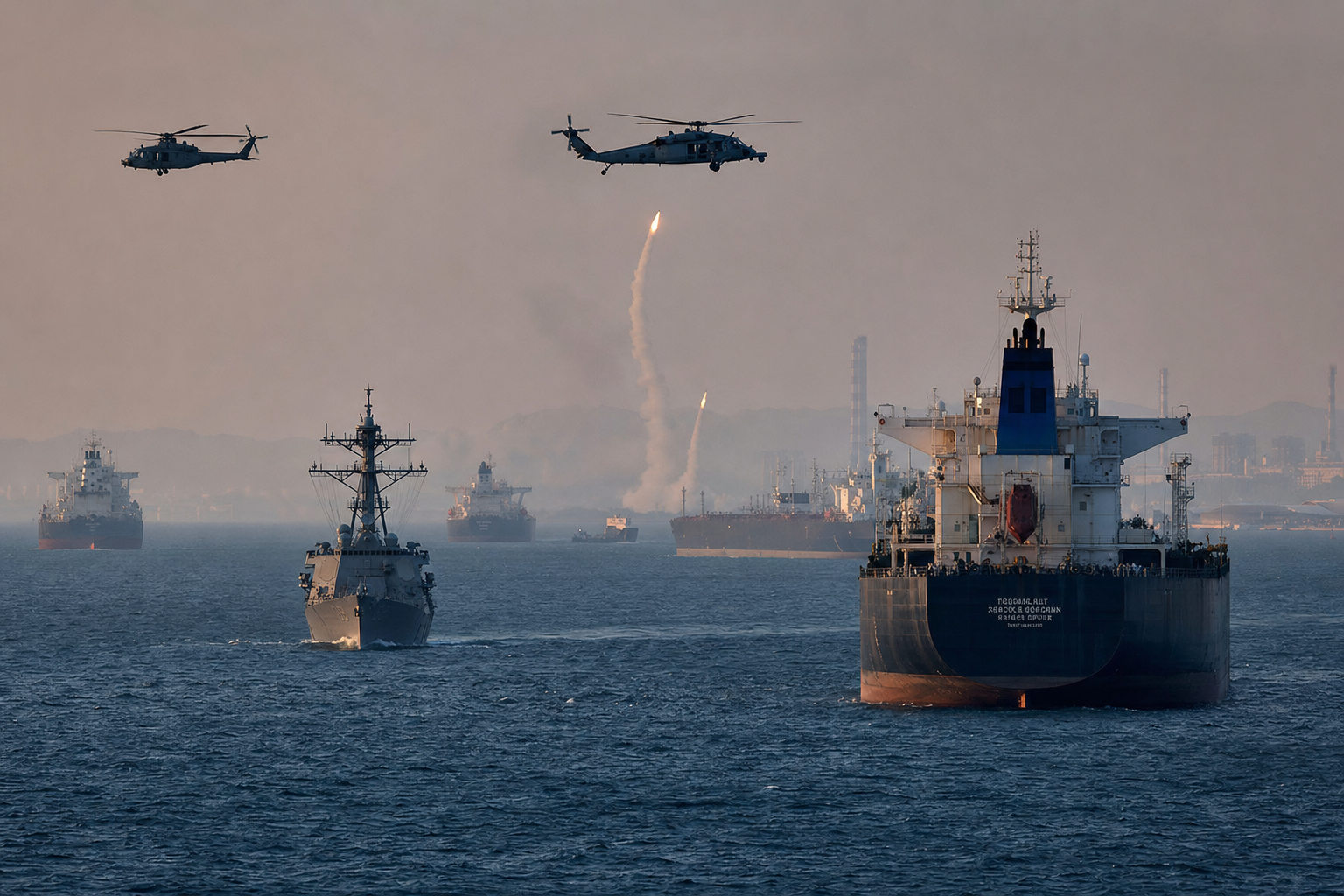
The article reports a sharp escalation in the conflict between the United States and Iran, with the US military carrying out another night of strikes aimed at weakening Iran’s ability to attack shipping in the Strait of Hormuz. The new strikes came as President Donald Trump threatened retaliation for the deaths of US soldiers in an Iranian attack in Jordan. Trump said Iran had already been hit hard and framed the US response as punishment for the killing of American troops. In response, Iran claimed it struck two oil tankers in the Strait of Hormuz and targeted US military assets in Bahrain and Kuwait, while President Masoud Pezeshkian described the situation as a “full-scale war” with the United States.
The article places the military exchanges in a broader regional context, noting that diplomacy was still reportedly continuing through intermediaries even as ceasefire efforts collapsed. US Central Command said its strikes hit Iranian military command centres, missile and drone launch sites, maritime capabilities, and air defence systems, while asserting that commercial vessels were still transiting the strait. Regional tensions widened further as Jordan said it intercepted Iranian missiles, Kuwait reported downing drones, and Bahrain said drones targeted its air navigation systems. The article also details the identities of two US soldiers killed in the Jordan attack and notes that a third service member went missing in action, with remains later found. Overall, the article depicts an intensifying cycle of military retaliation, maritime disruption, and diplomatic uncertainty across the Middle East.
Entities: United States, Iran, Donald Trump, US Central Command (Centcom), Strait of Hormuz • Tone: urgent • Sentiment: negative • Intent: inform
21-07-2026
Nearly 100 U.S. service members have been injured in a recent wave of Iranian strikes on American bases and assets in the Middle East, according to U.S. officials cited by CBS News. Pentagon spokesman Sean Parnell said almost 100 people were deemed injured since July 7, 2026, and that 96% have already returned to duty. He described most of the injuries as minor concussions, suggesting that the majority were not severe. The injuries come amid a sharp escalation in U.S.-Iran hostilities after a monthslong ceasefire collapsed. The U.S. military has been carrying out nightly strikes on Iranian targets, saying it is trying to stop attacks on commercial shipping, while Iran has responded by striking U.S. assets in Jordan, Kuwait, Bahrain, and other allied locations. The article also places these injuries in the broader context of earlier casualties in Jordan and Iraq, including the deaths of two American soldiers on a Jordanian base, the disappearance of a third service member, and another U.S. soldier killed in Iraq during explosives disposal. CBS notes that the Pentagon has not publicly provided full damage assessments or the exact injury count from the latest attacks. The piece also references official military casualty databases and President Trump’s vow to retaliate, underscoring the seriousness of the ongoing confrontation.
Entities: U.S. service members, Iran, U.S. military, Middle East, Sean Parnell • Tone: analytical • Sentiment: negative • Intent: inform
21-07-2026
The Pentagon identified two U.S. Army soldiers killed in an Iranian attack on Muwaffaq Salti Air Base in Jordan: 19-year-old Pvt. Isabella Gonzales of Carrollton, Texas, and 1st Lt. Tyler James Feehan, 25, of Ewa Beach, Hawaii. A third service member had initially been reported missing, and unidentified remains were later found in the area. Four other U.S. service members were medically evacuated for treatment and later discharged, while others suffered minor injuries. Both Gonzales and Feehan were serving in air defense units supporting Operation Inherent Resolve, the U.S. mission against the Islamic State group.
The article also places the attack within a broader escalation between the U.S. and Iran. Following the strike on the Jordan base, U.S. forces launched additional airstrikes against Iran at President Trump’s direction, with CENTCOM describing the attacks as aimed at degrading Iran’s ability to threaten shipping in the Strait of Hormuz and punishing IRGC forces responsible for the assault. The report notes that the latest deaths bring the total number of U.S. service member fatalities in this conflict to 15 and 16, and it briefly references earlier deaths in related incidents in Kuwait, Iraq, and Saudi Arabia. The piece also includes reactions from Defense Secretary Pete Hegseth and White House press secretary Karoline Leavitt, and personal details remembered by Gonzales’s friends and family.
Entities: Pentagon, U.S. Army, Iran, Jordan, Muwaffaq Salti Air Base • Tone: urgent • Sentiment: negative • Intent: inform
21-07-2026
The article is a live CNN update on the escalating US-Iran conflict, centered on continued mutual strikes, rising regional instability, and growing humanitarian and military fallout. The Pentagon says nearly 100 US service members have suffered injuries since July 7, most described as minor concussions, while CNN reports the military has been slow to disclose the extent of those injuries. The US has continued airstrikes against Iran for a 10th consecutive night, with Iranian state media reporting explosions in several locations, including Bandar Abbas, Qeshm, and parts of Hormozgan Province. President Donald Trump has warned that Tehran will pay for the deaths of three US service members, and a dignified transfer for the killed troops is now set for Wednesday at Dover Air Force Base. The article also reports a maritime incident in the Strait of Hormuz: the crew of a vessel reportedly struck there abandoned ship and moved to a lifeboat, while Iran’s Revolutionary Guards claimed responsibility for striking two tankers. Beyond the direct US-Iran conflict, the update highlights wider regional effects, including missile and drone interceptions by Kuwait and Jordan, increased US aircraft deployments in the Middle East, and concerns about shipping disruption in the Strait of Hormuz and Bab al-Mandeb. The story underscores the conflict’s impact on global trade, oil markets, and regional security, with mention of a floated but downplayed ceasefire proposal and a separate Israeli military pilot program involving partial withdrawal from Lebanon.
Entities: United States, Iran, Donald Trump, Pentagon, UK Maritime Trade Operations (UKMTO) • Tone: urgent • Sentiment: negative • Intent: inform
21-07-2026
The article reports on escalating U.S.-Iran hostilities and centers on remarks by Seyed Mohammad Marandi, an Iranian-American academic frequently described by Fox News as a regime mouthpiece and former adviser to Iran’s nuclear negotiation team. Marandi claims that Tehran has spent decades preparing for a possible U.S. ground invasion and even welcomes the prospect, arguing that Iran’s military has dispersed and buried missiles and drones underground to survive sustained airstrikes. The piece places these comments in the context of a renewed conflict that has spread across western and southern Iran, with missile and drone attacks reportedly hitting U.S.-linked targets in Jordan, Kuwait, and Bahrain, and U.S. retaliatory strikes targeting bridges, tunnels, surveillance outposts, and underground weapons storage sites inside Iran.
The article emphasizes the strategic importance of the Strait of Hormuz and the collapse of a recently signed memorandum of understanding that had been intended to create a 60-day ceasefire and support nuclear talks. It also describes continued bombardment of Iranian military infrastructure, including the Khorramabad area and the Imam Ali Missile Base, which the article says is an underground silo facility used for Shahab-3 ballistic missiles. Marandi is quoted saying Iran has accumulated missiles and drones for decades and that the Islamic Revolutionary Guard Corps introduced a new missile during the fighting. Overall, the piece frames the conflict as a rapidly intensifying military confrontation in which Iran claims readiness for a broader land war while the United States expands airstrikes and considers further escalation.
Entities: Seyed Mohammad Marandi, Glenn Diesen, Donald Trump, Islamic Revolutionary Guard Corps (IRGC), U.S.-Iran conflict • Tone: urgent • Sentiment: negative • Intent: inform
21-07-2026
This live France 24 update covers an escalating confrontation between Iran and the United States, with both sides claiming strikes against military targets in the Gulf region. Iran’s Revolutionary Guards said they hit US military assets in Bahrain and Kuwait, including air defence systems, radar installations, and missile defence infrastructure, and warned of further drone and missile attacks. In response, the US military said it had carried out additional strikes on Iranian military command centres, maritime capabilities, missile and drone launch sites, and air defence systems, aimed at reducing Tehran’s ability to threaten commercial shipping in the Strait of Hormuz.
The liveblog also reports that the US State Department issued a worldwide caution alert, urging American citizens to exercise increased vigilance due to the risk of further escalation and possible attacks on US facilities abroad. Alongside the military exchanges, the article situates the conflict within broader regional instability: a British military report says a ship is ablaze near Oman in the Strait of Hormuz, and Yemen’s Houthis have announced a maritime embargo against Saudi Arabia. The update additionally notes a separate political development in Lebanon, where President Joseph Aoun is due to meet Donald Trump as pressure grows on Beirut to disarm Hezbollah, a key issue tied to Israel’s withdrawal from south Lebanon. Overall, the article presents a rapidly developing regional crisis with military, diplomatic, and shipping-security dimensions.
Entities: Iran, Iran's Revolutionary Guards, United States, Bahrain, Kuwait • Tone: urgent • Sentiment: negative • Intent: inform
21-07-2026
The article reports that President Trump ordered another round of U.S. airstrikes against Iranian military targets, marking the tenth consecutive night of attacks. According to CENTCOM, the strikes were aimed at degrading Iran’s military capabilities used to target commercial shipping in the Strait of Hormuz, including command centers, maritime assets, missile and drone launch sites, air defense systems, and communications networks. The article says the latest strikes followed Trump’s public anger over the deaths of three U.S. service members killed in Iranian-related incidents in Jordan, and that he vowed Iran would pay “many times over” for killing Americans. It also notes that the campaign is connected to a broader U.S.-Israel operation, ongoing tensions over the Strait of Hormuz, and the collapse of a prior memorandum of understanding that had sought to reopen shipping lanes and continue nuclear talks. The piece highlights that Iran has retaliated with attacks on U.S. bases in the Middle East, while Qatar has proposed a 10-day cease-fire to de-escalate the conflict. Despite the escalation, the article says talks between the two countries are still continuing.
Entities: Donald Trump, CENTCOM, Iran, US military, Strait of Hormuz • Tone: urgent • Sentiment: negative • Intent: inform
21-07-2026
Analysts say inflation fears are resurfacing as the conflict between the United States and Iran keeps oil prices elevated, increasing the risk of renewed pressure on global consumer prices. The article highlights views from BlackRock, OCBC, and PNC Asset Management that a sustained energy shock could push headline inflation higher, especially in Europe and parts of Asia that rely heavily on imported energy. BlackRock estimates the conflict could add about 0.8 percentage points to global headline inflation, though the effect would vary by region. OCBC argues that if a new energy shock occurs, the Federal Reserve would likely remain focused on upside inflation risks rather than easing policy. Yung-Yu Ma of PNC Asset Management says profit-margin improvements for U.S. small- and mid-cap companies may not hold up if oil prices stay high for several quarters. He also suggests Fed hawkishness is likely to persist until energy markets and other inflation pressures ease, and recommends investors think about portfolio diversification to reduce risk. Although oil prices dipped in early Friday trading, they were still headed for weekly gains amid continued U.S.-Iran strikes.
Entities: Inflation fears, oil prices, Iran, United States, Middle East conflict • Tone: analytical • Sentiment: negative • Intent: inform
21-07-2026
Vessel traffic through the Strait of Hormuz has fallen sharply after a renewed escalation in U.S.-Iran hostilities, with shipping companies pulling back from one of the world’s most strategically important energy chokepoints. The article says President Donald Trump’s blockade, combined with fresh U.S. strikes on Iran, Tehran’s broad maritime traffic ban, and attacks on commercial vessels, has caused operators to reassess the danger of entering the Gulf. Multiple shipping datasets show a steep decline in crossings: Lloyd’s List Intelligence recorded 53 transits in the week through July 20, down 66% from 157 the week before, while tanker and gas carrier movements dropped from 90 to 30. Kpler and S&P Global data similarly show traffic deteriorating almost immediately after the blockade began, with daily crossings falling into single digits at times and weekly traffic down nearly 50% in one dataset. Although traffic has not stopped entirely, mainstream shipowners remain cautious, and the waterway that carries roughly one-fifth of global oil consumption is operating far below normal. Analysts quoted in the article say movement is likely to remain erratic, with brief windows of activity followed by renewed pullbacks as tensions rise. The article also notes that oil prices could climb back to $100 a barrel if fighting continues or regional energy infrastructure is hit.
Entities: Strait of Hormuz, U.S.-Iran conflict, Donald Trump, U.S. blockade, Lloyd's List Intelligence • Tone: analytical • Sentiment: negative • Intent: inform
21-07-2026
The article describes the renewed Iran conflict and its immediate effects on global shipping and energy markets after President Donald Trump declared the ceasefire with Iran “over.” U.S. Central Command has conducted 10 consecutive nights of strikes on Iran, aiming to reduce Iranian capabilities used against commercial shipping in the Strait of Hormuz. As a result, traffic through the strait has plunged, with only 30 ships transiting over the weekend compared with more than 100 per day before the war intensified, even as the Trump administration insists the waterway remains open under U.S. protection. The disruption has pushed Brent crude above $90 a barrel, raising fears that a prolonged conflict could send prices back into triple digits if crude flows remain constrained into August.
The piece also highlights Iran’s continued retaliatory capacity through missile, drone, and shipping attacks, including reported damage to a vessel operated by Greek firm Dynacom and recent deaths of U.S. servicemen at bases in the region. On the diplomatic front, regional mediators Qatar and Pakistan reportedly proposed a 10-day ceasefire, though the article notes that Washington and Israel are preparing for the possibility that talks fail and the war widens. Finally, the article warns that the Houthis’ threat to impose a maritime embargo on Saudi Arabia and potentially target the Bab el-Mandeb Strait could compound the crisis by disrupting an alternate route for Saudi oil exports, removing a key relief valve for global oil markets and worsening an already fragile energy shock.
Entities: Donald Trump, U.S. Central Command, Iran, Strait of Hormuz, Brent crude • Tone: urgent • Sentiment: negative • Intent: inform