20-09-2026
The article examines a new security agreement involving the United States, Denmark and Greenland, arguing that it may have successfully de-escalated a dispute over Greenland’s sovereignty without substantially changing the existing balance of power. The agreement’s full contents remain undisclosed, but the available information suggests that Denmark and Greenland protected their territorial integrity while giving US President Donald Trump a political victory he could present to his supporters.
Trump’s allies claim that his pressure campaign improved the United States’ position and will allow it to expand its military presence in Greenland, which is strategically important to Washington. However, the author notes that the United States already possesses extensive military rights under a 1951 defence agreement, updated in 2004 to include Greenland’s Home Rule Government. During the Cold War, the US operated 17 installations and stationed more than 10,000 personnel there; today, only Pituffik Space Base remains, with roughly 150 US personnel.
The new agreement may introduce two changes. It could establish an open-ended commitment not tied to NATO’s continued existence and give the United States formal approval rights over adversarial military bases, military presence or sensitive investments in Greenland. Yet the author argues that these powers largely existed in practice, since Denmark previously blocked Chinese-linked proposals that raised US security concerns. The main change may therefore be formal rather than substantive.
The article characterizes the deal as a “triumph of optics”: Trump can claim success, while Greenland and Denmark preserve sovereignty. It raises doubts about Trump’s claim that the arrangement will cost the United States nothing, though Greenland could benefit economically from an expanded US military presence. The author concludes that final judgment must await the full text, but says the agreement provides grounds for cautious optimism and relief in Nuuk and Copenhagen.
Entities: Donald Trump, United States, Denmark, Greenland, Nuuk • Tone: analytical • Sentiment: neutral • Intent: analyze
20-09-2026
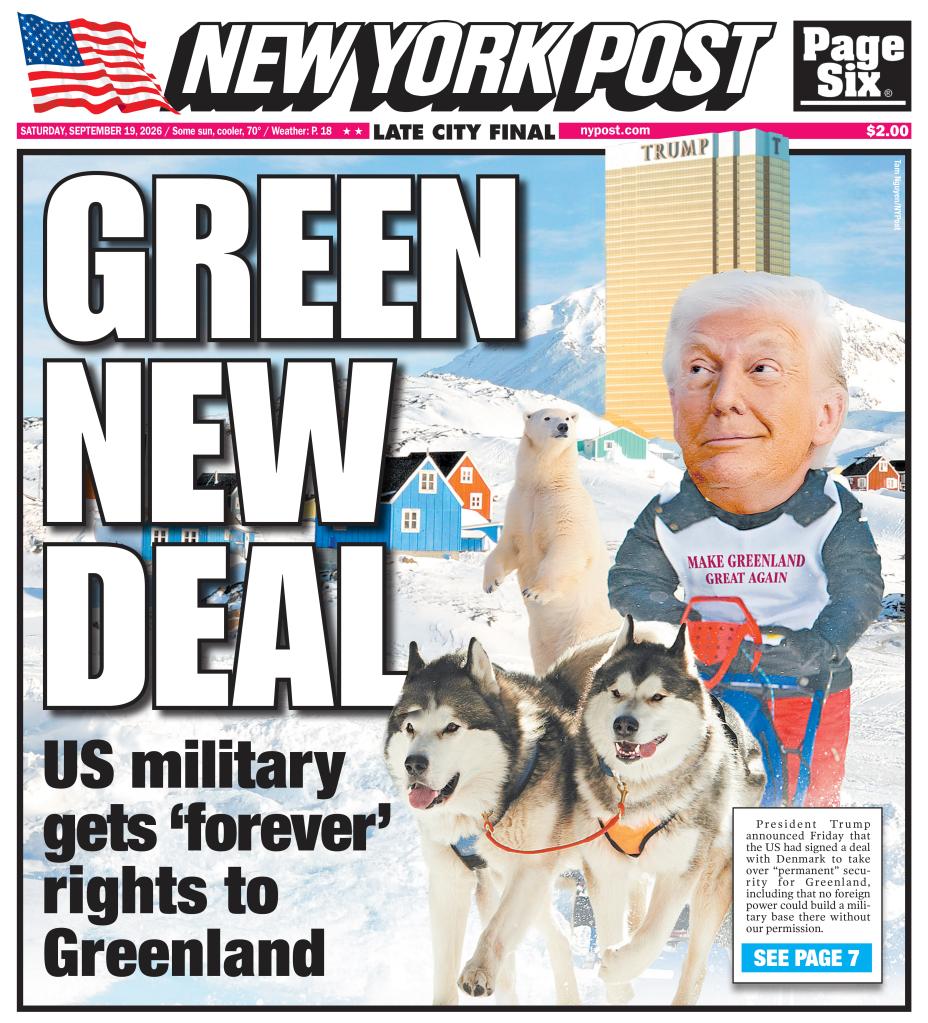
The United States and Denmark have announced a preliminary agreement on Greenland’s security after months of threats from President Donald Trump to acquire or seize the semi-autonomous Danish territory. The agreement is intended to strengthen security in Greenland, Denmark, the Arctic and the North Atlantic, and is expected to be signed at the United Nations General Assembly before undergoing parliamentary approval. The leaders of Denmark and Greenland said the arrangement recognises Danish sovereignty, Greenland’s territorial integrity and the Greenlandic people’s right to self-determination.
The agreement’s full text has not been published, leaving important details unresolved. Trump said it would give the United States permanent control over Greenland’s security and allow it to take measures necessary to defend the territory, at no cost to Washington. He also said adversaries would be barred from maintaining military facilities or making sensitive investments without US approval. A US State Department official said the deal would provide permanent American access, basing and overflight rights; permit the unilateral construction of additional military structures; prevent non-Nato countries from building bases; and restrict investments by countries such as Russia and China in sensitive sectors. The arrangement would reportedly remain valid even if Greenland became independent.
The deal appears to stop short of transferring territory, a key red line for Denmark and Greenland. Nato and French President Emmanuel Macron welcomed it as a measure supporting regional stability and Danish sovereignty. Some Danish commentators described the outcome as a diplomatic success because Trump did not obtain Greenland, although he presented the agreement as a victory. In Greenland, reactions were more cautious. Supporters stressed the need to protect self-determination, while former politician Aaja Chemnitz said she remained sceptical of Trump. Questions also remain about how the agreement differs from the 1951 US-Danish defence arrangement. Greenland’s strategic position, military importance and large rare-earth reserves remain central to the dispute.
Entities: Greenland, United States, Denmark, Donald Trump, Mette Frederiksen • Tone: analytical • Sentiment: neutral • Intent: inform
20-09-2026
The United States and Denmark have announced a security agreement concerning Greenland, apparently resolving a diplomatic dispute triggered by President Donald Trump’s earlier threat to seize the semi-autonomous territory. The report says the precise terms of the agreement have not been disclosed, leaving important questions about how the arrangement will operate in practice.
According to the available details, Denmark is expected to retain sovereignty over Greenland, while the United States would gain the ability to establish or significantly expand its military presence on the island. The agreement would also reportedly prevent US adversaries from constructing their own military bases there. These provisions suggest that the deal is intended to strengthen Greenland’s strategic importance to US and Danish security policy without transferring control of the territory.
Greenland’s location gives it considerable military and geopolitical significance, particularly in relation to Arctic security and the broader interests of the United States, Denmark, NATO and the European Union. However, the article does not provide specific information about the size, location or legal status of any future US military facilities, nor does it explain how Greenland’s own authorities were involved in the negotiations.
The report presents the agreement as a diplomatic settlement following heightened tensions over Trump’s comments, while emphasizing that its exact implications remain uncertain. Its central message is that Denmark appears to have preserved its formal sovereignty, but Washington may receive expanded strategic access and greater influence over the island’s military environment. The deal therefore addresses the immediate dispute but may leave unresolved questions about Greenlandic autonomy, regional security and the balance between Danish sovereignty and US defense interests.
Entities: United States, Denmark, Greenland, Donald Trump, NATO • Tone: analytical • Sentiment: neutral • Intent: inform
20-09-2026
The article reports that President Donald Trump has announced a new security agreement with Denmark and Greenland intended to give the United States lasting authority over security and defense-related needs on Greenland. According to the article, the agreement would prevent China and Russia from establishing military bases or making adversarial economic investments on the island, reinforcing Greenland’s role in the strategic defense of North America and the Arctic.
Grant Newsham, a senior fellow at the Center for Security Policy and a retired US Marine colonel, compared the agreement with the US acquisition of Alaska in 1867. He argued that, although the United States has not purchased Greenland, the pact brings strategically important territory within Washington’s security framework and limits Russian and Chinese influence. Newsham predicted that both countries would object and might increase activity elsewhere in their Arctic territories, but said they would have limited ability to block the agreement.
Trump announced the pact on Truth Social, describing it as providing the United States with permanent control over Greenland’s security at no cost to American taxpayers. He also said the United States would begin developing a larger military presence in an appropriate part of Greenland. Secretary of War Pete Hegseth echoed that position, while Secretary of State Marco Rubio called the agreement a major victory that permanently protects US security interests in the Arctic.
The article notes that the agreement still requires formal signatures and parliamentary procedures before taking effect. Denmark and Greenland have stressed that their sovereignty and territorial integrity will be preserved. The report presents the pact as part of a broader Trump strategy to prevent adversarial expansion and strengthen US homeland defense.
Entities: Donald Trump, United States, Denmark, Greenland, China • Tone: analytical • Sentiment: positive • Intent: inform