20-09-2026
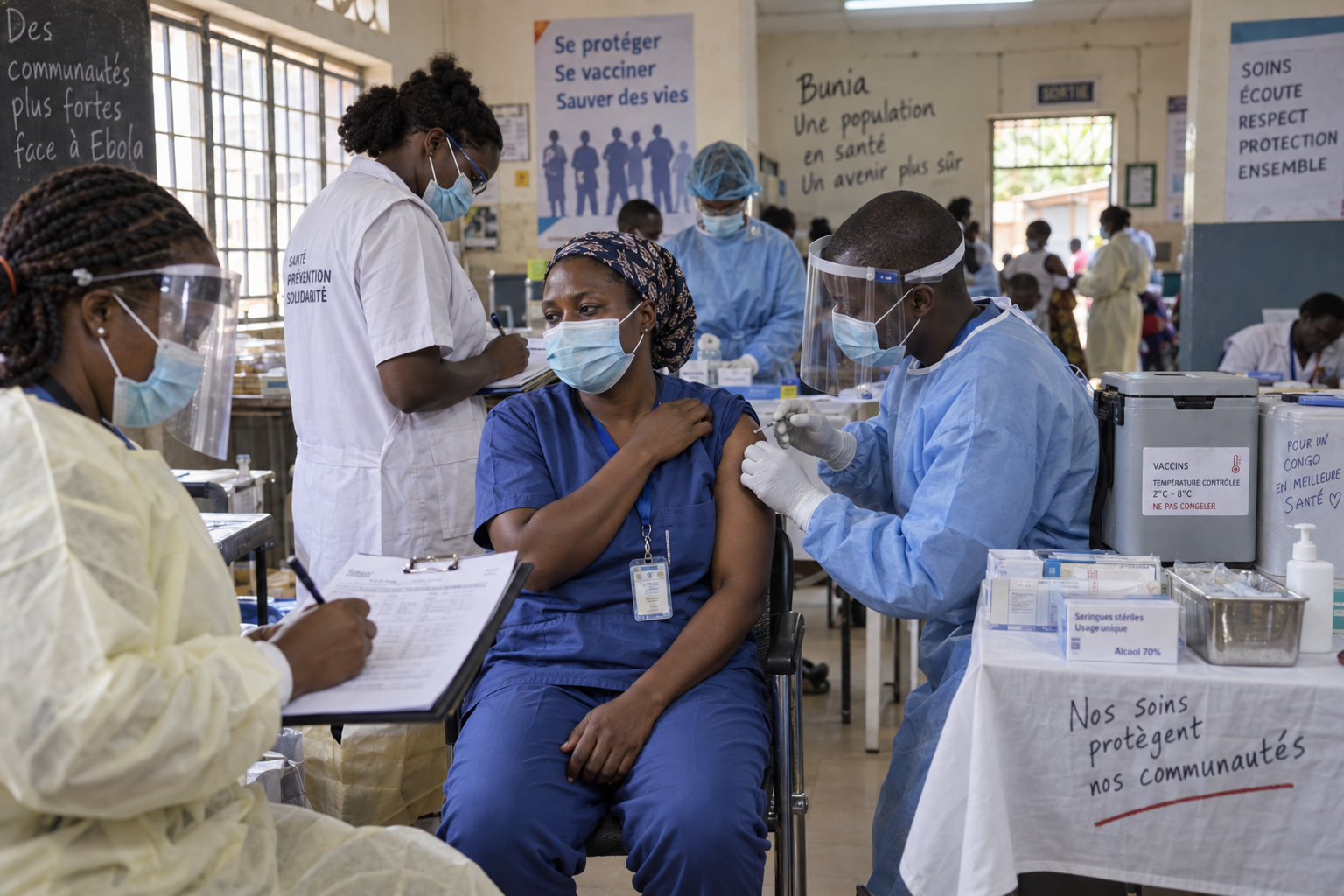
Congo has begun vaccinating health care and other frontline workers against Ebola in Bunia, the center of the country’s fastest-growing and deadliest Ebola outbreak. The campaign is initially focused on the Bunia and Mongbwalu health zones in Ituri province, two areas heavily affected by the outbreak. Workers are receiving Ervebo, a vaccine proven effective against the more common Zaire strain of Ebola. Health authorities believe it may provide some protection against the related Bundibugyo virus, although its ability to prevent illness from that strain remains under study.
The vaccine is being administered through a compassionate-use program because it is not specifically approved for Bundibugyo Ebola. Of the 70,000 Ervebo doses approved for use in Congo, approximately 50,000 are intended for frontline and health workers. The remaining 20,000 doses will be used in a clinical trial examining whether the vaccine protects against Bundibugyo virus, for which there is currently no licensed vaccine or treatment.
Government figures show that Congo has recorded 7,541 confirmed cases and 3,639 deaths. The outbreak has been intensified by insecurity, displacement, a health workers’ strike and significant population movements. The World Health Organization has described the outbreak as out of control and warned that it could surpass the 2014–2016 West Africa Ebola outbreak, which killed more than 11,000 people.
The vaccination campaign follows an earlier rollout in Kisangani and planned coverage of health zones in Tshopo, Bas-Uele and Haut-Uele provinces. Health workers and officials, including Ituri’s military governor, Maj. Gen. Gaby Kasongo Mulumba, have emphasized the importance of protecting those directly involved in the response.
Entities: Congo, Bunia, Ituri province, Mongbwalu, Ebola outbreak • Tone: urgent • Sentiment: negative • Intent: inform
20-09-2026
The article reports that the Democratic Republic of the Congo (DR Congo) has begun Ebola vaccination trials aimed at frontline health workers located at the centre of the country’s current Ebola crisis. The effort involves the Ervebo vaccine, which has been used during previous Ebola outbreaks. Health officials hope the vaccine will be effective against the strain responsible for the present outbreak.
The report presents the vaccination program as a public-health response focused first on workers who are likely to have close contact with Ebola patients and therefore face heightened exposure risks. However, the brief does not provide details about the number of participants, the locations of the trial sites, the trial design, or when results are expected. It also does not identify the specific Ebola strain involved or state whether any vaccine effectiveness findings are yet available.
The article is primarily a concise news update about the launch of the trials rather than an assessment of their results. Its central point is that health authorities are deploying a previously used vaccine while seeking evidence that it can protect people against the current strain. The report underscores both the continuing seriousness of the Ebola crisis and the importance of protecting frontline medical personnel. At the time of publication, the initiative remains at the trial or rollout stage, and its effectiveness against the current outbreak has not been established in the supplied text.
Entities: Democratic Republic of the Congo (DR Congo), Ebola, Ebola crisis, Frontline health workers, Ebola vaccination trials • Tone: neutral • Sentiment: neutral • Intent: inform
20-09-2026
Health workers in Bunia, the capital of Ituri province in northeastern Democratic Republic of the Congo, have begun receiving the Ervebo Ebola vaccine as the country confronts its fastest-growing Ebola outbreak. The vaccination campaign, supported by the World Health Organization (WHO) and Doctors Without Borders (MSF), will also extend to North Kivu, where infections are increasing sharply.
Authorities plan to vaccinate approximately 50,000 healthcare and other frontline workers. Because the outbreak is caused by the Bundibugyo virus, rather than the more common Zaire strain for which Ervebo was developed, officials will monitor the vaccine’s effectiveness in 20,000 recipients for up to a year. Clinical trials are also continuing to develop a licensed vaccine for the current strain, which has no specifically licensed vaccine or proven treatment.
Congolese health officials acknowledge that the vaccine’s level of protection against Bundibugyo remains uncertain. Some healthcare workers described the vaccination as beneficial or mandatory, reflecting the high risks they face while responding to the epidemic. WHO experts have pointed to preliminary animal data suggesting Ervebo may provide some protection.
Since May, the outbreak has reportedly infected about 7,541 people and killed at least 3,639, while 1,823 people have recovered. The WHO approved 70,000 doses for use in the DRC in August under a compassionate-use programme, which permits the use of a medical product for a serious disease even when it is not specifically approved for that application.
Although WHO officials have reported encouraging signs that transmission may be slowing, MSF says there is no clear evidence that the epidemic is under control, underscoring the continuing danger to health workers and communities.
Entities: Democratic Republic of the Congo (DRC), Ituri province, Bunia, North Kivu, World Health Organization (WHO) • Tone: analytical • Sentiment: negative • Intent: inform