20-09-2026
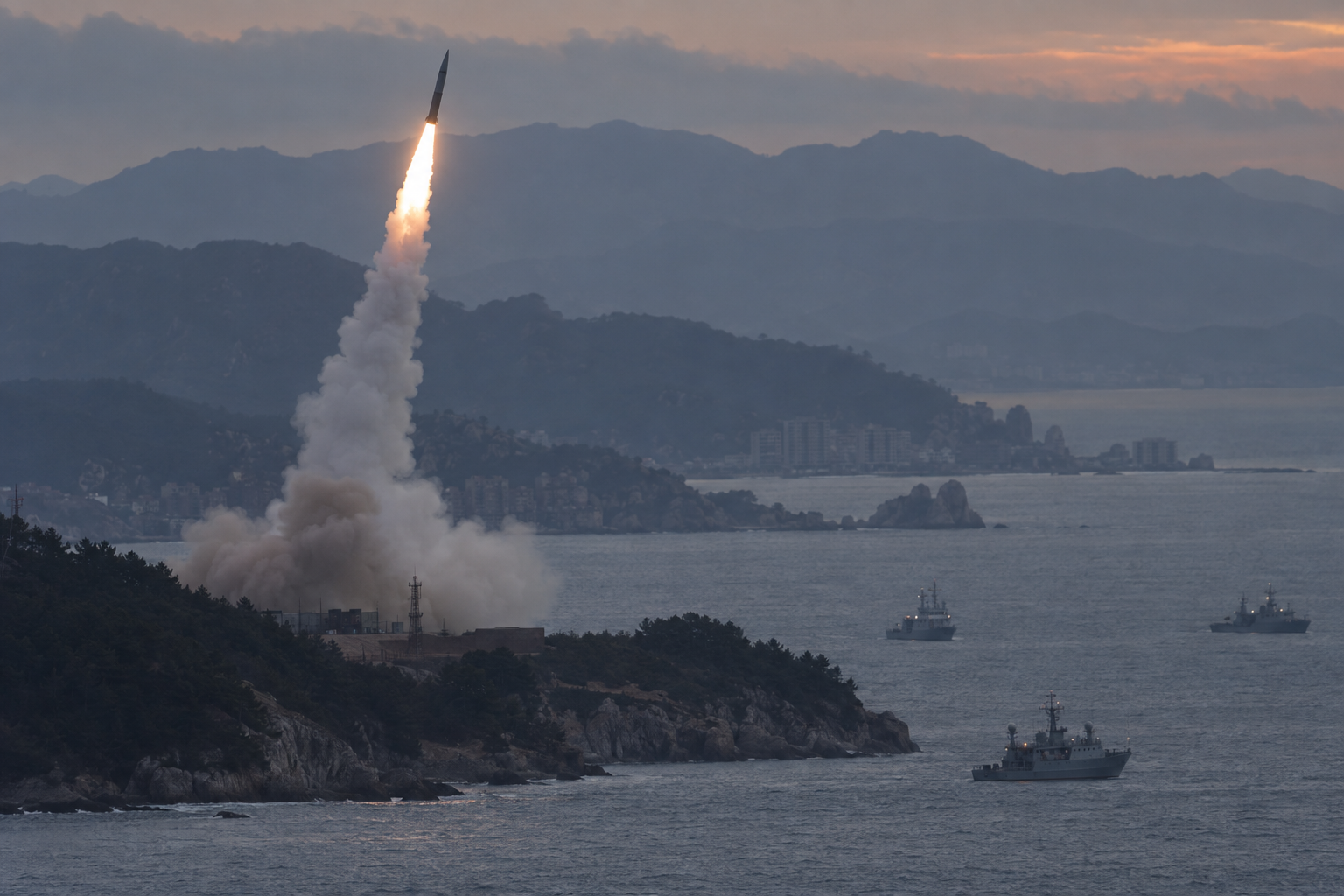
North Korea launched two short-range ballistic missiles toward the sea from the Wonsan area on its eastern coast, South Korea’s military reported. The launches occurred roughly three hours apart: one missile traveled about 280 miles, while the other flew more than 370 miles before landing in waters off North Korea. South Korean and U.S. authorities were analyzing the second missile to determine its precise specifications, while Japan’s Defense Ministry also detected a suspected launch but said it did not enter Japanese territorial waters.
The tests came shortly after North Korea reaffirmed its status as a nuclear-armed state and rejected a United Nations resolution demanding an end to its nuclear activities. They also followed a series of weapons demonstrations conducted despite President Trump’s decision to scale back a joint U.S.-South Korean military exercise, apparently in an effort to support renewed diplomacy with North Korean leader Kim Jong Un.
South Korea’s presidential office called on Pyongyang to stop ballistic missile launches, which are prohibited under U.N. Security Council resolutions. Seoul’s military said it remained prepared to respond to provocations under its alliance with Washington.
The article places the launches in the broader context of escalating criticism from Kim Jong Un’s sister and senior official, Kim Yo Jong. She dismissed the reduced U.S.-South Korean drill as still provocative and condemned the multinational Pacific Vanguard exercise involving the United States, South Korea, Japan, Australia, New Zealand and Canada. She argued that U.S.-led military exercises were driving regional tensions and vowed that North Korea would strengthen its nuclear deterrence. Earlier in the month, North Korea had also conducted a live-fire exercise involving missiles, artillery and drones, apparently practicing methods to overwhelm South Korean and U.S. air defenses.
Entities: North Korea, South Korea, United States, President Trump, Kim Jong Un • Tone: neutral • Sentiment: negative • Intent: inform
20-09-2026
North Korea launched at least one suspected ballistic missile from its eastern coast toward the northeast on Sunday, according to Japanese and South Korean authorities. Japan’s Defence Minister Shinjiro Koizumi said the missile was launched at about 3 p.m. local time, reached an estimated maximum altitude of 60 kilometres, travelled approximately 440 kilometres and landed outside Japan’s exclusive economic zone. South Korea initially described the weapon as an unidentified projectile, while Japan’s Prime Minister’s Office called it a suspected ballistic missile.
The launch followed North Korea’s rejection of a resolution by the International Atomic Energy Agency concerning its nuclear programme. A North Korean Foreign Ministry spokesperson said the resolution would not affect the country’s status as a nuclear weapons state. The report also places the launch within broader uncertainty over possible renewed contact between North Korean leader Kim Jong-un and US President Donald Trump. Trump said in August that Kim possessed “57 very powerful nuclear weapons,” praised their relationship and indicated that he hoped to meet Kim later in the year.
South Korean President Lee Jae Myung has urged Trump to preserve dialogue with Pyongyang and said Seoul was working to facilitate talks between North Korea and the United States. However, prospects for an imminent meeting may have weakened after Kim Jong-un’s sister, Kim Yo Jong, condemned recent US-led military exercises in the Western Pacific as a “war rehearsal.” The US, South Korea and Japan recently completed Exercise Freedom Edge 26, which US Pacific Command said was intended to strengthen trilateral readiness in the Indo-Pacific. Kim Yo Jong responded that North Korea would take clearer action to defend its sovereignty and continue strengthening its nuclear deterrence.
Entities: North Korea, Kim Jong-un, Donald Trump, Shinjiro Koizumi, Lee Jae Myung • Tone: analytical • Sentiment: negative • Intent: inform
20-09-2026
North Korea fired two short-range ballistic missiles into the East Sea off its eastern coast on September 20, according to South Korea’s military. The first missile was launched from the Wonsan area at approximately 3:00 p.m. local time and traveled about 450 kilometers. A second missile was launched at around 5:50 p.m. and flew more than 600 kilometers. South Korean and US authorities were analyzing its precise specifications, while South Korea, the United States, and Japan tracked and shared information about the launches from the outset.
The missile tests prompted an emergency security meeting in Seoul and a call from the South Korean government for Pyongyang to immediately stop its launches. Seoul described the firings as a grave act violating United Nations Security Council resolutions. Japan also lodged a stern protest, saying the launches threatened regional peace and security.
The tests took place eight days after North Korea launched another group of short-range ballistic missiles during what it described as a joint firepower drill involving artillery and missiles. They also followed Pyongyang’s reaffirmation that it is a nuclear-armed state and its rejection of a UN resolution calling for an end to its nuclear activities.
During the week’s General Conference of the International Atomic Energy Agency, North Korea accused hostile powers of attempting to dismantle its nuclear program. A North Korean Foreign Ministry spokesperson said the IAEA resolution had no effect on the country’s status as a nuclear weapons state, which Pyongyang said was permanently established by its nuclear deterrent and state law. Kim Yo Jong similarly called North Korea’s nuclear status absolute. The article also cites estimates by Donald Trump and South Korea regarding North Korea’s nuclear arsenal.
Entities: North Korea, South Korea, Japan, Pyongyang, Wonsan • Tone: analytical • Sentiment: negative • Intent: inform