20-09-2026
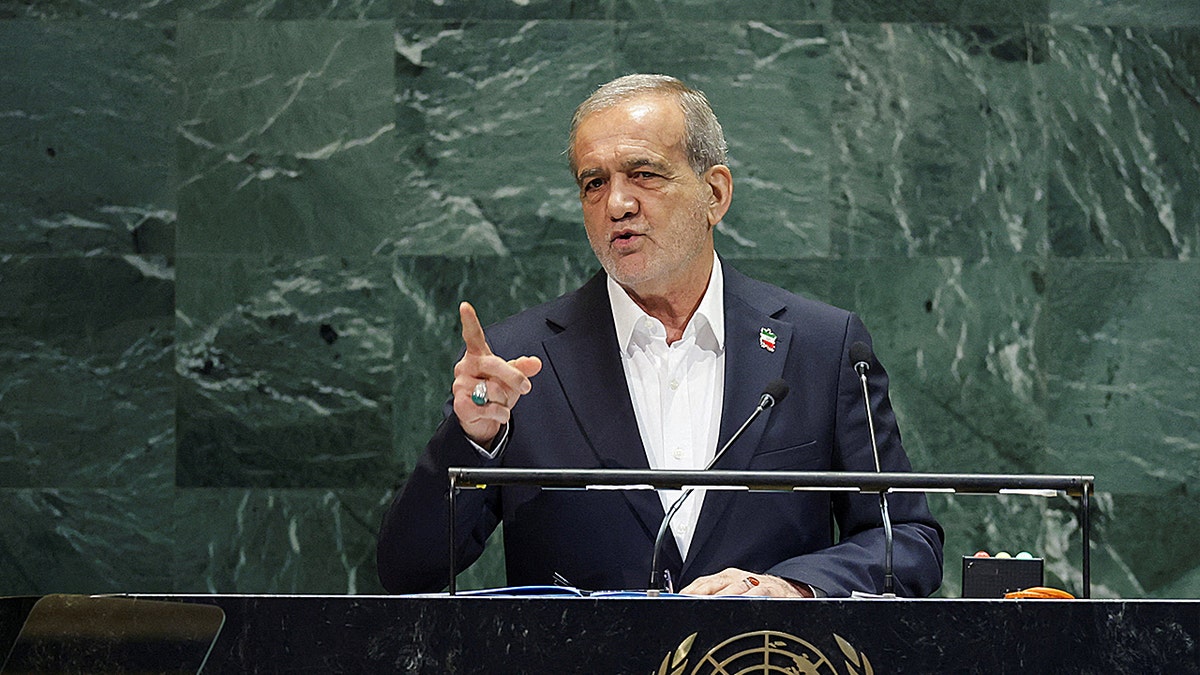
President Donald Trump and Iranian President Masoud Pezeshkian are expected to attend the United Nations General Assembly in New York during the same week, creating a potentially tense diplomatic encounter amid escalating Middle East tensions. Trump is scheduled to address the assembly on Tuesday, while Pezeshkian is expected to speak on Wednesday. Former White House official Theo Wold described the meeting as a “dramatic” diplomatic moment because Iran’s delegation will be allowed to participate in official U.N. events but will face strict limits on movement in Manhattan.
The United States approved visas for Pezeshkian, Foreign Minister Abbas Araghchi and other Iranian officials, as required under the 1947 U.N. agreement governing access to the organization’s headquarters. However, the State Department restricted the delegation’s travel largely to its accommodations and the U.N. complex. Wold said the restrictions are intended to prevent Iranian officials from conducting shopping trips, visiting retailers or engaging in activities beyond their diplomatic responsibilities. The State Department also reportedly instructed major membership-based retailers, including Sam’s Club, Walmart and Costco, not to conduct business with the delegation and to notify authorities if Iranian officials attempted to shop.
The gathering comes as Trump considers renewed strikes against Iran after nearly seven months of war. Iran has reportedly outlined seven conditions for negotiations with Washington and warned that it had intelligence indicating a major U.S. or allied attack could be under preparation. State Department spokesperson Tommy Pigott defended the restrictions by citing repression, shortages of water and electricity, and inflation affecting ordinary Iranians. Pezeshkian has accused the United States of a “grave betrayal” at the United Nations, while Iranian officials continue to criticize Washington’s policies. The article presents the UNGA appearance as both a formal diplomatic obligation and a highly controlled confrontation between the Trump administration and Tehran.
Entities: Donald Trump, Masoud Pezeshkian, Theo Wold, Abbas Araghchi, Mohsen Rezaei • Tone: analytical • Sentiment: negative • Intent: inform
20-09-2026
The article reports that President Donald Trump plans to use the United Nations General Assembly to press international partners to enforce sanctions against Iran. U.S. Ambassador to the U.N. Mike Waltz told Fox News Digital that Washington expects both allies and adversaries to comply with sanctions, warning that countries that fail to do so will face consequences. Trump is also expected to meet with Gulf leaders whose countries have been affected by the conflict and related disruptions to regional shipping and energy markets.
According to the article, the U.S.-Iran war has entered its seventh month after U.S. and Israeli strikes began in February. Iran has allegedly obstructed shipping through the Strait of Hormuz, while Houthi allies have increased pressure on the Red Sea shipping corridor. Waltz said the Iranian economy is deteriorating because of its currency crisis, inflation and a U.S. naval blockade, while reiterating Trump’s position that Iran must not obtain a nuclear weapon.
The diplomatic effort follows a U.N. Security Council vote in which Russia and China blocked the continuation of independent monitoring of international sanctions on Iran. The administration is also seeking closer coordination with Gulf states on regional security.
A second major theme is the Trump administration’s effort to reform, rather than abandon, the United Nations. The United States recently paid $725 million toward the U.N.’s regular budget and $102 million for peacekeeping, reducing its outstanding debt and avoiding a potential loss of General Assembly voting rights in 2027. However, the U.S. still owed approximately $1.312 billion to the regular budget. Waltz defended continued funding by pointing to efforts to reduce spending and return the organization to what the administration considers its original mission. The supplied article ends mid-sentence while beginning to explain that rationale.
Entities: Donald Trump, Mike Waltz, United Nations, U.N. General Assembly, United States • Tone: analytical • Sentiment: negative • Intent: inform
20-09-2026
The article reports that the Trump administration is not prepared to set a definite end date for the war involving Iran. President Donald Trump’s ambassador to the United Nations said Sunday that he would not establish a timeline for when the conflict might conclude. This statement contrasts with Trump’s earlier expectation that the war would last only four or five weeks. According to the article, the conflict has instead continued for nearly seven months, underscoring the gap between the administration’s initial prediction and the war’s actual duration.
The ambassador’s refusal to offer a timetable suggests that the conflict remains unresolved and that the administration cannot confidently predict when hostilities will end. The brief report does not provide further details about the ambassador’s reasoning, the military or diplomatic situation, casualties, or possible negotiations. It also does not identify the ambassador by name. Its central focus is therefore the uncertainty surrounding the war’s duration and the reversal of expectations established at the beginning of the conflict.
The article presents the development in a straightforward news-reporting style. It emphasizes the contrast between Trump’s initial promise of a short war and the conflict’s prolonged course, highlighting the difficulty of predicting its conclusion. The report’s overall implication is that the war has become significantly longer and less predictable than the administration originally anticipated.
Entities: Donald Trump, Sammy Westfall, United Nations, Trump administration, Iran • Tone: analytical • Sentiment: negative • Intent: inform