20-09-2026
Qatar’s Prime Minister and Foreign Minister, Sheikh Mohammed bin Abdulrahman bin Jassim Al Thani, has warned that the economic and security consequences of the US-Israeli war on Iran are spreading well beyond the Middle East. Speaking at the opening of a Qatar Economic Forum event held alongside the United Nations General Assembly in New York City, he described the conflict’s impact as “an earthquake” whose shock waves are challenging established assumptions about security and stability.
Sheikh Mohammed called for a regional framework based on respect for national sovereignty, arguing that no state should be permitted to threaten another. He said lasting security cannot be achieved through arrangements that leave any country permanently vulnerable and urged governments to address the underlying sources of tension and build confidence.
The Qatari leader also discussed the war’s effects on energy supplies, shipping routes, investment plans and broader economic stability. Although he said Qatar had withstood tests to the foundations of its economy and security, he acknowledged that the continuing conflict is affecting the region.
Qatar plans to respond in part by redirecting its investment strategy toward more than $38bn in domestic infrastructure spending over the next five years. The plan is intended to attract private investment and demonstrate Qatar’s economic resilience amid regional uncertainty.
The issue is expected to feature prominently during the UN General Assembly, where Middle Eastern security and the conflict’s global consequences will be central topics. Al Jazeera reported that Gulf leaders are expected to reiterate similar concerns when they meet US President Donald Trump. Separately, Qatar’s Foreign Ministry spokesman, Majed Al-Ansari, said the country’s mediation efforts to restart talks between Tehran and Washington and end the war remain ongoing.
Entities: Sheikh Mohammed bin Abdulrahman bin Jassim Al Thani, Majed Al-Ansari, Kristen Saloomey, Qatar, Iran • Tone: analytical • Sentiment: negative • Intent: inform
20-09-2026
Qatar’s Prime Minister, Sheikh Mohammed bin Abdulrahman Al Thani, has called for a new security framework in the Gulf that includes assurances that regional states will not threaten one another. In comments to Bloomberg at the Qatar Economic Forum in New York, he argued that the Gulf region cannot return to the situation that existed before the war without a broader arrangement to provide security and stability.
The prime minister also emphasized the importance of maintaining good relations across the region. His remarks suggest that Qatar sees improved relations and a formal security framework as necessary for reshaping the Gulf’s postwar political and security environment. The report does not specify which war he referenced, identify the countries that would participate in the proposed framework, or provide details about how such an arrangement would operate.
The comments are particularly notable because they explicitly connect Gulf security with relations involving Iran, as reflected in the report’s headline. Rather than outlining a specific diplomatic initiative, Sheikh Mohammed’s statement presents a general regional vision based on mutual non-aggression and improved ties. It indicates that Qatar believes lasting stability will require more than a return to prewar conditions and instead depends on a new understanding among Gulf countries and Iran.
The report is a brief account of the prime minister’s remarks and contains no information about responses from Iran, other Gulf states, or outside governments. Its central message is that the region needs a cooperative security structure and better relations if it is to achieve a stable postwar future.
Entities: Qatar, Sheikh Mohammed bin Abdulrahman Al Thani, Bloomberg, Qatar Economic Forum, New York • Tone: neutral • Sentiment: neutral • Intent: inform
20-09-2026
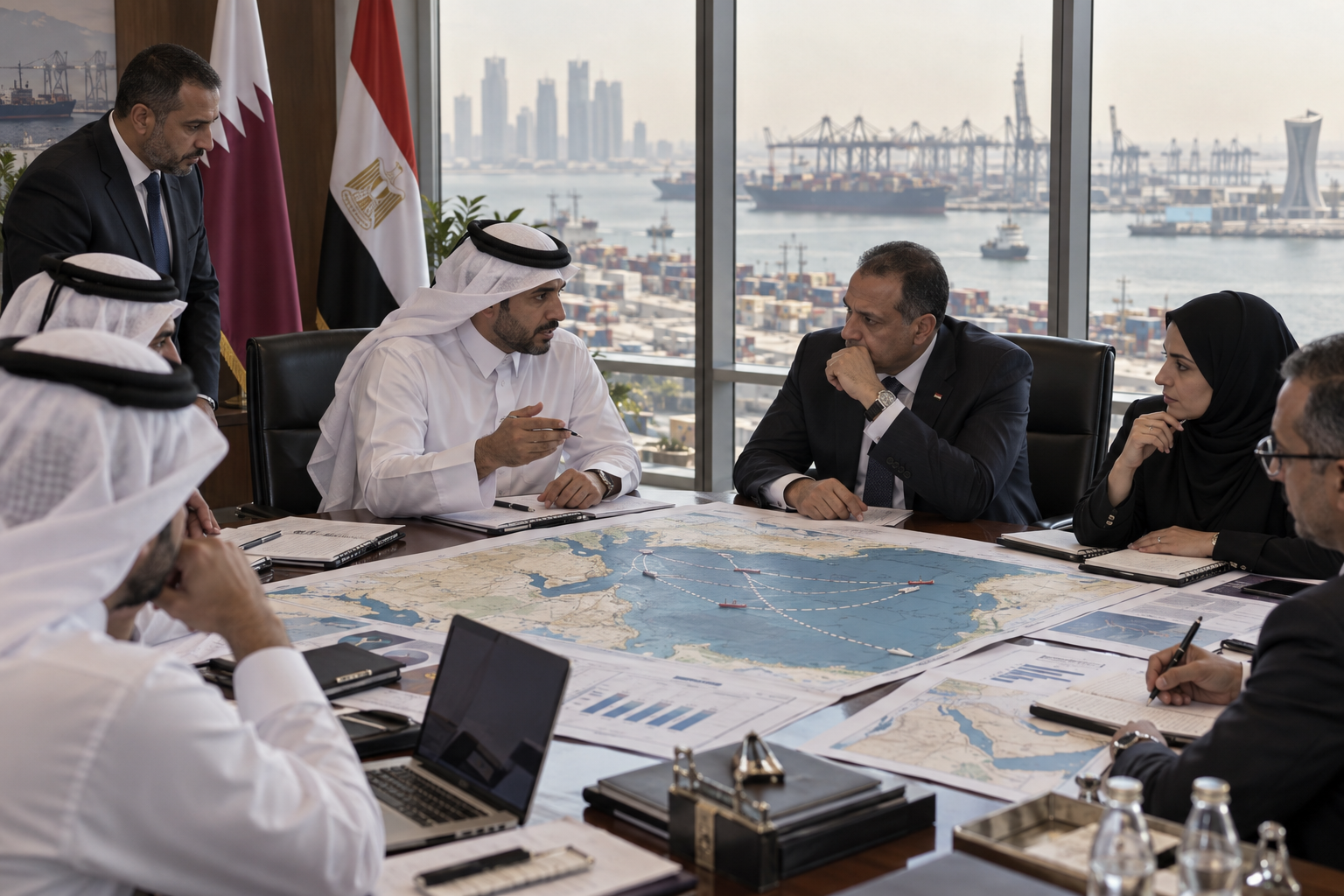
The article reports that Egyptian President Abdel Fattah El Sisi met CIA Director John Ratcliffe in Cairo as Egypt attempts to mediate between the United States, Iran and Arab countries affected by the regional conflict. The meeting, which had not been publicly announced beforehand, reflects Cairo’s effort to preserve communication with all major parties and help establish terms for ending the war, restoring regional stability and protecting maritime shipping.
Egypt is balancing its longstanding alliances with Gulf Arab states and the United States, including its receipt of $1.3 billion in annual US military aid, while also maintaining working relationships with Iran, Russia and China. Egyptian officials reportedly want an end to attacks on Arab countries and an agreement based on international maritime law to protect shipping in the Red Sea and through the Bab Al Mandeb Strait.
Cairo also has strong economic incentives to pursue a settlement. Higher oil prices could force the Egyptian government to raise domestic petrol prices and intensify public dissatisfaction. Attacks on vessels or any closure of the Bab Al Mandeb Strait could reduce revenues from the Suez Canal, a vital waterway connecting the Red Sea with the Mediterranean.
The diplomatic effort comes amid continued escalation. El Sisi recently met Iranian President Masoud Pezeshkian and Egyptian and Iranian foreign ministers have continued discussions. Meanwhile, Iran-backed Houthi rebels claimed attacks on targets in Riyadh, while Saudi-led forces reported intercepting missiles and thwarting attacks on civilian infrastructure. Iran has also refused to reopen the Strait of Hormuz until its demands are met and US commitments are implemented. Iranian Parliament Speaker Mohammad Bagher Ghalibaf said Tehran must both fight and negotiate.
Entities: Abdel Fattah El Sisi, John Ratcliffe, Egypt, CIA, United States • Tone: analytical • Sentiment: negative • Intent: inform