19-09-2026
Slovak Prime Minister Robert Fico has accused some Western politicians of seeking to provoke a direct war between NATO and Russia after what he described as a failed strategy to defeat Moscow through Ukraine. In a video message posted on social media on Sept 19, Fico said Western support for Ukraine had failed to achieve its intended goal and that some “war hawks” now wanted to transform the Ukraine conflict into a broader confrontation.
Fico warned that Europe was closer than ever to a large-scale war and said Slovakia faced a “mortal danger” as the West continued to support Ukraine. He argued that the war was neither Slovakia’s nor NATO’s conflict and reiterated that Slovakia would not send troops to fight under what he called a fabricated pretext. Slovakia borders Ukraine but is also a NATO member, making Fico particularly concerned that a drone incident or other provocation could trigger the alliance’s collective-defence clause and draw his country into the conflict.
The article places Fico’s claims alongside warnings from other European leaders about alleged Russian hybrid attacks. French President Emmanuel Macron said Russia was intensifying such operations against Europe, citing an attempted drone attack at Leipzig airport in August that Germany attributed to Moscow. Polish Prime Minister Donald Tusk also said, citing unnamed intelligence agencies, that Russia planned hybrid drone and missile attacks against countries supporting Ukraine.
The report presents Fico’s position and the contrasting assessments of France, Poland and Germany without independently resolving the competing claims. It highlights the growing tension over the risk that the war in Ukraine could spill into a direct Russia-NATO confrontation.
Entities: Robert Fico, Slovakia, Russia, NATO, Ukraine war • Tone: urgent • Sentiment: negative • Intent: inform
19-09-2026
France 24 reports that Russian President Vladimir Putin has accused Europe and NATO of preparing for a potential war with Russia. The report places his comments in the context of continued Western condemnation of Russia’s aggression in Ukraine and ongoing economic and military support for Kyiv. According to the article, Putin argues that NATO is expanding its reach and influence with the purpose of preparing for conflict with Russia. The brief report presents this as a Russian interpretation of NATO’s activities rather than an independently established fact.
The segment is identified as an analysis by Dr Alexander Titov, a lecturer in Modern European History at Queen’s University Belfast. Although the supplied text does not include Titov’s detailed assessment, his inclusion indicates that the video is intended to provide historical and geopolitical context for Putin’s remarks. The article focuses on the widening confrontation between Russia and Western countries, particularly the relationship between NATO’s policies, European security, and the war in Ukraine.
The language is concise and analytical, while the subject matter is highly serious. References to Russian aggression, military support, NATO’s expansion, and preparations for war convey the heightened tensions between Moscow and the West. The report does not describe a new military action or announce a specific decision by NATO or European governments. Instead, it highlights Putin’s warning and the competing narratives surrounding European and Western security policy. The segment was issued and modified on September 19, 2026, and includes video reporting by Haxie Meyers-Belkin.
Entities: Vladimir Putin, NATO, Russia, Ukraine, Kyiv • Tone: analytical • Sentiment: negative • Intent: analyze
19-09-2026
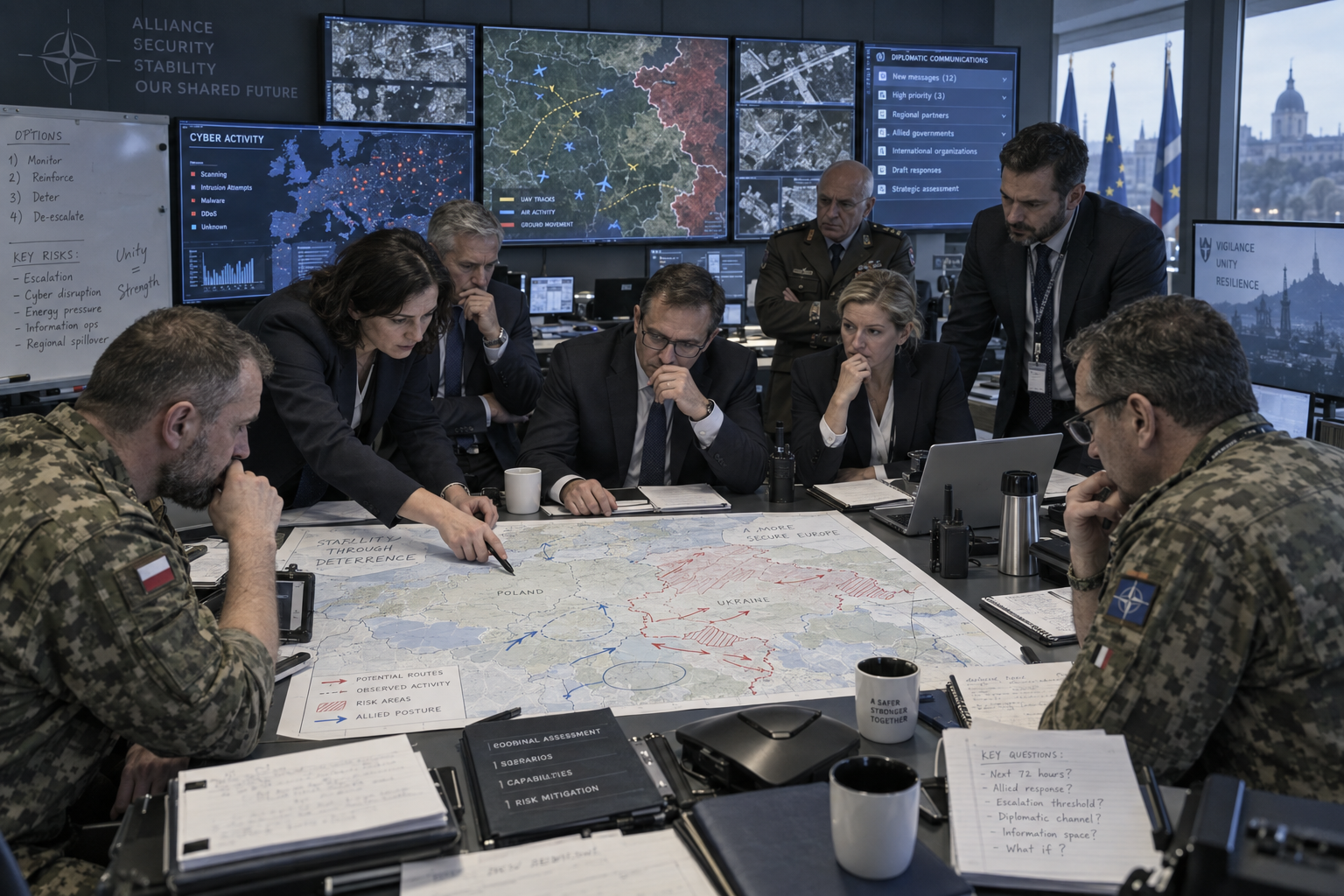
European leaders are warning that Russia is intensifying a campaign of “hybrid” attacks designed to undermine Europe without provoking an open military confrontation with NATO. In an interview with NPR’s Scott Simon, correspondent Charles Maynes explains that hybrid attacks occupy a gray zone between peace and traditional warfare. They can include sabotage of defense or logistics infrastructure, cyberattacks, election interference, misinformation, covert assassination plots, and drone incursions near NATO territory.
Maynes cites attack drones reportedly found hidden at a German airport serving as a NATO transit hub, as well as repeated drone incidents in or near Poland and Romania. Western intelligence agencies attribute such operations to Moscow, pointing to intercepted communications in which Russian security services allegedly recruit intermediaries to carry out attacks. Russia rejects the accusations, calling them unproven and part of an anti-Russian campaign. President Vladimir Putin has characterized some incidents as false-flag operations staged by Ukraine or Western governments.
According to Maynes, Moscow may be seeking to punish European countries for supporting Ukraine and pressure their governments and voters to abandon that support. Russia’s strategy, he says, may be to keep attacks below the threshold that would trigger NATO’s Article 5 collective-defense commitment while gradually weakening confidence in the alliance.
European leaders, including French President Emmanuel Macron and Polish Prime Minister Donald Tusk, say they intend to respond with tougher sanctions, continued aid to Ukraine, and potentially military measures. The Trump administration, by contrast, appears more focused on negotiations and future economic agreements. Maynes concludes that the competing “carrot or stick” approaches are being tested during a dangerous period, especially because a deadly attack could force NATO to respond directly.
Entities: Russian hybrid attacks, France, Poland, Russia's war in Ukraine, NATO • Tone: analytical • Sentiment: negative • Intent: inform