19-09-2026
Prime Minister Mark Carney is seeking a closer, more strategic relationship between Canada and the European Union, but Canada’s incoming ambassador to the bloc, Jonathan Wilkinson, says the plan will not involve direct contributions to the EU’s general budget or Canadian membership in the union. Wilkinson said Canada would be selective about funding and cooperation, potentially supporting specific initiatives such as the EU’s Security Action for Europe (SAFE) defence-loan program. Canada is currently the only non-European participant in SAFE.
Potential areas of cooperation include critical-minerals investment, artificial intelligence, digital technologies, computing capacity, broadband infrastructure, AI safety, financial services, education and research. Carney has also proposed seamless digital trade in non-agricultural goods and services, Canadian participation in Erasmus+ and expanded access to the EU’s Horizon research program.
The precise terms of the proposed “unique alliance” remain unclear. Questions include what Canada would have to offer in return, whether EU governments and Canada’s Parliament would approve the arrangement, and whether it could affect Canadian migration policies. Wilkinson rejected suggestions that the plan would create free movement between Canada and Europe, emphasizing that Canada would retain its sovereignty.
European officials expressed both support and caution. Ireland’s Thomas Byrne said Canada and Europe share commitments to democracy, free trade and the rule of law, while European Parliament member Arash Saeidi warned that formal negotiations could take years and distract from practical cooperation.
The proposal also faces pressure from U.S. President Donald Trump, who called closer Canada-EU ties “laughable” and threatened tariffs if the arrangement were deemed hostile. Analysts said Europe has reasons to pursue greater strategic independence from Washington and argued that economic retaliation could harm the United States as well as Canada and Europe. Carney framed the initiative as an effort to protect Canada’s resilience, sovereignty, markets and democratic freedoms rather than create an anti-American power bloc.
Entities: Mark Carney, Jonathan Wilkinson, Donald Trump, Thomas Byrne, Arash Saeidi • Tone: analytical • Sentiment: neutral • Intent: inform
19-09-2026
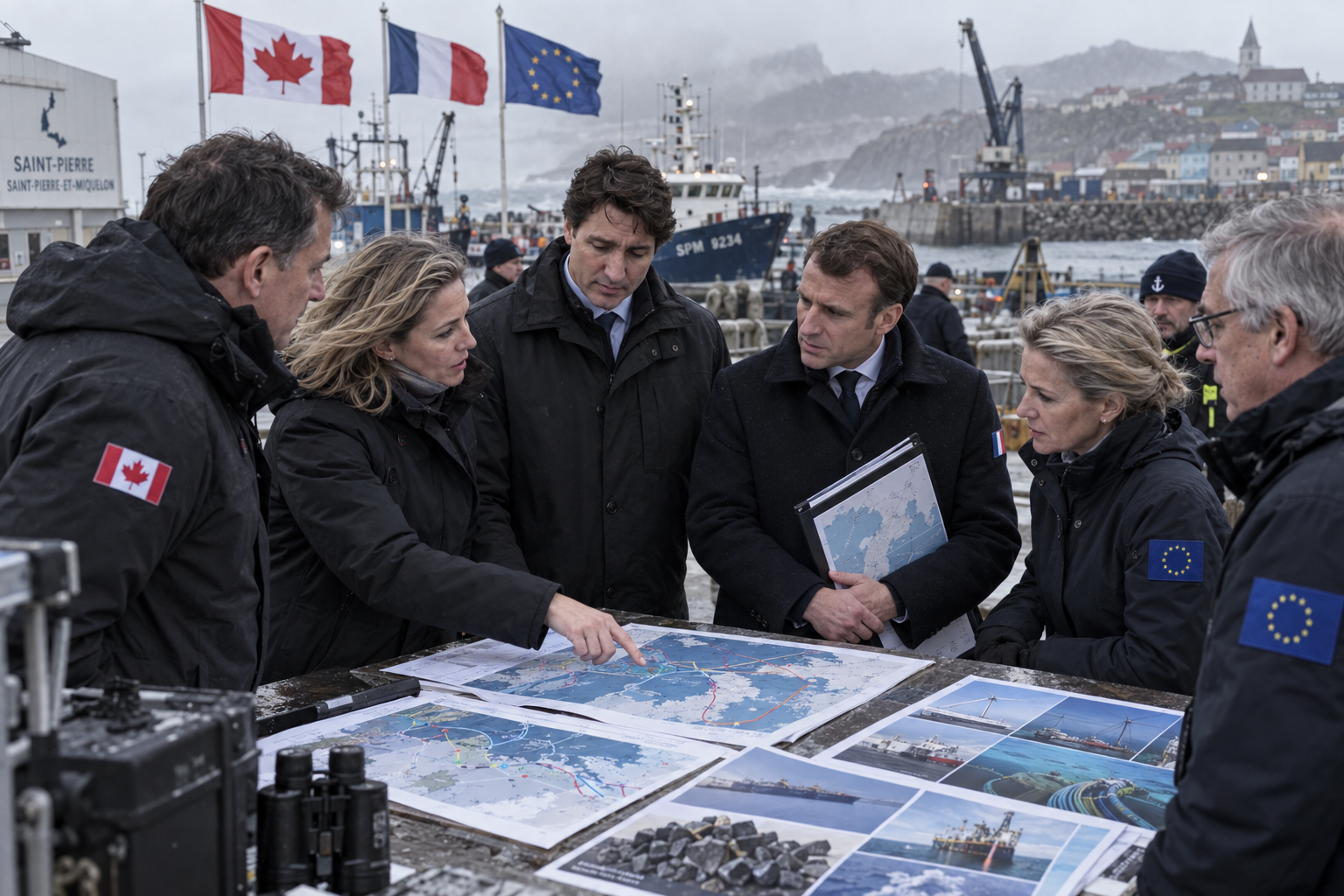
French President Emmanuel Macron is travelling to Saint Pierre and Miquelon, a French overseas collectivity located about 20 kilometres off Newfoundland and Labrador, where he will meet Canadian Prime Minister Mark Carney. The visit will focus on the archipelago’s future, France’s strategic presence in the North Atlantic, maritime sovereignty, regional cooperation and ties with Canada. Macron is the first French president to visit the territory since François Hollande in 2014.
The Élysée Palace describes Saint Pierre and Miquelon as central to France’s global presence because it gives France access to the Arctic, a significant exclusive economic zone and a permanent military presence through the patrol vessel Fulmar. Paris also wants to develop the archipelago as a base for polar cooperation involving Canada, Denmark and Greenland. Discussions are expected to cover digital cables, links with Europe, space-related activities and investment.
Macron will also address the territory’s economic and social difficulties. Its population is declining, its fishing industry was severely damaged by Canada’s long-running cod moratorium, and a 1992 court ruling reduced France’s exclusive economic zone. Climate change is creating additional risks, particularly rising sea levels. The village of Miquelon-Langlade, built on a narrow strip of land only two metres above sea level, is being relocated inland in France’s first climate-related relocation project.
The meeting also comes as Carney develops closer relations with the European Union, including a proposal from European Commission President Ursula von der Leyen for Canada to become an EU associate member. France supports stronger EU-Canada ties and may seek cooperation on energy, including Canadian help to secure European hydrocarbon supplies amid high fuel prices and geopolitical tensions. Macron and Carney are expected to continue their discussions in New York during the United Nations General Assembly.
Entities: Emmanuel Macron, Mark Carney, Saint Pierre and Miquelon, France, Canada • Tone: analytical • Sentiment: neutral • Intent: inform
19-09-2026
The article examines the European Union’s unexpected proposal to create an “associate membership” arrangement for Canada, potentially making it the bloc’s first country in such a category. The idea was announced in consecutive speeches by European Commission President Ursula von der Leyen and Canadian Prime Minister Mark Carney, generating international attention and political debate while leaving many practical questions unanswered.
There is no established legal or institutional model for associate membership in the EU treaties. Officials believe the framework could be developed without treaty change, potentially using Article 217, which allows the EU to establish association agreements with third countries involving reciprocal rights and obligations. The proposal is distinct from full EU membership: Canada is geographically ineligible for conventional accession and does not seek to adopt the bloc’s entire legal framework or surrender sovereignty.
The name and political presentation of the arrangement also remain unsettled. Carney has preferred the less politically sensitive phrase “alliance for the future,” insisting that Canada’s sovereignty, culture, language and foreign-policy independence would be protected. He has promised that any final agreement will be debated and voted on by the Canadian parliament.
On the EU side, the proposal will require coordination across the European Commission and the member states. Ireland, Spain and France have supported exploring the idea, while a broader discussion could occur at an October EU summit. Von der Leyen and Carney are also expected to discuss the proposal further in Montreal.
Economic cooperation appears to be the immediate priority. The potential partnership could expand trade and collaboration in energy, batteries, artificial intelligence, quantum technology, cybersecurity, defence, the Arctic, semiconductors, hydrogen and critical minerals. It would build on the EU-Canada free trade agreement, CETA, which has not yet been ratified by all member states. The article ends while beginning to discuss Canada’s participation in EU programmes, leaving the full scope of the proposed relationship unresolved.
Entities: Canada, European Union, Ursula von der Leyen, Mark Carney, European Commission • Tone: analytical • Sentiment: neutral • Intent: analyze
19-09-2026
The article reports that French President Emmanuel Macron is preparing to host Canadian Prime Minister Mark Carney during a rare and symbolically important visit to a remote French territory in the North Atlantic. The meeting is presented as taking place against a backdrop of worsening tensions between Canada, Europe and the United States, particularly over trade and tariffs associated with US President Donald Trump.
The encounter carries broader geopolitical significance because Canada’s relationship with Washington is under strain while European countries are considering closer ties with Ottawa. European Commission President Ursula von der Leyen has proposed that Canada become the European Union’s first associate member, a move that would represent an unusual and potentially significant development in EU external relations. The proposal is cited as an indication of Europe’s interest in strengthening cooperation with Canada amid uncertainty in the transatlantic relationship.
Macron’s choice to meet Carney in a remote French territory also gives the visit a symbolic dimension, emphasizing France’s overseas presence and its role in North Atlantic affairs. The article frames the meeting as part of wider debates about European strategic autonomy, Canada’s international partnerships and the consequences of trade conflict with the United States.
The piece includes analysis by Guillaume Lavoie, an associate member of the Raoul-Dandurand Chair in strategic and diplomatic studies. The supplied text provides the article’s introduction and framing but does not include further details about the leaders’ agenda, specific agreements, or the outcome of the meeting. Its central focus is therefore the diplomatic symbolism of the visit and its connection to broader tensions involving Canada, the EU and Washington.
Entities: Emmanuel Macron, Mark Carney, France, Canada, United States/Washington • Tone: analytical • Sentiment: neutral • Intent: analyze