08-09-2026
Canadian Prime Minister Mark Carney has defended Canada’s decision to impose a new wave of retaliatory tariffs on US goods, warning that shifting the country’s trade away from the United States “will come at a cost” but arguing that inaction would be more damaging. The counter-tariffs, described as dollar-for-dollar measures, cover nearly C$28bn ($20bn; £15bn) of American products and range from 15% to 50%. They target goods including steel, aluminium, clothing, milk, golf clubs, cheese, toilet paper and household appliances. Canada already has retaliatory taxes on some US-made vehicles.
The measures follow the collapse of US-Canada trade negotiations in late August. US Trade Representative Jamieson Greer has indicated that Washington may respond with further tariffs, while President Donald Trump has threatened to halt US business with Canadian aircraft manufacturer Bombardier. Trump says tariffs encourage consumers to buy American products and attract foreign investment, but economists warn that they increase prices for consumers.
Carney said Canada would support workers affected by the dispute and focus on diversifying its trade relationships and strengthening its domestic economy. The two countries have the world’s largest bilateral trading relationship, worth almost $900bn last year, leaving businesses on both sides concerned about prolonged disruption. The Canadian Chamber of Commerce supports retaliation but has urged the government to avoid endless escalation. Canada also modified its measures after pressure from the fisheries industry, removing seafood products because the Canadian and US lobster industries are closely interconnected.
Canada’s economy had shown resilience before the latest tariffs, with GDP growing 3.3% in the second quarter and 181,000 jobs added from April to July. However, about 41,000 jobs were lost in August as tariffs were introduced and negotiations collapsed. Canada’s trade data also indicates some diversification: the share of exports going to the US fell to 66% in July, compared with an average of 75% before the trade war.
Entities: Mark Carney, Donald Trump, Jamieson Greer, Canada, United States • Tone: analytical • Sentiment: negative • Intent: inform
08-09-2026
Canada has imposed retaliatory tariffs ranging from 15% to 50% on $27.6 billion worth of U.S. goods after trade negotiations between Ottawa and Washington collapsed at the end of August. The measures cover hundreds of products, including dairy, agricultural equipment, paper, household appliances, electronics, furniture, motorbikes, clothing and selected beauty products. Canadian duties on U.S. steel, aluminum and iron have doubled to 50%, the highest rate applied under the new measures.
Ottawa describes the tariffs as a “dollar for dollar” response to U.S. levies imposed on Canadian goods under Section 338. Canada’s Department of Finance said the measures are intended to protect domestic workers, producers and manufacturers and help them compete with U.S. products in Canada. Existing Canadian counter-tariffs, including a 25% duty on the politically sensitive auto sector, will remain in place.
The tariff escalation reflects deteriorating relations between the two longstanding trading partners. Officials from both countries have publicly blamed one another for the breakdown in negotiations, while U.S. President Donald Trump has called for a boycott of Canadian aircraft manufacturer Bombardier. The United States exported $333.6 billion in goods to Canada and imported $381.9 billion from Canada, with the countries deeply integrated across energy, vehicles, machinery, aircraft, pharmaceuticals, food and other industries.
Although economists say the newly targeted goods represent a relatively small share of total bilateral trade, they warn that small and medium-sized businesses and companies in the most affected sectors could face severe damage. Ottawa has announced a $7.5 billion support package for businesses and workers, in addition to an existing $25 billion program created after the U.S. began its broader tariff campaign in April 2025.
Entities: Canada, United States, Ottawa, Washington, U.S.-Canada trade war • Tone: analytical • Sentiment: negative • Intent: inform
08-09-2026
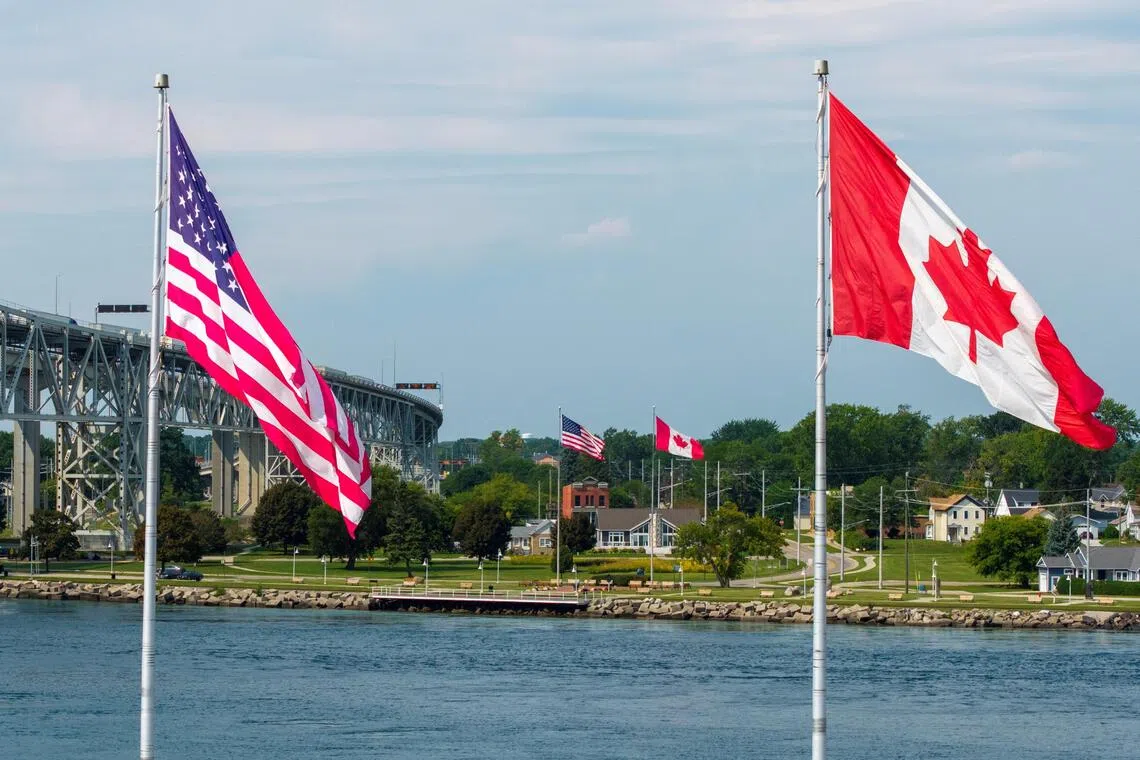
A new suspension bridge linking Windsor, Ontario, and Detroit, Michigan, has become a symbol of deteriorating relations between Canada and the United States after Canadian officials attended its opening without US President Donald Trump or other senior US representatives. The strained atmosphere follows Trump's announcement of a 50% tariff on a broad range of Canadian goods and a separate increase in tariffs on Canadian automobiles and auto parts. Canada responded with tariffs of between 15% and 50% on approximately $20 billion worth of US imports.
The article explains that the escalating dispute threatens deeply integrated economies, particularly the automotive industries in Ontario and Michigan. Parts and vehicles routinely cross the border multiple times during production, meaning tariffs increase costs, disrupt supply chains, delay investment, and threaten jobs on both sides. Ontario's Financial Accountability Office estimates that the new tariff regime could cost the province 119,000 jobs in 2026 and reduce auto manufacturing output by 8% compared with a no-tariff scenario. Michigan is also vulnerable because it produces more than one-fifth of all vehicles manufactured in the United States.
The trade conflict comes as the US auto sector is already facing weak investment, high vehicle prices, uncertainty over electric-vehicle policy, and slowing production indicators. Beyond manufacturing, the dispute is damaging tourism, real estate transactions, and consumer sentiment. Visit Detroit reported an 11% decline in Canadian visitors, while “buy Canadian first” campaigns have encouraged consumers to avoid US products. Detroit and Windsor/Essex normally facilitate more than $100 billion in annual trade, making the deterioration in bilateral relations economically significant. Business groups are urging both governments to restore stability and focus on the United States-Mexico-Canada Agreement rather than escalating retaliatory tariffs.
Entities: Gordie Howe International Bridge, Detroit, Michigan, Windsor, Ontario, Detroit River, Donald Trump • Tone: analytical • Sentiment: negative • Intent: analyze
08-09-2026
France 24 reports that Canada’s retaliatory tariffs on billions of dollars’ worth of US products took effect on Tuesday, September 8, 2026, marking a further escalation in the trade dispute between the two North American neighbors. The report characterizes the measures as counter-tariffs and presents them as part of an increasingly heated trade war between Canada and the United States.
The article also highlights a separate threat made by US President Donald Trump on Monday. Trump warned that the United States could block sales of aircraft produced by Bombardier Aviation, a Quebec-based plane manufacturer, unless the company moves some manufacturing operations to the United States. The threat appears to broaden the dispute beyond tariffs on goods and into the aerospace industry, corporate production decisions, and cross-border market access.
The short video report does not provide details about the exact tariff rates, the specific US products affected, the US measures that prompted Canada’s response, or the Canadian government’s justification for the tariffs. It also does not include reactions from Bombardier, US officials, or Canadian officials, nor does it describe the likely economic consequences for consumers, businesses, or bilateral trade. Instead, it focuses on the immediate implementation of Canada’s countermeasures and Trump’s warning against Bombardier. Overall, the report depicts a rapidly deteriorating Canada-US trade relationship, with retaliatory economic measures and pressure on a major Canadian company signaling that the conflict may continue to expand.
Entities: Canada, United States, Donald Trump, Bombardier Aviation, Quebec • Tone: urgent • Sentiment: negative • Intent: inform
08-09-2026
Canada has imposed its latest round of tariffs on U.S. goods, escalating a trade war that is increasing costs and straining one of the world’s historically closest bilateral relationships. Prime Minister Mark Carney’s government introduced tariffs of up to 50% on approximately $20 billion worth of American products, matching the value of U.S. tariffs on Canadian goods, although the measures do not target identical products.
The dispute has become politically and emotionally significant in Canada. Many Canadians feel betrayed by the United States, particularly because President Donald Trump has repeatedly suggested that Canada should become the 51st U.S. state and has threatened to use economic pressure to achieve that goal. In response, Canadians have reduced travel to the United States and boycotted American products.
The countries’ economies remain deeply interconnected. U.S. auto exports to Canada have declined 22% since the dispute began, while Canada is the largest export customer for 26 U.S. states and among the top three customers for 45 states. These ties make the economic consequences of a prolonged conflict difficult to contain.
Former Canadian Deputy Prime Minister and Finance Minister Chrystia Freeland, who helped negotiate the United States-Mexico-Canada Agreement during Trump’s first term, argues that Washington risks alienating traditional allies. She says cooperation with allies is essential to addressing China’s global influence, but that the United States must stop treating its friends adversarially. Freeland also rejects the idea that Canada’s smaller economy means it must simply accept U.S. demands. Recalling an earlier negotiation in which American officials emphasized the size imbalance between the two countries, she said such an approach is incompatible with a genuine partnership and will not be accepted by Canadians.
Entities: Chrystia Freeland, Donald Trump, Mark Carney, Steve Inskeep, Majd Al-Waheidi • Tone: analytical • Sentiment: negative • Intent: inform
08-09-2026
Canada has retaliated against the United States with tariffs on approximately $20 billion worth of American goods, matching Washington’s measures in both value and rates. The tariffs, ranging from 15% to 50%, affect hundreds of products, including steel, aluminum, cheese, appliances, clothing, cosmetics and farm equipment. Canadian provinces have also restricted U.S. alcohol sales, contributing to a sharp decline in American spirits exports to Canada.
The escalation follows the collapse of Canada-U.S. trade talks on Aug. 21 and a series of tariffs, threats and personal attacks by President Donald Trump. Trump has threatened to ban sales of Canadian Bombardier aircraft, impose further tariffs on Canadian goods, and levy 50% tariffs on Canadian vehicles, auto parts and steel. Canadian officials warn that such measures could gradually eliminate important domestic industries and disrupt North American supply chains.
The conflict has intensified Canadian resistance rather than forcing concessions. Prime Minister Mark Carney has gained public support by portraying the dispute as a challenge to Canadian economic independence and sovereignty. Canadians have reduced travel to the United States and boycotted U.S. products, while tensions have damaged a relationship historically defined by close economic, cultural, defense and security ties.
Canada is economically vulnerable because the U.S. economy is much larger and more than 70% of Canadian exports go south. However, the United States also depends on Canada for roughly four million barrels of oil per day and for potash fertilizer used by American farmers. Analysts say Canada’s position could benefit from Trump’s domestic unpopularity, legal challenges to U.S. tariffs and the approaching midterm elections. Carney’s resistance has also attracted international attention, potentially offering other smaller countries a model for responding to U.S. economic pressure. The supplied article ends while discussing whether Canada might use its own economic leverage.
Entities: Canada, United States, Mark Carney, Donald Trump, Canada-U.S. trade war • Tone: analytical • Sentiment: negative • Intent: inform
08-09-2026
Canadian small businesses are facing severe economic pressure after the United States imposed 50 per cent tariffs on about US$20 billion of Canadian goods, including textiles, apparel, paint, alcohol and honey. The tariffs followed the collapse of trade talks on Aug 21 and took effect the next day, while Canada’s retaliatory duties began on Sept 8. The measures have disrupted orders, raised production costs and prompted companies to consider layoffs or absorb major losses.
Toronto-based Fine Cotton Factory, which exports up to half its products to the US, has seen orders cancelled or delayed. Executive vice-president Skip Kann fears the company may have to lay off workers and says government assistance may arrive too late. The company’s potential closure could also damage Jerico, an Ontario clothing manufacturer that relies on Fine Cotton’s dyeing facility to maintain its domestic supply chain. Jerico expects to lose most or all of its US exports, while Redwood Classics Apparel anticipates losing its US sales, which account for about a quarter of production.
The effects extend beyond clothing. Alberta honey producer Kevin Nixon is uncertain whether American buyers can absorb a 50 per cent price increase, while British Columbia’s Cloverdale Paint faces higher costs for US-made steel cans. President Darrin Noble estimates tariffs from both countries could reduce profitability by 20 per cent. Ontario winery Henry of Pelham expects its US exports to disappear, although it has benefited from a surge in domestic sales after Ontario banned US alcohol from government-controlled stores.
The Canadian government has announced C$7.5 billion in loans and other assistance for affected businesses and workers, but some owners say longer-term programmes will not address their immediate cash-flow problems. Despite the uncertainty, local consumers and businesses have shown support for Canadian producers, helping some companies find new orders and maintain hope.
Entities: Canada, United States, Mark Carney, Donald Trump, Fine Cotton Factory • Tone: urgent • Sentiment: negative • Intent: inform
08-09-2026
Canada has begun imposing retaliatory tariffs on US imports, escalating an already tense trade dispute between the two countries. The counter-measures took effect at 12.01am on Tuesday and range from 15% to 50%, covering approximately $20bn in American goods. They target sectors including steel, dairy, appliances, agricultural equipment, pulp and paper, and electronics—industries affected by US tariffs.
The Canadian government said the tariffs were a response to Washington’s decision to impose a 50% tariff on $20bn of Canadian goods from 22 August. The Canadian measures do not apply to US goods already in transit when the tariffs took effect. Earlier, Donald Trump announced 50% tariffs on Canadian cars and raw materials, accusing Canada of exploiting the United States. Those measures affect products including hockey sticks and cement and cover about 5.5% of Canadian exports to the US.
The trade dispute has increasingly expanded into diplomatic tensions. Prime Minister Mark Carney has urged the Trump administration to take negotiations seriously, while Trump and other US officials have repeatedly criticized Canada. Trump has also made symbolic gestures, including proposing to rename Lake Ontario “Lake America,” and threatened to block sales of Canadian aircraft manufacturer Bombardier in the US unless the company shifts manufacturing south of the border. Bombardier responded by highlighting its extensive US workforce, suppliers, and economic contribution.
Formal negotiations broke down on 21 August after US negotiators reportedly sought restrictions on Canadian trade agreements with other countries and raised concerns about French-language protections and Quebec culture. Carney called those demands unacceptable, while US trade representative Jamieson Greer later said Washington understood the sensitivity of the issue.
Although polls show strong Canadian support for Carney, analysts warn that the economic consequences of the trade war could weaken it. A Reuters/Ipsos poll found that only 20% of Americans approved of Trump’s tariffs on Canadian goods. Carney says Canada remains prepared to reach a mutually beneficial agreement, but there are currently no active negotiations.
Entities: Canada, United States, Donald Trump, Mark Carney, Canada-US retaliatory tariffs • Tone: analytical • Sentiment: negative • Intent: inform