05-10-2026
The 2026 Nobel Prize in Medicine has been awarded to Karl Deisseroth, Peter Hegemann and Georg Nagel for research that made it possible to control the activity of individual nerve cells using light. Their work underpins optogenetics, a technique now used in laboratories worldwide to investigate how the brain functions and how its activity relates to behaviour and disease.
The research began with Hegemann’s study of how single-celled green algae move toward light. Hegemann and Nagel identified a protein that responds to blue light by opening a channel and producing an electrical impulse. Introducing the protein into other cells makes them sensitive to light. Deisseroth subsequently used the gene controlling the protein to develop a light-operated switch for nerve cells in the brains of living mice.
The Nobel Assembly said optogenetics had opened a new era in neuroscience by helping researchers trace pathways connected to behaviour and disease. Deisseroth is based at Stanford University in California; Hegemann works at Humboldt University in Berlin, and Nagel at the University of Würzburg in Germany. The prize was announced at Stockholm’s Karolinska Institute, opening Nobel week. The award is worth 12 million Swedish kronor, approximately $1.718 million. The announcements for physics, chemistry, literature and peace follow during the week, with the economics prize scheduled for October 12. Last year’s medicine prize recognized research into the immune system.
Entities: Karl Deisseroth, Peter Hegemann, Georg Nagel, Nobel Prize in Medicine, Optogenetics • Tone: analytical • Sentiment: neutral • Intent: inform
05-10-2026
The Nobel Prize in medicine has been awarded to Karl Deisseroth, Peter Hegemann and Georg Nagel for research explaining how individual nerve cells can be switched on and off. Their work centers on light-gated ion channels and optogenetics, methods that use light to control and study nerve cells. The Nobel committee said the approach is now used in laboratories around the world to investigate the brain.
Deisseroth is based at Stanford University in California. Hegemann works at Humboldt University in Berlin, and Nagel is at the University of Würzburg. Thomas Perlmann, secretary of the medicine committee, said he had reached all three winners by telephone on Monday. The award was announced at Stockholm’s Karolinska Institute, opening Nobel week.
The three recipients will divide a prize of 12 million Swedish kronor, equivalent to approximately 1.2 million US dollars. The article notes that the previous year’s medicine prize recognized three scientists for research on the immune system. It also sets out the schedule for the remaining awards: physics on Tuesday, chemistry on Wednesday, literature on Thursday, and the peace prize on Friday. The Nobel Memorial Prize in Economic Sciences is scheduled to be announced on October 12. Overall, the article reports the laureates, the scientific significance and institutional use of their research, and the timing and context of the award within the annual Nobel announcements.
Entities: Karl Deisseroth, Peter Hegemann, Georg Nagel, Thomas Perlmann, Nobel Prize in medicine • Tone: neutral • Sentiment: positive • Intent: inform
05-10-2026
Karl Deisseroth, Peter Hegemann and Georg Nagel have been awarded the 2026 Nobel Prize in Physiology or Medicine for their contributions to optogenetics, a technique that lets researchers control nerve-cell activity using light. The Nobel Committee said their work established the foundation for a new era in neuroscience by enabling scientists to switch particular neural circuits on or off, helping them investigate the brain processes involved in memories, feelings and behaviours, including those relevant to psychiatric and neurological disorders.
Hegemann and Nagel discovered channelrhodopsin, a light-sensitive protein originating in algae, in the early 2000s. Deisseroth developed a way to use the protein to activate nerve cells in mice. Researchers have since used optogenetics to study cells and pathways in animals, gaining insight into the nervous system and its interactions with other parts of the body, including the heart and gut. The Nobel Assembly described the technique as having fundamentally changed scientists’ understanding of the brain and said it was helping address the question of how the brain works.
The article also describes potential clinical applications. Researchers are testing optogenetics as a treatment for vision loss caused by retinitis pigmentosa, which damages the eye’s rods and cones. In clinical trials, a light-sensitive protein has been introduced into damaged areas of the eye. One patient regained some vision while wearing special glasses that emit light to activate the protein. The three laureates will share the prize of 12 million Swedish kronor, reported as approximately £900,000. They described receiving the award as “absolutely wonderful” and an honour to share with friends.
Entities: Karl Deisseroth, Peter Hegemann, Georg Nagel, Per Svenningsson, Nobel Prize in Physiology or Medicine • Tone: analytical • Sentiment: positive • Intent: inform
05-10-2026
The 2026 Nobel Prize in Physiology or Medicine has been awarded to Karl Deisseroth, Peter Hegemann and Georg Nagel for discoveries involving light-gated ion channels and optogenetics. Optogenetics combines optics and genetics to let researchers use light to stimulate neurons. The Nobel Assembly says the technique has transformed understanding of the brain by enabling researchers to investigate neural circuits associated with memories, feelings and behaviors, including those relevant to neurological and psychiatric disorders.
The article describes potential applications beyond basic research. Optogenetics has helped researchers study how brain circuits are disrupted in conditions such as blindness, depression, addiction and dementia. Scientists are also investigating its use to restore sight in people with visual impairment, and hope it may contribute to treatments for disorders including Parkinson’s disease and epilepsy.
Hegemann, a photobiology expert and professor of neuroscience at Humboldt University of Berlin, and Nagel, a biophysicist and professor of neurophysiology at the University of Würzburg, studied a protein found in green algae. They found that blue light causes the protein to open a channel, producing an electrical impulse; putting the protein into other cells makes those cells sensitive to light. Deisseroth, a Stanford University professor of bioengineering and psychiatry and behavioral sciences, subsequently worked with the gene controlling the protein to develop a light-controlled switch for nerve cells in living mice.
The medicine award is the first Nobel Prize announced that week. Awards in physics, chemistry, literature and peace were scheduled to follow. The article also notes that the previous year’s medicine prize went to Mary Brunkow, Fred Ramsdell and Shimon Sakaguchi for discoveries concerning peripheral immune tolerance. The prizes are to be presented in Stockholm on December 10, with each carrying 12 million Swedish kronor.
Entities: Karl Deisseroth, Peter Hegemann, Georg Nagel, Abdel El Manira, Nobel Prize in Physiology or Medicine 2026 • Tone: analytical • Sentiment: neutral • Intent: inform
05-10-2026
The 2026 Nobel Prize in Physiology or Medicine was jointly awarded to Karl Deisseroth, Peter Hegemann and Georg Nagel for research on light-gated ion channels and optogenetics. Their work concerns ways to use light to switch the activity of individual nerve cells on or off, helping researchers investigate how the brain functions. The Nobel committee praised the method, saying it is now used in laboratories around the world to explore the brain’s mysteries.
The laureates are based at universities in the United States and Germany. Deisseroth is at Stanford University in California; Hegemann is at Humboldt University in Berlin; and Nagel is at the University of Wurzburg in Germany. They are 54, 71 and 73, respectively, according to the article.
The award was announced at the Karolinska Institute in Stockholm, opening Nobel week. The article notes that the previous year’s medicine prize went to three scientists whose research concerned the immune system. The week’s remaining announcements include physics on Tuesday, chemistry on Wednesday and literature on Thursday. The Peace Prize is scheduled for Friday, followed by the Nobel Memorial Prize in Economic Sciences on October 12.
The prize amount this year is 12 million Swedish kronor, approximately $1.2 million. The article says this amount applies whether the award goes to an individual, a small group of laureates or an organisation. The report was published by France 24 with material from the Associated Press.
Entities: Karl Deisseroth, Peter Hegemann, Georg Nagel, Nobel Prize in Physiology or Medicine, light-gated ion channels • Tone: neutral • Sentiment: neutral • Intent: inform
05-10-2026
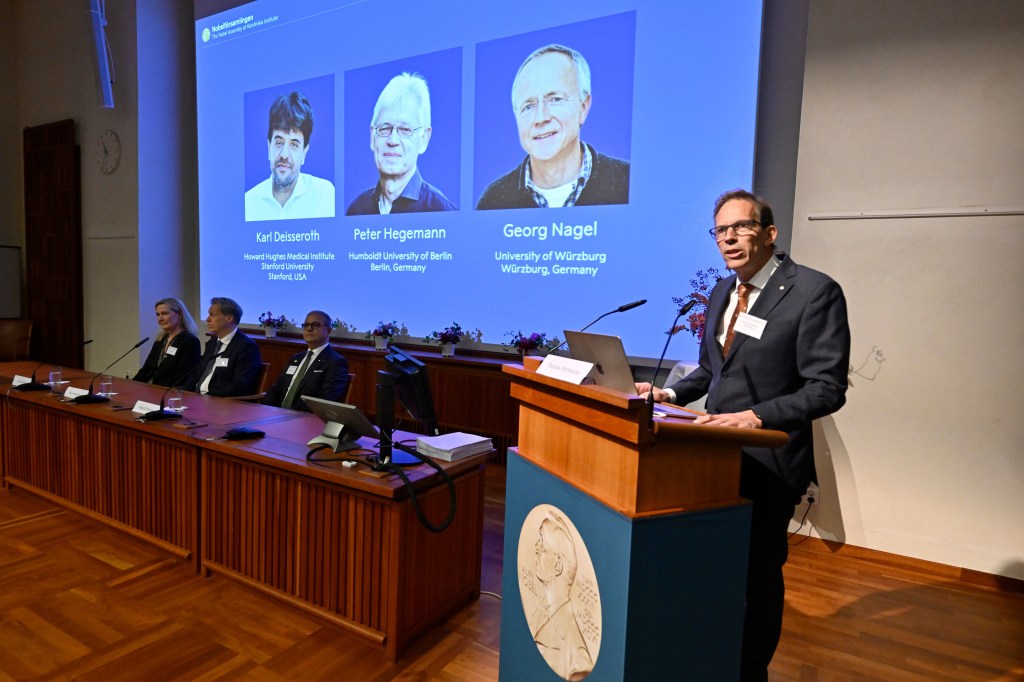
The 2026 Nobel Prize in Physiology or Medicine was awarded to Karl Deisseroth, Peter Hegemann and Georg Nagel for research into light-gated ion channels and optogenetics. Their work concerns mechanisms that allow the brain to switch the activity of individual nerve cells on or off. The Nobel committee said the method is now used in laboratories around the world to investigate the brain. Deisseroth is based at Stanford University in California; Hegemann works at Humboldt University in Berlin, and Nagel at the University of Würzburg in Germany. The award was announced Monday at the Karolinska Institute in Stockholm, beginning the annual week of Nobel Prize announcements. Medicine committee secretary Thomas Perlmann said he reached all three recipients by phone. The prize is worth 12 million Swedish kronor, approximately $1.2 million, whether awarded to one recipient, a small group or an organization. The article notes that last year’s medicine prize went to three researchers studying the immune system. The week’s other announcements include physics on Tuesday, chemistry on Wednesday, literature on Thursday, the peace prize on Friday, and the economics prize on October 12. The report is attributed to The Associated Press and includes a photograph caption identifying the laureates as they appeared during the announcement at the Nobel Forum at Karolinska Institutet.
Entities: Karl Deisseroth, Peter Hegemann, Georg Nagel, Nobel Prize in Physiology or Medicine, light-gated ion channels • Tone: neutral • Sentiment: neutral • Intent: inform
05-10-2026
The 2026 Nobel Prize in Physiology or Medicine was awarded to Karl Deisseroth, Peter Hegemann and Georg Nagel for research that enabled optogenetics, a technique for controlling and studying nerve-cell activity with light. Their work centers on light-gated ion channels, proteins that can trigger electrical impulses when exposed to light. The Nobel Assembly said optogenetics is now used in laboratories around the world to investigate the brain.
The research began with Hegemann’s investigation of how single-celled green algae swim toward light. Hegemann and Nagel identified a protein that opens a channel and produces an electrical impulse when illuminated with blue light. By introducing the protein into other cells, researchers can make those cells responsive to light. Deisseroth used the gene controlling the protein to develop a light-controlled switch for nerve cells in the brains of living mice. This approach lets scientists turn nerve cells and circuits on or off, helping them study how brain pathways relate to behavior and disease.
The three laureates are affiliated with Stanford University in California, Humboldt University in Berlin and the University of Würzburg in Germany. Medicine committee secretary Thomas Perlmann said he reached all three by phone after the announcement; the Associated Press had not immediately reached them.
The award was announced at Stockholm’s Karolinska Institute, beginning the week of Nobel announcements. The prize is worth 12 million Swedish kronor, approximately $1.2 million. The medicine award was followed by prizes in physics, chemistry, literature and peace, with the economics prize scheduled for October 12. The previous year’s medicine prize had gone to three researchers for work on the immune system.
Entities: Karl Deisseroth, Peter Hegemann, Georg Nagel, Thomas Perlmann, Nobel Prize in Physiology or Medicine • Tone: analytical • Sentiment: neutral • Intent: inform
05-10-2026
American neuroscientist Karl Deisseroth and German scientists Peter Hegemann and Georg Nagel have won the 2026 Nobel Prize in Physiology or Medicine for research that led to optogenetics. The Nobel Assembly at Sweden’s Karolinska Institute recognized their discoveries concerning light-gated ion channels and the development of the technique. Optogenetics uses light to control the activity of individual nerve cells in the brain, allowing researchers to switch cells on or off in a living brain. The three laureates will share a prize of 12 million Swedish crowns, reported as approximately US$1.2 million. Thomas Perlmann, secretary general of the Nobel Assembly, said laboratories around the world now use the method to investigate the brain. The article presents the award and the technique’s scientific significance, with no further details about the researchers’ individual contributions or the history of their work.
Entities: Karl Deisseroth, Peter Hegemann, Georg Nagel, Thomas Perlmann, Nobel Prize in Physiology or Medicine • Tone: neutral • Sentiment: positive • Intent: inform
05-10-2026
Karl Deisseroth, Peter Hegemann and Georg Nagel have been awarded the 2026 Nobel Prize in Physiology or Medicine for discoveries concerning light-gated ion channels and optogenetics. The three scientists will share the prize of 12 million Swedish kronor. Optogenetics uses light-sensitive proteins to control the activity of individual nerve cells in a living brain, enabling researchers to investigate brain function. The method is now used in laboratories worldwide.
The article traces the work leading to the technique. In the early 1990s, Hegemann studied how the alga Chlamydomonas responds to light and proposed that a protein could both capture light and function as an ion channel. Nagel tested the idea by introducing algal genes into frog eggs, identifying channelrhodopsin-2, which opens in response to light. In 2003, the researchers reported that the protein could produce electrical impulses when introduced into human and hamster cells. Deisseroth demonstrated the technique in rat nerve cells in 2005; the method became known as optogenetics the following year.
The award announcement highlighted possible medical applications. Clinical trials are investigating whether light-sensitive proteins inserted into the retina can restore sight to people with retinitis pigmentosa. Researchers also hope the technique could make cochlear implants more precise by stimulating the auditory nerve with greater accuracy than current electrical devices. Nobel Assembly secretary-general Thomas Perlmann said the laureates were surprised and delighted to receive the award together, and described them as friends.
The article also outlines the history and traditions of the Nobel Prizes. The five original prizes, established under Alfred Nobel’s will, have been awarded since 1901, while the economics prize was created in 1968. Medicine laureates have included Alexander Fleming for penicillin and Karl Landsteiner for the discovery of human blood groups. The annual award announcements begin with medicine, and the ceremonies culminate on Dec 10 in Stockholm, except for the Peace Prize ceremony, which takes place in Oslo.
Entities: Karl Deisseroth, Peter Hegemann, Georg Nagel, Thomas Perlmann, Karolinska Institutet • Tone: neutral • Sentiment: neutral • Intent: inform
05-10-2026
The article excerpt reports that the 2026 Nobel Prize in physiology or medicine has been awarded to three scientists for work on optogenetics. The laureates are American neuroscientist Karl Deisseroth, 54, a professor at Stanford University, and German scientists Peter Hegemann, 71, of Humboldt University, and Georg Nagel, 73, of the University of Würzburg. According to the excerpt, their discoveries have revealed more about how the brain functions. The headline specifically identifies the work as optogenetics, while the body describes the achievement more generally as discoveries about brain function.
The supplied text is only a short opening passage, not the complete Washington Post article. It does not explain what the scientists discovered, how their research was conducted, how optogenetics works, or what consequences the work may have for neuroscience or medicine. It also provides no statements from the laureates or other researchers and no additional details about the Nobel committee’s reasoning. Accordingly, a fuller account of the research, its significance, or the award announcement cannot be reliably reconstructed from the material provided. The summary is limited to the headline and excerpt rather than filling in absent reporting. The page’s slogan and sign-up prompt are not part of the article’s substantive content.
Entities: Karl Deisseroth, Peter Hegemann, Georg Nagel, Stanford University, Humboldt University • Tone: neutral • Sentiment: positive • Intent: inform