05-10-2026
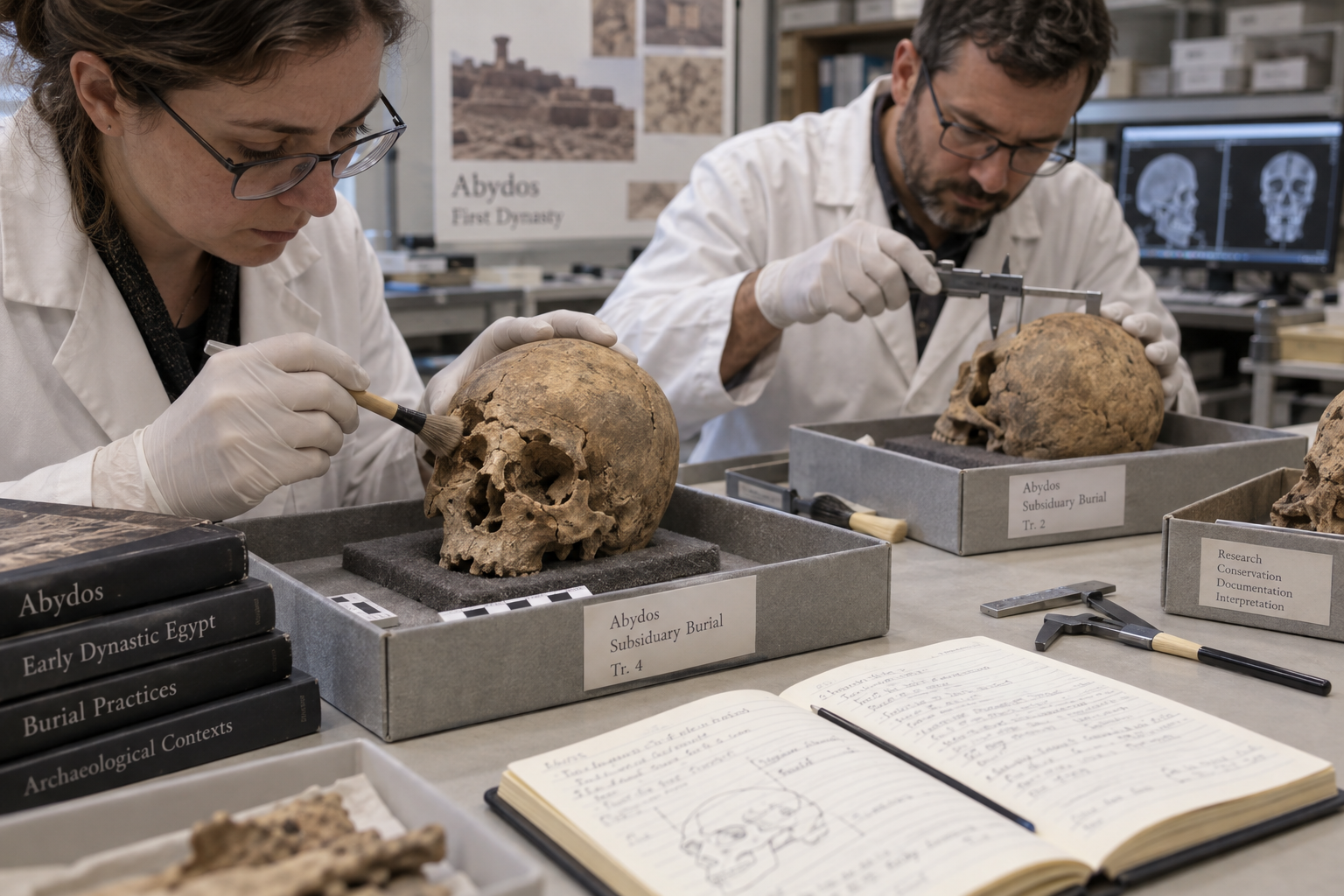
A study of 46 skulls from graves surrounding the tombs of three First Dynasty rulers at Umm el-Qa’ab, near Abydos, has found evidence consistent with the sacrifice of some royal retainers. The graves, dating to around 3000 BC, belonged to people associated with royal households, including officials and artisans. Their presence beside royal tombs had led early Egyptologist Flinders Petrie to propose that they were sacrificed when their ruler died, but he reported no clear signs of trauma. Other researchers argued that the people may have died naturally and been reburied.
Dr Roselyn Campbell of Purdue University re-examined the skulls, held in the University of Cambridge’s Duckworth Collections. She found that 18 showed potentially lethal injuries, including fractures and one chopping injury to the eye. Campbell says the damage was likely inflicted around the time of death and was probably caused by broad, flat objects made of wood or antler, rather than the mace often shown in Egyptian art. The findings do not establish that every retainer was killed: the sample is small, and skulls without trauma cannot be confidently classified as evidence against sacrifice.
Experts interviewed about the research describe it as a methodologically rigorous contribution to a debate lasting more than a century. They note that subsidiary burials declined and apparently disappeared early in the Second Dynasty, with statuettes later taking the place of people in the service of the deceased ruler. The article also cautions against assuming the retainers welcomed their fate: some may have viewed eternal service to a god-king as a benefit, while others may have feared or resisted it.
Entities: Umm el-Qa’ab, Abydos, First Dynasty, Second Dynasty, Dr Roselyn Campbell • Tone: analytical • Sentiment: neutral • Intent: analyze
05-10-2026
Modern forensic analysis of skulls excavated at Abydos has found evidence that some people buried near ancient Egyptian royal tombs may have been deliberately killed. Dr Roselyn Campbell of Purdue University examined 46 skulls in the Duckworth Collection at Cambridge University. Eighteen showed significant cranial injuries—about 39 per cent of the sample—which Campbell says are consistent with fatal blows delivered around the time of death. Earlier, the Egyptologist Flinders Petrie had suspected that royal retainers were sacrificed when kings died, but he could not confirm the theory because the injuries were not recognized at the time.
The burial complexes were built around 3000BC by Egypt’s first kings. Alongside royal tombs and chambers used for funerary rituals were subsidiary graves, sometimes numbering in the hundreds. They held people including lower- and mid-level officials, artisans, and members of the royal household. The graves often contained simple coffins and a small number of grave goods. Campbell said modern forensic methods helped distinguish perimortem injuries from damage previously thought to have occurred naturally. Some skulls also showed sharp-force trauma.
The findings do not establish exactly how every person died or whether all those buried there were sacrificed. Campbell noted that linear fractures could result from a weapon or a fall, although a fall severe enough to fracture a skull might also have damaged other bones. Some people may have died naturally, or been killed in ways that leave no detectable marks on the skull. The study therefore supports, but does not settle, the possibility of retainer sacrifice: the killing of people close to a ruler at the ruler’s death. In some societies, such sacrifice was associated with continued service in the afterlife or with displaying royal power; individuals might have volunteered, been selected, or been forced.
Entities: Roselyn Campbell, Flinders Petrie, Abydos, Ancient Egypt, Purdue University • Tone: analytical • Sentiment: neutral • Intent: inform
05-10-2026
A modern examination of 46 skulls excavated from the First Dynasty royal cemetery at Abydos has identified significant cranial trauma in 18 individuals, providing new forensic evidence that some people buried near Egypt’s early kings may have been deliberately killed. The remains were excavated by British archaeologist Flinders Petrie in the 1920s. Petrie had suspected that the numerous subsidiary burials surrounding royal tombs could represent retainer sacrifice—the killing of people associated with a ruler so they could continue serving him in the afterlife—but he found no clear evidence of fatal injuries, leaving the deaths unexplained.
The new study, published in Frontiers in Environmental Archaeology, was led by Roselyn Campbell, a bioarchaeologist and Egyptologist at Purdue University. Campbell located 46 skulls from Petrie’s excavations in the Duckworth Collection at the University of Cambridge and reassessed them using modern forensic methods. Researchers identified injuries in 18 skulls, or at least 39% of the people represented in this sample. Many were linear fractures that could have caused rapid unconsciousness, internal bleeding and death. Some skulls also showed sharp-force injuries, including a chopping wound around one individual’s eye.
The precise means of injury remains uncertain. Although Egyptian kings are often depicted striking enemies with maces, the buried individuals were not enemies, and the fracture patterns did not clearly match expected mace injuries. Falls or other causes cannot be entirely ruled out, though the researchers note that a severe fall might be expected to injure other bones as well. The findings therefore support, but do not conclusively prove, retainer sacrifice.
The royal funerary complexes were built around 3000 BCE and included tombs, ritual enclosures and rows of subsidiary graves, sometimes numbering in the hundreds around a royal tomb. Grave goods and markers suggest some buried people were officials or artisans. The researchers stress that the skull evidence cannot explain every death: some people may have died naturally, while asphyxiation or other violence may leave no clear marks on skulls. Because most excavated remains were reburied and only an incomplete sample survives, examination of complete skeletons could provide further answers.
Entities: Flinders Petrie, Roselyn Campbell, Abydos, First Dynasty of Egypt, Purdue University • Tone: analytical • Sentiment: neutral • Intent: inform