05-10-2026
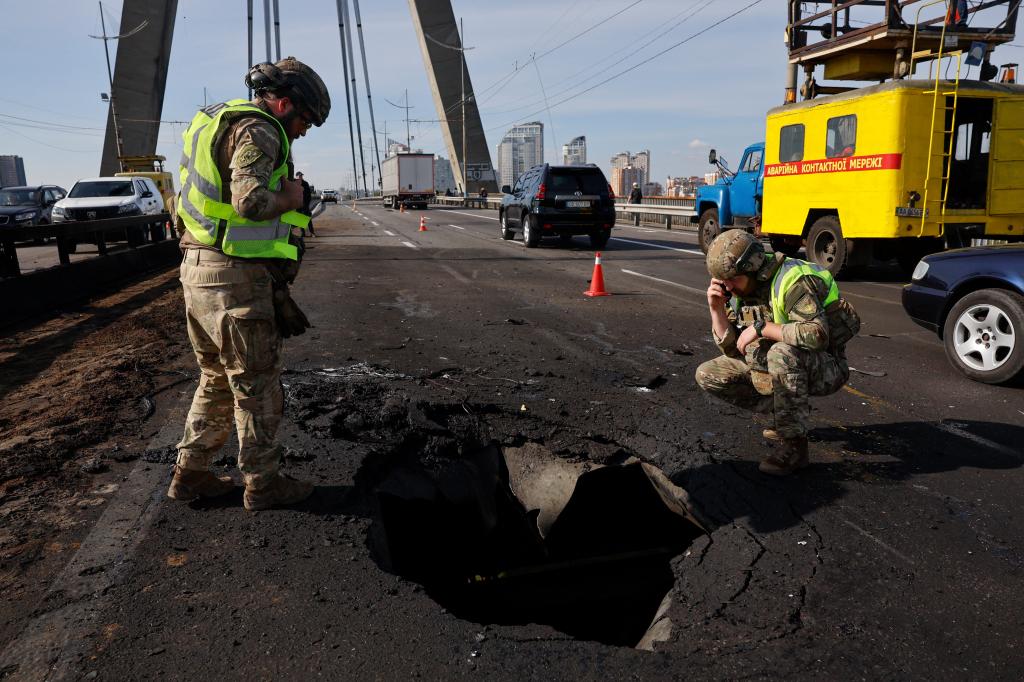
Russia’s Defense Ministry has threatened to intensify attacks on Kyiv and other Ukrainian cities following a drone strike that damaged the capital’s Northern Bridge. The strike on Saturday damaged the bridge’s road surface and suspended traffic; Kyiv Mayor Vitali Klitschko said two people were injured. Moscow said the bridge supported troop movements and military logistics, and described its wider strikes as retaliation for actions by Ukrainian President Volodymyr Zelenskyy.
The threat comes amid an increase in Russian attacks on Kyiv, including strikes on data centers, telecommunications facilities and energy infrastructure. The article says these attacks appear aimed at disrupting daily life and causing power cuts ahead of winter. Russian drones had also targeted the Southern Bridge earlier in the week. The Northern Bridge strike followed German Chancellor Friedrich Merz’s visit to Kyiv, where he pledged 1 billion euros in military aid.
Zelenskyy told Reuters that Ukraine would intensify attacks on Russian oil refineries in response to Russia’s air campaign, while saying Ukrainian strikes would not target Russian civilians. Russia’s ministry said Zelenskyy bore “full personal and political responsibility” for the intensified Russian attacks.
Alongside the escalation, Zelenskyy said the Trump administration had proposed technical-level trilateral peace talks by the end of October. Ukraine is open to meeting in the United Arab Emirates or another location suggested by the United States. Zelenskyy said Ukraine welcomed negotiations and was waiting to learn whether Russia would accept the proposal. CNBC said it had sought comment from the White House and Russia’s Embassy in London.
The conflict, which began with Russia’s full-scale invasion more than four and a half years ago, remains largely deadlocked along the frontline and is entering a fifth winter. U.S. President Donald Trump has previously urged Zelenskyy to stop attacking Russian oil refineries, arguing that the strikes are hurting global fuel supplies and contributing to higher U.S. diesel prices.
Entities: Russia, Ukraine, Kyiv, Volodymyr Zelenskyy, Donald Trump • Tone: analytical • Sentiment: negative • Intent: inform
05-10-2026
The article reports warnings that Russia may be using small, concealed ground-based signal repeaters inside Kyiv to improve the control and accuracy of its long-range drones. Draganfly CEO and co-founder Cameron Chell says the devices are part of a growing mesh network: drones and repeaters relay encrypted signals through multiple connections, making the system more resilient to Ukrainian electronic jamming and more difficult to disable. The network could also allow operators to make live, last-minute targeting decisions, including directing a drone toward a specific window or part of a bridge.
The report places the warning amid escalating Russian threats and attacks. It says Moscow urged foreign nationals and embassy staff to leave Kyiv on October 3, citing “mortal danger” and threatening further strikes. It also describes unusually precise attacks on critical infrastructure. Ukrainian Air Force spokesperson Yurii Ihnat confirmed that Russian forces are incorporating mesh networking and improving drone optics, which he said enable more detailed observation and make the technology dangerous. Ukrainian defense technology adviser Serhii Beskrestnov separately warned that hidden repeaters may be extending drone control within the capital and would be difficult to locate. He cautioned that electronic shielding would not be effective while the devices remained in place.
Chell characterizes Russia as increasingly innovative in its tactics, technology, and overall approach to the war. He argues that a network with many connected nodes could force Ukraine to disrupt numerous links simultaneously to stop a drone or swarm. Overall, the article presents mesh networking and concealed repeaters as a developing challenge for Ukraine’s counter-drone defenses and raises the possibility that devices could be operating within Kyiv itself.
Entities: Cameron Chell, Yurii Ihnat, Serhii Beskrestnov, Draganfly, Kyiv • Tone: analytical • Sentiment: negative • Intent: warn
05-10-2026
The NPR article reports an escalation in Russian attacks on Ukraine: Russian jet-powered drones are targeting bridges in Kyiv, the Ukrainian capital. The article’s introductory description places the attacks in the context of more than a month of strikes carried out both day and night. Those repeated attacks, it says, have made Kyiv feel almost like a frontline city. The reported targeting of bridges is presented as a further development in this sustained campaign, and the headline likewise characterizes the attacks as escalating.
The material provided includes only the headline, a short article description, and publication and broadcast details—not the full report. It does not specify which bridges were targeted, when the drone attacks occurred, whether bridges were damaged, or what Ukrainian officials and residents said. It also provides no details about casualties, military responses, or the broader effects of the strikes. Therefore, the available text supports a concise account of the reported escalation and the atmosphere of prolonged attacks in Kyiv, but not a more detailed reconstruction of events.
The story is attributed to NPR journalists Joanna Kakissis and A Martínez and was published on October 5, 2026, for Morning Edition. Its apparent purpose is to inform readers and listeners about the reported change in the pattern or targets of Russian attacks. The tone is serious and news-focused, while the subject matter conveys a negative sentiment because it concerns persistent attacks and a capital city increasingly experiencing conditions associated with a frontline. These conclusions are limited to the article text supplied.
Entities: Russia, Ukraine, Kyiv, NPR, Joanna Kakissis • Tone: urgent • Sentiment: negative • Intent: inform
05-10-2026
The article reports that a Russian drone struck Kyiv’s Northern Bridge on Sunday during morning traffic, causing a large explosion and fire. Kyiv Mayor Vitaliy Klitschko said two people were injured. The strike took place during German Chancellor Friedrich Merz’s visit to Ukraine, which was also marked by air raid sirens, explosions and interceptor fire. The article places the attack amid a broader Russian campaign against Ukrainian infrastructure, noting that Russian forces had attacked Kyiv’s Southern Bridge several times on Thursday and Friday. Russia’s Ministry of Defense said strikes on military, military-industrial and associated infrastructure in Kyiv and other regions would intensify.
Ukrainian President Volodymyr Zelensky said his meeting with Merz was successful and focused on a reported aid package worth nearly $1.5 million, including weapons and support for Ukraine’s energy sector ahead of winter. Zelensky also emphasized the need for air defense. Analysts cited in the article warn that winter may become a pivotal period in the war, as Ukraine faces logistical challenges in severe cold and Russia seeks to replenish its forces following high casualties.
The article also reports that Vladimir Putin may be preparing another mass mobilization. According to the Sunday Times, leaked documents signed on September 15 impose restrictions on young men, requiring them to present draft papers before carrying out activities such as taking out a mortgage, buying or selling property, or registering as a business owner. The documents say the rules are intended to ensure men appear at military commissariats when summoned. Russia has avoided another broad mobilization since the backlash that followed the first year of the war, but officials are planning to conscript 120,000 soldiers this fall. Col. Gen. Yevgeny Burdinsky reportedly told conscripts to be ready to depart as early as October 10, while saying they would not be sent to the front lines.
Entities: Kyiv, Northern Bridge, Southern Bridge, Russia, Ukraine • Tone: urgent • Sentiment: negative • Intent: inform