03-09-2026
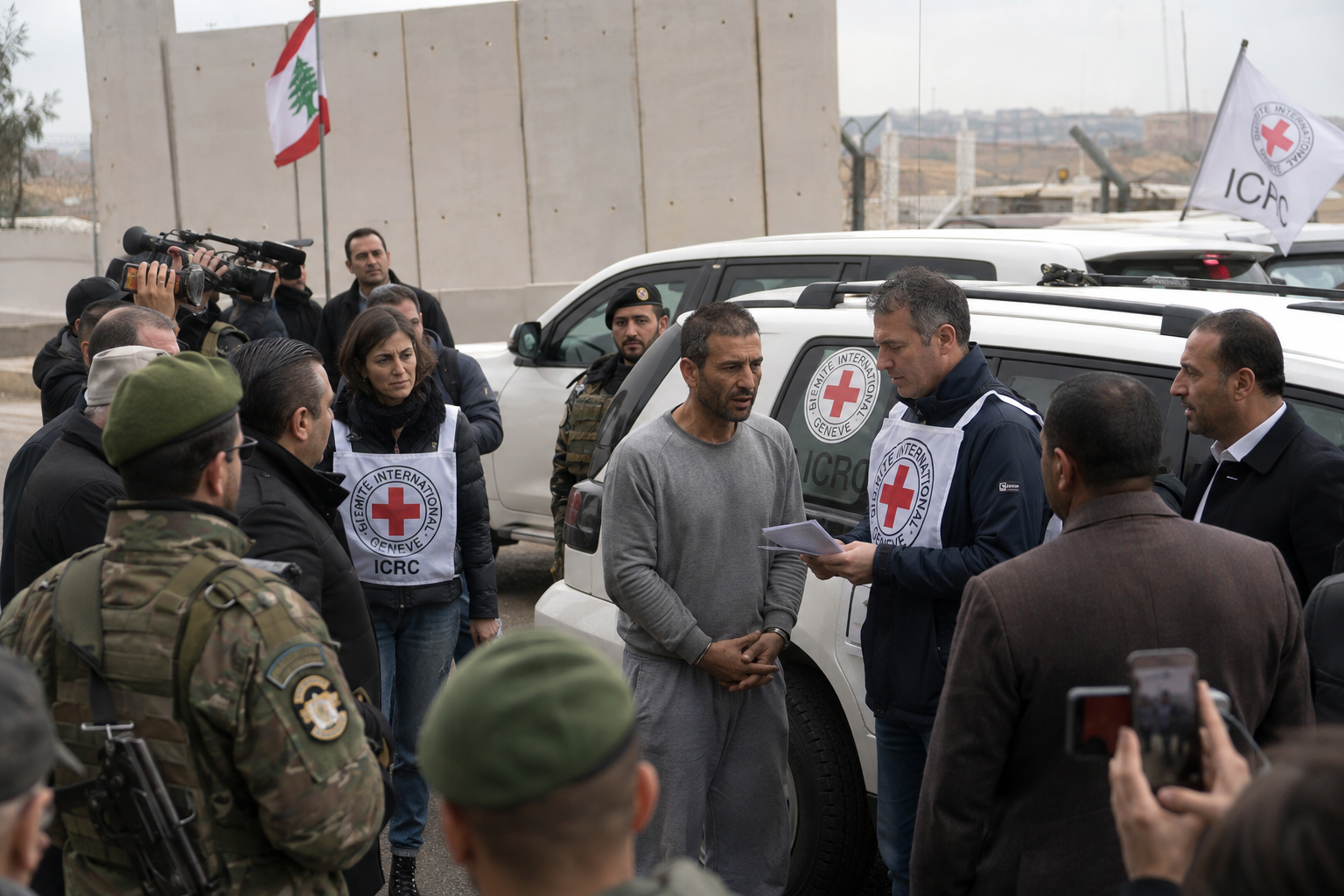
Israel released Malek Ghazi, the first of five Lebanese civilians detained by Israeli forces in southern Lebanon, in a handover facilitated by the International Committee of the Red Cross. Ghazi was transferred to the Lebanese army in the city of Tyre. Israel said that interrogations established that the detainees were civilians, had no affiliation with terrorist organizations, and had not engaged in terrorism. Lebanese officials said the four remaining prisoners were expected to be released the following day.
Lebanese Prime Minister Nawaf Salam welcomed the release but said Lebanon would continue seeking the return of all prisoners, information about missing people, and a complete Israeli withdrawal from Lebanese territory. The United States described the releases as the product of US-led mediation between Israel and Lebanon, finalized during a visit to Israel by US Ambassador to Lebanon Michel Issa. Washington expressed hope that the agreement would lead to broader discussions on civilian matters.
The arrangement also involves Lebanon’s efforts to locate the remains of Lebanese Jewish leaders whom Israel says were abducted and killed by terrorist organizations during Lebanon’s civil war in the 1980s. However, the prisoner release has not resolved the broader dispute between Israel and Lebanon. A US-mediated framework signed in June called for an Israeli withdrawal from southern Lebanon in exchange for Hezbollah’s disarmament, but negotiations remain stalled.
The situation was further complicated by reports that Israeli forces detained three additional Lebanese men in the southern town of Halta. Hezbollah is not participating in the negotiations and rejects calls to surrender its weapons north of the Litani River. Israel, meanwhile, has said it will not withdraw unless Hezbollah is disarmed throughout Lebanon. The release therefore represents a limited confidence-building measure rather than a breakthrough in the wider conflict.
Entities: Malek Ghazi, Israel, Lebanon, Hezbollah, International Committee of the Red Cross (ICRC) • Tone: analytical • Sentiment: neutral • Intent: inform
03-09-2026
Israel plans to release five Lebanese citizens detained in southern Lebanon after determining that they had no connections to militant groups, according to the office of Israeli Prime Minister Benjamin Netanyahu. The decision is linked to ongoing negotiations between Israel and Lebanon over the recovery of the remains of Jewish community leaders who were kidnapped and killed in Lebanon during the mid-1980s.
Israeli and Lebanese authorities have undertaken several recent efforts to locate the remains, including ground operations. One of the five detainees, Malek Kamal Ghazi, has already been released. He was captured in October 2025 and transferred by the Red Cross to Lebanese authorities at the Naqoura crossing. Lebanese security and prisoners’ commission sources rejected reports that Ghazi was a Hezbollah member and said the other four detainees were civilians as well.
The sources said that 35 Lebanese detainees remain in Israeli custody, including 20 civilians. The planned releases follow a US-mediated framework agreement signed by Israel and Lebanon in June. The agreement includes commitments to work toward the release of detainees and the search for and repatriation of remains.
The framework also proposes an eventual Israeli withdrawal from southern Lebanon, alongside the Lebanese army’s assumption of control in the area and the disarmament of Iran-backed Hezbollah. Hezbollah has rejected those provisions. The release of the detainees and the search for remains therefore form part of broader, politically sensitive negotiations involving detention, territorial control, military disarmament and unresolved losses from the Lebanese conflict.
Entities: Israel, Lebanon, Benjamin Netanyahu, Malek Kamal Ghazi, Hezbollah • Tone: neutral • Sentiment: neutral • Intent: inform
03-09-2026
Israel announced that it would release five Lebanese civilians detained in occupied southern Lebanon, with the first transfer taking place on Thursday evening and the remaining four reportedly due to be handed over on Friday. The Israeli military said the detainees were civilians who were not involved in terrorism. Israel linked the releases to discussions about returning the remains of Jewish community leaders killed in Lebanon during the 1980s.
The agreement was brokered by the United States, which said it hoped the arrangement would create a foundation for broader talks between Israel and Lebanon, potentially in Rome later in September. Lebanese Prime Minister Nawaf Salam welcomed the deal and thanked Washington and US Ambassador to Lebanon Michel Issa. The first released detainee, Malek Ghazi, was transferred to the Lebanese army at the Naqoura crossing with assistance from the International Committee of the Red Cross. Ghazi had been missing since October and was reportedly arrested near Mount Hermon.
The release announcement coincided with an Israeli raid on Halta, a mainly Sunni village inside Israel’s declared security zone in southern Lebanon near the occupied Golan Heights. Israeli forces reportedly entered homes at dawn, ordered about a dozen residents to report for questioning, and detained three people. Local officials said roughly 300 soldiers took over three houses, searched them extensively, and prevented residents from leaving. Villagers described the operation as four hours of “pure terror.”
The latest detentions brought the number of people abducted from Halta since March 2 to seven. It remained unclear whether the three newly detained villagers were among those scheduled for release. Lebanon has no official tally of people held by Israel, while the Lebanese Association for Prisoners and Released Detainees said it had documented 36 cases. The issue has featured in recent Lebanon-Israel discussions in Washington and Rome, although progress has reportedly stalled.
Entities: Israel, Lebanon, United States, Hezbollah, Benjamin Netanyahu • Tone: analytical • Sentiment: negative • Intent: inform
03-09-2026
Israel announced that it would release five Lebanese detainees on Thursday, shortly after Israeli forces detained three men during a raid in Halta, a Sunni-majority village in southern Lebanon’s Hasbaya district. The Israeli Prime Minister’s Office said the five detainees had been interrogated and were found not to belong to a terrorist organisation or to have engaged in terrorism. Their release was reportedly connected to Israeli efforts to recover the bodies of Jewish community leaders killed in Lebanon in the mid-1980s. It remained unclear whether the three men taken from Halta were among those scheduled for release.
Lebanon’s National News Agency reported that Malek Ghazi, who had been missing since October 2025, was transferred to the Lebanese army through the International Committee of the Red Cross at the Naqoura crossing. The ICRC confirmed that a humanitarian operation was under way but provided no further details. Lebanese Prime Minister Nawaf Salam thanked the US administration and Ambassador Michel Issa for their involvement, describing the return of freed citizens as a step toward resolving the detention issue.
The raid involved roughly 300 Israeli military personnel and 15 vehicles. Local officials said troops occupied several homes, gathered residents, searched the properties, and used residents’ phones to summon people for questioning. Three men—Hatem Abdel Aal, Assem Abdel Aal and Zaal Abdel Aal—were taken away. Residents described widespread fear and coercion during the operation.
The raid brought the number of people abducted in Halta since March 2 to seven. Lebanon’s Association for Prisoners and Released Detainees has documented 36 cases of Lebanese people held by Israel, though there is no official tally. The issue has featured in rare Lebanon-Israel negotiations in Washington and Rome. The article also reports continuing Israeli military activity in southern Lebanon despite a stated ceasefire, with Lebanese authorities reporting more than 4,300 deaths and 12,000 injuries since March, while ACLED recorded hundreds of airstrikes and property-destruction events since late June.
Entities: Israel, Lebanon, Benjamin Netanyahu, Nawaf Salam, Halta • Tone: urgent • Sentiment: negative • Intent: inform